

Quick Answer
A 60kW DC charger can be a practical commercial-property investment when the site needs faster turnover than AC charging but does not justify a full highway HPC installation. MIDA’s published 60kW station descriptions cover 150–1000V DC output, dual-gun configurations, dynamic load balancing on selected models, and OCPP connectivity for remote operations. The correct business case depends on utilization, electricity tariffs, parking dwell time, grid capacity, and the selected connector configuration. Operators should compare total delivered energy, not just nameplate power: a compact 60kW station serving two vehicles, with one vehicle receiving priority when required, can create more useful capacity per parking bay than a single-port charger. Final efficiency and operating-temperature values should be confirmed against the model-specific datasheet before procurement.
Key Takeaways
- Match 60kW output to retail, office, hotel, fleet, and destination dwell times.
- Select a dual-gun model when two-vehicle access is more valuable than peak single-vehicle speed.
- Use the 150–1000V range to accommodate both conventional and high-voltage EV platforms.
- Treat OCPP as an operating requirement, not an optional marketing feature.
- Confirm efficiency, connector type, inlet current, and temperature derating in the final datasheet.
Why 60kW Fits the Middle of the Market
Faster Than AC Without Highway-Scale Infrastructure
A commercial site often sits between two extremes. AC charging may be inexpensive to install but can leave a vehicle parked for several hours. A 180–420kW highway charger delivers much higher peak power but may require a larger grid connection, more civil work, and a different utilization model. A 60kW DC station addresses the middle: it supports meaningful energy transfer during a shopping, working, dining, or service appointment window.
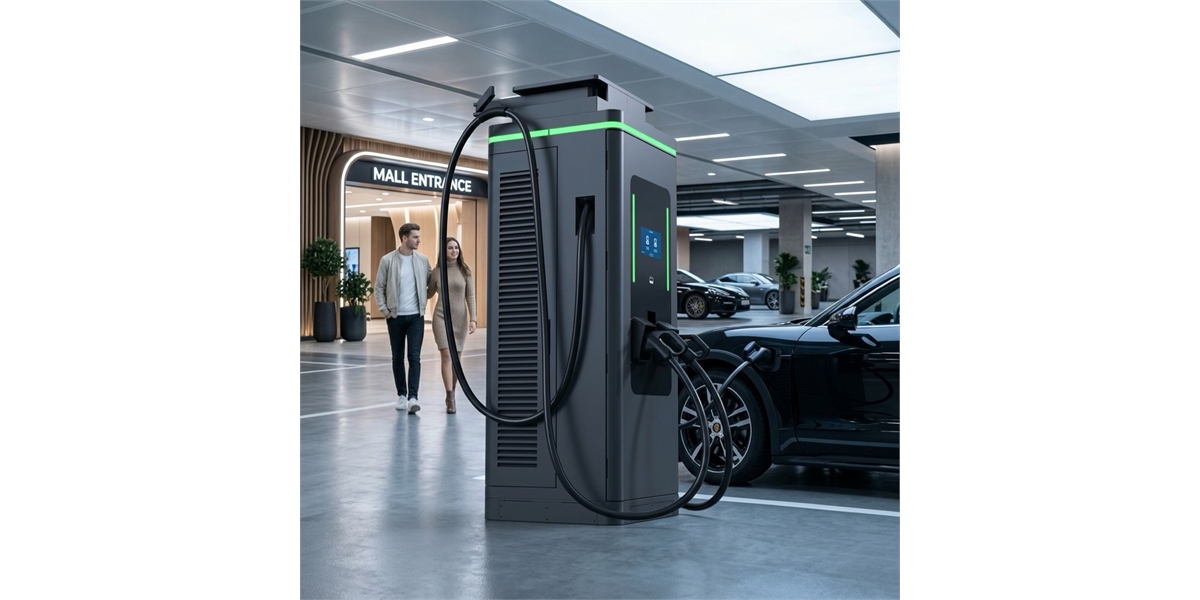
MIDA’s 60kW dual CCS2 DC fast charger is positioned for this type of commercial deployment. The published product family also includes 40kW/60kW dual-port pedestal stations and a 60kW dynamic-load-balance charger, allowing a buyer to compare footprint, connector arrangement, and site requirements.
Business Metrics That Matter
A procurement model should calculate five variables: average sessions per day, average energy delivered per session, tariff spread, uptime, and maintenance cost. A charger with a lower nameplate rating can outperform a larger unit when it is used more consistently. Conversely, a 60kW station placed at a low-traffic site may underperform even if the hardware is technically capable.
Technical Selection Table
| Procurement factor | Confirmed MIDA information or decision rule |
|---|---|
| Power class | 40kW and 60kW published station variants |
| DC output voltage | 150–1000V DC in the relevant published descriptions |
| Connector arrangement | Dual-gun configurations available; connector type is model-specific |
| Network protocol | OCPP 1.6J; OCPP 2.0.1 support or option depends on model |
| Outdoor protection | IP54/IK10 for relevant 40–60kW descriptions; confirm exact model |
| Compliance | CE/TUV/UKCA-related statements appear in published product data; verify certificate scope |
Installation and Operations
Plan the Site Before Ordering
The site survey should identify transformer capacity, cable route, parking-bay geometry, drainage, ventilation, accessibility, emergency isolation, and network coverage. A dual-gun station should be positioned so both cables can reach their intended bays without crossing pedestrian routes. The operator should also decide whether the charger is primarily for public access, tenant access, fleet dispatch, or mixed use.
Use OCPP Data for Continuous Improvement
OCPP connectivity supports session records, remote status, fault reporting, and tariff integration when paired with a compatible backend. The operator can use this information to determine whether the site needs more ports, a different pricing window, or a revised power-sharing policy. Hardware selection and software compatibility should therefore be evaluated together.
Seven FAQs
- Is 60kW suitable for a highway charging hub? It can serve destination or regional sites, but highway operators should compare dwell time and traffic requirements with higher-power options.
- Can one 60kW station charge two vehicles? Yes, dual-gun configurations are available; the exact allocation logic is model-specific.
- Does 150–1000V mean every EV receives 60kW? No. Vehicle voltage, battery state, connector rating, and the vehicle BMS determine actual power.
- Which OCPP version should a buyer request? Request the version supported by your CSMS; MIDA materials identify OCPP 1.6J and OCPP 2.0.1 support or options.
- Is IP54 enough for outdoor use? It can be appropriate for protected outdoor deployment, but site exposure and local installation rules must be assessed.
- What should be confirmed before purchase? Confirm connector standard, current limit, efficiency test condition, thermal derating, and certification scope.
- What is the main ROI risk? Low utilization or insufficient grid planning can outweigh the technical capability of the charger.
Post time: Sep-01-2026