

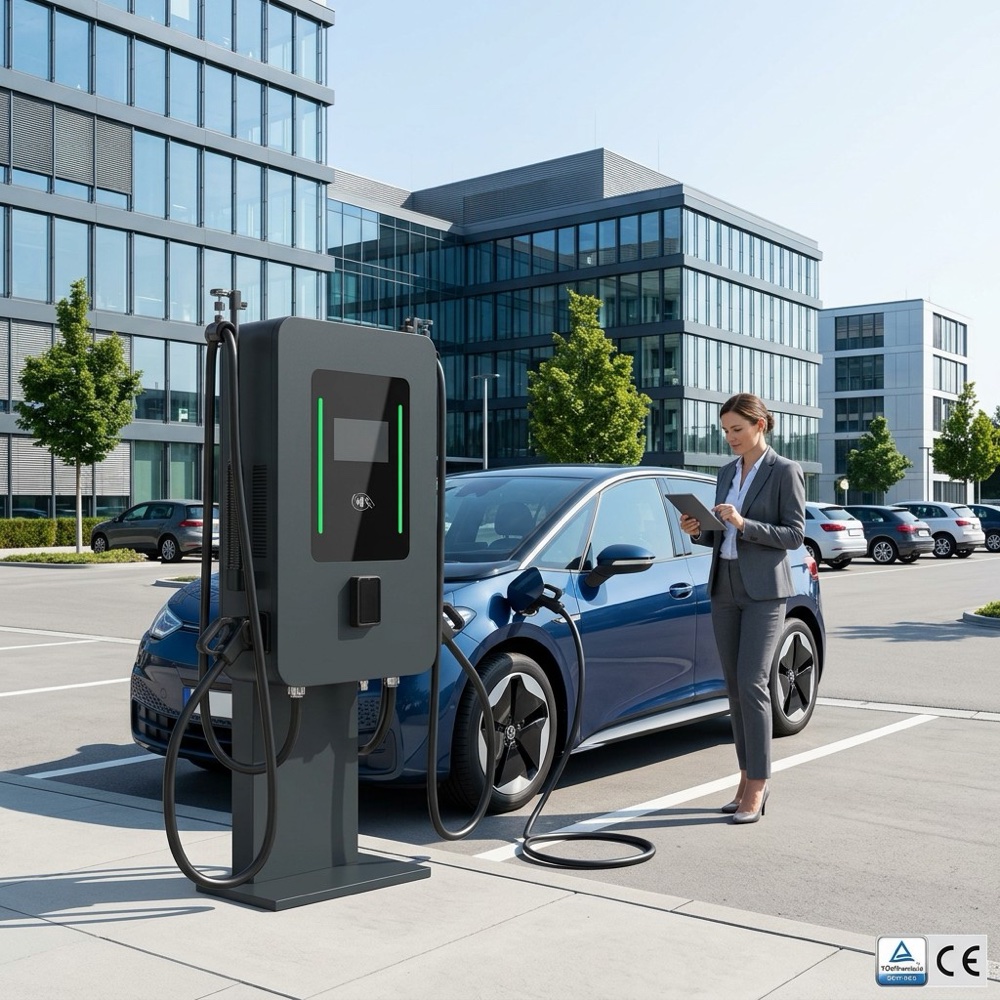
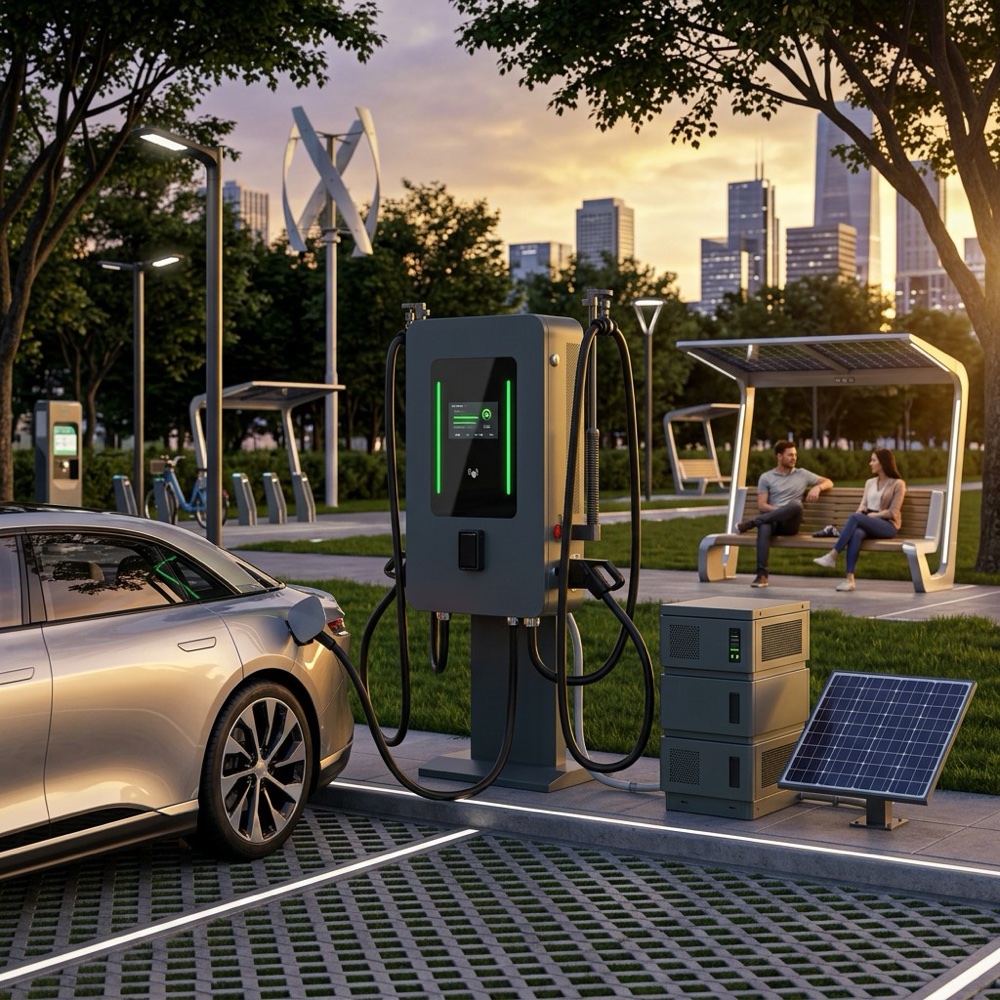
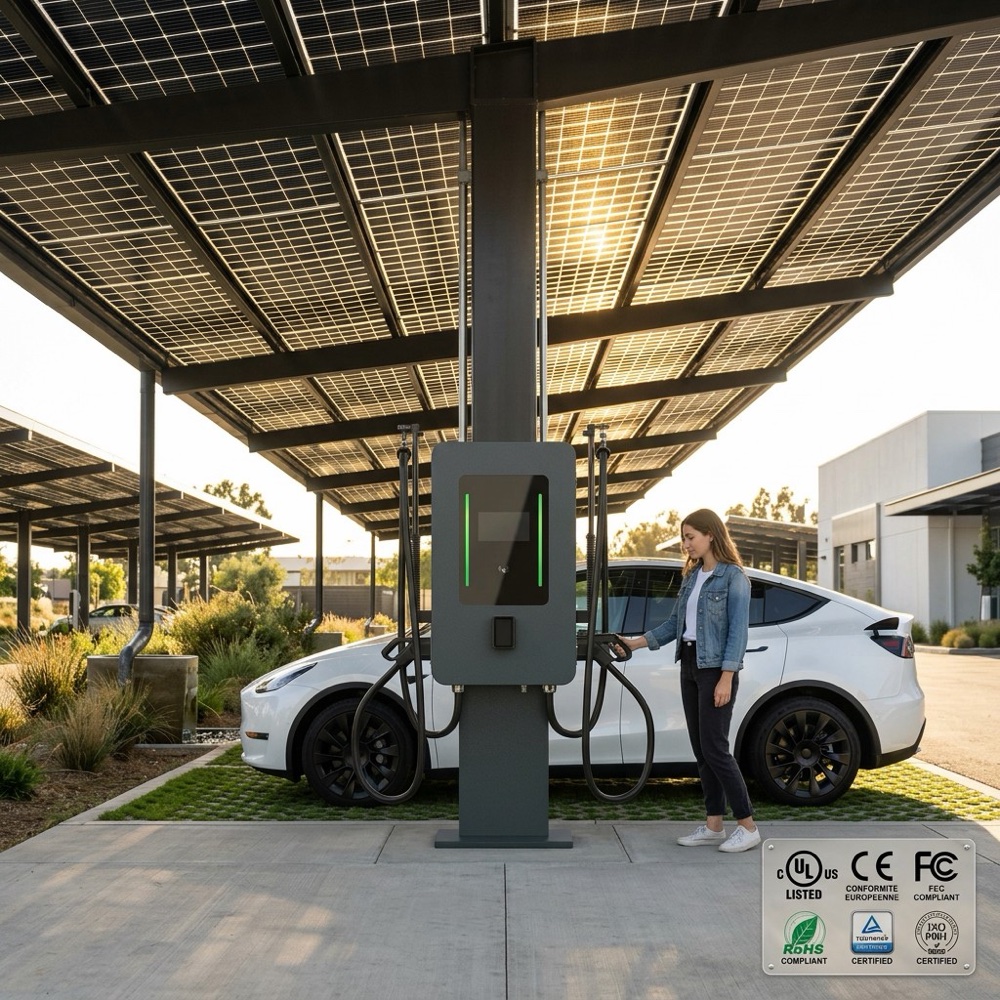
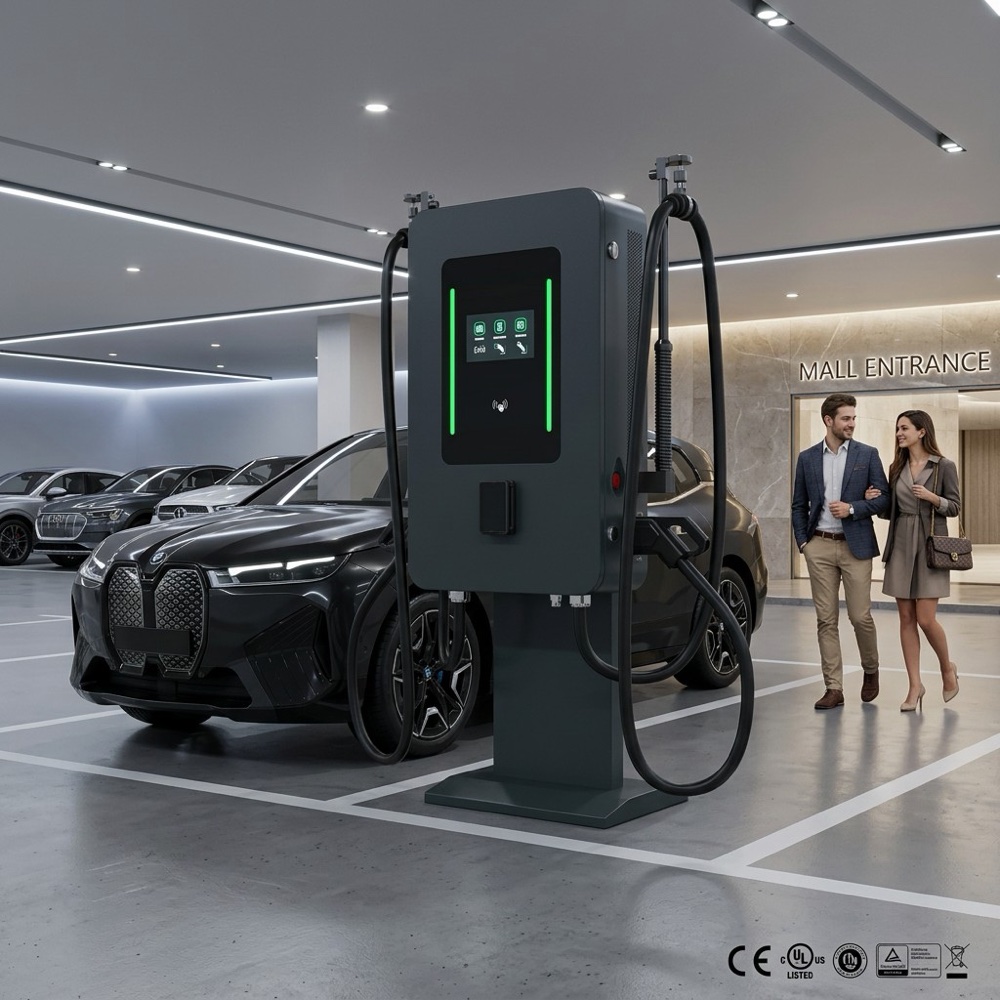
MIDA 60kW Dual CCS2 DC Fast Charger — Floor-Mounted Smart EV Charging Station with OCPP 1.6J / 2.0.1
Quick Answer
The MIDA 60 kW Dual CCS2 DC Fast Charger is a floor-mounted commercial charging station from MIDA Power’s WY Series, built for public charging hubs, highway corridors, fleet depots, and workplace sites that need continuous, high-uptime DC fast charging. It delivers up to 60 kW across a 150 V–1000 V ultra-wide voltage window, with dual CCS2 connectors and intelligent dynamic power sharing that lets two vehicles charge from a single cabinet. Power conversion efficiency reaches ≥ 95.5%, reducing electricity waste and operating cost per kWh. The unit is protected to IP54 and IK10 standards and certified to TUV CE, UKCA, RoHS, ISO 9001, ISO 14001, and ISO 15118. It is fully OCPP 1.6J and 2.0.1 compliant, supporting RFID, mobile app, Wi-Fi, and 4G. With more than ten years of EVSE engineering experience at MIDA Power, this charger is engineered for 24/7 commercial duty and seamless integration into existing charging networks.
Key Takeaways
- Dual CCS2 connectors with dynamic power sharing — two vehicles charge simultaneously; a single port draws the full 60 kW, with balanced distribution in dual-port mode.
- 150 V–1000 V output range — full compatibility with today’s 400 V platforms and next-generation 800 V architectures.
- ≥ 95.5% conversion efficiency — less energy lost as heat, faster payback, lower carbon footprint per kWh delivered.
- IP54 + IK10 rugged construction — dust-protected, water-jet-resistant, and impact-resistant, built for exposed public and fleet locations.
- OCPP 1.6J / 2.0.1 with RFID, App, Wi-Fi, and 4G — open-standard connectivity with no vendor lock-in.
- Complete compliance suite — TUV CE, UKCA, RoHS, ISO 9001/14001, and ISO 15118 Plug & Charge readiness.
Introduction: Why the 60 kW Class Dominates Modern Charging Networks
| The global shift to electric mobility is measurable: according to the International Energy Agency’s Global EV Outlook, worldwide electric car sales surpassed 14 million units in 2023, up roughly 35% year on year, pushing EVs past 18% of global car sales. Europe alone saw plug-in vehicles approach one in four new registrations, and commercial fleets — vans, light trucks, taxis — are electrifying faster as EU and UK CO2 regulations tighten.
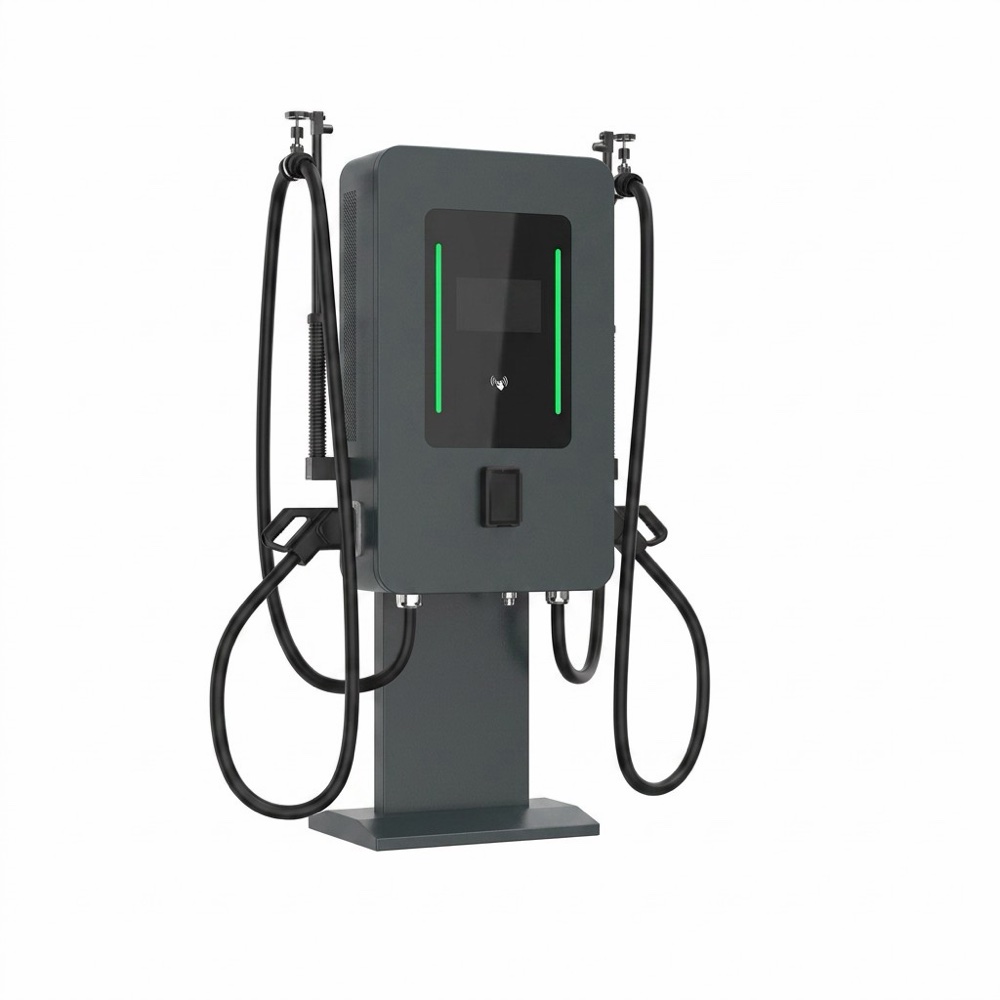
Yet infrastructure lags behind, and the gap is sharpest in the “middle mile” of the charging pyramid. AC chargers (7–22 kW) remain too slow for drivers needing meaningful range in 30–60 minutes, while 150–350 kW chargers carry hardware, grid-connection, and civil-works costs that only the busiest corridors justify. Between them sits the 40–80 kW DC fast charging class — the sweet spot for urban public parking, fleet depots, retail, and hospitality dwell times, while keeping grid connection and installation costs within reach of operators without utility-scale budgets. The 60 kW configuration has become the operational sweet spot. It adds roughly 250 km of range to a typical 60 kWh EV in about 45–55 minutes — fast enough to be a paid service, modest enough that most sites run on an existing three-phase low-voltage connection. This combination of speed, manageable power infrastructure, and per-station capital cost is why charging point operators, fleet managers, and property owners repeatedly choose this class when expanding networks. This document profiles the MIDA 60 kW Dual CCS2 station end to end — architecture, performance, durability, connectivity, certification, and total cost of ownership — so procurement teams and engineers can evaluate it with complete confidence. |
 |
Product Overview — A Floor-Mounted Station Built for the Operator’s Day
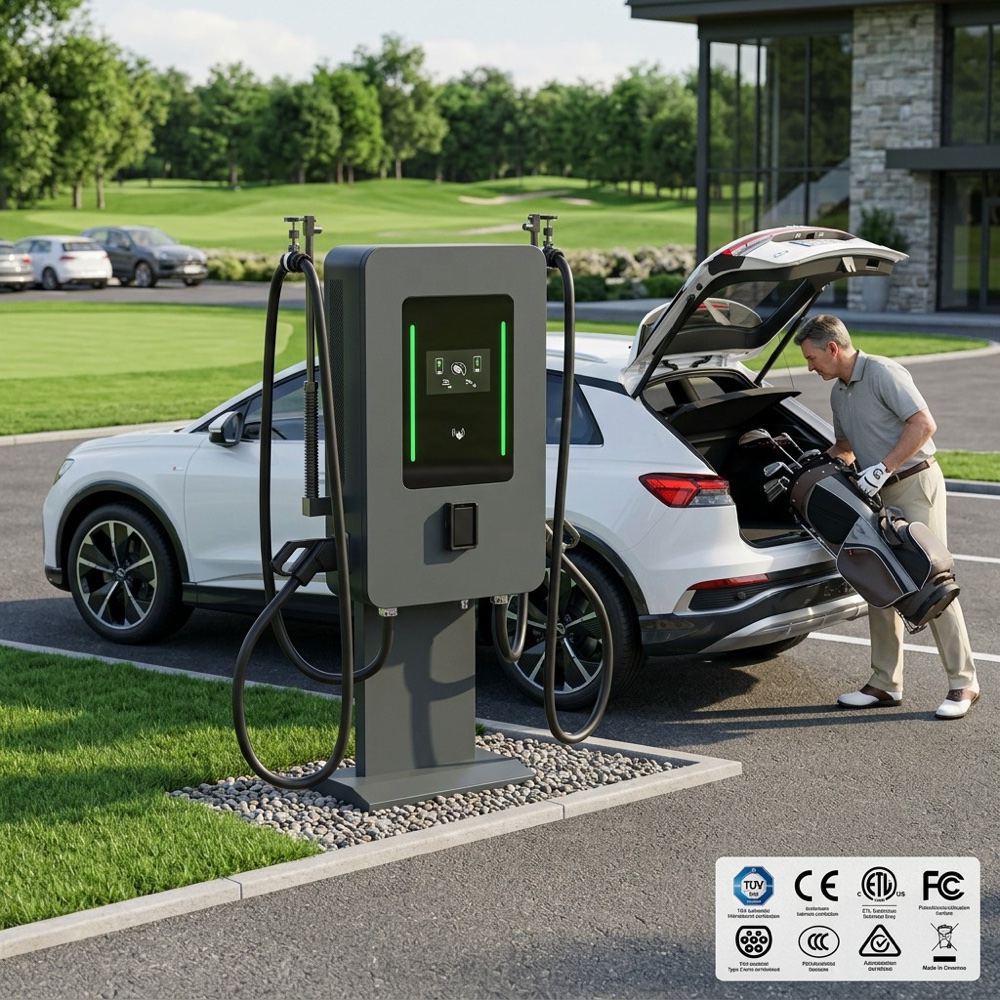
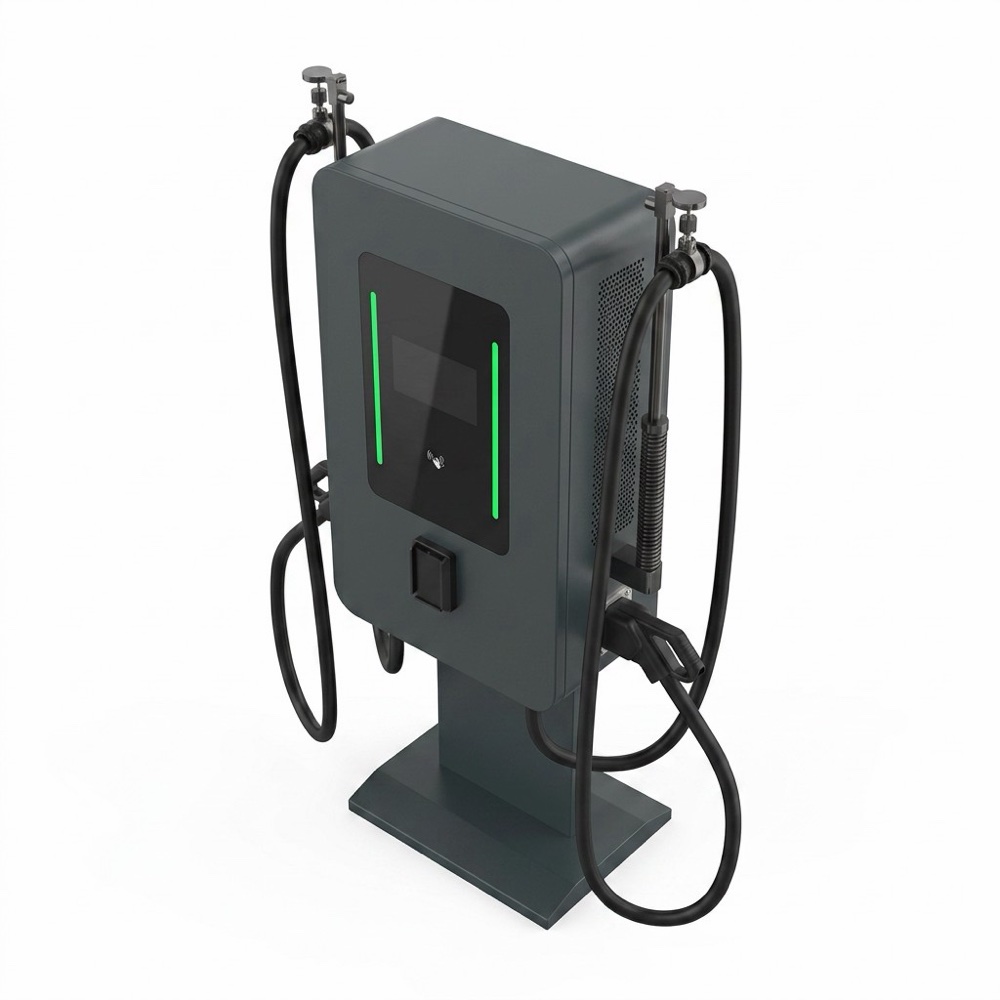
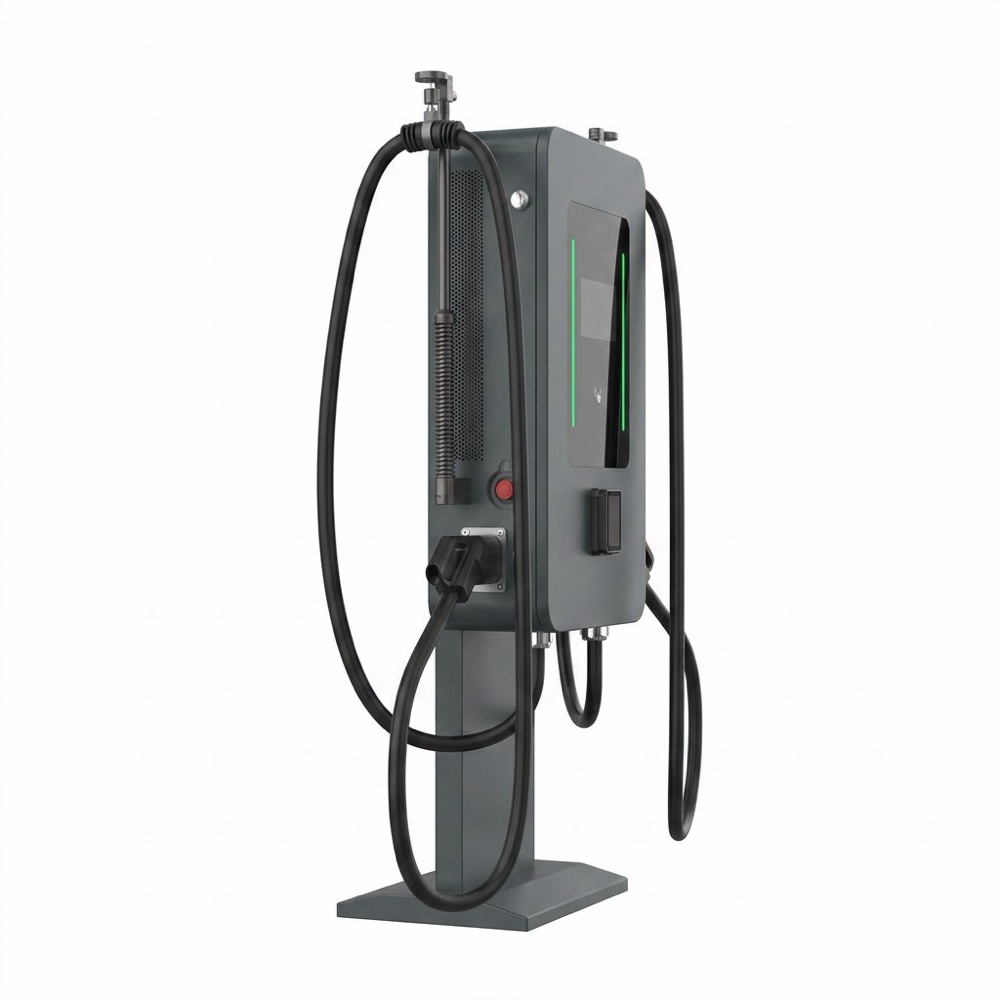
| The MIDA 60 kW charger is a self-contained, floor-mounted unit: one rugged enclosure houses the power conversion modules, control system, metering, communications, and human-machine interface. The floor-mounted configuration is the default for commercial operators because it removes wall-structural load requirements: on a concrete pad or pre-cast plinth, the cabinet can be positioned anywhere — kerbside, parking bay, service yard — and relocated if the site layout changes. With a footprint of roughly 700 mm (W) × 480 mm (D) and a height of about 1600 mm, it occupies little more space than a vending machine, preserving parking bay count on valuable real estate.
The enclosure is heavy-gauge, corrosion-protected steel with a UV-stable powder-coated finish. Front access panels let a technician reach all internal modules without moving the cabinet, and integrated cable management routes two 5-meter CCS2 charging cables cleanly to the front. That cable length matters in daily operation: it determines whether every parking bay in the layout is actually usable, regardless of where a vehicle’s charge port sits. |
 |
Dual-Gun Architecture: Two Vehicles, One Cabinet
The defining feature is the dual-port design. Two CCS2 connectors are fed from a single 60 kW module bank, and a dynamic power-sharing controller distributes power in real time. With one vehicle connected, that vehicle receives the full 60 kW. When a second plugs in, the controller rebalances — typically 40 + 20 kW or 30 + 30 kW — based on each vehicle’s state of charge and acceptance rate. As the first vehicle tapers, freed capacity diverts automatically to the second port, so no driver is unfairly throttled.
For the operator, this halves the number of cabinets, grid connection points, and civil works needed to offer two simultaneous charging points. It also caps the site’s peak draw at 60 kW rather than 120 kW — a decisive advantage where the grid connection is the scarcest and most expensive resource.
The Smart System Inside
The station uses a modern two-stage architecture. An active power factor correction (PFC) stage holds power factor above 0.98 and suppresses harmonic distortion in line with IEC 61000 requirements, avoiding utility penalties and protecting co-located equipment. A high-frequency DC-DC converter (IGBT/MOSFET-based) produces the regulated DC output with galvanic isolation and comprehensive protection. An industrial-grade embedded controller manages the session state machine, safety interlocks, metering, and all protocols, monitoring voltage, current, and temperature at multiple points. On abnormal conditions — cable overheating, insulation faults, fan failure — it responds in milliseconds, isolates circuits, logs the event, and reports to the network backend for remote dispatch.
Technical Specifications at a Glance
|
|
Charging Performance: Speed, Compatibility, and Battery Care
The 150 V–1000 V Voltage Window
The most important compatibility specification on any DC charger is its output voltage range. The EV market is split between 400 V systems (Nissan Leaf, most volume models, many commercial vehicles) and 800 V platforms (Porsche, Hyundai E-GMP, Audi, Lucid, and an increasing number of volume brands) whose pack voltages reach 900 V+ at the top of the charging window. A charger capped at 750 V cannot deliver rated power to 800 V vehicles — producing the frustrating “slow charge despite fast charger” experience that undermines network utilization. The MIDA station’s 1000 V ceiling serves both worlds at full rated power and future-proofs the asset as fleets migrate to higher-voltage platforms.
Charging Speed in Real-World Terms
As a planning benchmark for a typical 60 kWh mid-size EV, a 10%–80% session at 60 kW completes in roughly 45–55 minutes depending on the vehicle’s charging curve, adding on the order of 250 km of range. A 77 kWh long-range vehicle gains roughly 50% state of charge (about 200 km) in the same window. With per-connector current up to 200 A, the station holds its power output even at low battery voltages — the situation in which lesser chargers throttle — keeping real-world sessions close to the theoretical maximum.
≥ 95.5% Efficiency: A Quiet Profit Driver
Efficiency is the specification buyers most often undervalue. Every percentage point of conversion loss is electricity paid for at the meter but never delivered to a battery. Assume a station delivers 100,000 kWh per year: at 95.5% efficiency it draws about 104,700 kWh; a typical 92% competitor draws about 108,700 kWh. The difference — roughly 4,000 kWh per station per year — is pure cost: about EUR 800 per year at EUR 0.20/kWh, or EUR 8,000 over a decade. Across a fifty-station network, the differential exceeds EUR 40,000 per year. Reduced waste heat also means lighter cooling loads, quieter operation, and longer component life.
Dynamic Power Sharing and ISO 15118 Readiness
The dual-port controller uses a rules-based allocation that guarantees a minimum power to each active port while redirecting surplus to the session that can use it — increasing daily energy throughput by 15–25% versus fixed-split designs. The vehicle-communication stack is ISO 15118 / DIN 70121 compliant, supporting Plug & Charge (cryptographic vehicle authentication with automatic billing) and smart-charging data exchange, enabling future vehicle-to-grid services without hardware replacement.
Built for the Elements: IP54 and IK10 Protection
| A commercial DC charger is outdoor infrastructure: rain, road spray, dust, coastal salt air, and — in public locations — deliberate abuse. The MIDA station is rated IP54 (dust-protected, protected against water splashing from any direction) and IK10 (5 joule impact resistance, IEC 62262), the de facto industry benchmark for street-deployed charging in Europe. Sealed cable glands, gasketed doors, and pressure-compensating vents keep moisture away from live electronics; the display, RFID reader, and connector holsters sit inside the IK10-protected envelope. Operating range is −25 °C to +55 °C with automatic derating above 45 °C, connector heating keeps pins ice-free in winter, and a salt-spray-resistant finish is available for coastal sites. All serviceable components are reachable from the front, so routine maintenance takes minutes, not hours. | |
Smart Connectivity: OCPP 1.6J / 2.0.1 and Network Integration
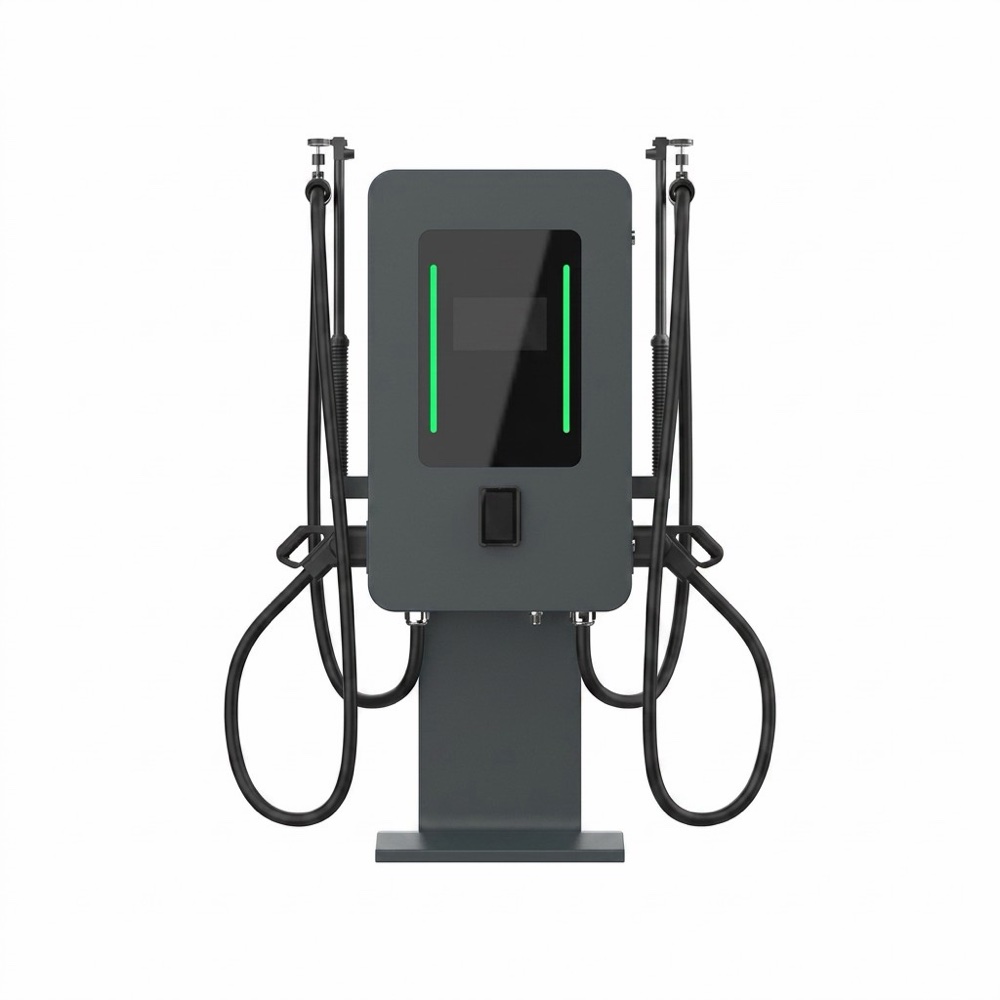
| The charger is fully compliant with OCPP 1.6J and 2.0.1, the worldwide standard connecting stations to central management systems. A charger that speaks only a proprietary protocol is a charger locked to one vendor’s software — limiting tariff flexibility, roaming, and future features. Because the MIDA station is OCPP-compliant, it onboards to virtually any CMS — ChargePoint, Monta, AMPECO, Driivz, EVBox, open-source SteVe, or an in-house backend — and the operator keeps the freedom to switch platforms without touching hardware. OCPP 2.0.1 adds a stronger security model (TLS encryption, certificate management, signed payloads) aligned with the EU’s cybersecurity regulatory trajectory.
Authentication spans RFID cards (ISO 14443A/B, 13.56 MHz), mobile app start/stop, and OCPP remote commands — online or offline-with-whitelist. Connectivity includes Wi-Fi and 4G LTE as standard, with Ethernet optional; dual-path fallback keeps the station online when one medium fails, protecting revenue, because an offline public charger cannot sell electricity. Communications are encrypted, and session data, metering, and fault logs stream to the backend in near real time for remote diagnostics, over-the-air firmware updates, and predictive maintenance. Billing accuracy is anchored by precision kWh metering, with an optional MID-certified meter where billing-grade measurement is a legal requirement. |
 |
Certification and Compliance: Selling with Confidence
| Compliance is a gate, not a differentiator — but it has tripped up many projects. The MIDA station is certified across the dimensions that matter for export: TUV CE (third-party verification of the Low Voltage and EMC Directives, the compliance foundation for the EEA), UKCA (Great Britain), RoHS (hazardous substances), ISO 9001:2015 (factory quality management), ISO 14001:2015 (environmental management), and ISO 15118 (vehicle communication). Regional variants — GB/T connectors, Type 2 combinations — extend the platform to other markets without a separate development cycle. Declarations of conformity and test reports ship with each order, smoothing electrical inspection, grid-connection approval, insurance review, and tender submissions. | 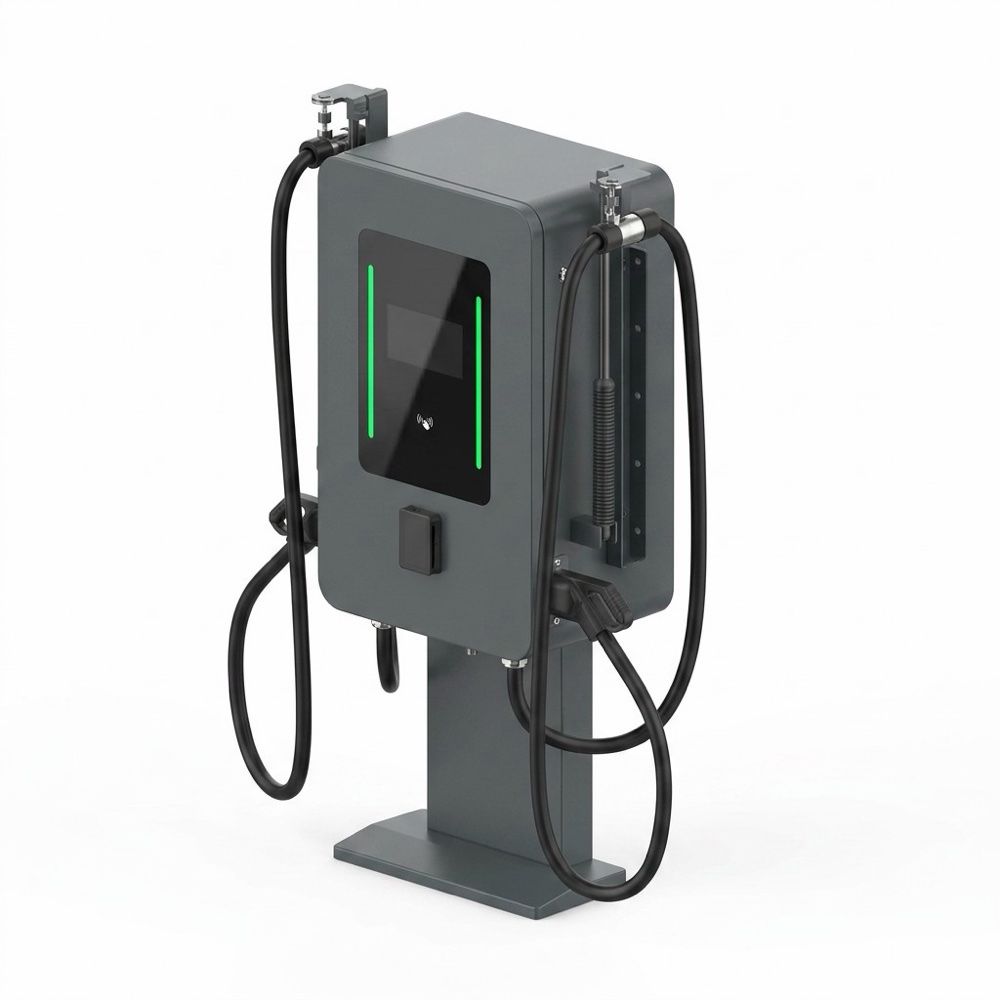 |
Deployment Scenarios and Buyer Personas
|
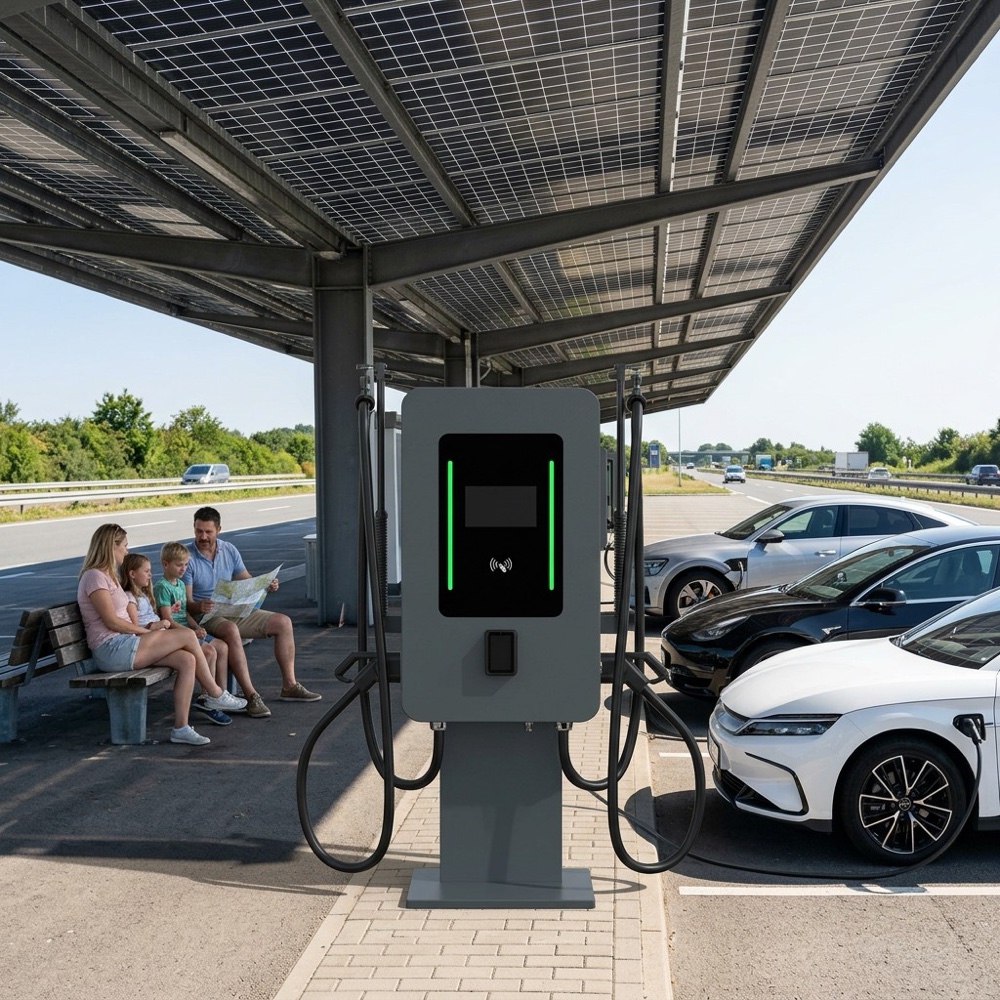
Public charging operators (CPOs). Urban hubs, supermarket car parks, municipal lots, and converted forecourts with 30–60 minute dwell times align perfectly with this speed class. Two connectors per cabinet yield two bays from one 60 kW connection, and OCPP 2.0.1 allows immediate CMS onboarding. At EUR 0.45–0.65/kWh retail and 3–6 sessions per connector per day, well-located stations often reach cash-flow breakeven in 2–3 years on energy margin alone.
Fleet and depot operators. Return-to-depot fleets restore vehicles from 25–35% to 80–90% in 45–70 minutes, enabling consecutive shifts per bay. Dual-port sharing covers lunch-break windows, and OCPP integration feeds per-vehicle session data for cost allocation and compliance reporting. Workplace, hospitality, and retail. A 60 kW session turns a lunch break into meaningful range for employees and guests; the floor-mounted form factor integrates cleanly into car parks, and quiet cooling suits mixed-use environments. Auto dealerships and service centers. PDI (pre-delivery inspection) of new EVs, service-lane top-ups, and test-drive prep benefit from scheduled 40-minute sessions that keep delivery calendars moving. |
Total Cost of Ownership: The Economics of 60 kW
This is not an argument that 60 kW is universally “better” — it is an argument that 60 kW sits at the efficiency frontier for the most common commercial duty cycles. For sites expected to deliver 150–300 kWh/day, the dual-port station offers the lowest capital cost per delivered kWh, one manageable grid connection, and the utilization advantage of two active bays. Below roughly 50 kWh/day, a well-designed AC solution may suffice; above roughly 600 kWh/day, higher-power hardware earns its premium. The MIDA 60 kW is the right answer for the very large middle. |
 |
MIDA 60 kW vs. Other Power Classes in the WY Series
| Feature | MIDA 40 kW | MIDA 60 kW (this model) | MIDA 80 kW |
|---|---|---|---|
| Typical grid connection | 63 A three-phase | 80–100 A three-phase | 125 A three-phase |
| Session to +200 km (60 kWh EV) | ~65–75 min | ~45–55 min | ~35–45 min |
| Best-fit sites | Taxi ranks, small fleets | Public hubs, medium fleets, retail | Corridors, high-turnover sites |
| Dual-port sharing | Yes | Yes | Yes |
| OCPP / certs / connectivity | Identical | Identical | Identical |
The WY Series is one engineering platform across 40, 60, and 80 kW, so operators who standardize on MIDA scale from a single cabinet to a multi-site network with identical connectivity, certification, and spare-parts ecosystems. Buyers with different site economics should also review the MIDA 40–60 kW Dual Port Pedestal Charger and the MIDA 80 kW WY Series DC Fast Charger.
Why MIDA Power
| MIDA Power brings a decade-plus track record in power electronics and EV charging, with production and engineering facilities in Shanghai, Shenzhen, and Wuxi — three of China’s most concentrated electronics and EV supply-chain regions — giving direct control over component sourcing, assembly, and quality assurance. The portfolio spans AC charging, DC fast charging from 20 kW to 480 kW, and complete site solutions, so the team engineering your 60 kW station is the same team building corridor chargers and enterprise systems.
For international buyers, this shows up in three areas. Reliability engineering: power-stage derating, thermal design, and component selection are informed by years of field data across European and Asian deployments. Documentation and support: full technical documentation, commissioning support, remote diagnostics, configurable 12–24 month warranties, and a spare-parts pipeline that keeps units serviceable for their full operating life. Flexibility: as an OEM, MIDA supports connector variants, private-label branding, and software customization that branded distributors cannot offer — and can supply the pedestal-mounted dual-port DC charger and AC solutions for a complete network from one accountable vendor. |
|
Frequently Asked Questions
1. Can two cars charge at full speed simultaneously?
No charger in this class delivers full rated power to both ports at once. The 60 kW bank is shared dynamically — one vehicle gets the full 60 kW; two vehicles share (e.g., 40 + 20 or 30 + 30 kW) with continuous rebalancing. This is standard for dual-port DC chargers and maximizes total throughput.
2. Will this charger work with 800 V vehicles?
Yes. The 150 V–1000 V output range covers both 400 V and 800 V architectures, so modern premium EVs and next-generation volume models receive full rated power — future-proofing the asset.
3. What is the real-world charging time?
A 60 kWh battery from 10% to 80% takes roughly 45–55 minutes at 60 kW, adding 200–250 km depending on the vehicle’s acceptance curve and ambient temperature.
4. Which backends is it compatible with?
Any OCPP-compliant CMS — ChargePoint, Monta, AMPECO, Driivz, SteVe, or in-house systems. OCPP 1.6J and 2.0.1 compliance means no proprietary lock-in.
5. Is it certified for Europe and the UK?
Yes — TUV CE (LVD + EMC), UKCA, and RoHS are standard; the factory holds ISO 9001 and ISO 14001; ISO 15118 enables Plug & Charge. Full documentation ships with each order.
6. How is it protected against weather and vandalism?
IP54 (dust and water splash) and IK10 (5 joule impact resistance) ratings, sealed glands, gasketed doors, and a UV-stable, corrosion-protected finish. Operating range −25 °C to +55 °C with derating above 45 °C.
7. What warranty and after-sales support are provided?
Configurable 12–24 month warranty, remote diagnostics, over-the-air firmware updates, spare-parts supply, and commissioning support — backed by an OEM with facilities in Shanghai, Shenzhen, and Wuxi.
Conclusion
The MIDA 60 kW Dual CCS2 DC Fast Charger is engineered for the commercial duty cycles that define modern EV charging: dual-vehicle capability from one cabinet, a 150–1000 V window that serves today’s and tomorrow’s vehicles, ≥ 95.5% efficiency that protects margins, IP54/IK10 durability, full OCPP 1.6J/2.0.1 connectivity, and a complete TUV CE, UKCA, RoHS, ISO, and ISO 15118 compliance package. For CPOs, fleet managers, property owners, and dealerships, it is the most capital-efficient path from grid connection to dependable, revenue-generating fast charging. Contact MIDA Power for pricing, samples, technical documentation, and configuration support.
Products categories
-
180kw 240kW DC Ultra Fast EV Charger Station OC...
-
Level 3 EV DC Charger Electric Car Charging Sta...
-
240kw 300kw 360kw 420kW Fast Charging Station F...
-
120KW 160KW 180kW 200kw Fast EV Charger Station...
-
420KW CCS2 New energy electric vehicle Charging...
-
360KW New energy electric vehicle Charging station