

MIDA 40kW–60kW Dual Port DC EV Charger — Pedestal Level 3 Fast Charging Station for Commercial Fleet
Quick Answer
The MIDA 40 kW–60 kW Dual Port DC EV Charger is a pedestal-mounted Level 3 fast charging station from MIDA Power’s WY Series, engineered specifically for commercial fleet operations — delivery vans, taxis, municipal vehicles, light commercial trucks, and shared-mobility fleets that must return to service quickly and predictably. The charger accepts factory-configured power ratings from 40 kW to 60 kW, so operators can match the station to their vehicles, shift patterns, and site grid capacity. Dual DC connectors with dynamic power sharing let two vehicles charge from a single pedestal, cutting cabinet count and infrastructure cost per charging bay. The 150 V–1000 V DC output window covers both 400 V and 800 V battery architectures, and ≥ 95.5% conversion efficiency keeps energy losses and operating costs low. Built to IP54 and IK10 standards and certified to TUV CE, UKCA, RoHS, ISO 9001, ISO 14001, and ISO 15118, the pedestal is OCPP 1.6J and 2.0.1 compliant with RFID, mobile app, Wi-Fi, and 4G connectivity. MIDA Power’s ten-plus years of EVSE manufacturing experience in Shanghai, Shenzhen, and Wuxi underpins the reliability, spare-parts availability, and technical support that commercial operations depend on.
Key Takeaways
- Configurable 40–60 kW output — right-size the station to your fleet’s vehicles, dwell times, and electrical supply.
- Dual-port dynamic power sharing — two vehicles charge from one pedestal (e.g., 30 + 30 or 40 + 20 kW), cutting infrastructure cost per bay.
- 150 V–1000 V voltage range — compatible with vans, taxis, light trucks, and passenger EVs across 400 V and 800 V platforms.
- Pedestal form factor, compact footprint — quick installation on a concrete pad, minimal depot space, easy relocation as layouts evolve.
- OCPP 1.6J / 2.0.1 with RFID, App, Wi-Fi, and 4G — open-standard integration with fleet management and billing platforms.
- Commercial-grade durability — IP54, IK10, TUV CE, UKCA, RoHS, ISO 9001/14001, and ISO 15118 certifications.
Introduction: The Fleet Electrification Bottleneck That 40–60 kW Solves
| Commercial fleet electrification is now a board-level priority. Regulatory pressure leads the way: EU CO2 standards for new vans and trucks tighten through the 2020s, the UK has committed to ending the sale of new petrol and diesel vans by 2035, and dozens of cities have announced low-emission zones that effectively require zero-emission commercial access. Economics have crossed the threshold too — total cost of ownership parity for electric vans and taxis now arrives within the first few years of operation in most European markets.
But a fleet is only as electric as its charging infrastructure, and fleet charging is fundamentally different from private charging. Vehicles operate on fixed duty cycles: a delivery van returns at 20–30% state of charge, needs a predictable top-up, and must be back on the road for the next shift. Taxis charge opportunistically between fares; municipal vehicles have defined charge windows. In every pattern, dwell time ranges from 30 minutes to several hours, and session energy from 20 to 45 kWh — precisely the operating envelope of the 40–60 kW DC class. A 60 kWh battery at 40% state of charge reaches roughly 80% in under an hour at 50 kW; the same top-up at 11 kW AC takes five or six hours. Meanwhile, 40–60 kW stations draw power that existing three-phase site infrastructure can usually support without the multi-month grid upgrades and six-figure connection fees that 150 kW+ hardware routinely triggers. For a fleet operator, that distinction often separates a project deployed this quarter from one delayed a year. This description is a complete technical and commercial profile of the MIDA 40–60 kW Dual Port pedestal charger — hardware architecture, power flexibility, dual-port logic, environmental resilience, connectivity, certification, deployment scenarios, and total cost of ownership — giving fleet managers, project developers, and procurement teams everything needed to specify, budget, and deploy with confidence. |
 |
Product Overview — A Pedestal Charger Built for Depot Duty
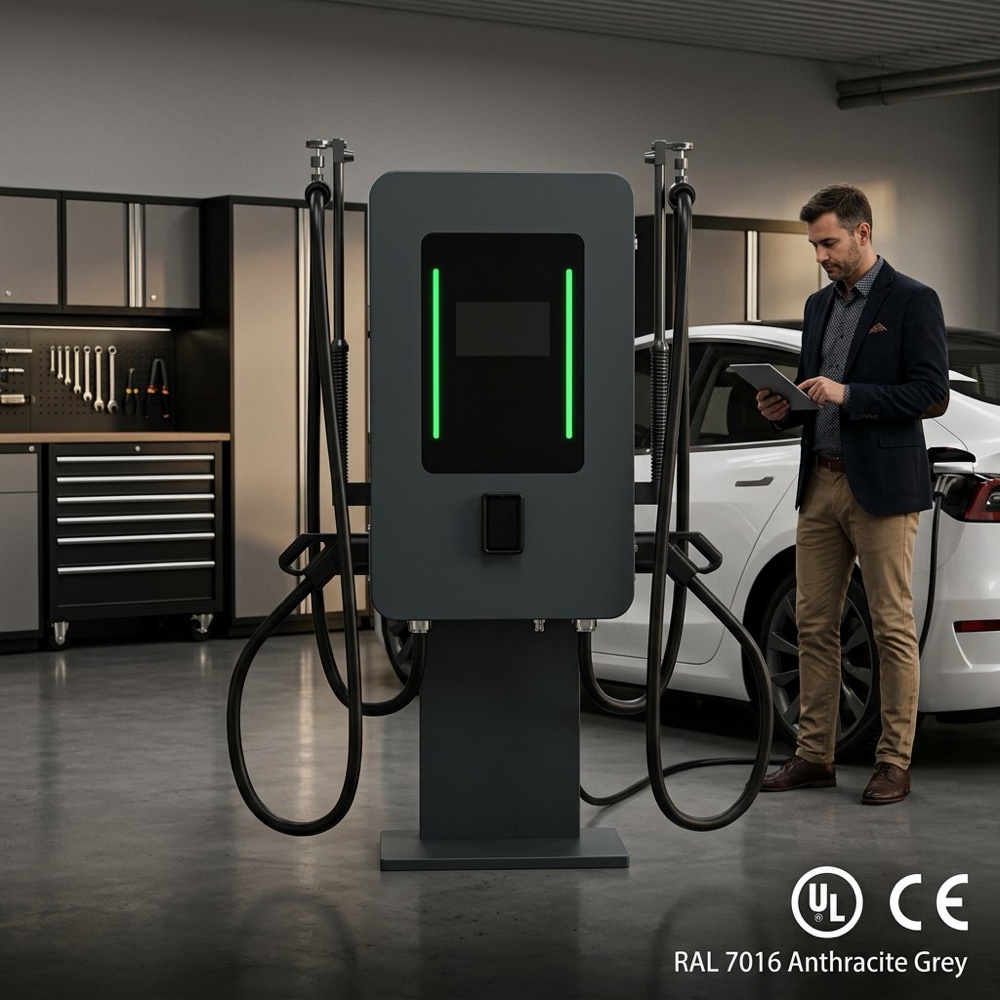
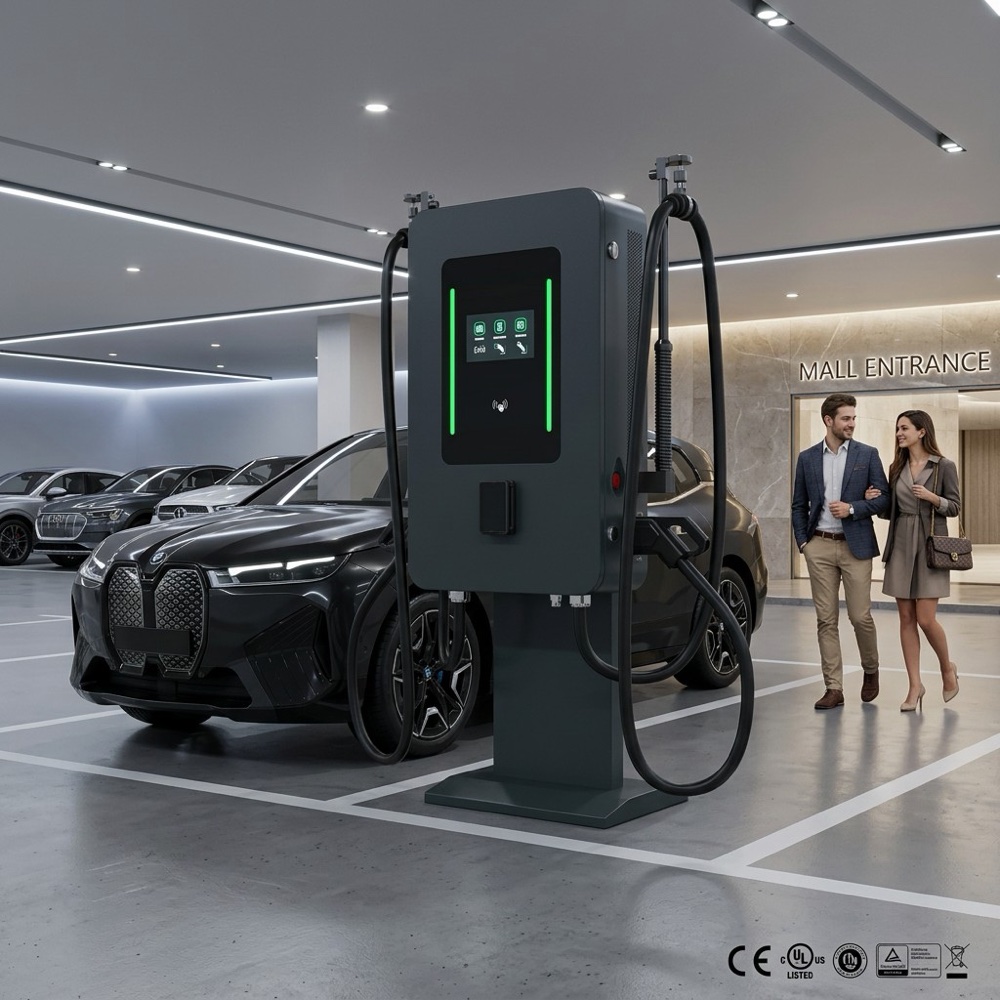
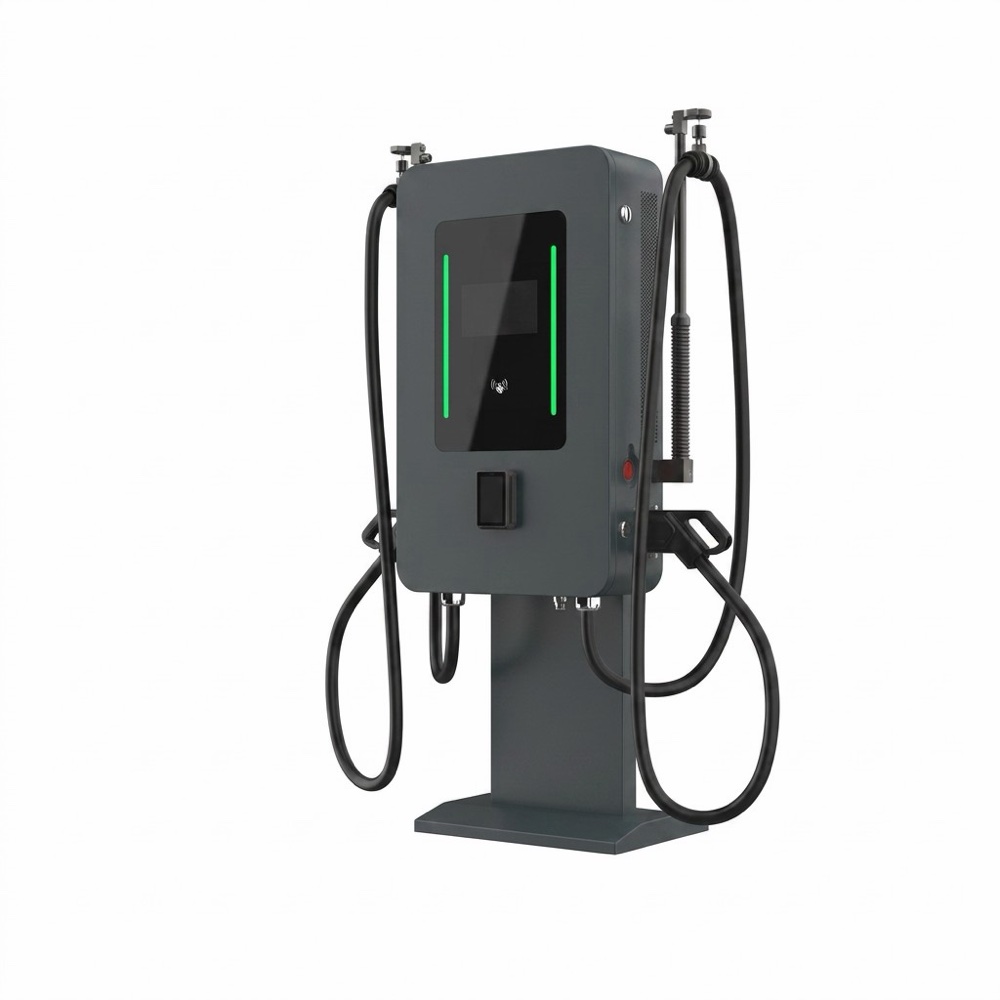
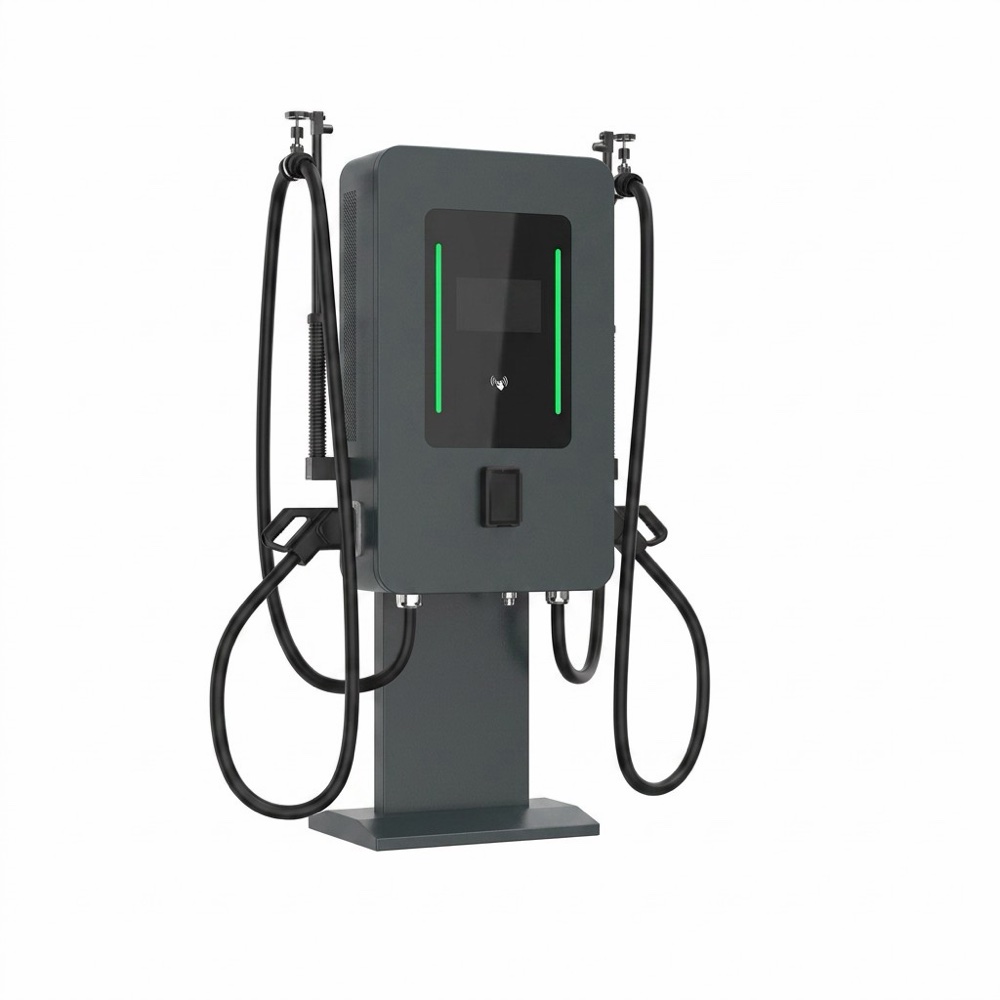
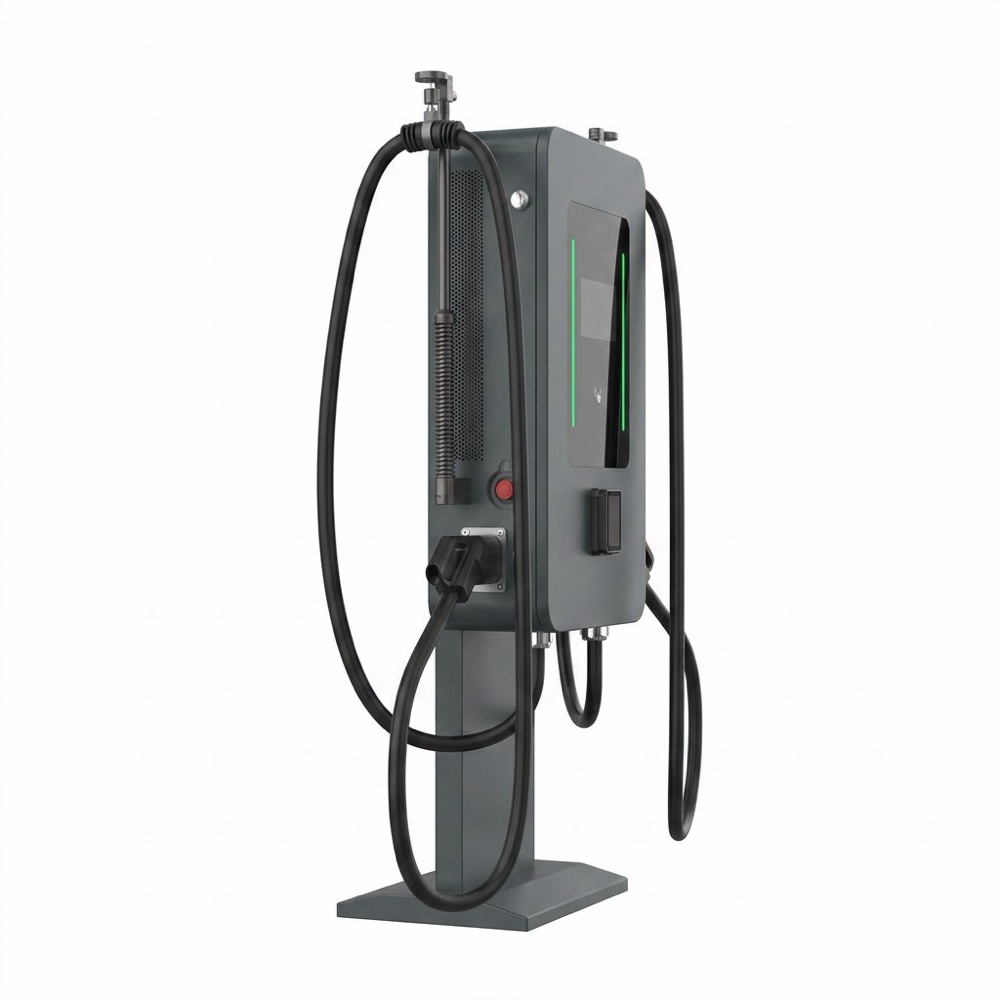
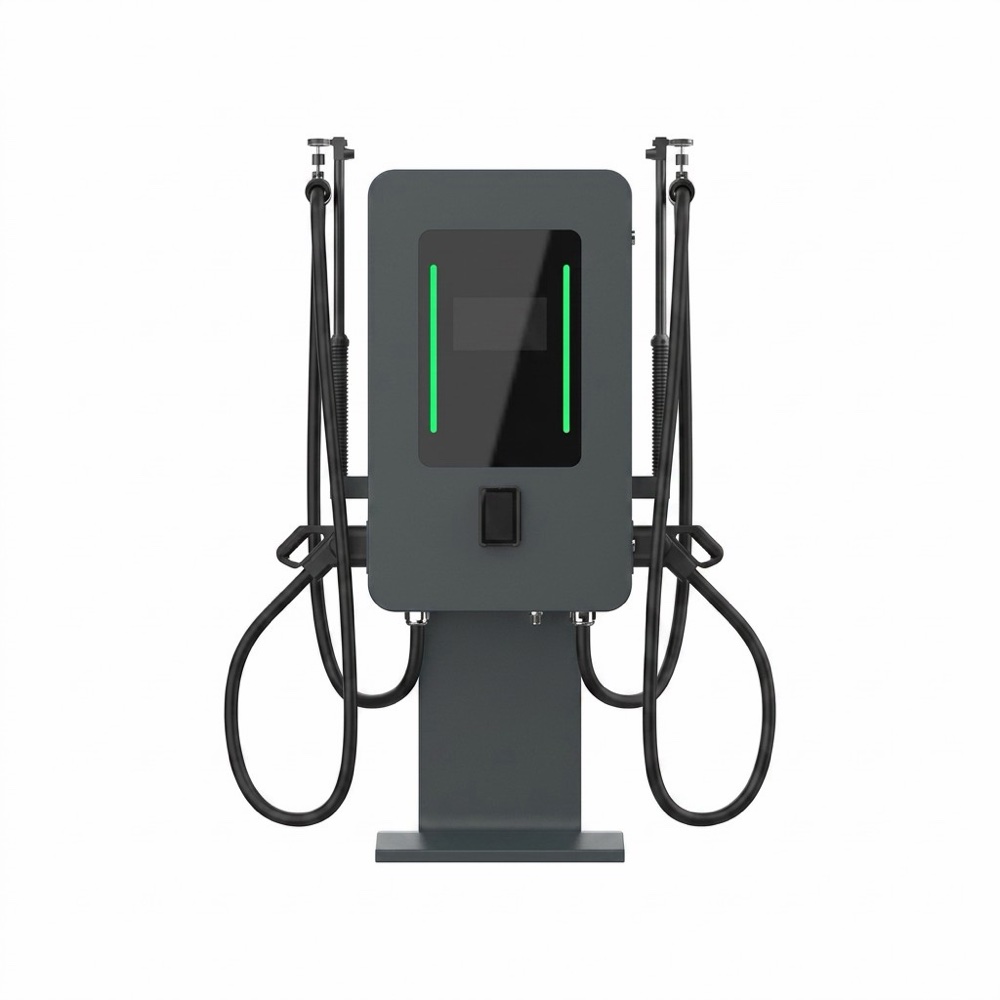
Why the Pedestal Form Factor Wins in Fleet EnvironmentsThe MIDA station is supplied as a pedestal-mounted unit: the power cabinet sits on a steel pedestal base bolted to a concrete pad or precast plinth, lifting the display and charging cables to a comfortable working height. For fleet applications, this offers decisive advantages. The pedestal is genuinely freestanding — it does not depend on wall structure, so it installs in open yards, under canopies, along fence lines, or in dedicated charging lanes. The elevated design keeps cable entries and connector holsters clear of ground-level mud, snow, and oil. And the compact footprint — roughly 600 mm (W) × 400 mm (D), about 1500 mm tall — allows high-density parking layouts, so more vehicles are served per square meter of depot space. The mechanical design anticipates commercial realities: hot-dip galvanized and powder-coated steel for corrosion resistance, an IP54-sealed electrical enclosure, an IK10-rated vandal shield over the display and RFID reader, reinforced strain relief at the cable exits, and connectors certified for the high insertion-cycle counts of daily professional use. |
 |
Configurable Power: 40 kW, 50 kW, or 60 kW from One Platform
A defining capability of this WY Series platform is power flexibility. The same pedestal cabinet is supplied and configured at 40 kW, 50 kW, or 60 kW rated output — right-sized to fleet composition and site supply. This matters commercially for three reasons. First, grid capacity varies enormously: a depot with a 100 A three-phase supply may only support 40 kW stations, while a newer site with 160 A can host 60 kW units. Second, fleets evolve: a van fleet may standardize on 40 kW today and move to larger batteries next year — and because the power stage is modular, the station’s rating can be adjusted without replacing hardware. Third, platform standardization simplifies spare-part inventories, technician training, and maintenance contracts across dozens of sites.
In practice: 40 kW suits taxis and light vans with frequent short sessions; 60 kW suits larger vans and light trucks that must recover more energy per session. All configurations share the dual-port architecture, preserving two-vehicles-per-pedestal flexibility across the entire power range.
Dual-Port Dynamic Power Sharing: Two Vehicles, One Connection
The pedestal integrates two DC connectors fed from a single power module bank, managed by a dynamic power-sharing controller. With one vehicle connected, it receives the full rated output; when the second port is occupied, power is redistributed intelligently (e.g., 30 + 30 kW on a 60 kW unit, 25 + 25 kW on a 50 kW unit) and continuously rebalanced as each session’s demand tapers.
For a depot, the value appears in the daily schedule. With single-port chargers, a 60 kW charger idling while its vehicle finishes a slow taper charge represents wasted capital. With dual-port sharing, the second vehicle plugs in the moment a bay frees, and the station immediately puts idle capacity to work — a materially higher number of vehicles served per day from the same grid connection, improving utilization and return on infrastructure investment.
Technical Specifications at a Glance
|
 |
Charging Performance: Built Around Fleet Duty Cycles
Matching Power to the Vehicle Mix
The power rating must match the fleet’s energy demand per session, not just its largest vehicle. Three reference patterns illustrate the trade-off. 40 kW suits taxi ranks and light van fleets with frequent short sessions: a 40 kWh taxi battery from 20% to 80% completes in roughly 35–45 minutes, and modest power draw simplifies site electrical work. 50 kW is the balanced choice for mixed fleets of passenger vehicles and small vans, fitting within a standard 80 A three-phase supply. 60 kW serves larger battery vans (70–90 kWh) and light trucks that must recover 30–45 kWh per session: a 75 kWh van from 25% to 85% completes in about 50–60 minutes, fitting neatly into a driver’s break. Because the rating is configured on one modular platform, a fleet can deploy 40 kW at constrained sites and 60 kW where capacity allows — with a single spare-parts inventory and one CMS integration.
The 150 V–1000 V Voltage Window
Fleet yards contain more vehicle architectures than private car parks: 400 V passenger EVs, 800 V light trucks, 350–450 V delivery vans, and specialized utility vehicles with non-standard pack voltages. A charger capped at 750 V would deliver a fraction of rated power to an 800 V truck — turning a scheduled 40-minute top-up into a two-hour session that wrecks the duty plan. The MIDA pedestal’s 1000 V ceiling keeps full rated current available across the working voltage range, so fleet planners can rely on session-time estimates, and the asset stays useful as vehicle platforms migrate upward.
Efficiency ≥ 95.5%: The Depot’s Operating-Cost Lever
In a high-throughput depot, every percentage point of conversion loss is multiplied across every session of every day. At ≥ 95.5% efficiency, the pedestal turns about 4,700 kWh of every 100,000 kWh it delivers into heat; a comparable unit at 92% loses roughly 8,700 kWh. The gap is worth on the order of EUR 800 per station per year at a EUR 0.20/kWh blended power price — more where commercial tariffs or demand charges apply. Because efficiency comes from a well-thermalized, derated power stage rather than exotic components, lower waste heat also means lighter cooling loads, quieter operation, and longer component life.
Dual-Port Logic for Shift-Based Operations
The dynamic power-sharing controller is the operational heart of the depot layout. With two vehicles per pedestal and real-time redistribution, a single 60 kW connection can serve a queue of vehicles through the afternoon and evening without intervention: as one vehicle’s demand tapers, freed capacity flows automatically to the other port, while minimum-power guarantees ensure no vehicle is stranded. For fleet managers, the metric that matters is vehicles-charged-per-day-per-bay — and the dual-port architecture typically delivers 40–70% more vehicles served per day than single-port layouts with identical grid infrastructure.
Built for the Depot: IP54, IK10, and Commercial-Grade Design
| Fleet depots are not cleanrooms — chargers share yards with forklifts, sweepers, gritting operations, and the general grime of daily service. IP54 ingress protection keeps dust and water splash out of the electronics, essential for installations in open yards or under canopies. IK10 impact resistance (5 joules, IEC 62262) protects against accidental strikes from vehicles and equipment and against vandalism in semi-public locations; the connector holsters, display, and RFID reader sit inside the protected envelope. Details reveal the commercial heritage: reinforced strain relief at cable exits, holsters that keep cables off the ground when idle, an emergency stop at driver height, and a locking service door. Operating range is −25 °C to +55 °C with derating above 45 °C, and a salt-spray-resistant finish is available for coastal depots. | |
Smart Connectivity: OCPP 1.6J / 2.0.1 and Fleet-Grade Integration
The pedestal speaks OCPP 1.6J and 2.0.1, the open standards connecting hardware to charging management systems. For fleets, this is the integration point with fleet management platforms, depot energy management systems, and billing/telematics stacks. Because the protocol is open, the pedestal integrates with leading commercial platforms (Monta, AMPECO, Driivz, ChargePoint, EVBox) and in-house backends — no proprietary lock-in. The practical fleet features include:
Authentication spans RFID (ISO 14443A/B), mobile app, OCPP remote commands, and PIN access — so a depot can restrict charging to its own fleet, open the site to guests off-peak, or run a hybrid model, all configured from the CMS. Wi-Fi and 4G LTE are standard, with Ethernet optional; the dual-radio design keeps the pedestal online if one path fails, and TLS-encrypted communication and certificate-based authentication follow OCPP 2.0.1′s security model. |
|
Certification and Compliance: A Complete Export Package
| Commercial buyers — particularly those bidding for municipal and utility contracts — require an auditable compliance record. The MIDA pedestal provides TUV CE (third-party verification of the EU Low Voltage and EMC Directives), UKCA (Great Britain), RoHS (hazardous substances), ISO 9001:2015 and ISO 14001:2015 (factory quality and environmental management), ISO 15118 / DIN 70121 (vehicle communication, Plug & Charge), and an MID-certified meter option for billing-grade measurement. The full documentation pack — declarations of conformity, test reports, installation manuals, wiring diagrams — ships with each order, accelerating electrical inspection, grid-connection applications, and insurance review. | 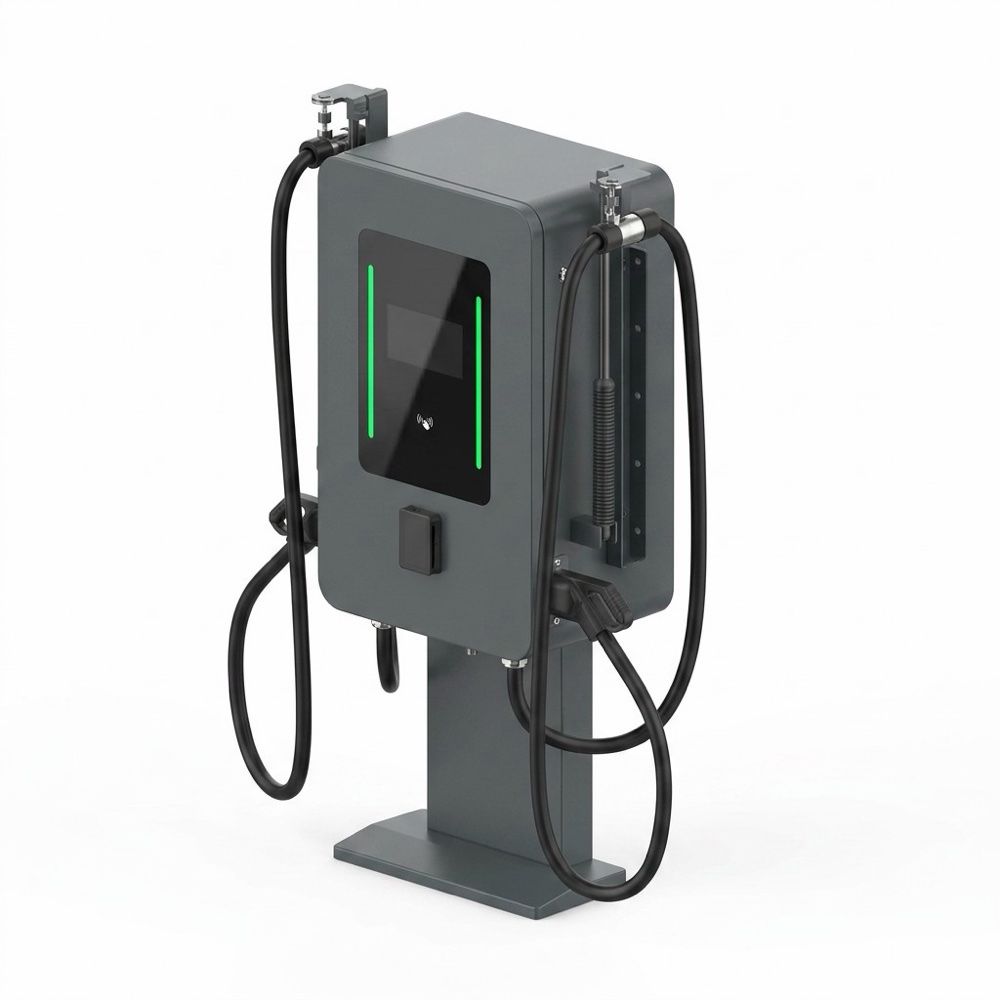 |
Deployment Scenarios: Where the Pedestal Earns Its Keep
|
Last-mile delivery and parcel fleets. A depot with twenty 60 kWh vans returning over a 4–6 hour afternoon window needs 400–600 kWh of charging capacity. A bank of 60 kW pedestals — two bays each — delivers that throughput with a fraction of the grid connections AC charging would demand, and dual-port sharing lets the operator schedule two waves of vehicles against each pedestal.
Taxi and ride-hailing fleets. Taxis charge opportunistically between fares. A 40–50 kW pedestal at a taxi rank or airport holding area turns a 30-minute wait into a meaningful top-up, RFID cards make access frictionless, and the modest power draw lets multiple pedestals share a site transformer — decisive at city-center ranks where grid capacity is scarce. Municipal and utility fleets. Street sweepers, refuse loaders, and utility vans run fixed schedules with defined windows. The compact pedestal installs in existing yard layouts without reconfiguring parking, and OCPP integration feeds the energy data municipal energy managers need for public reporting and grant compliance. Car-sharing and rental operations. Vehicles rotate continuously; dual-port pedestals keep two vehicles ready at hub locations, app-based access removes card friction, and the wide voltage range covers the mixed vehicle ages typical of rental pools. |
Total Cost of Ownership for Fleet Operations
| Cost Dimension | MIDA 40–60 kW Pedestal | 11–22 kW AC (per bay) | 150 kW+ DC (per bay) |
|---|---|---|---|
| Hardware per bay (dual-port) | Low–medium | Low per bay, many bays needed | High |
| Grid connection per depot | One connection per 2 bays | Many connections; new feeder often | Transformer + dedicated feeder |
| Session time for 40 kWh | ~45–60 min | 2–4 hours | ~20 min |
| Peak demand management | Simple (≤60 kW per pedestal) | Lower peak, far slower | High peak, demand charges |
| Fleet utilization potential | High (2 vehicles per pedestal) | Low (overnight only) | High, but capex-heavy |
The decisive number for most fleet operators is energy delivered per grid connection per day. A 60 kW dual-port pedestal on a single 100 A three-phase supply can realistically deliver 250–400 kWh per day across two bays — throughput that would require a transformer-fed 150 kW installation or more than a dozen AC points to match, at a fraction of the capital cost.
MIDA 40–60 kW Pedestal vs. the Broader WY Series
| Feature | MIDA 40–60 kW Pedestal (this model) | MIDA 60 kW Floor-Mounted Dual CCS2 | MIDA 80 kW WY Series |
|---|---|---|---|
| Mounting | Pedestal, freestanding | Floor cabinet | Floor cabinet |
| Best-fit environment | Depots, taxi ranks, yards | Public hubs, retail, workplaces | Corridors, large fleets |
| Power options | 40 / 50 / 60 kW | 60 kW | 80 kW |
| Dual-port sharing | Yes | Yes | Yes |
| OCPP / certs / connectivity | Identical | Identical | Identical |
Operators building multi-site networks can mix pedestals and floor cabinets from the same WY Series platform with complete interoperability — one CMS, one spare-parts catalog, one support contract. For public-facing sites, the MIDA 60 kW floor-mounted dual CCS2 station is the complementary choice; for corridor coverage, the MIDA 80 kW DC fast charger extends the same architecture to higher power.
Why MIDA Power
| MIDA Power brings more than ten years of power-electronics and EV-charging experience to the fleet segment, with manufacturing and engineering operations in Shanghai, Shenzhen, and Wuxi. The company designs and produces the complete charging portfolio — AC charging solutions, DC fast chargers from 20 kW to 480 kW, and site-level solutions — so fleet projects can be supplied from a single accountable vendor rather than assembled from mismatched third-party components.
For fleet operators, MIDA’s OEM model delivers three concrete advantages. Specification flexibility: power ratings, connector types, cable lengths, authentication modes, and branding can be configured to the operator’s standards, including private-label programs. Lifecycle support: configurable 12–24 month warranties, remote diagnostics, over-the-air firmware updates, and a spare-parts pipeline keep pedestals in service through their full economic life. Scale: whether a project is five pedestals or five hundred, MIDA’s production capacity and export logistics support consistent delivery schedules and uniform quality — the reliability base a depot schedule depends on. |
 |
Frequently Asked Questions
1. What is the difference between the 40 kW, 50 kW, and 60 kW versions?
The hardware platform is identical; the rated output is factory-configured. 40 kW suits taxis and light vans with short sessions, 50 kW suits mixed fleets, and 60 kW suits larger vans and light trucks needing 30–45 kWh per session. Your MIDA sales engineer will match the rating to your vehicles, dwell times, and site supply.
2. Can both ports charge simultaneously at full rated power?
No — rated power is shared across the two ports. One vehicle receives the full output; with two vehicles, power splits dynamically (e.g., 30 + 30 or 40 + 20 kW on a 60 kW unit) and rebalances continuously to maximize total depot throughput.
3. Will it charge 800 V fleet vehicles?
Yes. The 150 V–1000 V output range covers 400 V and 800 V architectures, so modern vans and light trucks on high-voltage platforms receive full rated power — protecting the investment as fleets transition.
4. How does the pedestal connect to my fleet management software?
Through OCPP 1.6J or 2.0.1 — to commercial platforms (Monta, AMPECO, Driivz, and others) or your own backend, providing session data, RFID fleet-card attribution, remote start/stop, load management, and diagnostics.
5. What installation groundwork does a pedestal require?
A level concrete pad or precast plinth with anchor fixings, plus a three-phase supply and data connectivity (4G, Wi-Fi, or Ethernet). Installation typically takes one to two days including commissioning, and the freestanding design makes relocation straightforward.
6. Is the charger certified for Europe and the UK?
Yes — TUV CE (LVD + EMC), UKCA, and RoHS are standard, with ISO 9001/14001 factory certifications and ISO 15118 vehicle-communication compliance. An MID-certified meter option covers billing-grade metering.
7. What support does MIDA provide after installation?
Configurable 12–24 month warranties, remote diagnostics, over-the-air firmware updates, spare-parts supply, and commissioning assistance — plus custom configurations and private-label branding for large fleet programs.
Conclusion
The MIDA 40 kW–60 kW Dual Port DC EV Charger is a purpose-built Level 3 fast charging station for the commercial fleet segment: a compact, relocatable pedestal that brings 40–60 kW of configurable DC power to the depot yard, two charging bays per grid connection, and a 150 V–1000 V output window that serves every vehicle class in a modern fleet. With ≥ 95.5% efficiency, IP54/IK10 durability, full OCPP 1.6J/2.0.1 connectivity, and a TUV CE, UKCA, RoHS, ISO, and ISO 15118 compliance package, it keeps vehicles on schedule and charging costs under control. Contact MIDA Power for configuration guidance, pricing, samples, and technical documentation — and to see how the WY Series platform scales from a single depot to a nationwide fleet network.
Products categories
-
180kw 240kW DC Ultra Fast EV Charger Station OC...
-
Level 3 EV DC Charger Electric Car Charging Sta...
-
240kw 300kw 360kw 420kW Fast Charging Station F...
-
120KW 160KW 180kW 200kw Fast EV Charger Station...
-
420KW CCS2 New energy electric vehicle Charging...
-
360KW New energy electric vehicle Charging station