



Quick Answer
The choice between 120kW and 180kW should follow site behavior, not a simple preference for the larger number. MIDA’s published charging range includes 120kW and 180kW advertising-screen configurations with 150–1000V DC output, modular power architecture, and OCPP connectivity on relevant models. A 120kW unit can suit a mixed commercial site where vehicles remain parked for longer periods; 180kW is more appropriate when turnover, fleet dispatch, or highway-adjacent demand justifies faster sessions. Actual power depends on battery voltage, state of charge, connector rating, and power-sharing logic. Buyers should compare simultaneous output, cabinet protection, cooling, and grid requirements before selecting the model.
Key Takeaways
- Select 120kW for balanced commercial throughput and moderate grid capacity.
- Select 180kW when vehicle turnover and short dwell time justify higher CAPEX.
- Confirm whether the power rating is total cabinet output or per connector.
- Use OCPP data to measure utilization before planning a capacity upgrade.
- Treat certification and optional features as SKU-specific requirements.
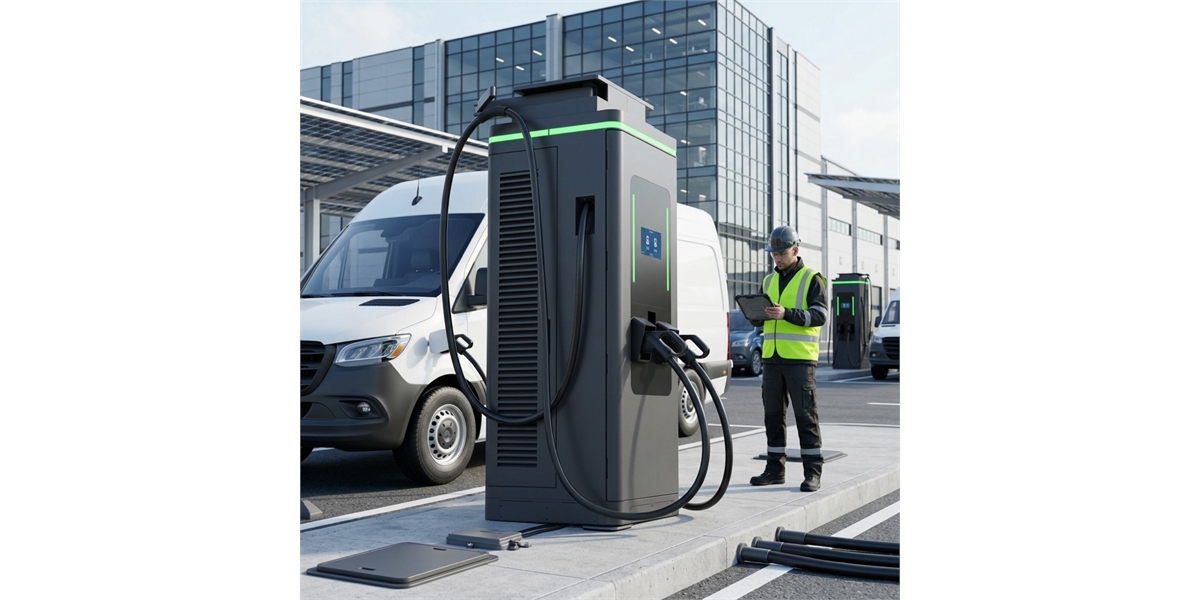
Match Power to Dwell Time
The 120kW Commercial Profile
A 120kW station is often a sensible choice for shopping centers, hotels, offices, and mixed-use parking. It delivers a meaningful energy session without forcing every site into a highway-scale electrical design. The operator can use utilization data to assess whether more ports or more power will create the better return.
MIDA’s 120kW/180kW digital-display DC charging station provides an official reference for this segment. For sites focused on a standard 60kW–240kW family, the 60kW–240kW charging station and 60kW dynamic-load-balance station give additional product-family references.
When 180kW Makes Commercial Sense
The 180kW level becomes more attractive when vehicles arrive continuously, queues develop, or a fleet needs rapid mid-shift replenishment. However, a higher power rating does not automatically reduce total session time because vehicle batteries taper power as state of charge increases. The operator should examine session data rather than rely on nameplate comparisons.
Decision Table
| Factor | 120kW choice | 180kW choice |
|---|---|---|
| Site profile | Retail, hotel, office, mixed parking | High-turnover hub or fleet depot |
| Grid planning | Moderate capacity requirement | Higher capacity and protection planning |
| Vehicle dwell time | Medium to long | Short to medium |
| Procurement focus | Utilization and connector access | Throughput and simultaneous output |
Procurement Questions
Confirm the Electrical Boundary
The charger rating should be evaluated together with transformer capacity, switchgear, cable length, and site load. Ask whether the system can restrict its total demand while maintaining useful service for multiple vehicles. If the site has a fixed grid limit, dynamic power management may create more value than a higher theoretical rating.
Confirm the Digital Boundary
OCPP 1.6J is identified in the published product data, with OCPP 2.0.1 available or optional on specified configurations. The buyer should identify the CSMS, payment method, remote-support workflow, and data-retention requirements before ordering.
Seven FAQs
- Is 180kW always faster than 120kW? Not necessarily; vehicle acceptance and state-of-charge tapering determine delivered power.
- Can 120kW serve two vehicles? Selected models support dual-gun operation; confirm allocation for the specific SKU.
- What is the output voltage? Relevant published MIDA models specify 150–1000V DC.
- Should a hotel choose 120kW or 180kW? Compare average parking duration, local demand, and grid capacity first.
- Are display models suitable for every site? They are suitable where media functionality is commercially useful; otherwise compare standard cabinets.
- Does OCPP guarantee compatibility? No. Confirm supported messages and backend certification with the CSMS provider.
- What should be included in the quotation? Cabinet, guns, cables, protection, communications, installation, commissioning, and warranty scope.
Post time: Sep-01-2026