

1. Introduction
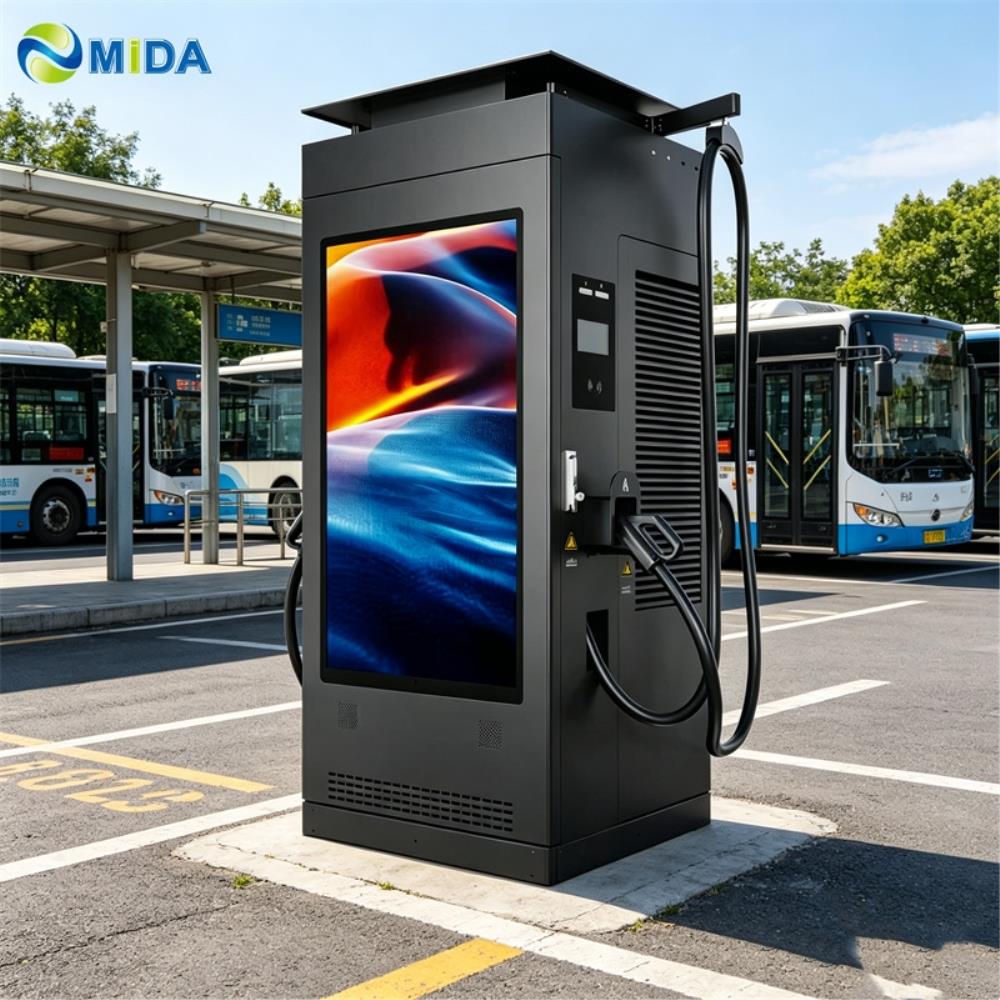
The global transition to electric mobility has reached an inflection point where charging infrastructure is no longer a convenience add-on but a core commercial asset. According to the International Energy Agency, EV sales exceeded 17 million units globally in 2024, and the ratio of EVs per public charger continues to tighten across Europe, North America, and Asia-Pacific. For commercial property owners — shopping malls, retail parks, and mixed-use developments — the question is no longer whether to install fast charging, but how to make it financially self-sustaining. The MIDA 60kW-240kW DC Fast Charging Station with a 55-inch HD Advertising Screen answers that question directly by converting a capital-intensive utility asset into a dual-revenue media platform.
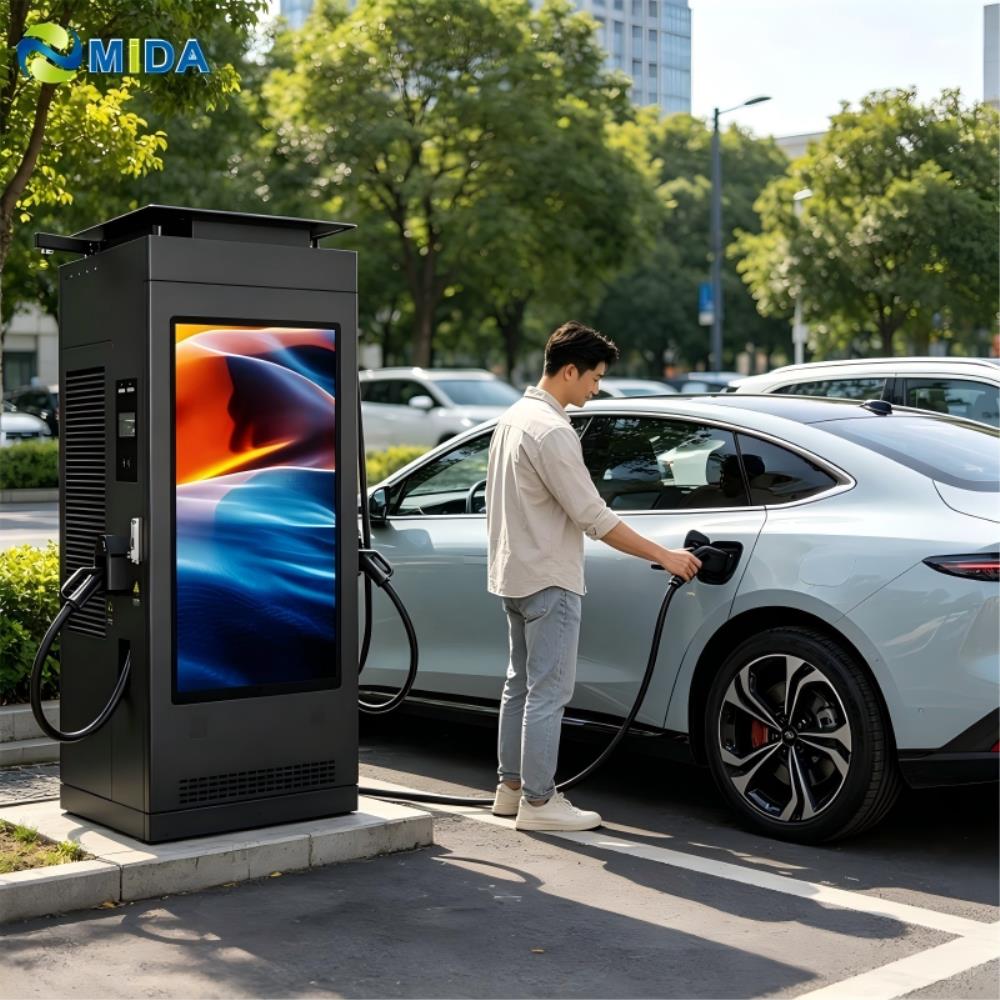
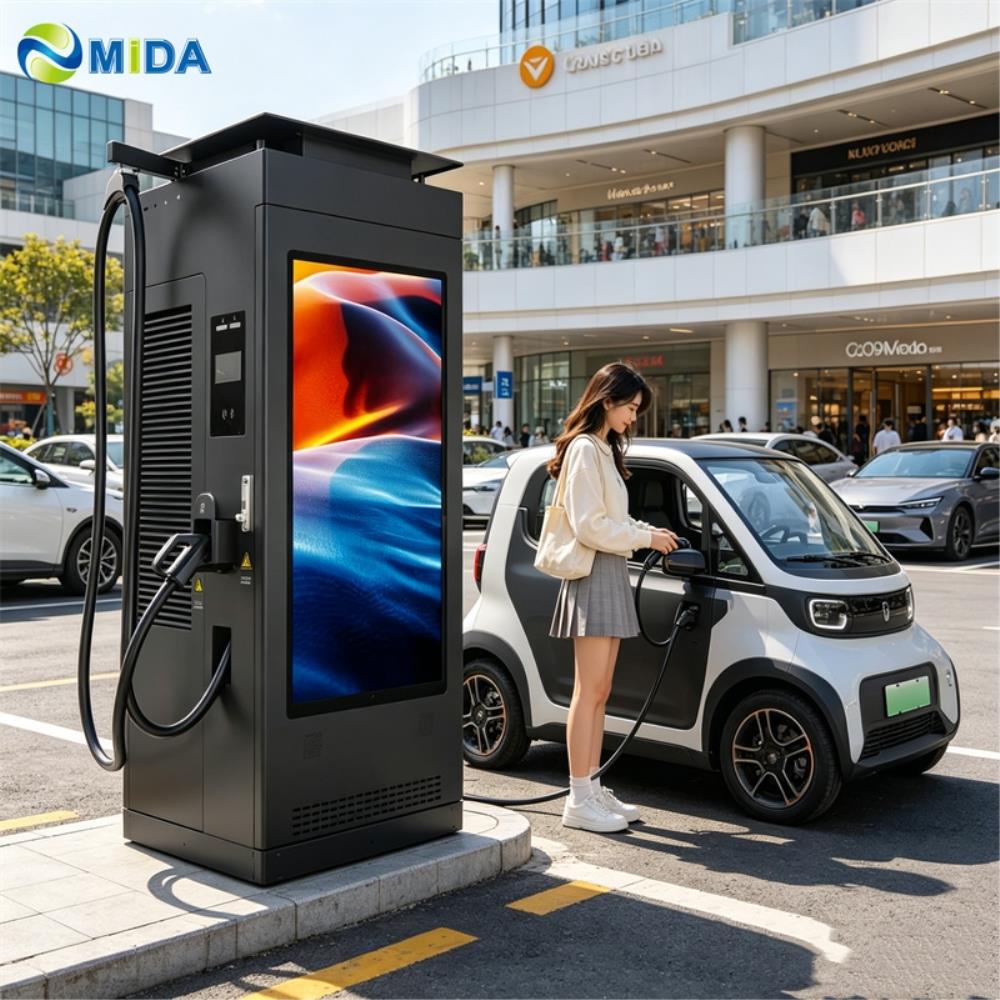
This product is positioned at the intersection of two high-growth industries: EV charging infrastructure and Digital Out-of-Home (DOOH) advertising. MIDA, a manufacturer with deep experience in grid-connected power electronics, has engineered this station so that every minute a driver spends charging — typically 20 to 45 minutes on a fast charger — becomes monetizable screen time. In a commercial mall context, where footfall is measured in tens of thousands of visitors per day and dwell time is naturally high, each charging bay effectively becomes a premium advertising slot with a guaranteed, stationary audience.
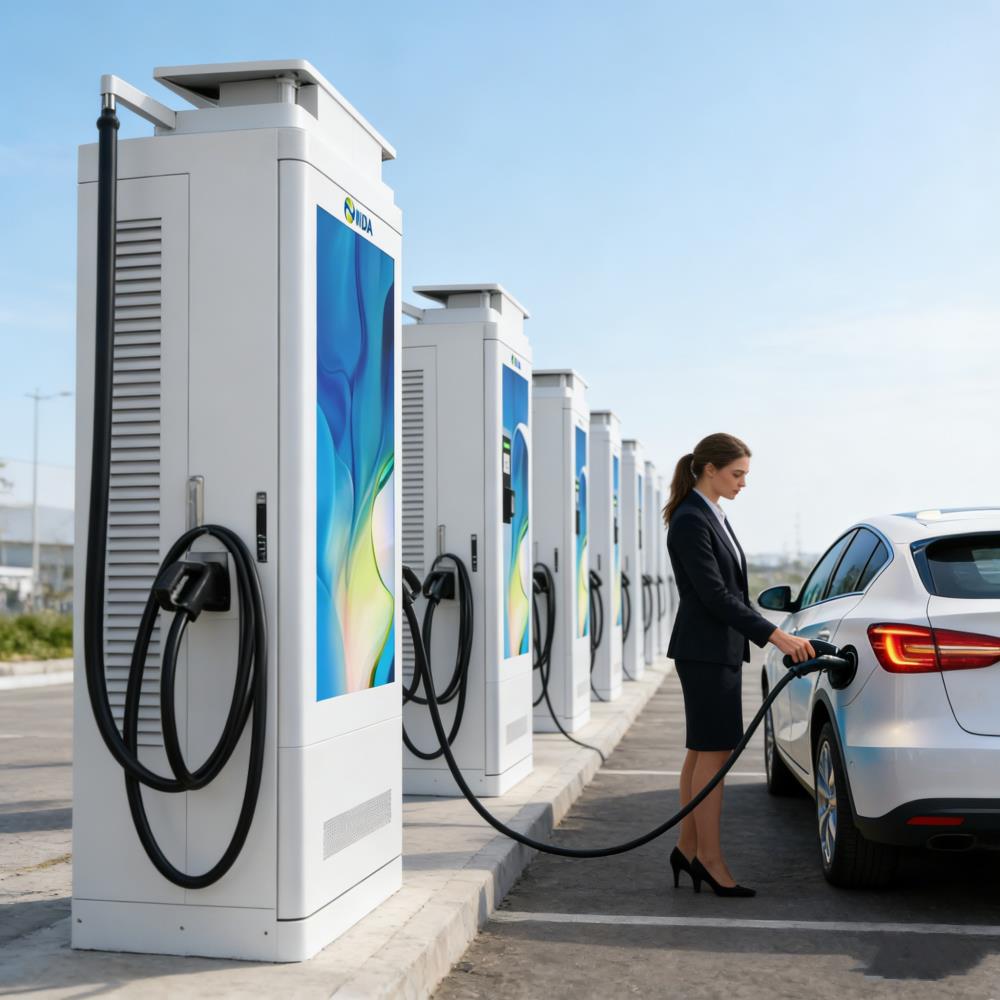
The station delivers 60kW to 240kW of modular DC output, supports dual-gun simultaneous charging, and covers a wide 150–1000V DC output range that accommodates both 400V and 800V vehicle architectures. The integrated 55-inch, 2000-nit daylight-readable display is managed through a cloud-based content management system, allowing the mall operator to sell advertising slots to national brands, local retailers, and food-and-beverage tenants, or to use the screen for its own promotional campaigns, wayfinding, and event announcements.
Positioning summary: this is not a “charger with a screen bolted on.” It is a purpose-engineered commercial asset where charging electronics, thermal management, connectivity, and display hardware are co-designed in a single IP55-rated enclosure. For a mall operator, it delivers three measurable outcomes: reduced net infrastructure cost through advertising revenue, increased tenant sales through targeted promotion, and a modern, eco-friendly brand image that attracts premium EV-driving demographics. For a Charge Point Operator (CPO) or investor, it offers a path to payback periods of 24–36 months instead of the 48–60 months typical of conventional fast chargers. The remainder of this document examines each subsystem in depth — from the advertising engine and power electronics to safety certification, software integration, and deployment scenarios.
2. Interactive Advertising Screen: A 55-Inch Revenue Engine
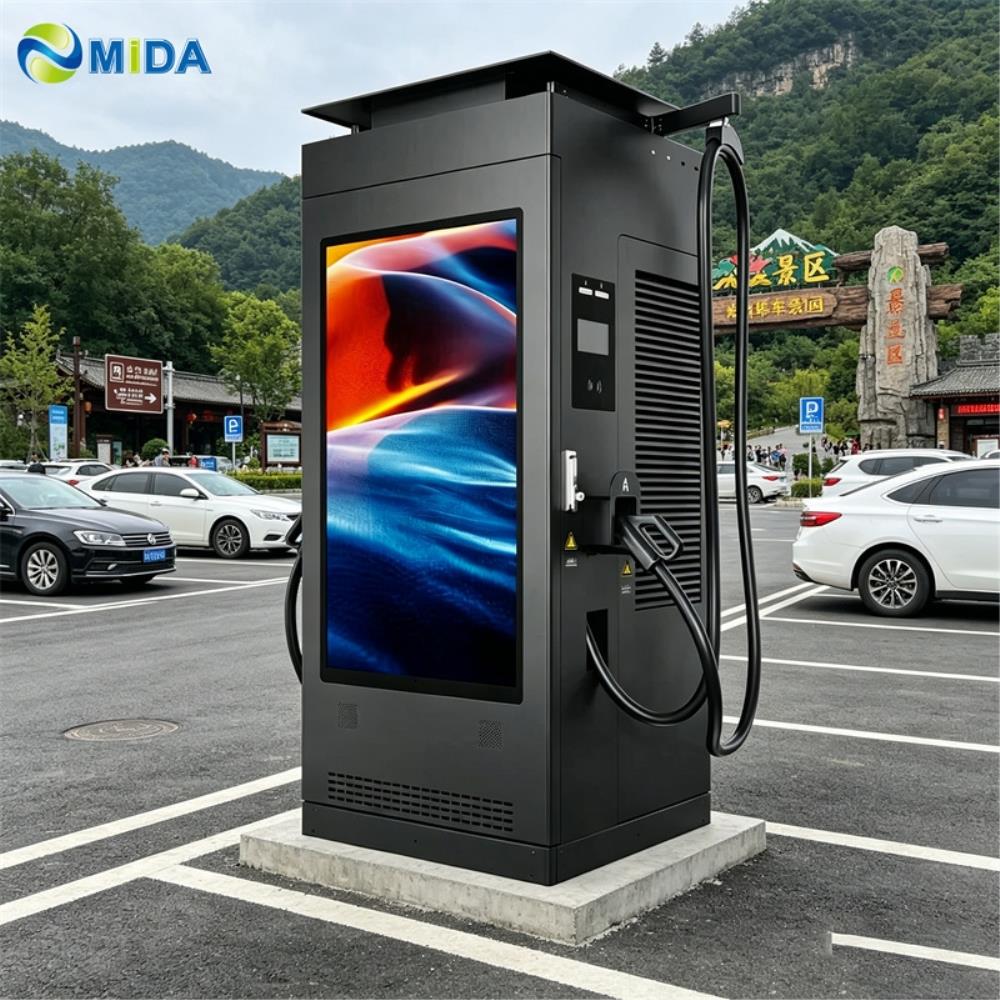
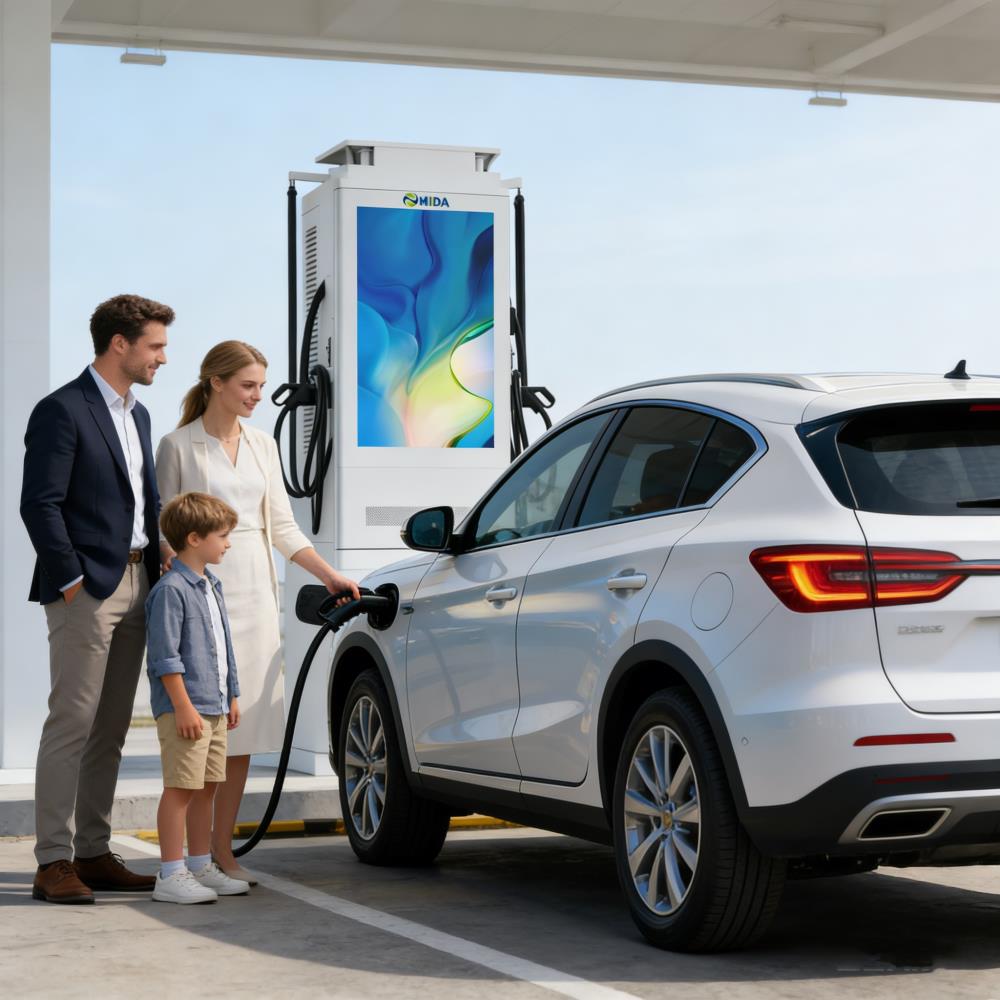
The 55-inch HD display integrated into this MIDA station is the single most distinctive feature of the product, and it deserves close scrutiny from both a technical and a commercial standpoint. On the hardware side, the panel is a 1920×1080 Full-HD TFT-LCD engineered for continuous outdoor-duty operation. Its 2000-nit peak brightness ensures full readability in direct sunlight — a critical requirement for mall forecourt and open-air parking deployments where glare would otherwise wash out the content. An ambient light sensor automatically adjusts brightness in real time: full output during the day, stepped-down illumination at night, which simultaneously reduces energy consumption and complies with local light-pollution ordinances that many European municipalities now enforce.
The display is protected by 4–6mm tempered glass with an IK10 impact rating, meaning it resists deliberate vandalism attempts with hammers, shopping-trolley collisions, and debris kicked up by vehicles. The display housing itself is IP65-rated, independent of the charger cabinet’s IP55 rating, so the media surface can survive hose-down cleaning, rain, and condensation without compromising the electronics behind it. Rated lifetime is 50,000 hours of continuous operation — roughly six years of 24/7 use — after which brightness is expected to degrade gradually rather than fail abruptly, thanks to conservative LED backlight derating and an active heat-pipe cooling loop that keeps panel temperature within specification even when the power modules beneath are running at full load.
From a profit-potential perspective, the screen transforms the charger from a cost center into a media asset. Industry benchmarks for DOOH inventory in high-traffic retail locations range from €8 to €25 CPM (cost per thousand impressions) for full-motion content. A mall charger positioned near the main entrance, food court, or elevator banks can generate 15,000–40,000 verified impressions per day when you count the driver, passengers, adjacent pedestrians, and vehicles queuing behind. At a conservative blended €12 CPM, that equates to €180–€480 per day in gross media revenue per screen. Even after agency fees, content production, and platform costs, the advertising line typically covers a substantial portion of the hardware amortization.
The commercial model works in several configurations:
- Direct sales: the mall or CPO sells time slots to local and national advertisers, typically in 4-week or 12-week packages, at rates of €300–€1,200 per advertiser per month for premium slots.
- Programmatic: the screen can be onboarded to DOOH programmatic platforms that fill unsold inventory automatically, guaranteeing a baseline fill rate.
- Internal promotion: the mall’s marketing department reserves prime slots for tenant campaigns, new-store openings, and loyalty program pushes — internal value that never appears on a media invoice but directly lifts tenant sales.
- Data-driven targeting: optional anonymous audience analytics (GDPR-compliant, no biometric data) measure dwell and impressions, giving advertisers verifiable numbers that justify premium rates.
The content management system (CMS) is the operational backbone. It supports multi-tenant scheduling, playlist rotation, day-parting (e.g., a coffee brand buys 07:00–10:00 slots, a cinema buys evening slots), geo-fenced campaigns, and split-screen layouts where one zone shows the live charging status — power delivered, state of charge, time remaining — while the rest plays advertising or informational content. This split-screen capability is commercially important: it ensures that advertising never hides the critical session information a driver needs, preserving both usability and trust. The CMS is accessible via 4G/5G, Wi-Fi, or Ethernet, meaning the screen operates independently even in underground parking with no public network coverage, using its own SIM and modem.
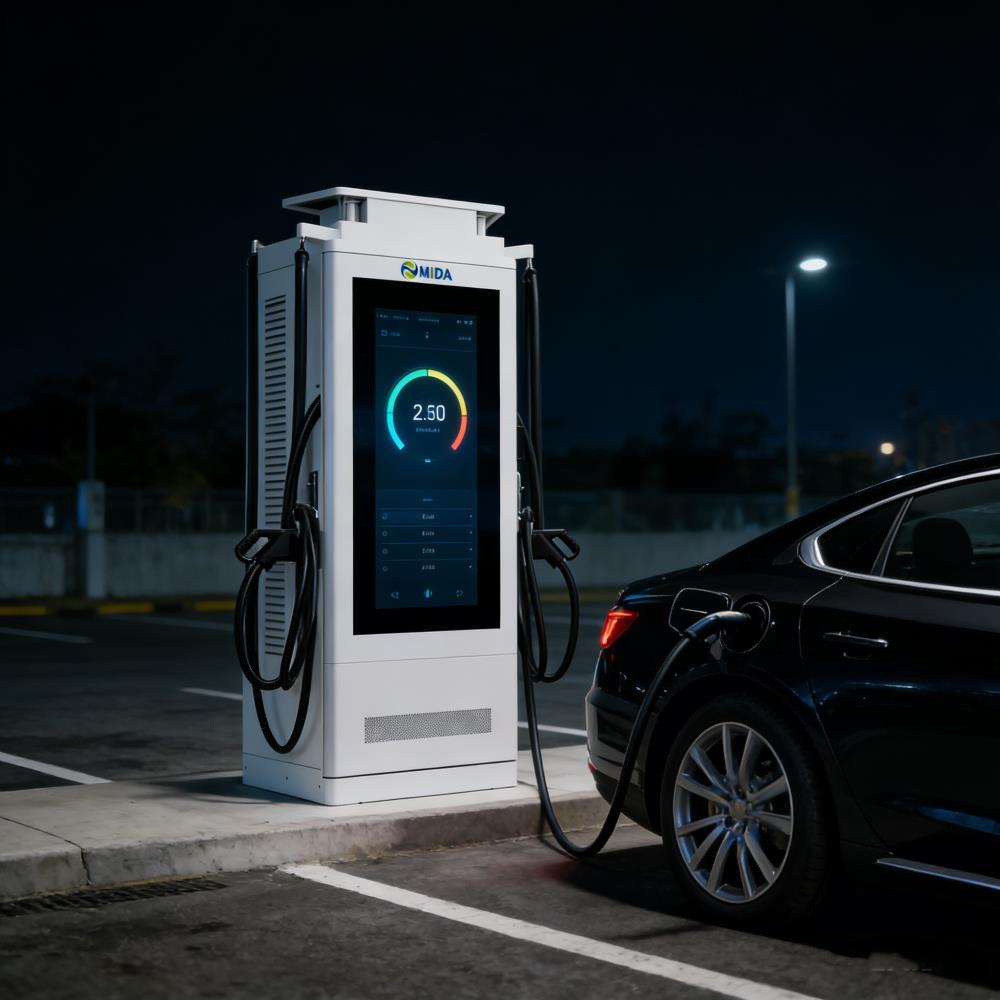
Energy cost of the screen is modest — typically 150–300W depending on brightness level, well under 1% of the energy the station itself dispenses — so the display never meaningfully erodes the charging margin. In short, the 55-inch advertising engine is a genuine profit center: it monetizes dwell time, provides a communication channel for the property owner, and enhances the perceived modernity of the facility. For decision-makers, the screen should be evaluated not as a marketing gimmick but as a P&L line item with its own revenue forecast, utilization targets, and advertiser pipeline.
3. High-Performance Charging Technology: 60kW–240kW Modular Power
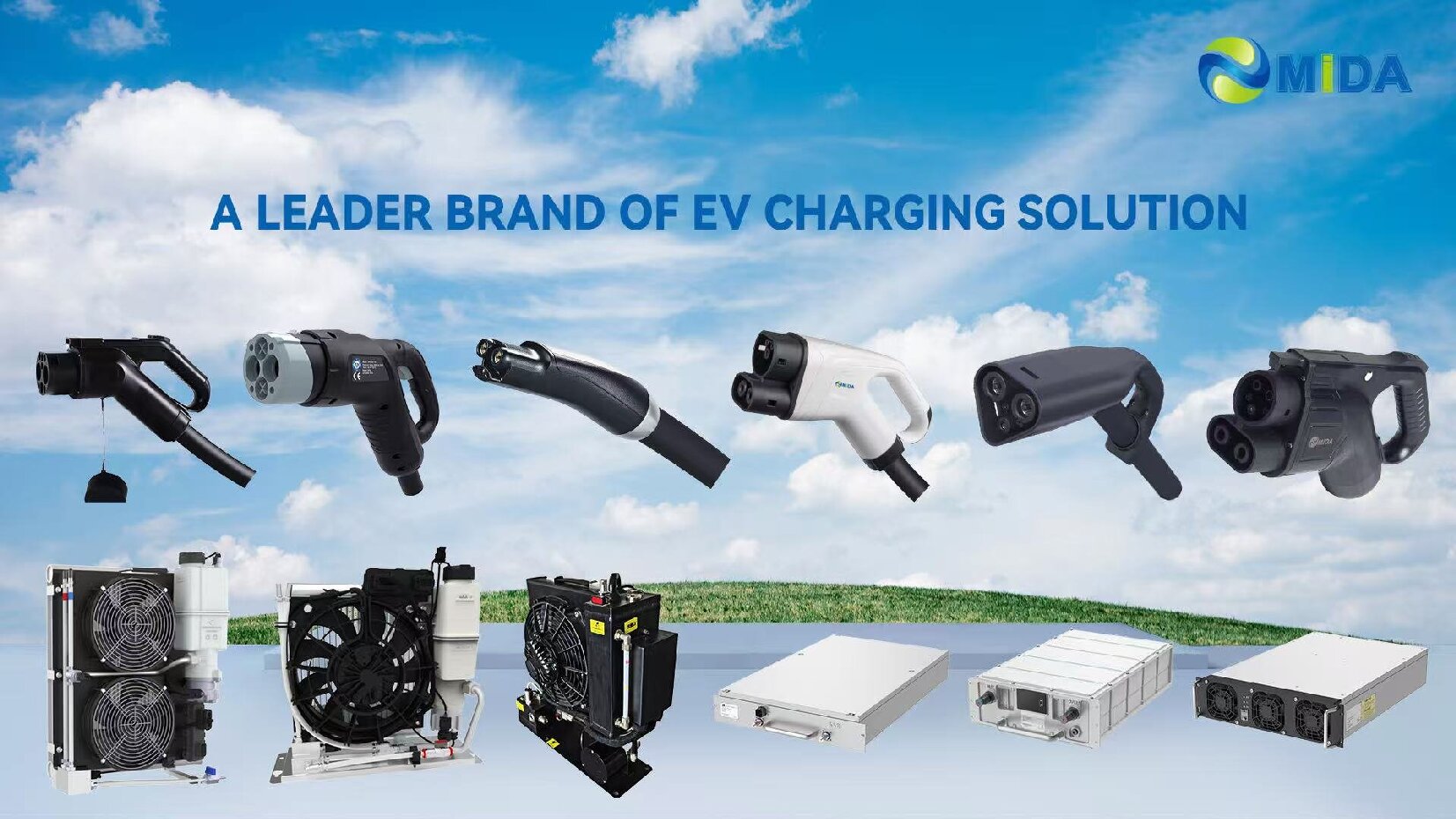
Under the display, the MIDA station is a serious piece of grid-connected power electronics. The architecture is modular: the cabinet ships with a configurable number of hot-swappable power modules (typically 20kW or 30kW each), allowing the operator to start at 60kW and scale to 120kW, 180kW, or the full 240kW as demand grows — without replacing the cabinet, the cabling, the grid connection, or the screen. This protects capital expenditure and makes the unit future-proof: a mall that forecasts modest demand at opening can defer module purchases until utilization justifies them.
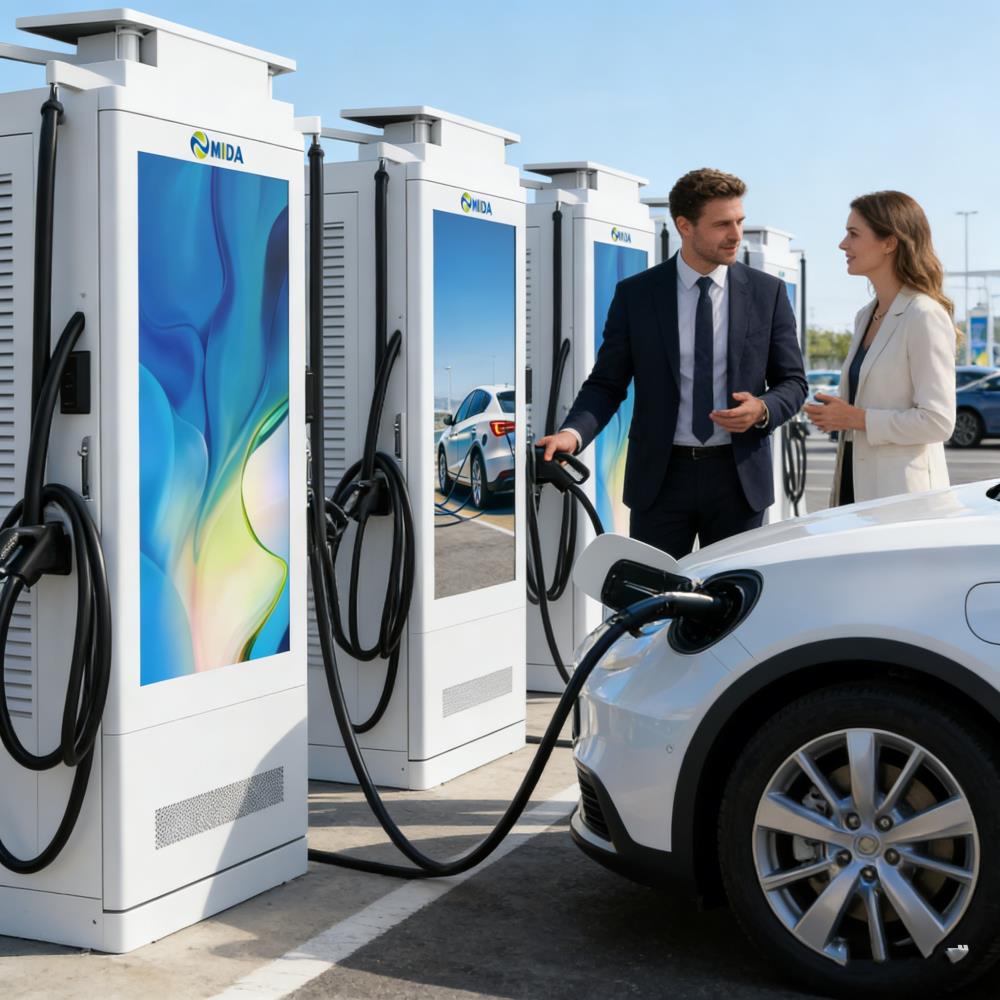
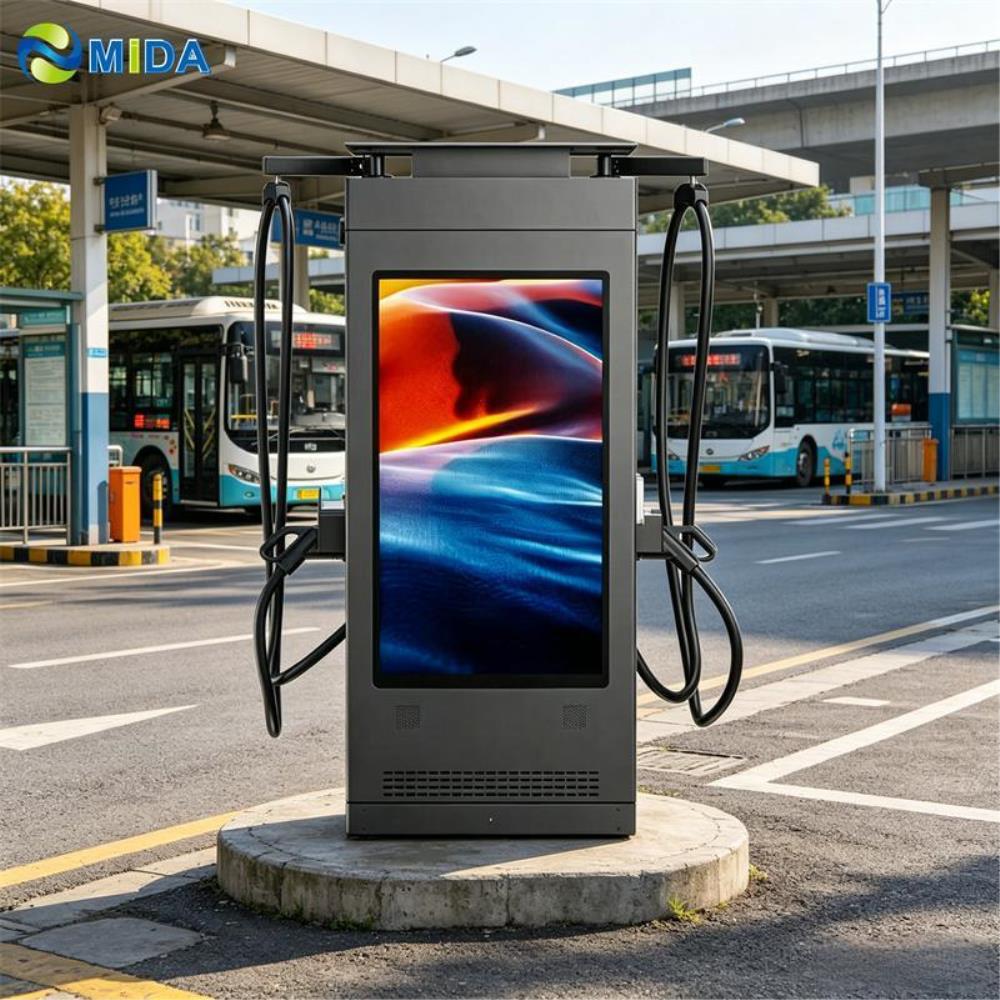
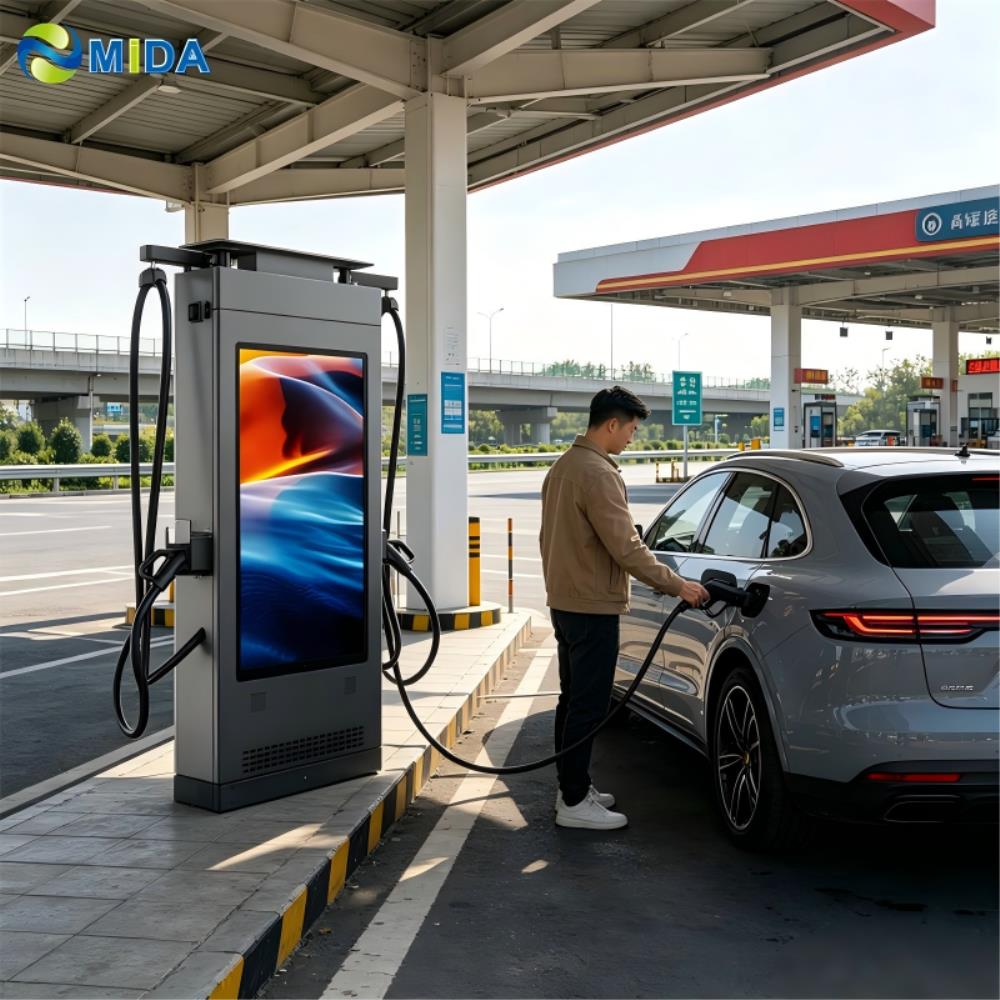
The station supports dual-gun simultaneous charging. In a 240kW configuration, the total power is dynamically distributed between the two cables — for example, 120kW + 120kW to two vehicles, or 180kW + 60kW, or the full 240kW to a single vehicle when only one gun is in use. This intelligent power-sharing is handled by the station’s controller in real time, and it can be further refined by load-management logic that coordinates with other chargers on the same grid connection. The result is dramatically better hardware utilization than single-gun units: dual bays mean fewer idle periods, higher daily throughput, and faster queue clearance during peak hours — precisely what a mall needs at lunchtime and on weekends.
The wide output voltage range of 150–1000V DC is one of the most future-proofing specifications on the datasheet. Today’s mainstream EVs operate on 400V architecture, but an increasing share of premium models — and essentially all next-generation platforms from major OEMs — use 800V architecture, which requires charge voltages above 900V to reach peak charging rates. A charger with a 500V or 750V ceiling simply cannot deliver rated power to these vehicles; the MIDA 1000V rail can. In practical terms, a 240kW unit connected to a modern 800V EV can add approximately 200km of range in 10 minutes and roughly 300km in 15 minutes, depending on battery state of charge and thermal conditions.
Other performance parameters matter for mall deployments specifically. Maximum continuous current per gun reaches 250A (with higher current options in split modes), enabling rapid charging of large-battery vehicles such as SUVs and light commercial vans, which are over-represented in mall parking. Charging efficiency is rated at 95–96% peak for the power modules, reducing wasted heat and electricity cost — meaningful when a unit dispenses several hundred kWh per day. The station accepts 400V AC three-phase input at 50/60Hz with ±15% tolerance, and it can be equipped with optional Type 2 AC input configurations for markets where the local grid standard differs.
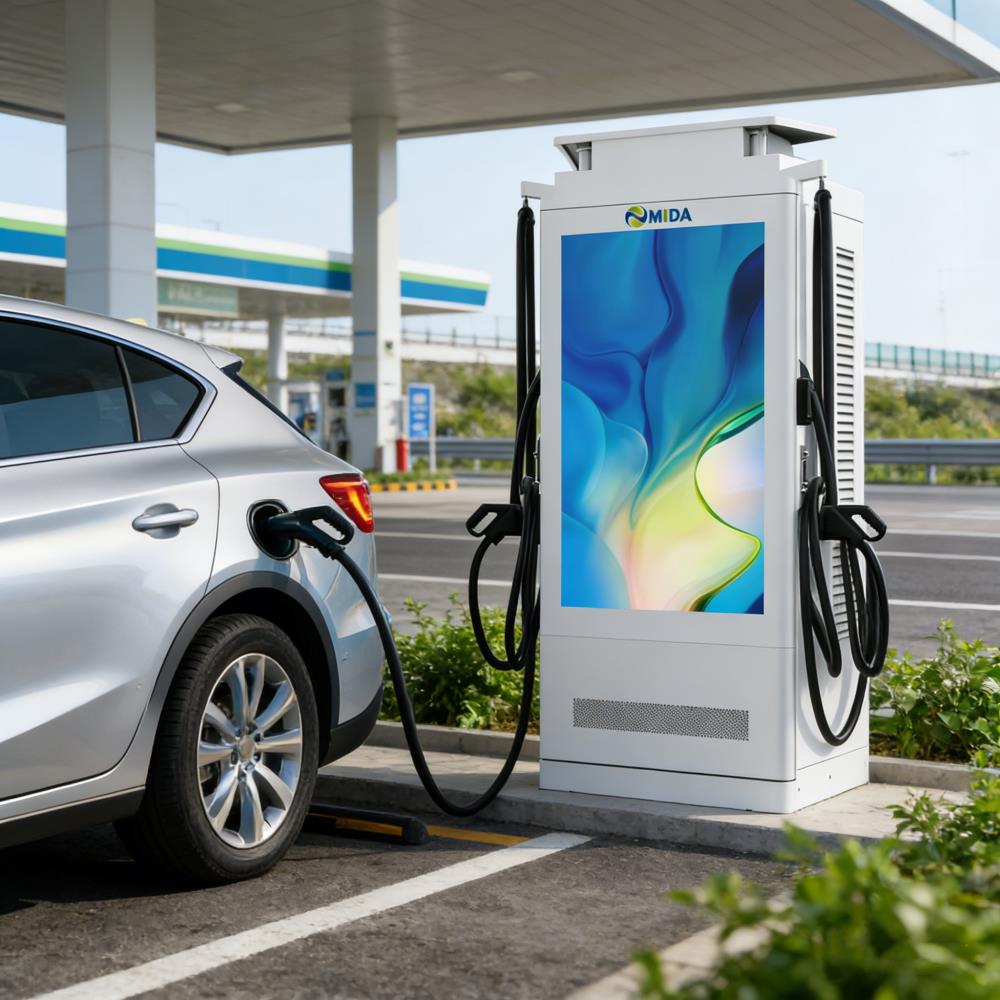
Connector flexibility is built in from the factory. The standard configuration for European markets is dual CCS2; North American orders can be configured with dual CCS1; and hybrid CCS1+CCS2 or CCS2+GB/T configurations are available for mixed fleets and export markets. NACS compatibility is supported via certified adapters, and the station is ISO 15118 Plug & Charge-ready on request, enabling automatic authentication and billing without RFID cards or apps. Communication with the vehicle follows DIN 70121 / ISO 15118, ensuring interoperability with all major OEM implementations.
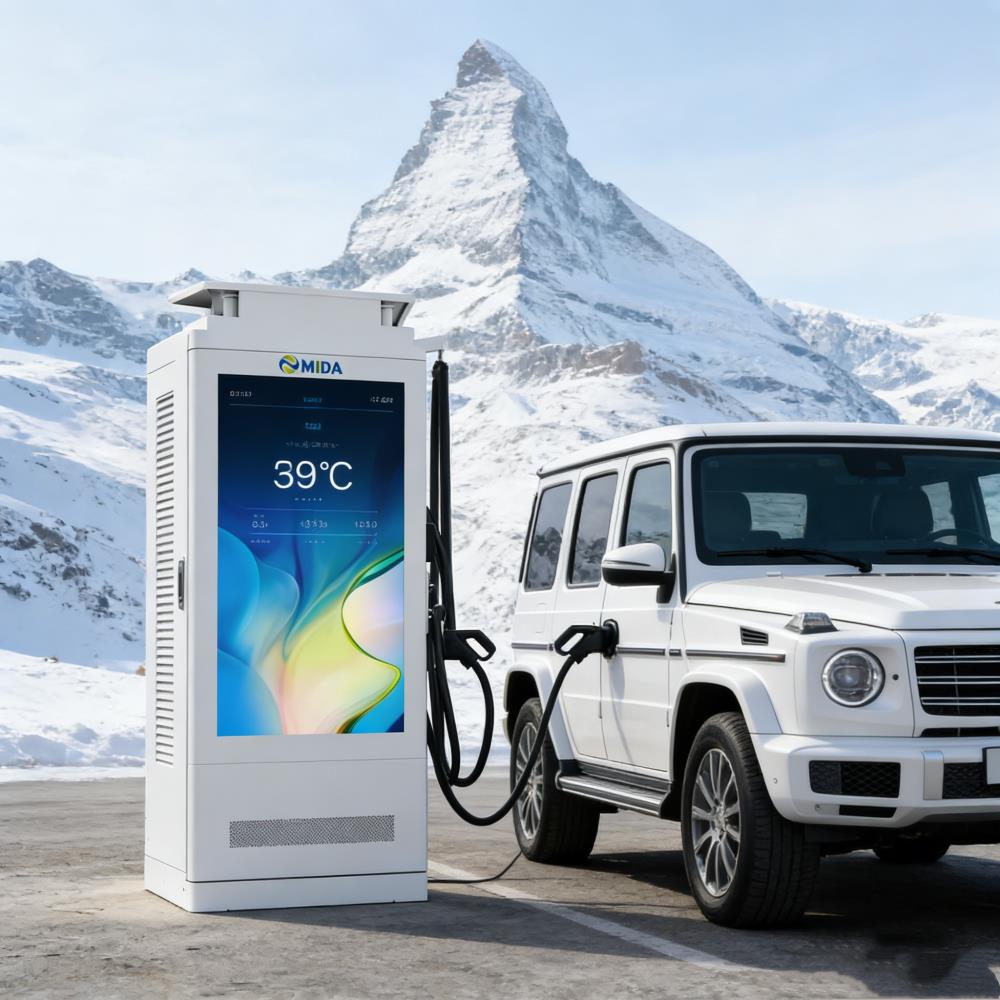
The charging process itself is designed for reliability in high-turnover environments: pre-session contactor weld checks, insulation monitoring before energization, and a charging curve that respects both the vehicle’s request and the station’s thermal limits. If ambient temperature exceeds 55°C, the unit gracefully derates output power rather than shutting down — a design choice that keeps the mall’s chargers available on the hottest summer days when EV drivers most need cooling-dependent fast charging. Conversely, down to -25°C, cold-weather startup is automatic with pre-heating of critical electronics.
4. Safety and Reliability
Safety is non-negotiable for equipment installed in public, high-traffic environments where children, shopping trolleys, and vehicles move freely. The MIDA station is certified to CE (LVD, EMC, RED) and UKCA, and the core standards compliance includes IEC 61851-1/23 (conductive charging), IEC 62196 (connectors), and ISO 13849 (safety-related control systems). Type testing against these standards is performed by independent notified bodies, and each production unit is factory-tested before shipment — including high-voltage insulation tests, functional tests of all protection circuits, and a full-power burn-in.
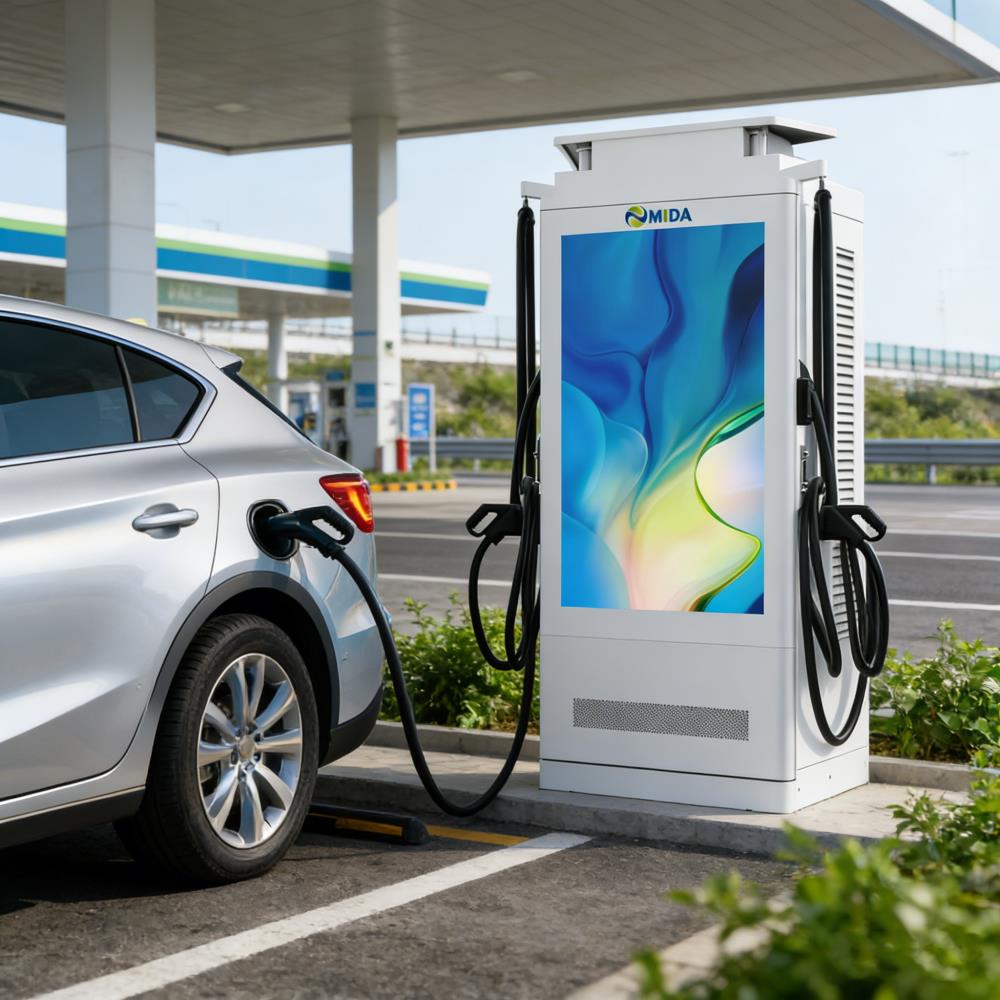
The electrical protection suite is comprehensive and layered. On the AC input side, Type II surge protective devices (SPDs) clamp grid transients, a common cause of premature electronics failure in commercial environments. Residual current protection uses Type A RCDs with 6mA DC fault detection, specifically required for DC charging applications to detect the DC fault currents that standard RCDs miss. On the DC output side, the station monitors insulation resistance before every session and continuously during charging, shutting down within milliseconds if a fault is detected. Each gun’s output contactor is weld-monitored; if a contactor is found stuck closed, the unit blocks that gun and reports a maintenance alert rather than risking an unsafe session. An emergency stop button is located on the front of the cabinet, and the system can also be remotely de-energized by the operator through the backend.
The IP55 enclosure rating means the cabinet is protected against dust ingress and against water jets from any direction — the standard required for outdoor installations exposed to rain and hose-down cleaning. The display housing goes further at IP65. Combined with the IK10 impact rating on both the screen glass and the cabinet body, the unit is engineered to survive both accidental damage (vehicle bumpers, trolleys) and deliberate vandalism in unsupervised hours.
Thermal management is a reliability domain often underestimated. The power modules generate substantial heat at full output, and mall installations frequently place chargers under canopies or in semi-enclosed parking areas where airflow is restricted. The MIDA station uses intelligent forced-air cooling with variable-speed fans controlled by module temperature sensors, plus heat-pipe cooling for the display. The control system continuously models thermal conditions and applies derating curves that protect component lifetime — targeting a design life of 10+ years for the power stage. All field-serviceable components (fans, power modules, communication boards) are hot-swappable or accessible without opening the main electrical compartment, minimizing mean time to repair.
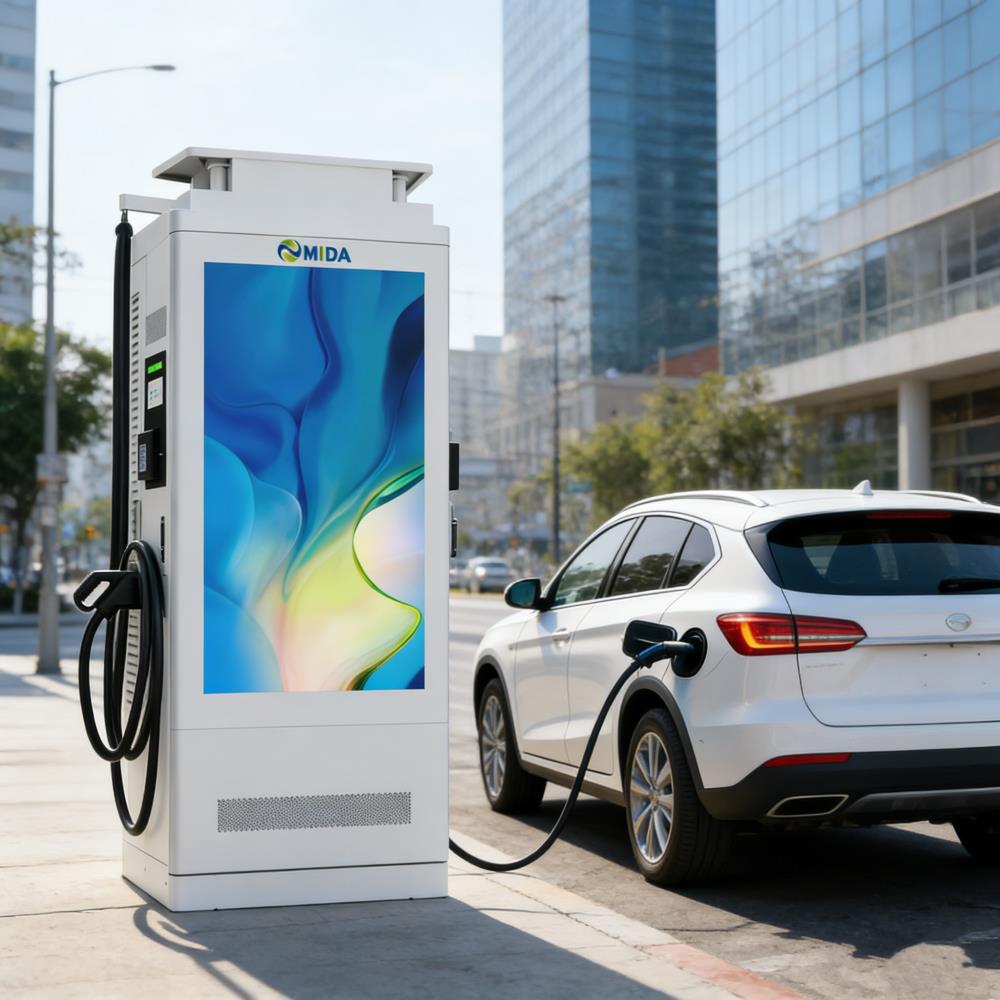
Physical durability extends to the cabling: charging cables are selected for high-flex applications with strain relief at both ends, and the cable management system keeps cables off the ground when not in use, reducing trip hazards and wear. The station is also designed for grid friendliness: it supports active power derating, scheduled charging windows, and optional local load management, preventing the mall’s substation from tripping during peak demand, and it can participate in demand-response programs via OCPP smart-charging extensions. For the site operator, the net reliability story is simple: redundant protection layers, certified compliance, thermally managed operation, and field-repairable architecture that keeps uptime high and total cost of ownership low.
5. Smart Management and Connectivity
Modern charging infrastructure lives or dies by its software. The MIDA station speaks OCPP 1.6J out of the box — the de-facto standard protocol for charging station-to-backend communication — with OCPP 2.0.1 available on request. This means the station connects to virtually any Charge Point Management System (CPMS) in Europe, North America, or the Middle East, from large roaming platforms to local white-label backends, with no vendor lock-in. For a mall operator working with a CPO partner, this interoperability is a contractual and operational necessity.
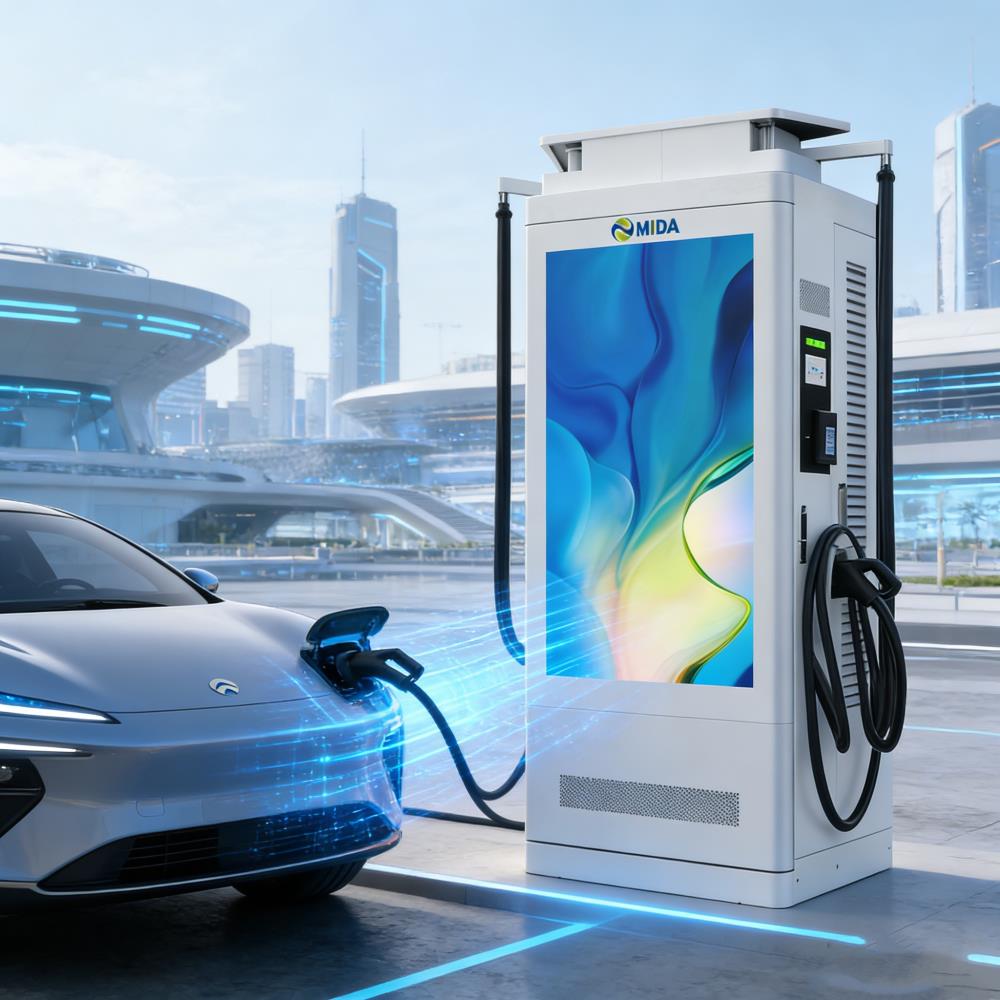
The station’s onboard communication suite includes a 4G LTE modem (5G-ready), Wi-Fi, and Ethernet, with optional RS485 for integration with site-level systems such as access control or energy meters. Redundant communication paths ensure the station remains reachable for remote monitoring even if one channel fails. Authentication options are equally flexible: RFID cards, QR codes, mobile apps, and ISO 15118 Plug & Charge can all be enabled, letting the operator match the payment and access habits of their specific user base. For a mall, QR and app-based charging combined with the ad screen is often the smoothest flow: the driver scans, the screen confirms the session, and the backend handles billing and receipts.
The backend management system provides the operator with full visibility and control. From a single dashboard, the operator can monitor live session status, power output per gun, energy delivered, revenue per session, and utilization metrics across an entire fleet of stations — whether the mall has two units or the operator runs 500 sites. Remote diagnostics reduce truck rolls: firmware updates are delivered over the air, configuration changes (pricing, power limits, load-balancing parameters) are applied without a site visit, and fault alerts with error codes are pushed to the dashboard and optionally to mobile notifications.
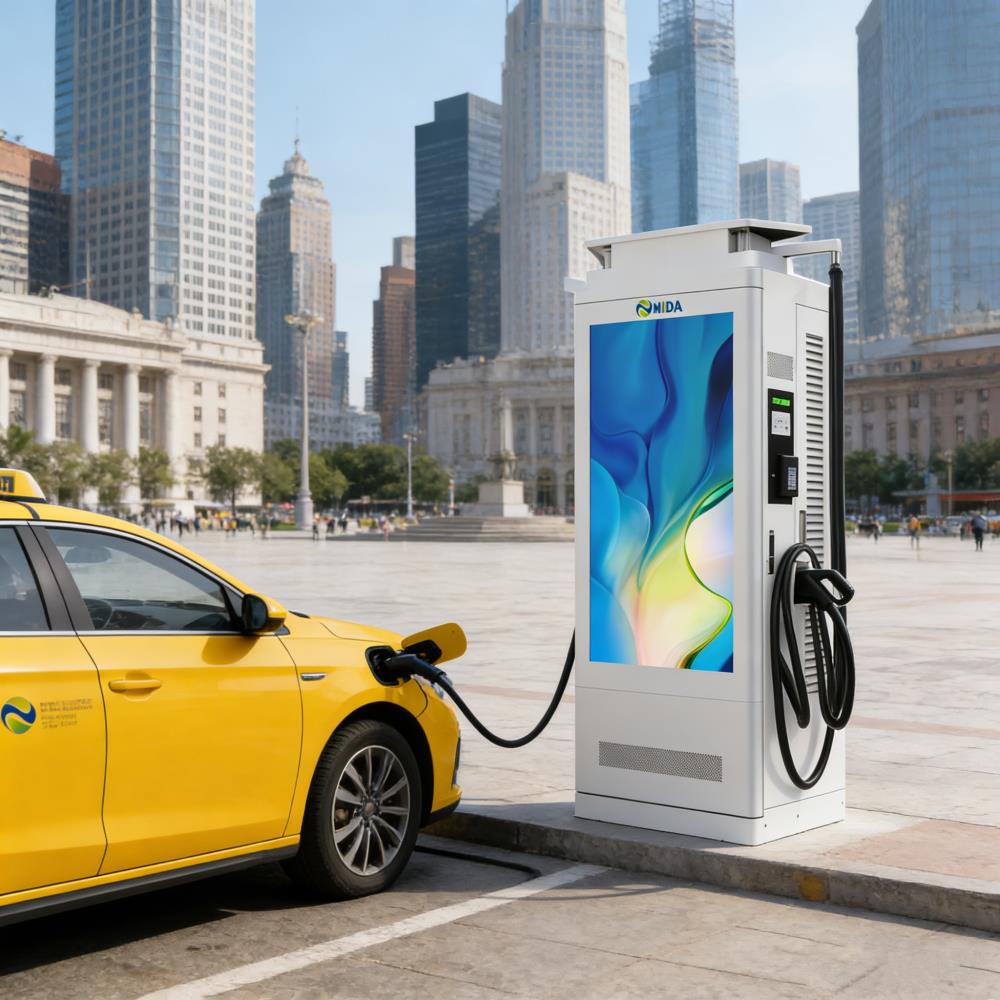
For the advertising function, the same connectivity backbone carries the CMS traffic, but the two systems are logically separated: even if the charging backend is temporarily unreachable, the screen continues playing scheduled content from its local cache, and charging sessions continue to operate normally. Pricing flexibility is a key commercial feature: the backend supports time-of-use tariffs, session fees, per-kWh pricing, and dynamic price changes — allowing the mall to charge premium rates during peak hours or to offer promotional pricing on quiet weekday mornings. Transaction data can be exported for integration with the mall’s finance systems, and roaming agreements can be activated to let drivers from any network charge seamlessly, increasing utilization and, by extension, ad impressions.
6. Detailed Technical Specifications
| Parameter | Specification |
| Model | MIDA 60–240kW DC Fast Charging Station with 55″ Advertising Screen |
| Output Power | 60kW / 120kW / 180kW / 240kW (modular, field-upgradeable) |
| Input | 400V AC ±15%, 3-phase, 50/60Hz |
| Output Voltage | 150–1000V DC (wide voltage, 400V & 800V platforms) |
| Output Current | Up to 250A per gun (up to 600A combined in split mode) |
| Charging Connectors | Dual CCS2 / Dual CCS1 / Hybrid combos; GBT & NACS adapter ready |
| Charging Protocols | OCPP 1.6J (2.0.1 on request), DIN 70121, ISO 15118 Plug & Charge ready |
| Display | 55-inch TFT-LCD, 1920×1080 FHD, 2000 nits, auto-brightness |
| Display Protection | 4–6mm tempered glass, IK10, IP65 display housing |
| Enclosure Rating | IP55 cabinet, IK10 vandal resistance |
| Cooling | Intelligent forced-air (power modules) + heat-pipe (display) |
| Communication | 4G LTE / 5G-ready, Wi-Fi, Ethernet, RS485; RFID/QR/App/Plug & Charge |
| Efficiency | ≥95% peak module efficiency |
| Operating Temperature | -25°C to +55°C (graceful derating above 55°C) |
| Certifications | CE (LVD/EMC/RED), UKCA, IEC 61851-1/23, IEC 62196, ISO 13849 |
| Dimensions (W×H×D) | ~800×2200×400mm, floor-mounted, integrated screen |
| Warranty | 2-year standard; 5-year extended option |
The specification set above reflects a machine engineered for commercial-grade duty: modular scalability, 1000V future-proofing, dual-gun throughput, outdoor environmental protection, and multi-standard connectivity. When evaluating competing products, decision-makers should compare not only headline power ratings but also the output voltage ceiling, dual-gun power-sharing behavior, display brightness, and the interoperability certifications — all of which are differentiating parameters for the MIDA platform.
7. Use Cases & Installation
The MIDA 60–240kW advertising station is designed for four primary deployment archetypes in and around commercial malls:
- Main Entrance Forecourt — One or two 240kW units directly at the main entrance deliver maximum visibility for both charging and advertising. This flagship placement signals the mall’s commitment to electromobility, attracts premium EV drivers, and commands the highest media rates.
- Underground Parking Levels — 60–120kW configurations on P1/P2 levels near elevators and escalators serve the “plug, shop, return” pattern. Drivers dwell for an hour or more, the screen doubles as a wayfinding and promotion panel, and the lower power rating matches the constrained grid capacity typical of basement installations.
- Retail Park / Outlet Strip — 120–180kW units in shared parking among big-box retailers create a landlord-controlled digital signage network, rotating tenant promotions and generating media revenue across the entire site.
- Mixed-Use / Transit-Oriented Developments — Stations adjacent to metro entrances or office lobbies serve commuter top-up patterns, with 60–90kW configurations matching shorter dwell windows and lower grid capacity.
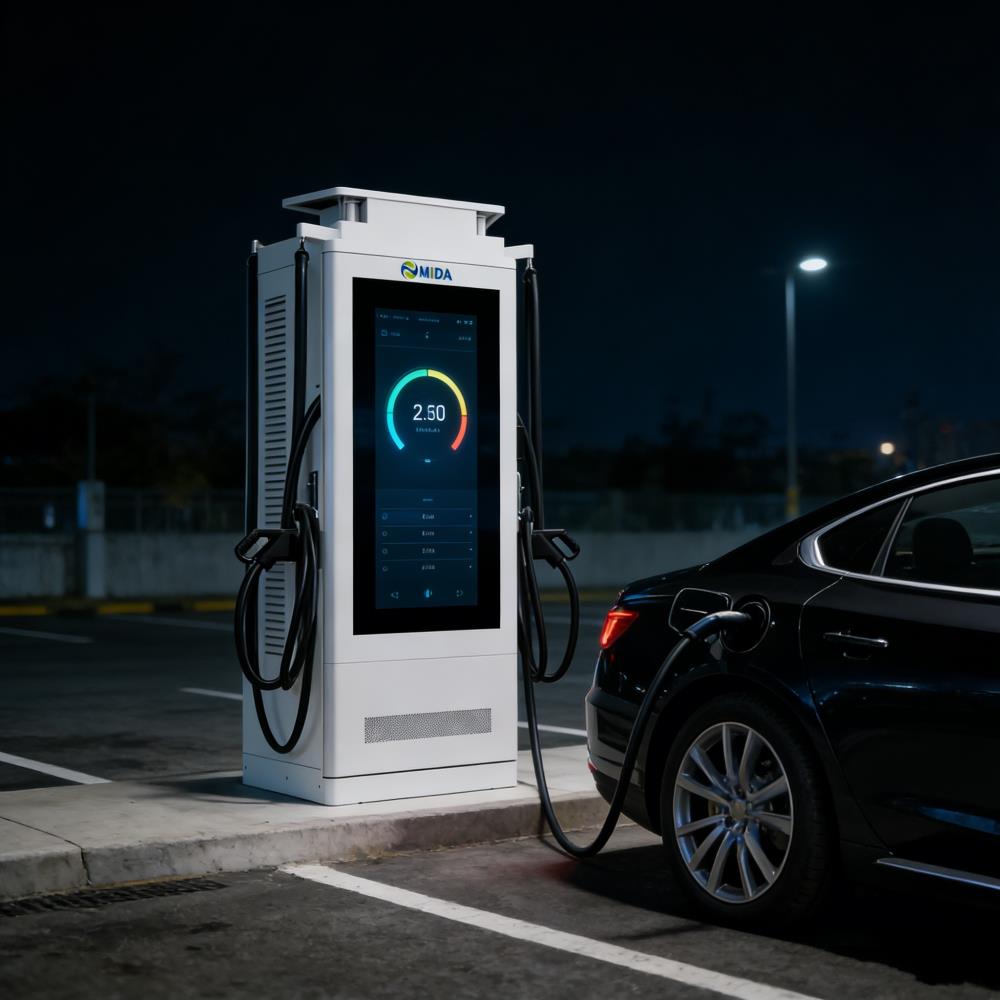
Installation planning follows a standard sequence. First, a site survey establishes available grid capacity: a 240kW unit typically requires a dedicated transformer capacity of 250–300kVA including headroom, while 60–120kW units can often be served by existing mall distribution boards with reinforcement. Civil works include a concrete foundation or plinth, cable trenches or conduit runs for the AC supply and data, and grounding per local codes. The station ships as a single integrated cabinet — the screen and charger arrive pre-assembled, which reduces on-site installation time compared to separate-component solutions. Commissioning includes connectivity setup (SIM, Ethernet, backend registration), RFID and tariff configuration, and a full-power test session.
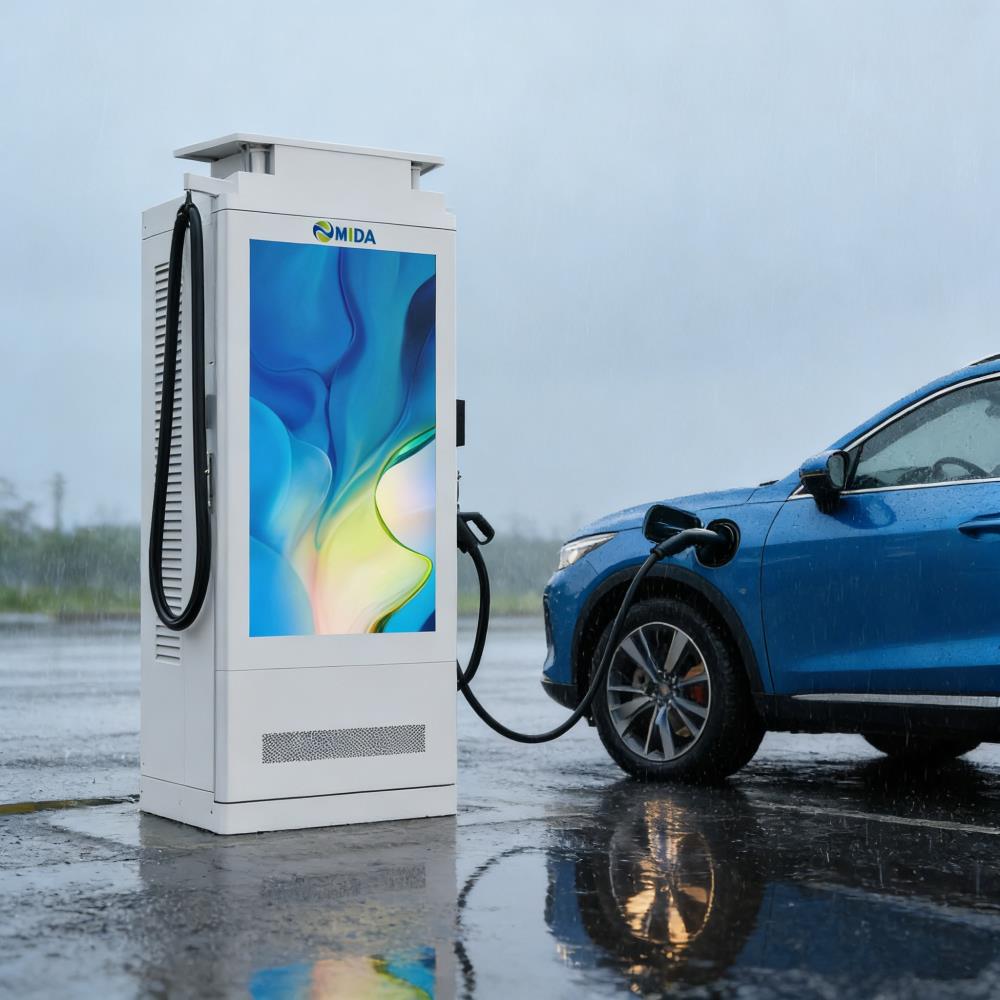
Operationally, malls should plan for 10–16 sessions per day per bay in year one, growing with EV adoption. Maintenance requirements are minimal: quarterly visual inspections, annual filter cleaning for the cooling system, and over-the-air firmware updates. MIDA provides remote diagnostics support and a regional service network, with spare modules stocked for rapid exchange. For property owners weighing the business case, the combination of charging margin, advertising revenue, tenant promotion value, and enhanced brand image typically supports a payback of 24–36 months — a decisive improvement over screen-less equivalents.
8. FAQ
Q1: How much advertising revenue can the 55-inch screen realistically generate?
In a high-traffic mall location, a 55-inch DOOH screen can generate €300–€1,200 per advertiser per month, and with 3–5 advertisers rotating slots, gross media revenue of €900–€4,500 per month per screen is achievable, depending on footfall and local market rates.
Q2: Does the screen affect charging performance or reliability?
No. The display operates on an independent power and control rail. Thermal management for the power modules and the display are separated, and the screen consumes under 300W — less than 1% of the station’s throughput energy.
Q3: Can we show our own mall promotions instead of paid ads?
Yes. The CMS gives the operator full control over content priority. You can reserve time slots for internal campaigns, wayfinding, events, and tenant promotions, and sell the remaining inventory to third-party advertisers.
Q4: What happens to the screen at night or in bad weather?
An ambient light sensor automatically dims the display at night for energy savings and light-pollution compliance. The screen housing is IP65-rated and the glass is IK10-rated, so rain, snow, and vandalism attempts do not compromise it.
Q5: Can the charger power two cars at once?
Yes. The unit features dual guns with intelligent power distribution. In a 240kW configuration, power is split dynamically — for example 120kW+120kW or 180kW+60kW — and the full 240kW is available to a single vehicle when only one bay is in use.
Q6: Which vehicles can use this station?
Essentially all modern EVs. The 150–1000V output range covers 400V and 800V architectures, and the connector configuration (CCS2, CCS1, hybrid, GBT, NACS-ready) is specified at order time to match your market.
Q7: How long does installation take and what grid capacity is required?
The integrated cabinet reduces installation to foundation, cabling, and commissioning — typically 2–5 days on site. Grid requirements scale with power: 60–120kW units can often use existing distribution capacity, while 240kW needs dedicated transformer capacity of roughly 250–300kVA.
Products categories
-
180kw 240kW DC Ultra Fast EV Charger Station OC...
-
Level 3 EV DC Charger Electric Car Charging Sta...
-
240kw 300kw 360kw 420kW Fast Charging Station F...
-
120KW 160KW 180kW 200kw Fast EV Charger Station...
-
420KW CCS2 New energy electric vehicle Charging...
-
360KW New energy electric vehicle Charging station