

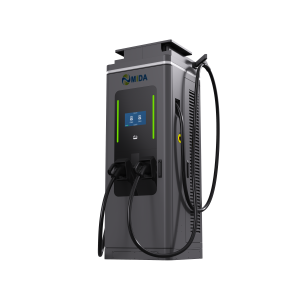
MIDA 60kW Floor-mounted DC Fast Charging Station, Dual Gun Level 3 EVSE with RFID & App Control
Quick Answer
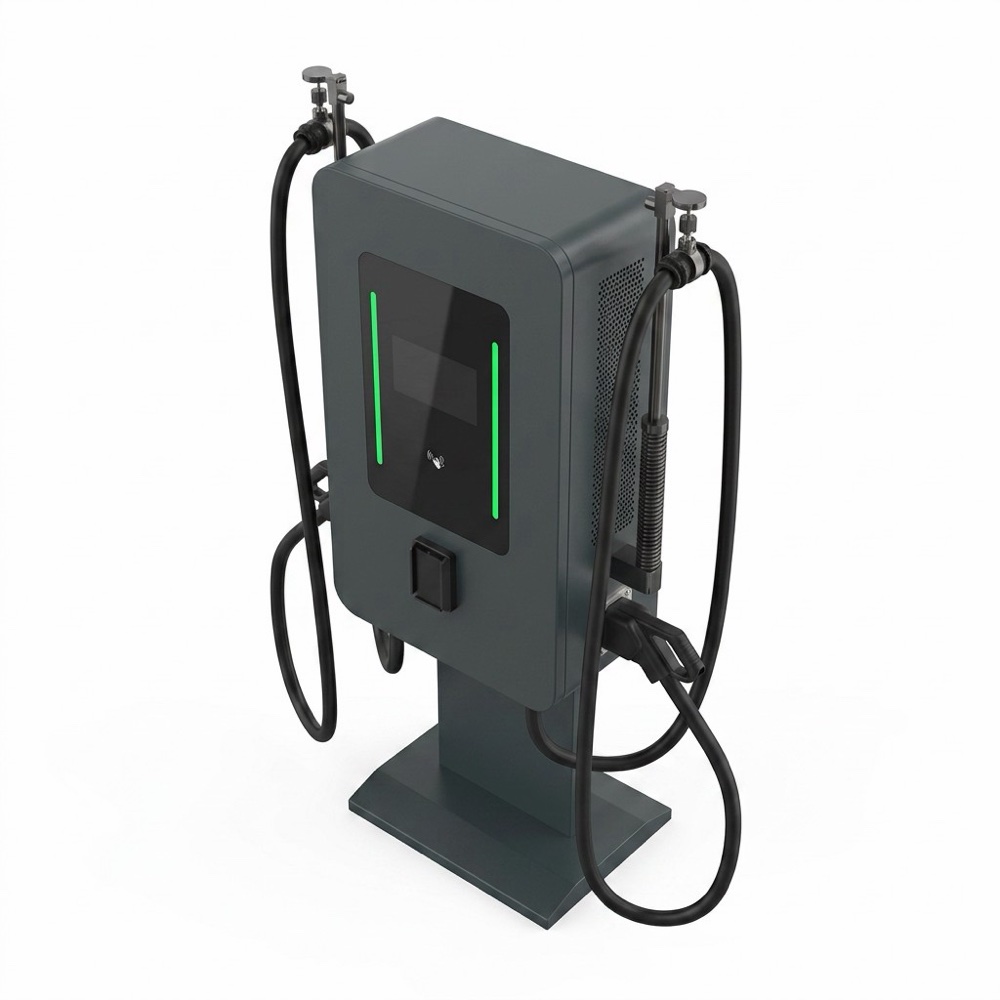
The MIDA 60kW Floor-mounted DC Fast Charging Station is a dual-gun, Level 3 (DC) electric vehicle supply equipment (EVSE) designed for commercial operators who need dependable high-power charging without utility-scale infrastructure costs. Built on MIDA Power’s decade of power-electronics engineering, this unit delivers 40 kW to 60 kW of continuous DC output across a 150V–1000V vehicle voltage range, supports two vehicles simultaneously through intelligent power-sharing between its twin CCS guns, and communicates over OCPP 1.6J/2.0.1 with RFID, mobile app, WiFi, and 4G access control. With a rated efficiency of ≥95.5%, an IP54 enclosure, IK10 impact resistance, and TUV CE, UKCA, and ISO 15118-ready certifications, it is engineered for fleets, dealerships, highway corridors, hotels, and commercial depots that need a robust, standards-compliant charging asset with a clear total cost of ownership (TCO) story. If your site needs Level 3 speed, dual-vehicle throughput, and open-protocol fleet management in a floor-mounted format, this station is a direct, future-proof answer.
Key Takeaways
- Dual-gun flexibility: Two CCS1/CCS2 connectors with dynamic load balancing let one station serve two vehicles at once, raising daily energy throughput per parking space.
- True DC fast charging: 60 kW peak output charges a typical 60 kWh EV battery from 10% to 80% in roughly 40–50 minutes under normal conditions.
- Open-standards connectivity: OCPP 1.6J and 2.0.1 compliance ensures compatibility with virtually all charging network management platforms (CRO/CPO backends), plus RFID, App, WiFi, and 4G options.
- Built for outdoor abuse: IP54 water/dust protection and IK10 impact rating protect the unit in exposed parking lots, curbsides, and depot yards.
- Compliance-ready: TUV CE and UKCA certified, with ISO 15118-ready firmware path for Plug & Charge (PnC) as bi-directional and automatic authentication rolls out.
- Commercial ROI focus: ≥95.5% conversion efficiency, low standby losses, and OCPP-driven smart scheduling cut both electricity waste and operating costs.
H1 → The Commercial Case for 60kW DC Fast Charging
H2: Why 60 kW Is the “Sweet Spot” for Commercial Sites
For years, the fast-charging market split into two camps: 20–30 kW units that were too slow for impatient customers, and 120–350 kW hyper-chargers that demanded transformer upgrades, high grid connection fees, and six-figure site works. A 60 kW DC fast charger sits deliberately between them, and that positioning is exactly why operators choose it.
At 60 kW, a MIDA station can replenish roughly 60–100 km of range in 20 minutes for a typical modern EV, depending on the vehicle’s charge curve. That is fast enough to feel like “fueling up” rather than “parking for the afternoon,” yet modest enough to run on a standard commercial three-phase supply (typically a 63–100 A feed at 400 V, depending on local configuration and derating). This dramatically lowers the barriers to entry: no medium-voltage transformer, no extended grid-connection lead times, and no demand-charge blowout for sites with modest traffic.
For a fleet depot, dealership forecourt, or destination venue, 60 kW also matches real dwell times. A shuttle bus or delivery van parked for 30–60 minutes between routes is fully serviced by a 60 kW charge session. A hotel guest with a 45-minute check-in window gets a meaningful top-up. In short, the 60 kW class converts parking time into revenue while keeping hardware, installation, and demand costs predictable.
H2: The MIDA WY Series Platform Advantage
MIDA Power has spent over a decade designing and manufacturing power-conversion equipment, and the WY Series 40–80 kW platform distills that experience into a family of DC fast chargers that share one proven core architecture. The 60 kW floor-mounted model sits at the center of the range, offering the highest power density per square meter of site footprint in the family while remaining serviceable by a single technician.
Because the entire WY Series shares common power modules, control boards, and communication stacks, operators who standardize on MIDA benefit from simplified spare-parts inventory, consistent operator training, and a single software ecosystem across 40, 60, and 80 kW sites. If traffic grows, the migration path is understood and the charging-management logic stays identical — a real operational advantage that reduces total cost of ownership across a multi-site network.
H2: Technical Specifications at a Glance
Before evaluating any EVSE, procurement teams need a single page they can hand to engineering. The table below summarizes the MIDA 60kW Floor-mounted DC Fast Charging Station’s headline parameters.
Configuration details (connector types, cable length, display size, and metering options) should be confirmed with the MIDA sales engineering team at order time. |
 |
H3: Output Voltage Range — 150V to 1000V DC
The 150–1000 V DC output window is not a marketing footnote; it is the difference between a charger that serves today’s fleet and one that is obsolete in three years. Older EVs — many 400 V-class vehicles — are joined in the market now by 800 V-architecture cars and the first 900 V+ commercial trucks. A charger capped at 500 V or 750 V silently leaves that newer hardware at reduced power or completely incompatible.
MIDA’s wide voltage range means the same 60 kW unit charges 400 V passenger EVs, 800 V premium sedans, and high-voltage light commercial vehicles at their platform’s native voltage, without an intermediate converter penalty. Combined with the power module’s wide constant-power band, the station sustains near-rated power across a broad state-of-charge (SoC) window — which is what actually determines real-world “minutes to 80%,” not the sticker kW figure.
H3: Efficiency ≥ 95.5% and What It Means for Your Electricity Bill
Efficiency in a DC fast charger is measured as DC-out divided by AC-in, and every percentage point matters when a unit runs 12–18 hours a day. At 95.5% peak efficiency, the MIDA 60 kW station wastes less than 4.5% of the energy it draws as heat. Over a year of 15,000 kWh delivered, a 95.5%-efficient unit consumes roughly 15,700 kWh from the grid — versus about 16,400 kWh for a 91.5%-efficient competitor. That ~700 kWh difference per unit per year is pure cost, and it scales linearly across a fleet of 10, 50, or 200 stations.
Beyond headline efficiency, MIDA designs for low standby consumption. The unit’s power management drops to a few watts in idle mode while keeping network connectivity alive, so operators are not paying to keep a 100 W electronics stack awake 24/7. When paired with OCPP-driven scheduled charging, sites can also shift sessions to off-peak tariffs, compounding the efficiency savings into demand-charge avoidance.
H2: Dual-Gun Architecture — Two Cars, One Station
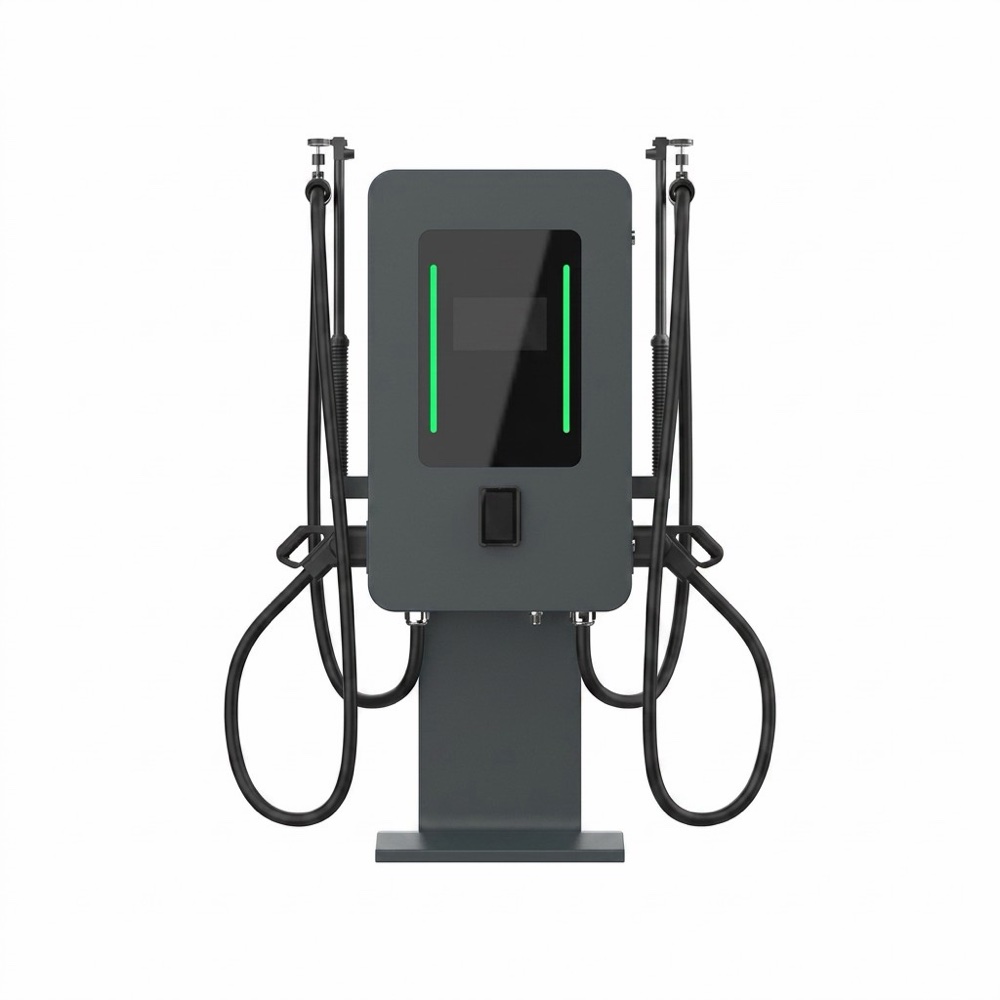
H3: How Power Sharing WorksThe MIDA 60 kW floor-mounted station ships with two charging guns, and here is the key engineering detail: both guns draw from one shared 60 kW DC power pool, and the internal controller allocates power dynamically between them.
This dual-gun design roughly doubles the charging throughput per parking bay compared to a single-gun 60 kW unit. Instead of one vehicle occupying a 60 kW asset for 45 minutes, two vehicles share the same asset and the operator captures two revenue events (or serves two fleet vehicles) in the same window. For sites where parking space is the scarcest resource, this is the single most valuable feature on the specification sheet. |
 |
H3: Connector Configurations for Global Markets
MIDA configures the dual guns to match regional standards:
- CCS1 (Type 1 combo) for North American and South Korean markets.
- CCS2 (Type 2 combo) for the EU, UK, and much of APAC.
- CHAdeMO variants available for Japanese legacy vehicles and specific Asian fleets.
Dual CCS1/CCS2 is the most common configuration because it maximizes compatibility with modern EVs, and the gun holsters are designed for one-handed operation even in poor weather. The cable management system keeps leads off the ground, reducing trip hazards, cable wear, and replacement frequency — a quiet but real line item in charger TCO.
H2: Connectivity and Open-Protocol Management
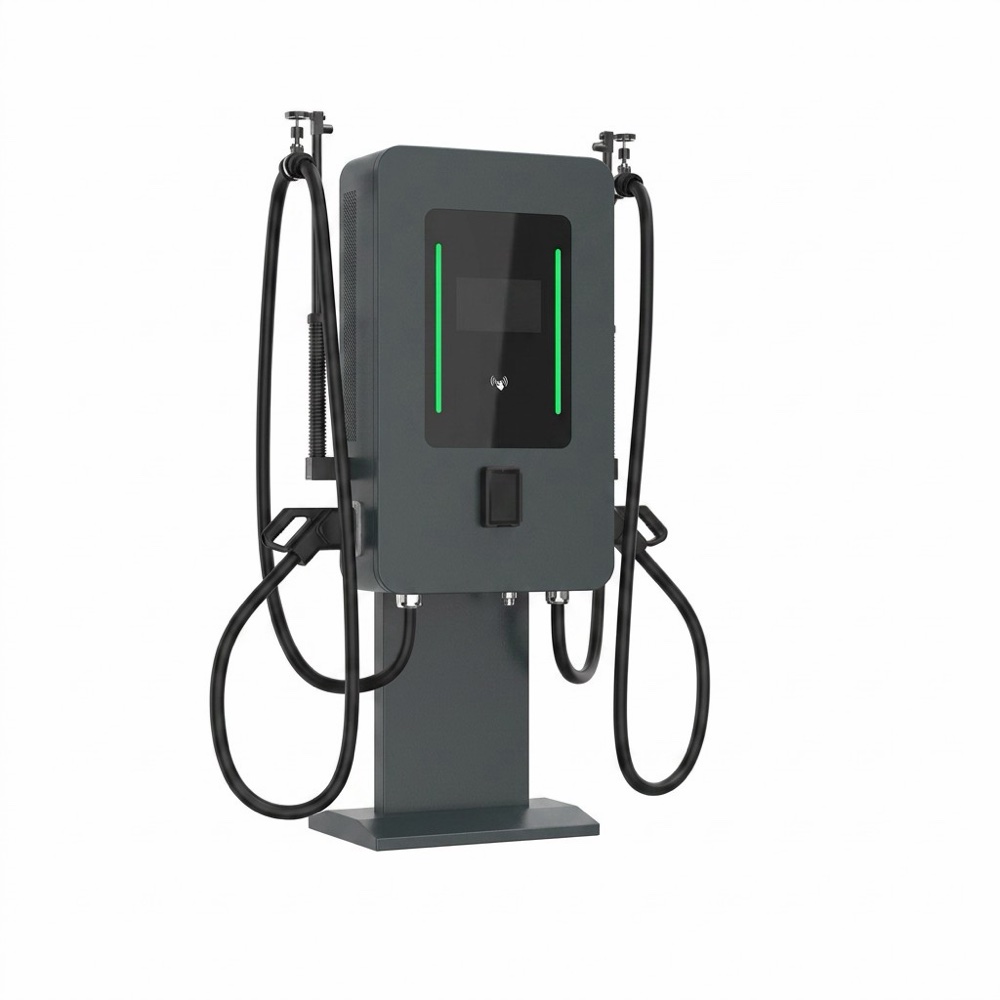
H3: OCPP 1.6J and 2.0.1 — Freedom of ChoiceThe Open Charge Point Protocol is the language that lets a charger talk to a central management system (CMS). Too many chargers on the market are “OCPP-ish” — they advertise compliance but break on JSON, drop messages, or lack proper security profiles. MIDA’s implementation is built on production OCPP 1.6J (JSON) with a clean upgrade path to OCPP 2.0.1, which brings the modern security architecture (TLS, secure firmware update, and role-based authorization) that network operators increasingly mandate. Why does this matter to you? Because OCPP compliance means you are never locked into a single charging network operator (CPO) or software vendor. You can onboard the station to ChargePoint, Virta, Monta, AMPcontrol, or your own in-house CMS, and you can migrate platforms later without touching hardware. For a business that wants competitive bidding on software services — or that wants to run its own white-label app — that portability is worth real money over a 10-year asset life. |
 |
H3: RFID, App, and Remote Access Control
Access control is where operators monetize and manage their chargers, and the MIDA station gives you four independent layers:
- RFID cards/tags: ISO 14443 A/B readers are standard, so each driver (or employee, or contractor) gets a card that starts a session with a tap. Cards are provisioned and revoked remotely through the backend — no on-site programming.
- Mobile app: Drivers can start/stop sessions, monitor live power and SoC, and pay via the app when integrated with the operator’s platform. The app experience is fully white-labelable through the CMS.
- Remote start via backend: Fleet dispatchers can authorize a session from an office — useful for telematics-driven workflows where a truck arrives at a pre-booked bay.
- Local PIN / emergency stop: For safety-critical moments, a physical E-STOP interrupts DC output instantly.
From a security standpoint, all user sessions are cryptographically authenticated at the charger level, and the unit logs every transaction locally as well as upstream — giving operators an audit trail for billing disputes and compliance reporting.
H3: WiFi and 4G — Connectivity That Survives Site Reality
Many commercial sites lack wired networking near parking bays. The MIDA 60 kW station solves this with dual-band WiFi and an integrated 4G LTE modem (SIM slot). The unit automatically fails over between links, so a lost router or a provider outage does not strand a driver mid-session. For sites where cellular coverage is poor, an optional Ethernet port supports wired backhaul. All remote management — firmware updates, pricing changes, diagnostics, and real-time monitoring — flows through the same secure channel.
H2: Built for the Outdoors — IP54 and IK10
H3: IP54 — Water and Dust ProtectionChargers live where cars live: open-air lots, roadside verges, depot yards, and coastal forecourts. IP54 means the enclosure is protected against dust ingress sufficient to interfere with operation (5 = dust-protected) and against water splashing from any direction (4 = splash-proof). In practice, that covers rain, hose-down cleaning, snowmelt, and typical roadside spray. The connector holsters and cable entry points are sealed to the same standard, and the touchscreen is rated for gloved and wet-finger operation. |
|
H3: IK10 — Vandal and Impact Resistance
IK10 is the highest impact-protection rating on the common scale: the enclosure withstands a 5-joule impact — equivalent to a 5 kg mass dropped from 1 meter. That means a shopping cart collision, a forklift nudge, or a thrown object is unlikely to crack the housing or expose live parts. For unstaffed sites open 24/7, IK10 is not a luxury; it is the difference between a charger that survives a Saturday night and one that is awaiting a service call on Monday morning.
H3: Thermal Management for Continuous Duty
DC fast charging is thermally demanding. MIDA’s power modules use forced-air cooling with intelligent fan-speed control: fans ramp up only as needed, which cuts noise, dust ingestion, and energy waste during low-load periods. In hot climates (up to +55°C ambient), the controller derates gracefully rather than tripping — a session might run at 55 kW instead of 60 kW on a 40°C afternoon, but it will not stop. That predictable behavior is what site operators need when they plan availability guarantees.
H2: Certifications That Open Doors
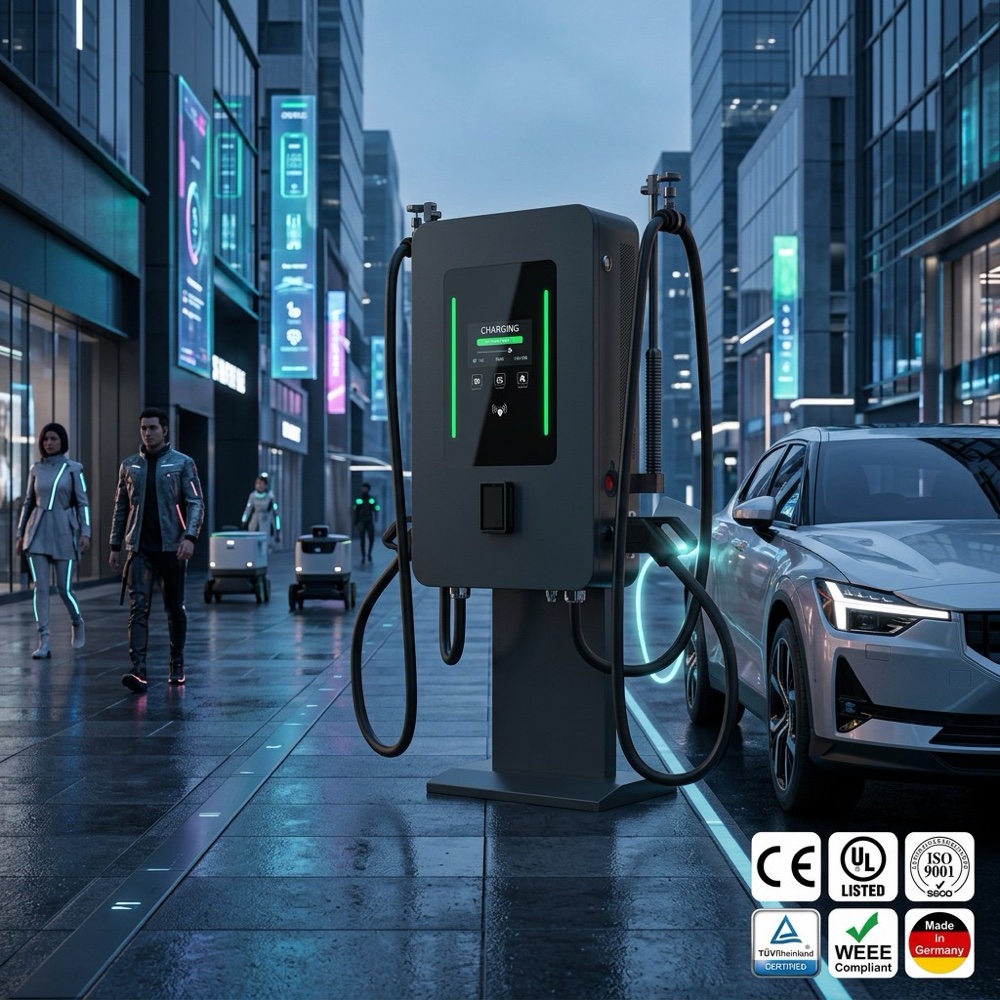
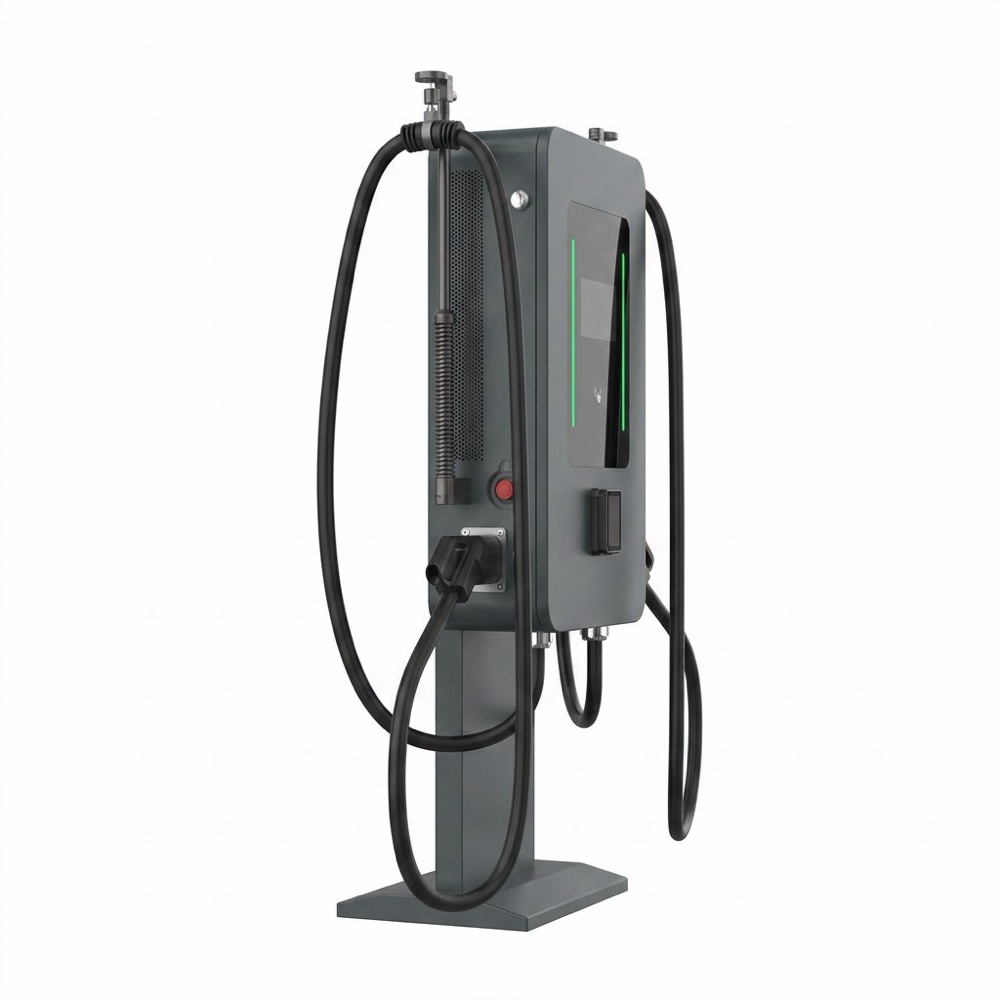
H3: TUV CE and UKCAThe station carries TUV-tested CE marking, the mandatory conformity for sale in the European Economic Area, and UKCA for the United Kingdom market. These aren’t decorative stickers: they mean the unit has been assessed against the Low Voltage Directive, EMC Directive, and relevant harmonized standards, with third-party testing rather than self-declaration alone. For project financiers, grid operators, and insurers, that documented compliance streamlines approvals. |
 |
H3: ISO 15118 Ready — The Plug & Charge Roadmap
ISO 15118 is the international standard for vehicle-to-grid (V2G) communication, and its flagship consumer feature is Plug & Charge (PnC): the car identifies itself, authenticates, and bills automatically the moment the cable is connected — no app, no card, no screen tap. MIDA’s “ISO 15118 Ready” status means the communication stack and hardware are prepared for PnC deployment via firmware, so operators can flip the switch as their CMS and OEM ecosystems support it. Buying a charger that is PnC-ready today avoids a forklift upgrade when Plug & Charge becomes the expected norm at public and semi-public sites.
H2: Deployment Scenarios — Where This Station Earns Its Keep
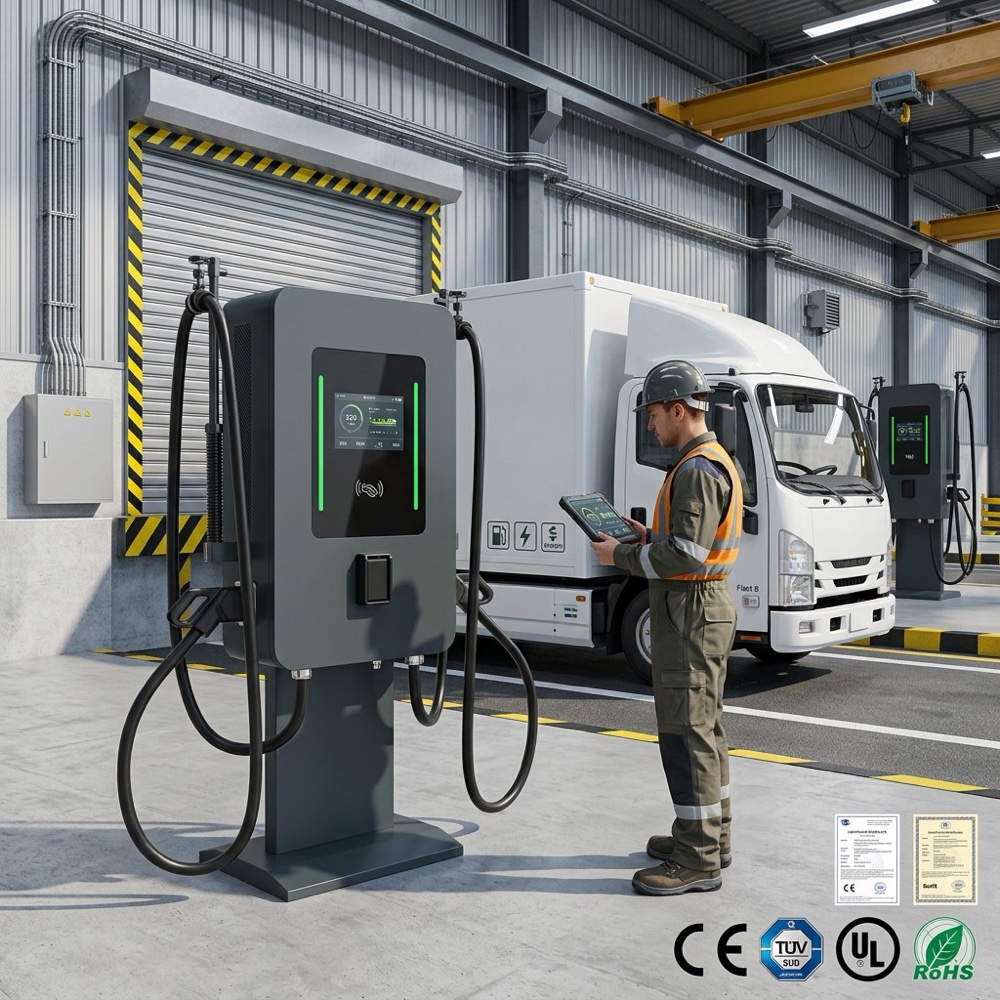
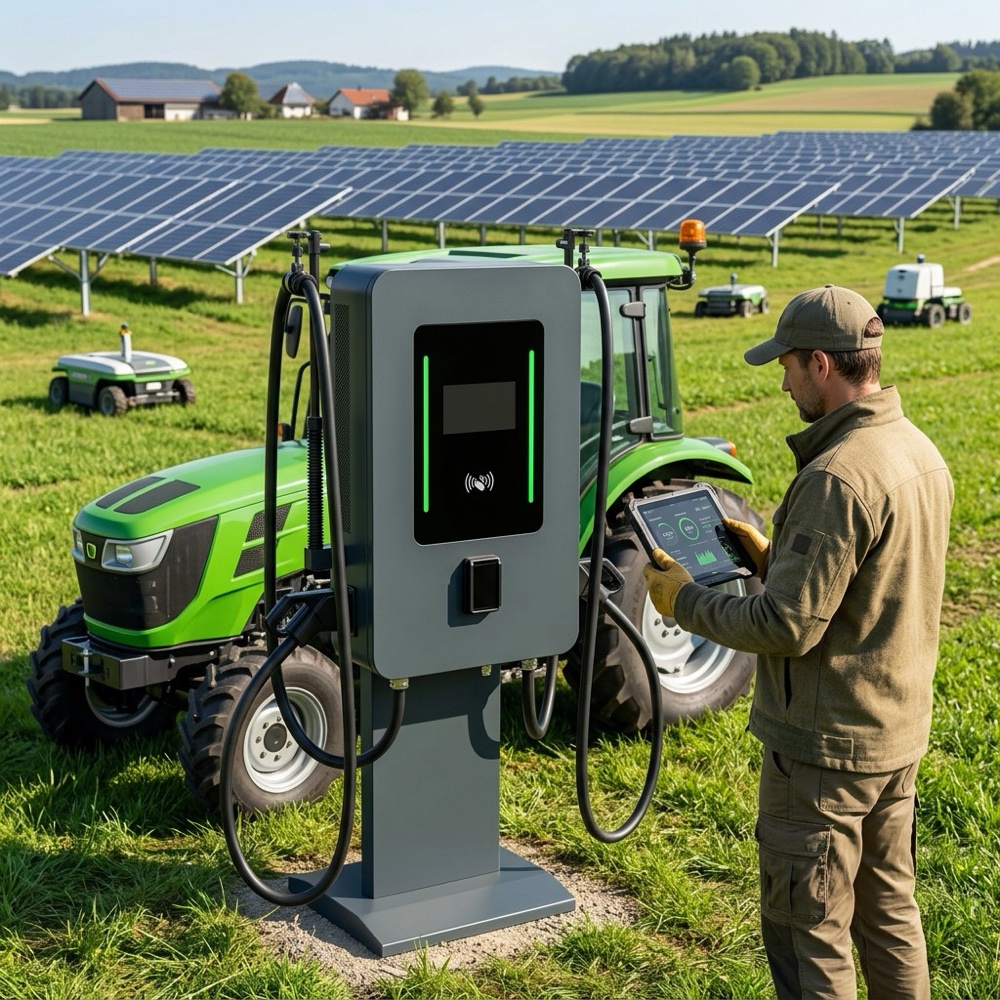
H3: Fleet Depots and Logistics HubsDelivery vans, shuttles, and last-mile trucks return to base with predictable dwell windows. A bank of MIDA 60 kW units lets a depot charge a vehicle during a 30–60 minute turnaround without the cost of megawatt-scale infrastructure. The dual-gun design means a single unit can top up two vans on staggered schedules, compressing the total number of units a depot must buy. |
|
H3: Car Dealerships and Service Centers
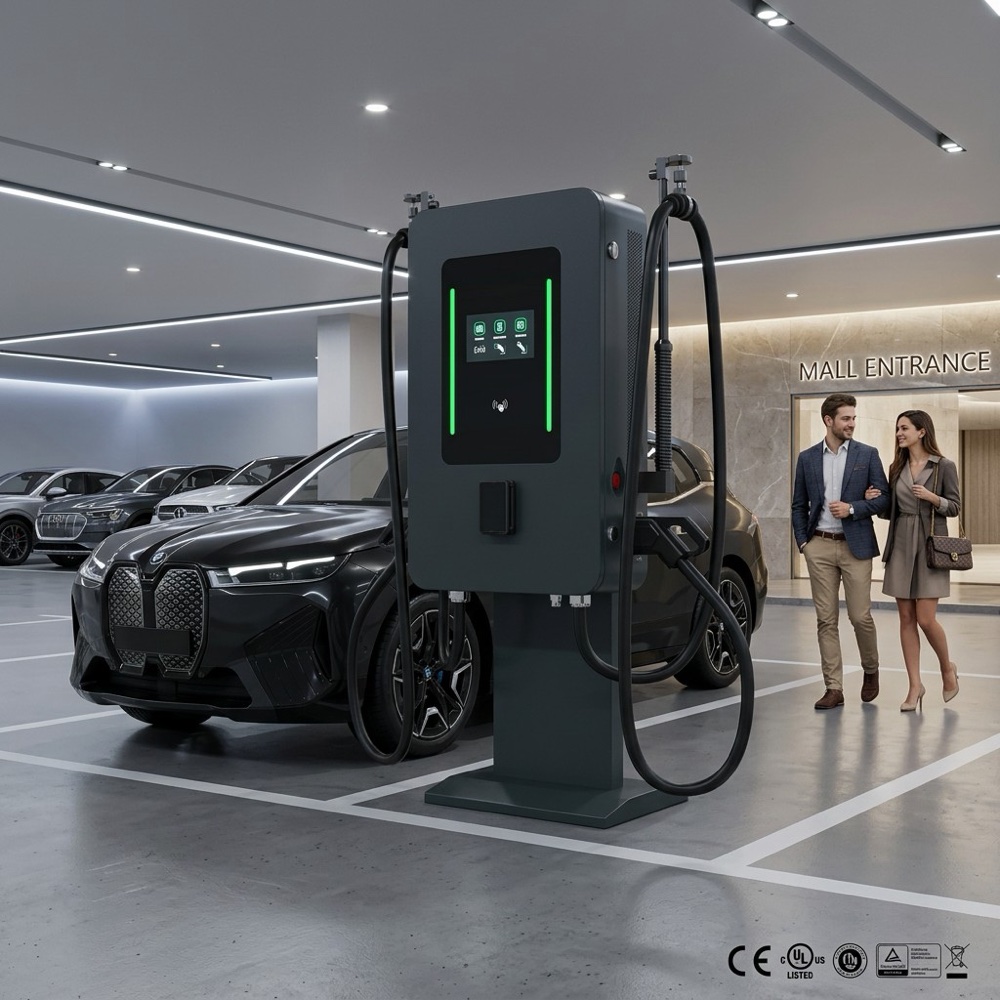
Dealership forecourts need to demonstrate EV capability while also prepping delivery vehicles for customers. The 60 kW floor-mounted station serves both: it fast-charges inventory and loaner vehicles, and it is a visible, branded technology asset for the showroom experience. With RFID and app control, staff can authorize sessions without keys or mechanical interlocks.
H3: Highway Corridors and Fuel Stations
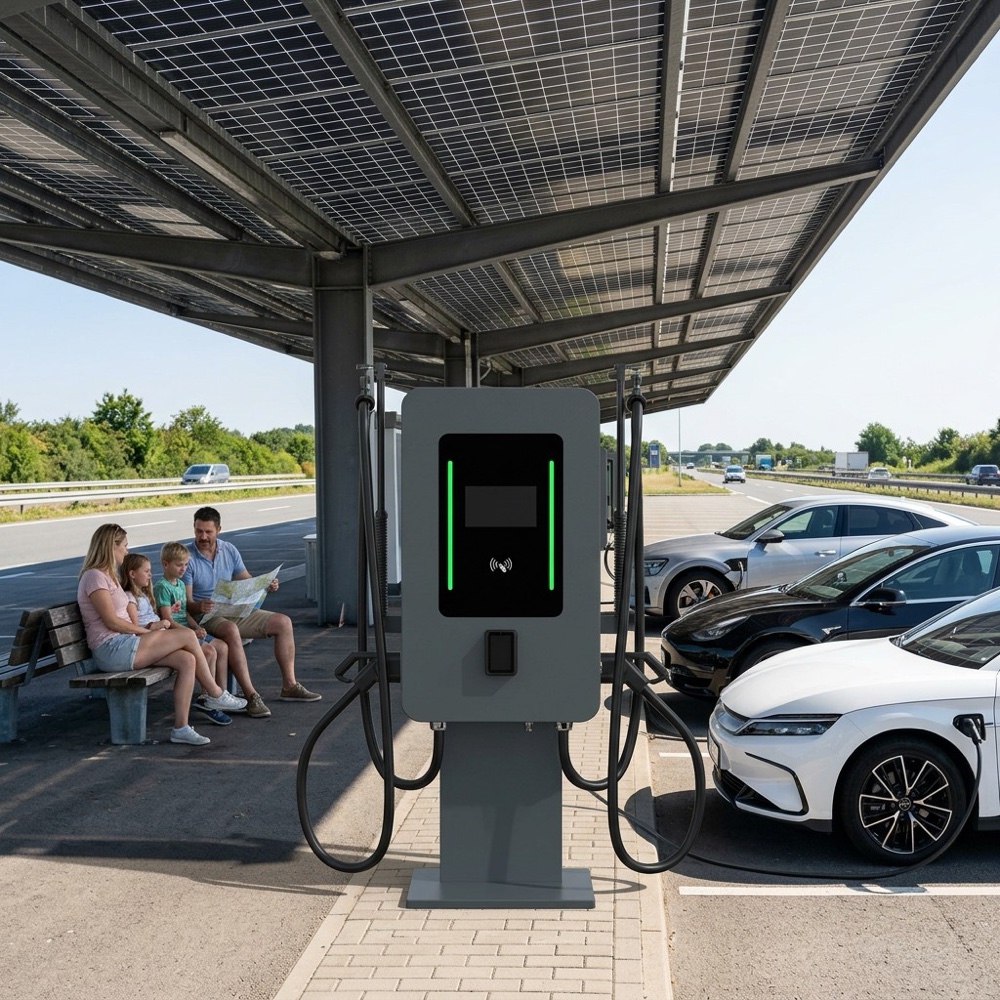
Along secondary highways and at fuel retailers adding EV lanes, 60 kW units provide a credible Level 3 experience at a fraction of the grid cost of 150 kW+ hardware. Two-gun operation lets two drivers charge while one unit is installed — compressing payback by doubling utilization per bay.
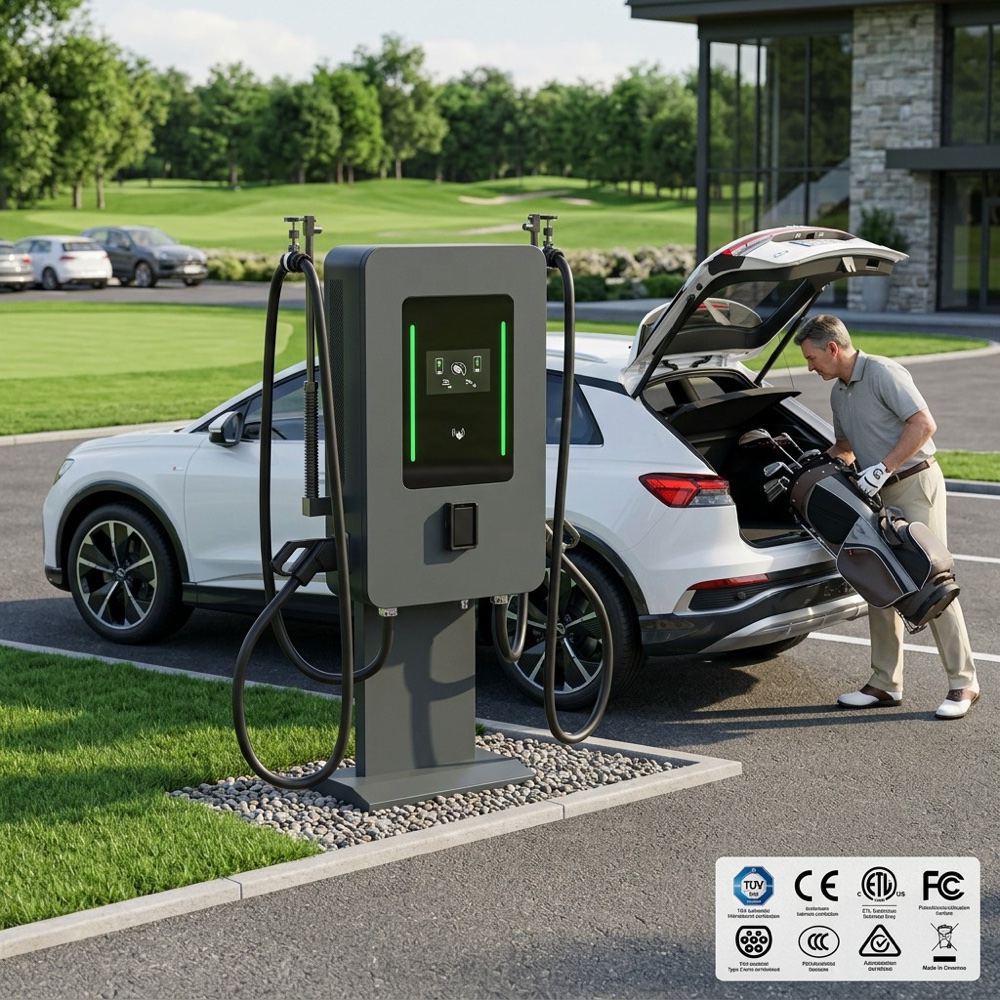
H3: Hotels, Resorts, and Destination Venues
For hospitality, the charger is a guest amenity that drives occupancy. A dual-gun 60 kW unit serves two guest vehicles in parallel, and OCPP integration lets the property set pricing (free for guests, paid for the public), cap session length, and publish live availability through the hotel app.
H3: Municipal and Workplace Charging
Cities and employers deploying public or employee charging benefit from the same station: robust outdoor rating, open protocol, and remote management. Municipalities can brand the unit and integrate it with public network apps, while workplaces use RFID fobs to offer free or subsidized charging to staff.
H2: Installation, Operation, and Lifecycle
H3: Installation RequirementsAs a floor-mounted unit, the station ships with a pedestal/footing configuration that bolts to a concrete pad or existing foundation. Site preparation is typical for commercial DC charging:
MIDA’s engineering team can review single-line diagrams and support commissioning remotely, and the unit’s guided commissioning wizard (via the touchscreen) gets a site online without a specialist technician on the ground. |
|
H3: Daily Operation and Driver Experience
The driver journey is deliberately frictionless:
- Tap an RFID card, scan a QR code, or select “start” in the app.
- Plug the CCS gun into the vehicle port; the latch clicks and the holster releases.
- The screen shows live voltage, current, power, energy delivered, and session cost.
- On completion, the session auto-stops when the vehicle reaches the target SoC or the driver stops remotely; a receipt is available via app or email.
For the operator, the CMS dashboard shows real-time status per gun, session history, revenue, and alerts. Faults are reported with descriptive error codes that reduce mean-time-to-repair, and most firmware updates apply over the air without a site visit.
H3: Maintenance and Total Cost of Ownership
DC fast chargers are long-life assets, and MIDA designs for serviceability: modular power modules, hot-swappable communication boards, and standardized fasteners. Routine maintenance is limited to periodic visual inspection, connector contact checks, filter cleaning (where fitted), and firmware updates. Compared with single-gun alternatives, the dual-gun unit also halves the cost per connector delivered — one enclosure, one grid connection, one controller serving two parking bays.
A simple TCO illustration (per unit, 5-year horizon, illustrative):
| Cost component | MIDA 60kW dual-gun (illustrative) |
|---|---|
| Hardware & installation | Baseline (see quote) |
| Energy losses at 95.5% vs 91.5% efficiency | Savings ≈ 700 kWh/unit/year → ~3,500 kWh over 5 years |
| Grid connection | Single 60 kW-class feed serves two bays |
| Maintenance | Modular, filter/service kit, remote diagnostics |
| Software/network fees | Zero lock-in; OCPP portability keeps fees competitive |
| Revenue capacity | Two revenue sessions per time window |
Figures are illustrative and must be validated against your tariff, utilization, and local install costs.
H2: How the 60 kW Model Compares Within the WY Series
Choosing the 60 kW floor-mounted model makes sense when you expect sustained multi-vehicle sessions, want the throughput advantage of dual-gun sharing at full series power, and prefer the floor-standing footprint for visibility and vandal-resistance in exposed locations. |
|
H2: Frequently Asked Questions
Q1: How long does it take to charge an EV with the MIDA 60kW station?
A typical 60 kWh battery EV charges from 10% to 80% in approximately 40–55 minutes at 60 kW, depending on the vehicle’s accepted charge curve and battery temperature. Lighter top-ups (e.g., 20%–60%) complete in roughly 20–30 minutes.
Q2: Can both guns charge at full power at the same time?
No. The unit has a shared 60 kW power pool. It dynamically allocates power between the two guns (e.g., 40/20 or 30/30 kW). A single vehicle receives the full 60 kW when the second gun is idle.
Q3: Which connector types are available?
CCS1, CCS2, and CHAdeMO variants are configurable at order time. Dual CCS1/CCS2 is the recommended default for maximum modern-EV compatibility.
Q4: Is this charger compatible with my existing charging network?
If your network platform supports OCPP 1.6J or 2.0.1 (the overwhelming majority do), yes. The station can also run standalone with RFID and local mode if no backend is present.
Q5: What power supply do I need to install it?
A three-phase AC feed (typically 400 V, 50/60 Hz) sized for roughly 60–75 kVA, with an external breaker and protective earthing. MIDA’s engineering team can review your site’s single-line diagram before order.
Q6: Does it work in very cold or very hot climates?
Yes. The unit operates from −30°C to +55°C ambient with automatic thermal management; above 45°C it derates output slightly rather than shutting down, and cold-weather performance benefits from the vehicle’s own battery preconditioning.
Q7: Is the station future-proof for Plug & Charge?
Yes. The unit is ISO 15118 Ready, meaning the hardware and communication stack support Plug & Charge via firmware as your network operator and vehicle OEM ecosystem enable it.
Conclusion
The MIDA 60kW Floor-mounted DC Fast Charging Station is a deliberately engineered middle path through the fast-charging market: Level 3 speed that respects your grid budget, dual-gun throughput that doubles revenue per bay, open OCPP connectivity that protects your software freedom, and IP54/IK10 construction that survives the real world. Backed by a decade of MIDA Power manufacturing experience, TUV CE and UKCA certifications, and an ISO 15118-ready roadmap, it is a commercial-grade asset built to earn its keep for years. For dealerships, fleets, hospitality, and municipal operators alike, it converts parking time into dependable charging revenue — one bay, two cars, zero compromise.
Contact the MIDA Power sales engineering team for a site-specific configuration, quotation, and commissioning plan.
Products categories
-
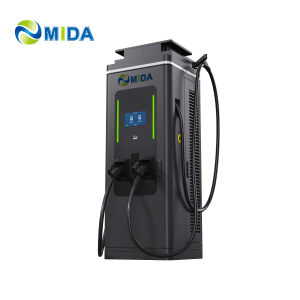
180kw 240kW DC Ultra Fast EV Charger Station OC...
-
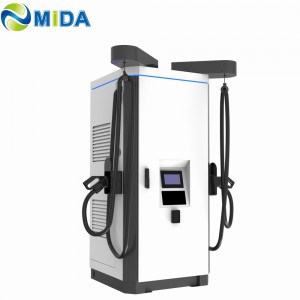
Level 3 EV DC Charger Electric Car Charging Sta...
-
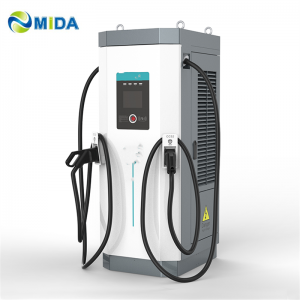
240kw 300kw 360kw 420kW Fast Charging Station F...
-
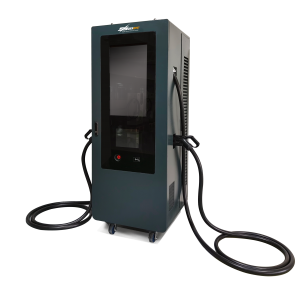
120KW 160KW 180kW 200kw Fast EV Charger Station...
-
420KW CCS2 New energy electric vehicle Charging...
-
360KW New energy electric vehicle Charging station