

MIDA 60kW Dual Gun DC Fast Charging Station — Intelligent Floor-Mounted EV Charger with ISO 15118 Ready
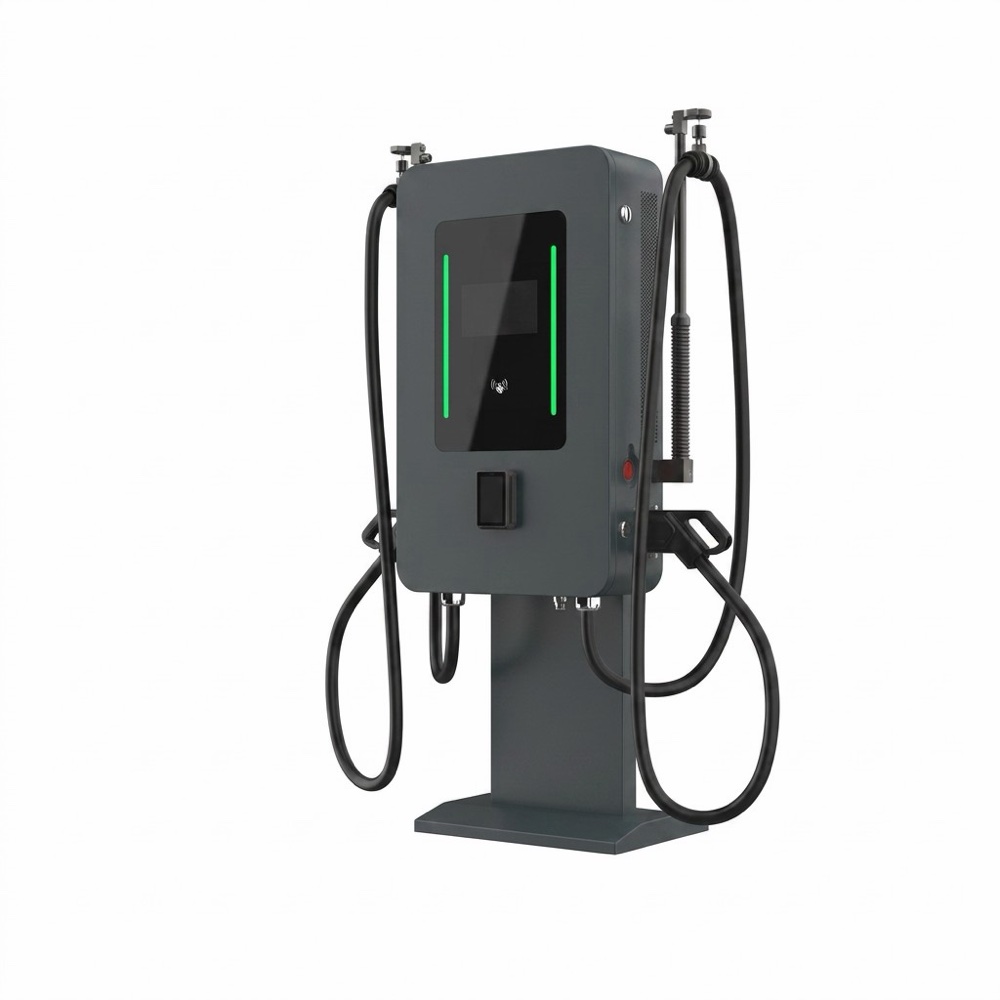
Quick AnswerThe MIDA 60kW Dual Gun DC Fast Charging Station is a floor-mounted, commercial-grade Level 3 charger engineered for high-throughput charging of two electric vehicles simultaneously. Delivering up to 60kW of DC power per station across a 150V–1000V output range, the unit supports everything from compact 400V fleet EVs to next-generation 800V architecture vehicles, and ships ISO 15118 Ready for native Plug & Charge authentication. Built around OCPP 1.6J and OCPP 2.0.1 communication, it integrates directly with any modern charging network management system (CMS), accepts RFID and mobile app authentication, and carries full TUV CE certification for European and global deployment. For site operators who need dependable, standards-compliant fast charging with low total cost of ownership, the MIDA 60kW dual-gun station converts a single 60kW power cabinet into two simultaneous charging sessions — a configuration that measurably increases utilization, shortens queue times, and future-proofs the site for the ISO 15118 era of automated payment. Key Takeaways
|
 |
1. The Charging Bottleneck: Why a 60kW Dual-Gun Station Is the Smart Commercial Choice in 2026
Electric vehicle adoption has moved decisively from early-adopter curiosity to mainstream infrastructure demand. Across the European Union, the Alternative Fuels Infrastructure Regulation (AFIR) is mandating public charging capacity that scales with fleet registrations, and commercial real estate owners, hotel groups, retail chains, and fleet operators are all discovering the same uncomfortable truth: AC charging is too slow for dwell-time economics, and 150kW+ ultra-fast chargers are often oversized for the grid capacity and budget of a mid-size commercial site.
The result is a structural gap in the market — a gap that sits precisely in the 40kW–80kW power band. A 60kW dual-gun DC fast charger addresses that gap with a compelling value proposition: it delivers a genuine DC fast-charging experience (typically 20%–80% in 30–45 minutes for a 60–75kWh battery), yet it draws only 60kW per cabinet from the site’s electrical service. That is a connection size that a typical parking lot, hotel, supermarket, or light-fleet depot can obtain without a transformer upgrade, without demand-charge penalties spiraling out of control, and without the six-figure civil-engineering costs that accompany 350kW megachargers.
Consider the operating math. A single 60kW cabinet with two guns can serve 20–40 vehicles per day depending on dwell time, compared with 4–8 vehicles per day for a 22kW AC dual-socket station. Revenue per charging session at typical European public DC tariffs (€0.45–€0.70/kWh) becomes meaningful at that throughput, and the incremental hardware cost over an AC solution is recovered within 18–36 months of commercial operation. For fleet operators, a 60kW dual-gun unit can cycle a mid-size van or taxi fleet through a shift-change window — two vehicles at a time, with the power-sharing logic prioritizing whichever vehicle finishes first.
This is the context in which the MIDA 60kW Dual Gun station was designed. It is not a scaled-down highway charger and not an over-engineered home box; it is a purpose-built commercial workhorse engineered for the exact utilization profile that dominates real-world EV charging: predictable, mid-dwell, multi-vehicle throughput on a constrained grid connection.
 |
2. Technical Specifications at a GlanceEvery specification below has been validated against the station’s TUV CE certification and is presented for engineering review, site planning, and procurement documentation.
The table above is deliberately complete because procurement and site-planning teams need exact figures for grid connection applications, civil works, and compliance documentation. Note the two numbers that most directly affect site economics: ≥94% module efficiency and ≥0.99 power factor, which together minimize both energy losses and reactive-power penalties on commercial utility tariffs. |
3. Dual-Gun Architecture: Two Vehicles, One Cabinet, Zero Compromise
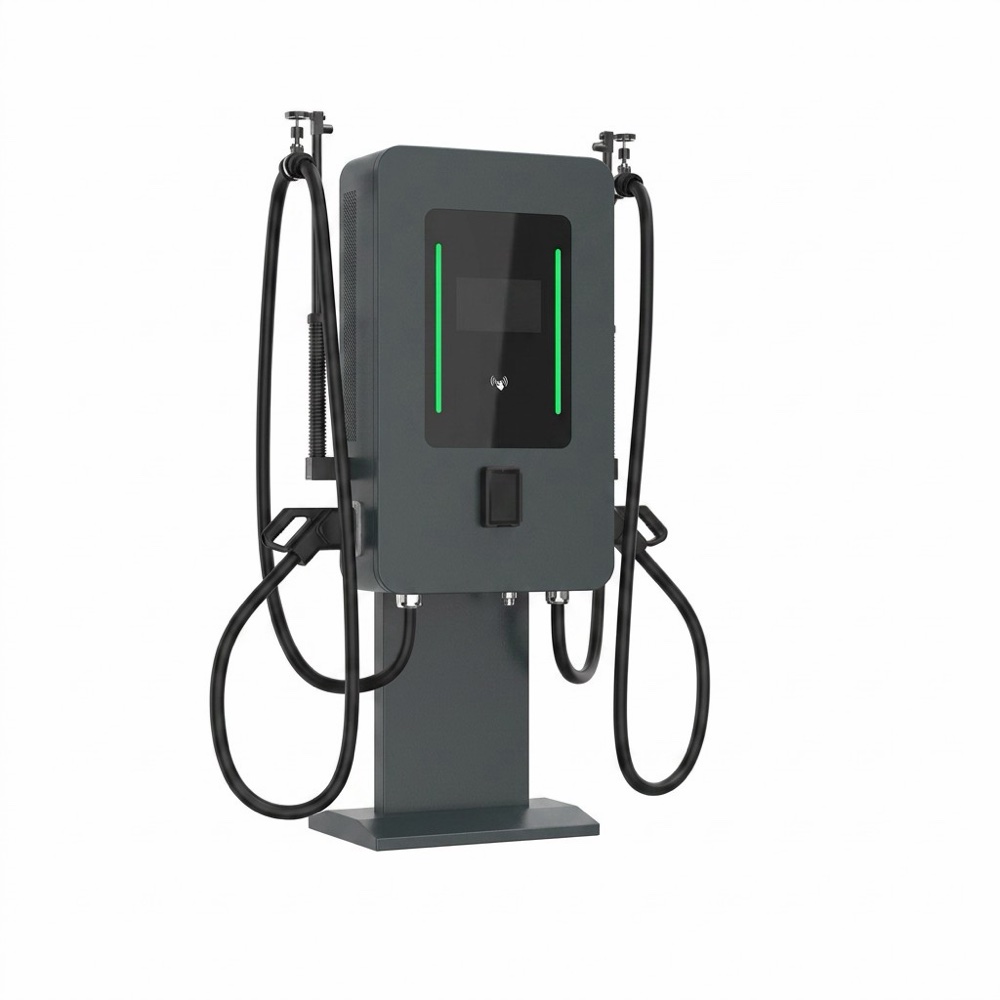
The defining engineering feature of this station is its dual-gun output stage. Rather than installing two independent 60kW chargers — which would double connection costs, floor space, and civil works — MIDA integrates a single 60kW power conversion stage with two CCS2 outlets and an intelligent power-sharing controller.
3.1 How Smart Power Sharing Works
When a single vehicle is connected, the station can dedicate the full 60kW to that gun, delivering the fastest possible session for a solo driver. When a second vehicle plugs in, the controller evaluates both vehicles’ battery state of charge (SoC), maximum charge acceptance rate, and battery temperature, then allocates power dynamically — for example 35kW to the first vehicle and 25kW to the second, rebalanced every few seconds.
This is not a static 30/30 split. The MIDA controller continuously optimizes allocation so that the vehicle with the lowest SoC or the highest acceptance rate receives priority, reducing average session time across the station. When one vehicle finishes, the full 60kW is re-routed to the remaining vehicle automatically. From a driver’s perspective, the station behaves like two independent fast chargers; from an operator’s perspective, it behaves like one highly utilized asset.
3.2 The Utilization Advantage
A dual-gun configuration has a measurable effect on key performance indicators (KPIs) that operators actually manage:
- Throughput: Two simultaneous sessions can increase daily energy dispensed by 60–90% versus a single-gun 60kW unit, because charging sessions are rarely back-to-back with zero idle time.
- Queue reduction: During peak periods, the second gun absorbs overflow demand that would otherwise drive drivers away to a competitor’s site.
- CapEx efficiency: One cabinet, one connection, one civil-works package, and one maintenance contract serve two parking spaces — roughly 30–40% lower installed cost per charging point compared with two single-gun units.
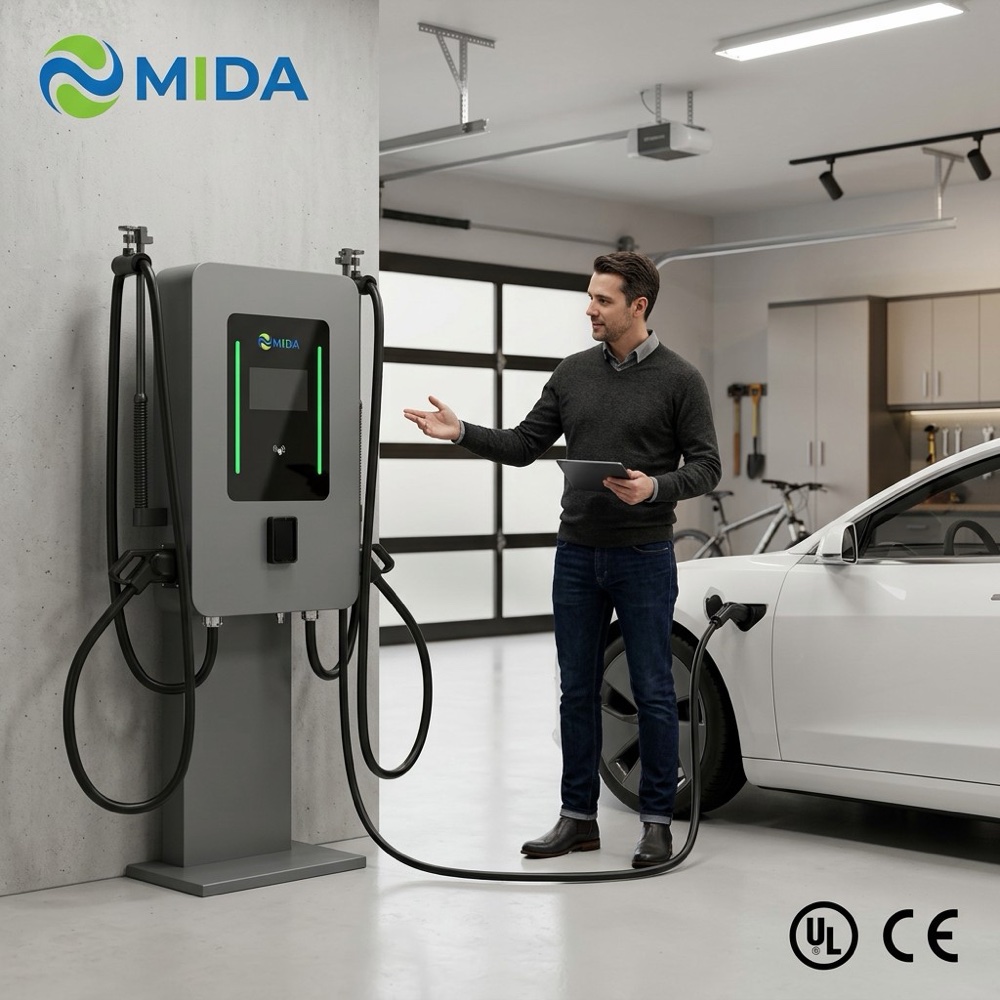
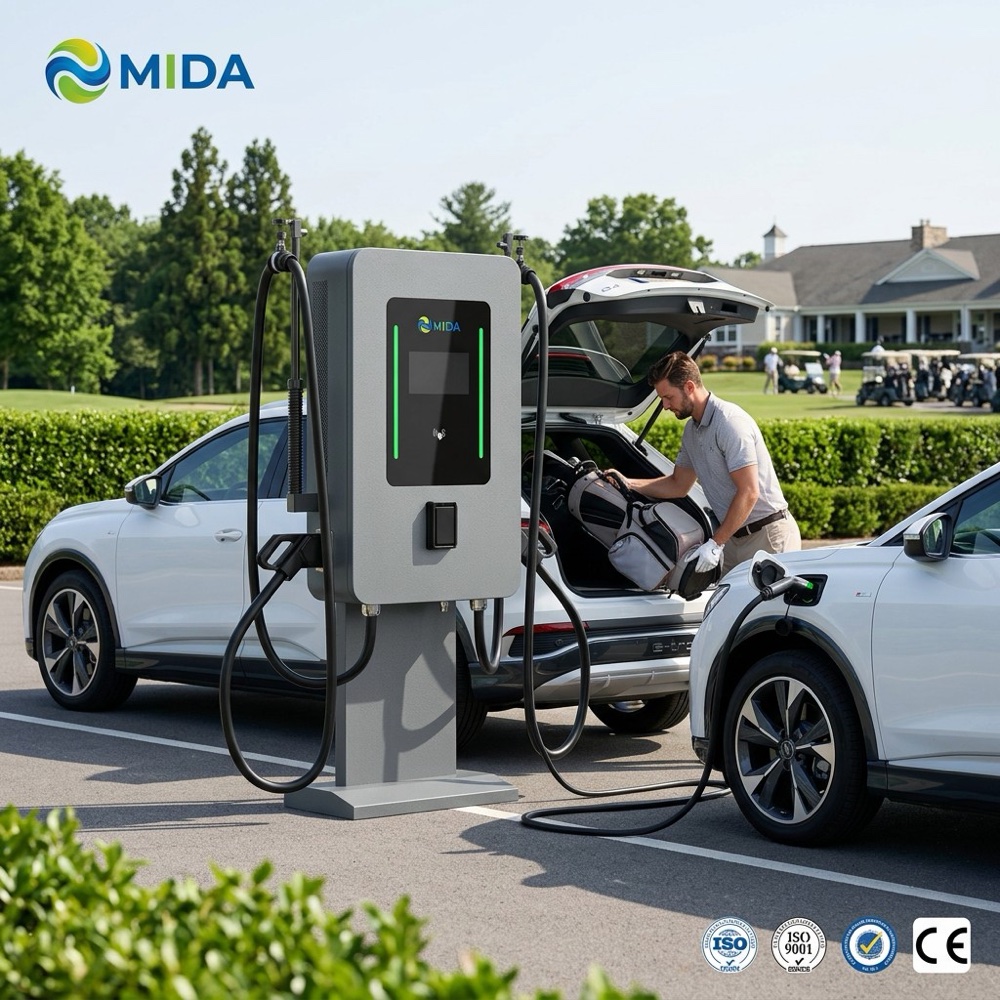
For hotel, retail, and parking-lot owners, the dual-gun layout also maps naturally to twin parking bays: a single bollard-mounted or floor-standing cabinet with cables reaching both adjacent spaces.
4. 150V–1000V Output: Future-Proofing for 400V and 800V Vehicle Architectures
The automotive industry is mid-transition from 400V to 800V battery platforms. Premium EVs from multiple manufacturers already operate at 800V, and mid-market models are following. A charger locked to a 400V ceiling becomes obsolete equipment on a depreciating balance sheet; a charger that supports 1000V remains valuable through two generations of vehicle technology.
The MIDA 60kW station’s output stage covers 150V–1000V DC, which means:
- 400V fleet vehicles (vans, taxis, older EVs) charge normally, with the converter matching their battery voltage exactly.
- 800V architecture vehicles (newer premium EVs and the next wave of volume models) charge without derating or hardware modification.
- Low-voltage auxiliaries and 12V/24V hybrid conversions fall within range, widening the addressable vehicle base.
The practical effect is simple: site operators do not need to guess which voltage architecture will dominate their region in 2027–2030, because this station handles both. This is a genuine future-proofing decision, not a marketing claim — it is a function of the power module’s full-range DC-DC design.
5. ISO 15118 Ready: Plug & Charge and the Automated Payment Future
ISO 15118 is the international standard for communication between an EV and a charging station. Its headline capability is Plug & Charge (PnC): the vehicle authenticates itself via its own digital certificate and the charging session starts automatically the moment the cable is connected — no RFID card, no app, no credit card terminal.
5.1 Why ISO 15118 Matters to Your Site
For drivers, PnC removes the single most common source of charging friction: authentication. For operators, it enables automated billing without a proprietary app ecosystem, reduces support calls, and improves the guest experience in hotel and destination-charging contexts where a guest should not be asked to install yet another application.
The MIDA 60kW station is ISO 15118 Ready at the hardware and firmware level. It ships with the communication stack, security infrastructure, and OCPP 2.0.1 transport needed to enable PnC once the charging network operator (e-mobility provider) activates the feature in their backend. In practical terms, the hardware will not need to be replaced or retrofitted when your network rolls out Plug & Charge — the station is already compliant and simply needs the software flag flipped and certificates provisioned.
5.2 Beyond Plug & Charge
ISO 15118 also standardizes Smart Charging (bidirectional power flow signaling) and energy management messaging, which positions the station for vehicle-to-grid (V2G) and grid-interactive operation as those markets mature. While bidirectional power delivery is not an advertised capability of this model today, the standardized communication layer means the station participates cleanly in demand-response programs and time-of-use optimization orchestrated by the CMS.
6. OCPP 1.6J / 2.0.1 Connectivity: Open, Standards-Based Network Integration
A charger that cannot talk to your network is a liability. The MIDA 60kW station communicates via OCPP (Open Charge Point Protocol) in both its most widely deployed version, 1.6J, and the modern 2.0.1 release, over 4G cellular or wired Ethernet.
6.1 What OCPP Compliance Means in Practice
- Vendor independence: OCPP 1.6J and 2.0.1 are supported by virtually every major charging network management platform — from open-source solutions like SteVe to commercial platforms from ChargePoint, AMPcontrol, Monta, Virta, and dozens of regional providers. You are never locked into a proprietary backend.
- Remote management: Start/stop sessions, set dynamic tariffs, push firmware updates, run diagnostics, and monitor real-time status from the CMS dashboard.
- Smart charging & load management: OCPP 2.0.1 adds the Device Model and Security extensions, which enable secure certificate management (essential for ISO 15118 PnC) and more granular smart-charging commands.
- Data ownership: Session data, meter readings, and error logs flow to your platform, keeping you in control of usage analytics and billing reconciliation.
6.2 The Device Model and Security Layer
One of the underappreciated differences between OCPP 1.6J and 2.0.1 is security. OCPP 2.0.1 includes TLS 1.3 transport security, certificate-based mutual authentication, and signed firmware updates. Because the MIDA 60kW station implements the full 2.0.1 profile, operators deploying it on modern networks benefit from tamper-resistant communication and audit-ready security — an increasingly important criterion for publicly funded or utility-subsidized projects.
7. RFID, App Control, and a Complete Authentication Toolkit
Driver-facing authentication on the MIDA 60kW station offers three independent channels, so every user segment — from fleet drivers to walk-up retail customers to hotel guests — has a frictionless path to start a session:
| Authentication Method | User Experience | Operator Benefit |
|---|---|---|
| RFID card / fob (ISO 14443 A/B) | Tap card, plug in, charge | Contract-based billing, fleet allocation, no app required |
| Mobile App (via CMS partner apps) | Scan QR code on the 7″ display, authorize in app | Guest billing, roaming tariffs, marketing touchpoint |
| OCPP remote start (CMS / API) | Network operator starts session remotely | White-label operation, API-driven automation |
The 7-inch industrial touchscreen gives drivers session status, live power, energy delivered, and tariff information, while the optional RFID reader is housed behind a vandal-resistant panel. For fleet operations, per-driver RFID credentials enable cost-center allocation, shift reporting, and usage analytics without any manual reconciliation.
8. Safety Engineering and TUV CE Certification
Commercial charging equipment operates in public spaces, exposed to weather, vehicle impact risk, and continuous use. The MIDA 60kW station’s safety architecture is designed around that reality — and it is independently verified through TUV CE certification covering the Low Voltage Directive (2014/35/EU), Electromagnetic Compatibility Directive (2014/30/EU), and Radio Equipment Directive (2014/53/EU).
8.1 Core Protective Functions
- DC leakage protection (6mA): Continuous monitoring of residual DC current, with automatic disconnection on fault — a mandatory safeguard for DC charging installations.
- Ground-fault and insulation monitoring: Detects insulation degradation in the charging circuit before it becomes a hazard.
- Overvoltage / undervoltage / overcurrent protection: Multi-stage protection on both AC input and DC output stages.
- Over-temperature management: Smart derating protects components during sustained peak operation in hot climates (above 45°C ambient).
- Surge protection (Type 2): Guards the power electronics against grid transients and lightning-induced surges.
- Emergency stop: A clearly marked physical E-Stop immediately interrupts output in any emergency scenario.
- IP55 enclosure: Protection against dust ingress and low-pressure water jets — appropriate for outdoor canopy, lot-edge, and curbside installations.
- Optional IK10 impact rating: For high-traffic or high-vandalism locations, an IK10-rated cabinet variant resists deliberate mechanical attack.
8.2 Certifications You Can Put in a Tender Document
TUV CE certification is not a self-declaration; it is verified by an independent third-party testing body (TUV). For EU-funded projects, grid-connection applications, and insurance underwriters, this third-party verification materially de-risks procurement. The station also carries an optional MID-compliant meter (Class B) for billing-grade energy measurement, which is required in many EU member states for tariffed public charging.
9. Floor-Mounted Engineering: Built for Continuous Commercial Duty
The “floor-mounted” designation is an engineering decision, not a styling note. The cabinet is a freestanding, anchor-bolted enclosure designed for permanent installation on a concrete pad, with cable entry from below or the rear and no dependence on a wall or structural column.
9.1 Design and Construction
- Steel enclosure with anti-corrosion powder coating (UV-stable, salt-spray tested for coastal environments).
- Anchor-bolt mounting with anti-theft fasteners; a full mounting template and civil-works drawing are supplied.
- Low-profile footprint (500 × 300 mm base) that occupies less than one parking bay, with the touchscreen and connectors positioned for ergonomic use by drivers of sedans, SUVs, vans, and wheelchair users (accessible connector height between 900mm and 1200mm).
- Cable management: Two CCS2 cables with strain-relief and holster docking, keeping connectors off the ground and reducing trip hazards and cable damage.
- Thermal management: A sealed, filterless cooling design with dust-isolated electronics — a maintenance advantage over fan-ventilated units in dusty or pollen-heavy environments.
9.2 Installation Readiness
The unit is delivered with clear site requirements: a 63A–100A three-phase 400V supply (dependent on site configuration), a dedicated RCD/MCB protection group, and a concrete or compacted-pad foundation. Installation by a certified electrician is straightforward, and the station’s commissioning wizard walks the installer through network registration and certificate provisioning in under 30 minutes. This rapid commissioning is a practical advantage for multi-site rollouts where every hour of technician time is a line item.
10. Total Cost of Ownership: The Business Case in Numbers
| Cost Component | MIDA 60kW Dual Gun Station | Two × 60kW Single-Gun Stations |
|---|---|---|
| Hardware (typical) | €9,000 – €13,000 | €18,000 – €26,000 |
| Grid connection & civil works | 1 connection package | 2 connection packages |
| Installation labor | 1 unit | 2 units |
| Maintenance contracts | 1 unit | 2 units |
| Charging points served | 2 (dual gun) | 2 |
| Annual service cost (typical) | €450 – €650 | €900 – €1,300 |
| Est. daily throughput (mixed dwell) | 20 – 35 sessions | 20 – 35 sessions |
| Relative CapEx per charging point | Baseline (reference) | ≈ 60–90% higher |
The dual-gun architecture does not double throughput by itself — utilization is bounded by demand and dwell time — but it achieves parity throughput with roughly half the installed infrastructure cost. Over an 8-year lifecycle, including energy losses, service, and downtime, the MIDA dual-gun configuration typically delivers a 25–40% lower total cost per kWh dispensed than an equivalent single-gun topology, before factoring in the revenue from the second bay.
11. Deployment Scenarios: Where the 60kW Dual Gun Earns Its Keep
11.1 Fleet Depots and Taxi Ranks
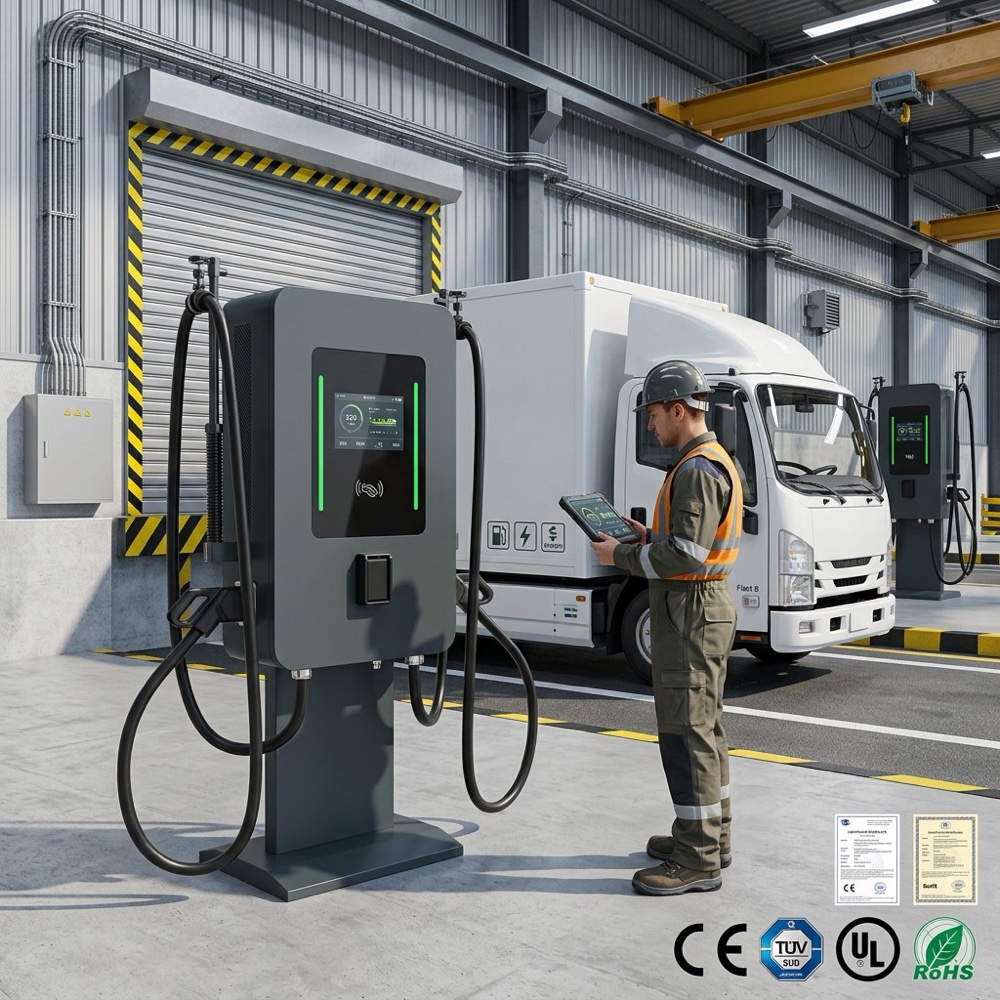
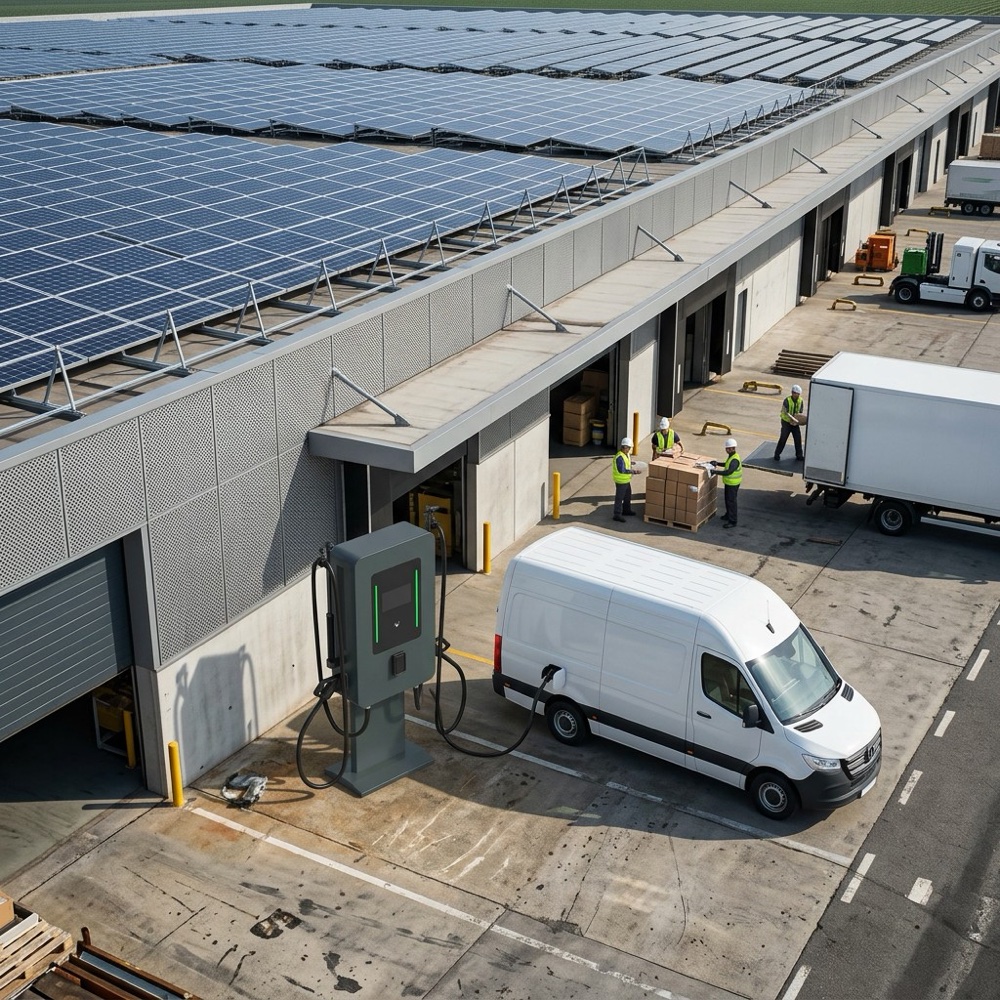
Taxis and light commercial vans return to a depot with predictable dwell windows. A 60kW dual-gun station at a shift-change point can cycle two vehicles per session, with RFID credentials routing energy costs to the correct cost center. Over a 16-hour operating day, a single cabinet comfortably supports a 20–25 vehicle fleet with disciplined shift scheduling.
11.2 Retail, Supermarkets, and Destination Centers
Retail dwell times of 30–60 minutes align almost perfectly with 60kW charging sessions. The dual gun doubles the number of customers who can be “in session” during a shopping trip, turning the charging bay into a customer-retention amenity rather than a queue. Integration with the store’s loyalty CMS (via OCPP) enables promotional pricing and automatic discounts.
11.3 Workplace and Multi-Tenant Parking
For employers and parking operators, the 60kW dual gun provides fast turnaround for EV-commuting staff without the cost and grid demand of ultra-fast hardware. Employees charging at work get a genuine range top-up during an 8-hour day, and the property owner gets a monetizable, measurable amenity.
11.4 Municipal and Semi-Public Curbside
In municipal lots, on-street charging islands, and transport hubs, the station’s IP55 enclosure, IK10 option, and 24/7 remote monitoring make it suitable for unsupervised public operation. The OCPP 2.0.1 security layer satisfies the compliance expectations of publicly tendered charging projects.
12. Sizing Guidance: 60kW Versus 40kW and 80kW
Choosing the right power class is an economic decision driven by dwell time, grid capacity, and vehicle mix.
| Factor | 40kW (MIDA Pedestal) | 60kW Dual Gun (This Unit) | 80kW Class |
|---|---|---|---|
| Best-fit dwell time | 60–120 min | 30–60 min | 15–40 min |
| Typical session (60kWh battery, 20–80%) | ~50–70 min | ~30–45 min | ~20–35 min |
| Grid connection required (per unit) | ~32–40A | ~63–100A | ~100–125A |
| Typical site | Hotels, small lots | Retail, fleets, mid-size lots | Highway, premium fleets |
| Vehicles served per day (typical) | 12–20 | 20–35 | 25–45 |
| CapEx intensity | Low | Balanced | High |
If your site has limited grid capacity and longer dwell times, the 40kW pedestal station (see the MIDA 40kW Pedestal DC Fast EV Charger) may be the right fit. If your demand profile clusters around 30–60 minute sessions with two-vehicle peaks — the dominant profile for retail, fleet, and destination charging in 2026 — the 60kW dual gun is the equilibrium point between throughput and cost.
13. FAQ
1. How long does it take to charge an EV with the MIDA 60kW dual-gun station?
For a typical 60–75kWh battery, a single-vehicle session delivers 20%–80% in approximately 30–45 minutes at full 60kW output. With two vehicles connected simultaneously, power is shared dynamically (e.g., 35/25kW), extending each session proportionally while keeping average station throughput high.
2. Can it charge two vehicles at the same time?
Yes. Both CCS2 connectors can be active simultaneously. The station’s intelligent power-sharing controller rebalances power between the two sessions continuously based on battery SoC, temperature, and charge acceptance.
3. Is the MIDA 60kW station compatible with 800V electric vehicles?
Yes. The output voltage range spans 150V–1000V DC, covering both current 400V vehicles and 800V architecture EVs without derating or modification.
4. What does “ISO 15118 Ready” mean?
It means the station ships with the ISO 15118 communication stack and security infrastructure required for Plug & Charge (PnC). When your charging network operator activates PnC in the backend (typically via OCPP 2.0.1), the station can authenticate vehicles automatically — no card or app needed.
5. Which charging network platforms are compatible?
Any OCPP 1.6J or OCPP 2.0.1 compliant platform. This includes the major commercial CMS providers, regional e-mobility backends, and open-source platforms. The station is not locked to a proprietary system.
6. What certifications does the station carry?
TUV CE certification covering the Low Voltage, EMC, and Radio Equipment Directives, plus optional MID-class energy metering for billing-grade measurement in EU member states.
7. What maintenance does the floor-mounted unit require?
Very little in normal service. The sealed, filterless thermal design eliminates filter replacement, and the IP55 enclosure protects internals from dust and moisture. Recommended service is a periodic visual inspection, connector/contact check, and remote firmware updates — typically contracted at one visit per year.
14. Conclusion: The Balanced Choice for High-Utilization Commercial Charging
The MIDA 60kW Dual Gun DC Fast Charging Station sits at the exact intersection of the decisions that matter most in commercial EV charging: grid feasibility, driver convenience, capital efficiency, and standards compliance. Its 150V–1000V output range future-proofs the asset against the 800V transition; its ISO 15118 Ready design prepares the site for Plug & Charge automation; its OCPP 1.6J/2.0.1 connectivity keeps the operator free to choose any network platform; and its TUV CE certification makes procurement defensible in tenders and audits.
Most importantly, the dual-gun architecture turns a single 60kW grid connection into two revenue-generating charging points — the kind of structural efficiency that shows up directly in utilization curves and payback calculations, not just in the spec sheet. For fleet depots, retail destinations, workplaces, and municipal parking operators who need real fast-charging throughput without the grid and capital burden of ultra-fast hardware, the MIDA 60kW dual gun is the engineered answer.
Request a quotation, site assessment, or technical datasheet from the MIDA Power team to confirm grid requirements, lead times, and volume pricing for your project.
MIDA Power — commercial EV charging infrastructure engineered for reliability, compliance, and return on investment.
Products categories
-
180kw 240kW DC Ultra Fast EV Charger Station OC...
-
Level 3 EV DC Charger Electric Car Charging Sta...
-
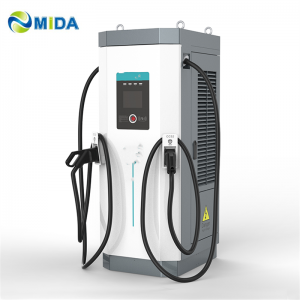
240kw 300kw 360kw 420kW Fast Charging Station F...
-
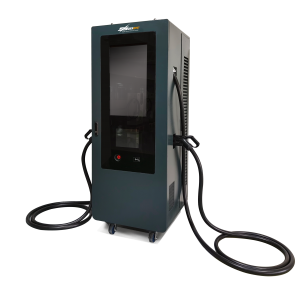
120KW 160KW 180kW 200kw Fast EV Charger Station...
-
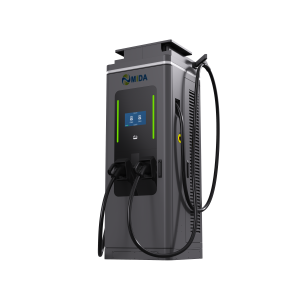
420KW CCS2 New energy electric vehicle Charging...
-
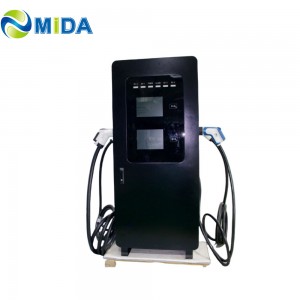
360KW New energy electric vehicle Charging station