

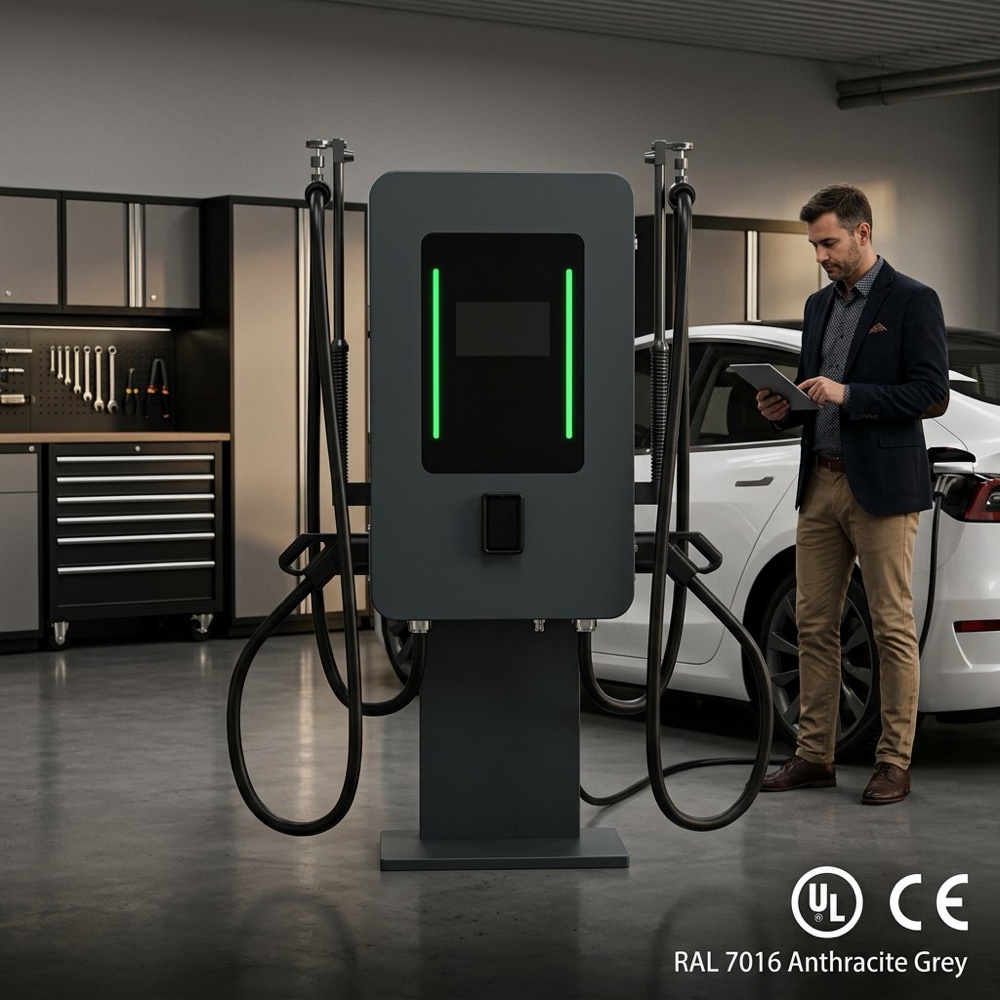
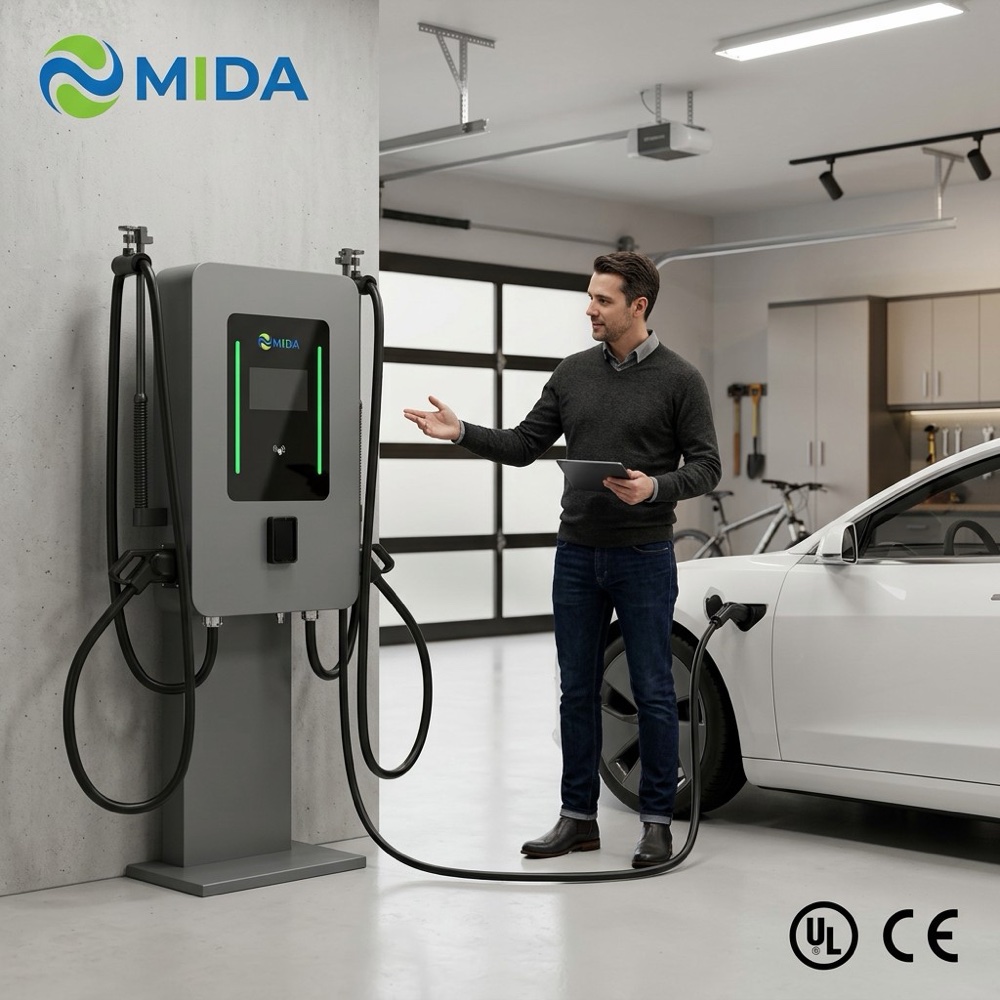
MIDA 40kW–60kW Dual Output DC Fast Charging Station — Rugged Pedestal Level 3 EV Charger for Public Hub Deployment
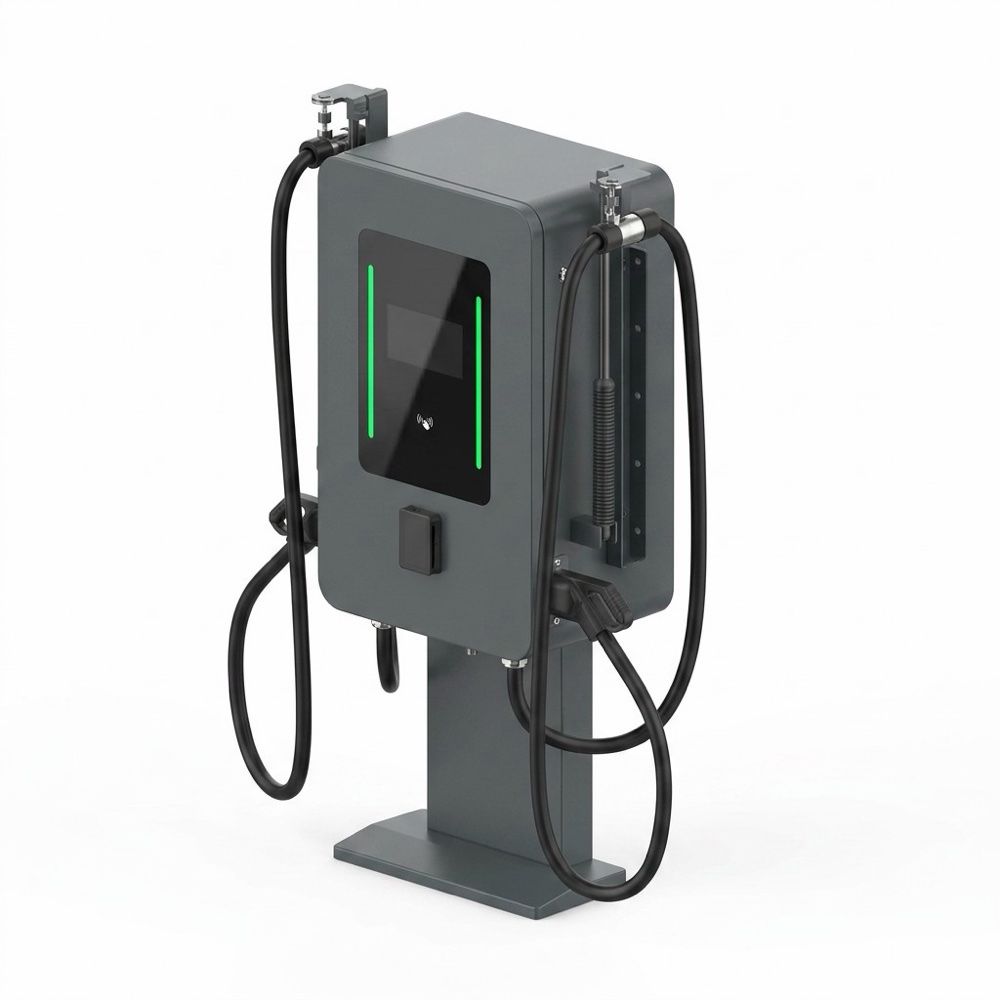
Quick Answer: What Is the MIDA 40kW–60kW Dual Output DC Fast Charging Station?The MIDA 40kW–60kW Dual Output DC Fast Charging Station is a rugged, pedestal-mounted Level 3 (DC) charger engineered for public hub environments where hardware must survive weather, vandalism and around-the-clock use. It delivers a software-configurable 40–60 kW across a 150 V–1000 V DC output envelope at ≥95.5% peak efficiency, charging two vehicles simultaneously through dual CCS2 or GBT connectors. Dynamic Load Balance manages power between the two guns and across neighbouring chargers, keeping peak demand low and site infrastructure small. With OCPP 1.6J/2.0.1, RFID, mobile App, WiFi and 4G connectivity, TUV CE and UKCA certification, and an IK10/IP-rated reinforced pedestal, it is purpose-built for fuel-station forecourts, highway rest stops, city-centre hubs, car parks and fleet depots that demand maximum uptime with minimal maintenance. Key Takeaways:
|
 |
The Public Hub Challenge: Why Charging Hardware Must Be Built Different
What “Public Hub” Demands of a Charger
A public charging hub is a hostile environment for electronics. The unit sits outdoors year-round, exposed to rain, snow, salt spray, UV radiation and temperature swings from −25 °C to +55 °C. It is touched by thousands of unfamiliar users, bumped by vehicles, hit by shopping trolleys and snow-ploughs, and increasingly targeted by thieves and vandals. Unlike a depot charger with a known driver base, a public-hub charger cannot assume goodwill, supervision or regular cleaning.
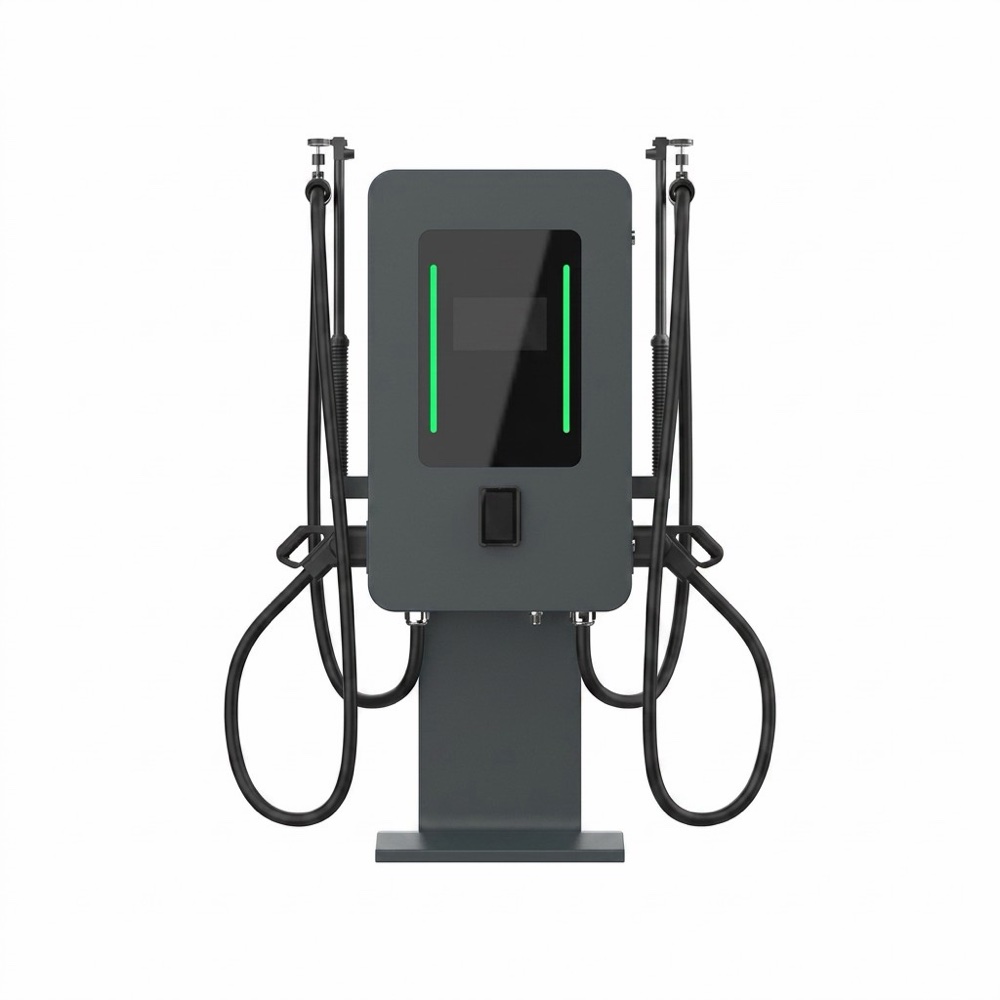
The MIDA 40kW–60kW Dual Output station is designed from the ground up for exactly these conditions. The pedestal architecture — a self-supporting floor-standing column with a low centre of gravity — is inherently more resistant to vehicle contact than a wall-mounted or slim pole unit. The enclosure carries an IK10 impact rating (the highest standard classification, tested against a 5 kg impactor at 20 J), an IP54-rated electronics compartment with condensation management, and a vandal-resistant user interface with tamper-proof fasteners. Every external cable entry is armoured or shrouded, and the display and RFID reader are recessed behind polycarbonate shields that remain readable in direct sunlight.
Uptime Is the Business Model
For a public CPO, revenue is a direct function of uptime. A charger that is offline for repairs is not merely idle — it is failing its service-level agreements, frustrating drivers and pushing them toward competitors. Public-hub hardware therefore has to deliver three properties that ordinary commercial chargers treat as optional:
- Reliability under continuous duty — power electronics rated for 24/7/365 operation with conservative thermal margins.
- Remote serviceability — most faults must be diagnosable and recoverable over the network, not by truck roll.
- Physical resilience — the enclosure must shrug off the environment and the public, so the electronics inside are never exposed.
The MIDA pedestal station is engineered to all three: its power modules are derated for high-ambient continuous operation, all firmware-level recovery routines (session restart, connector reboot, module reset) are exposed via OCPP, and the hardened enclosure keeps the electronics’ failure rate dominated by component quality rather than environmental stress.
Flexible 40–60 kW Output: One Platform, Every Site Tier
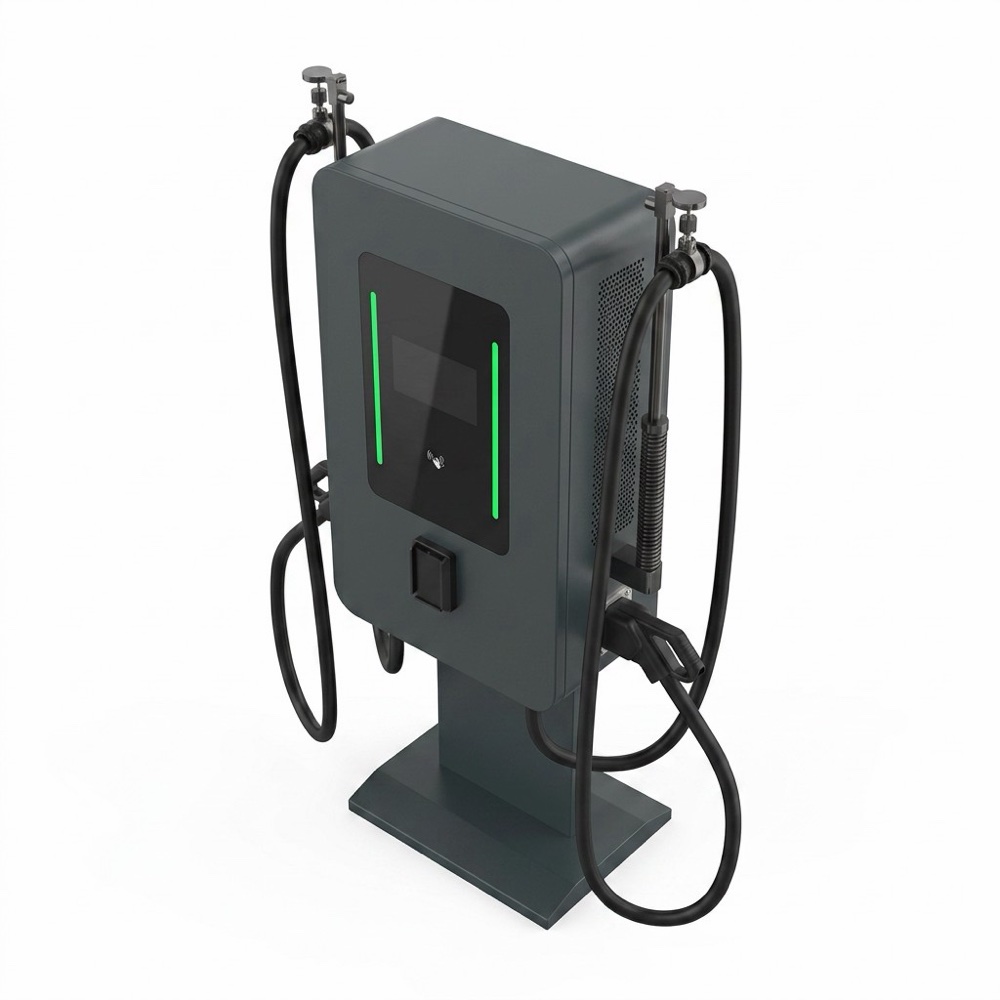 |
Software-Configurable Power: The Operator’s Option ValueMost charging networks begin with cautious assumptions about utilisation and grow faster than forecast. The MIDA 40kW–60kW station is built to absorb that uncertainty. The rated output is configurable in software across the 40–60 kW band — the same physical unit can be commissioned at 40 kW for a low-utilisation retail site, 50 kW for a mid-demand car park, or 60 kW for a busy forecourt — and re-configured remotely as demand evolves. This is option value that fixed-power hardware cannot offer:
|
Power That Matches the Vehicle Fleet
The 40–60 kW envelope also maps cleanly onto real-world battery sizes. At 60 kW, a 30-minute session adds roughly 200–260 km of range for a mid-size passenger EV; at 40 kW the same session adds 130–180 km. For a public hub serving commuter, taxi, delivery and leisure traffic — where the average session is 20–45 minutes — 40–60 kW is the throughput-correct answer: fast enough to turn bays over several times per day, yet gentle enough on the LV grid to keep connection costs low and DLB effective.
Dual Output Architecture: Two Bays, One Pedestal
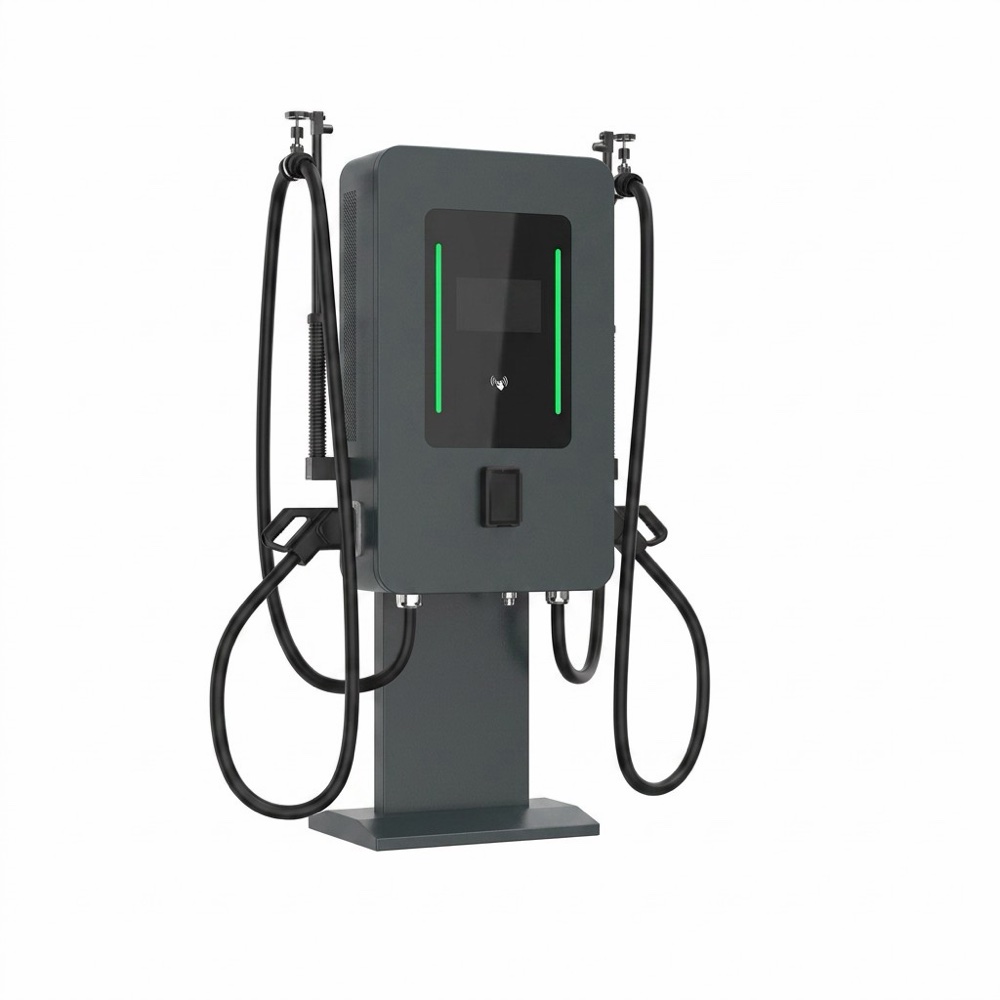
Doubling Throughput Without Doubling InfrastructureThe dual-output configuration is the defining economic feature of this charger class. Two integrated connectors draw from one 60 kW power bank, one grid connection and one pedestal footprint. When both bays are occupied, the controller splits power (2 × 30 kW balanced, or asymmetric priority splits); when a single vehicle is connected, it can draw the full available power. For public-hub operators, the operational consequences are concrete:
|
 |
Independent Port Control, Shared Intelligence
Each port runs its own full charging stack — metering, authentication, charging curve, fault isolation — while the load-balancing controller coordinates both from a single power budget. The operator can set per-port priorities: for example, guaranteeing 40 kW to a contracted taxi fleet port while the second port takes whatever capacity remains. This makes the same pedestal suitable for blended business models: contractual fleet charging on one bay, open public charging on the other.
Dynamic Load Balance: Protecting the Hub’s Grid Connection
Inside the Charger, Across the HubDynamic Load Balance in the MIDA 40kW–60kW station works at two scales. Internally, it arbitrates power between the two integrated guns second by second. Externally, through OCPP, it coordinates with other MIDA chargers and the site’s energy-management controller so the whole hub stays inside its contracted grid capacity. A typical public hub illustrates the value. Consider a forecourt with four pedestals (8 bays) and a 250 kVA LV connection. Without coordination, a morning rush of eight simultaneous sessions could demand more than the transformer’s continuous rating. With MIDA’s DLB, the four chargers negotiate a collective cap — each session throttles momentarily, power reallocates as vehicles taper, and the aggregate draw never exceeds the contracted ceiling. Drivers experience negligible impact; the operator avoids both breaker trips and punitive peak-demand bills. |
|
Delaying the Transformer: A Capital-Saving Feature
Grid-connection costs are frequently the single largest line item in public charging projects; upgrading from LV to MV supply can add €30,000–€80,000 and 6–12 months of utility lead time. DLB attacks this directly: by enforcing a site-level power cap, it lets operators run more bays on the existing LV connection than the arithmetic of connected chargers would suggest — routinely converting a “transform upgrade required” project into a “connect and energise” project.
150 V–1000 V Output: One Envelope for Every EV Generation
The pedestal station shares the MIDA platform’s native 150 V–1000 V DC output envelope. That single continuous range services:
- 400 V-class BEVs and PHEVs — the bulk of Europe’s current fleet, including vans and light commercial vehicles.
- 800 V-class premium EVs — charged at native pack voltage with no derating or conversion loss.
- 900 V-class next-generation platforms — entering production from 2025–2027, keeping the asset relevant through a full 10-year depreciation cycle.
- Legacy GBT vehicles — 300–500 V Chinese-standard cars and buses still common in export markets and cross-border corridors.
For public hubs, wide-range capability also reduces the “cannot charge” failure mode that frustrates drivers of 800 V vehicles at legacy 500 V-capable chargers. The MIDA power stage negotiates natively with whatever voltage the vehicle requests, so the bay is never the reason a driver leaves unsatisfied.
≥95.5% Efficiency: Public-Hub Economics at Scale
Energy Loss Is a Direct Cost LineAt public-hub utilisation levels — 60–120 sessions per day per pedestal is common at well-sited forecourts — conversion efficiency moves from a technical footnote to a line item on the P&L. Every percentage point of avoidable loss at 1,500 MWh/year of throughput is roughly 15 MWh of wasted energy; at €0.20/kWh that is €3,000/year per pedestal that could have been net margin. The MIDA 40kW–60kW station’s ≥95.5% peak efficiency is achieved through a high-frequency, silicon-carbide-class power stage, phase-shifted full-bridge topology and thermally optimised module layout. The design keeps efficiency above 94% across most of the load curve — not merely at a single test point — because real hub sessions rarely run at exactly full power. |
|
Thermal and Noise Behaviour
Efficiency’s quiet twin is thermal management. The pedestal’s smart cooling runs fans only when needed, dropping to near-silent natural convection at low load — a real advantage for city-centre hubs near residences and for night-time charging in hotel and hospital districts. The wide operating range (−25 °C to +55 °C ambient) with full power to +45 °C covers continental heatwaves and Nordic winters alike, and standby consumption below 50 W keeps 24/7-connected units from leaking money when idle.
Rugged Pedestal Engineering: Built for the Street, Not the Showroom
The Enclosure: Defence in DepthThe pedestal column is the product’s most distinctive engineering statement. Its structure combines:
|
 |
Designed for Rapid Deployment
Despite the rugged construction, the pedestal installs quickly. It arrives as a single column with pre-terminated internal wiring; the site team fixes the plinth, connects mains and earth, registers the SIM or WiFi, and runs the self-test. Because the unit is floor-standing, it needs no wall, no building works and no penetration — an advantage for leased sites, highway rest areas and municipal land where permanent structures are restricted.
Connectivity, Remote Operations and Smart Charging Services
OCPP 1.6J and 2.0.1: Interoperability as StandardThe MIDA pedestal station supports both OCPP 1.6J and OCPP 2.0.1, connecting to all major charge-point management systems — Hubject, Gireve, Monta, Ampcontrol and private network back-ends among them. Protocol-level openness keeps the operator’s software options liquid: platforms can be compared, switched or multi-homed without touching the hardware. OCPP 2.0.1 additionally brings certificate-based security (TLS), secure firmware updates and ISO 15118-ready messaging, aligning the charger with 2026-era smart-charging regulation and the UK’s PASP framework. |
|
Four Access and Backhaul Paths
- RFID (ISO 14443A/B) — operator white-label cards, fleet tags and pay-as-you-go RFID for drivers without apps; supports MiFare Classic and DESFire.
- Mobile App — branded or MIDA white-label app for location, live port status, session start/stop, payment and invoice history.
- WiFi — fast commissioning and low-cost backhaul for hubs with site-wide networks.
- 4G — redundant cellular backhaul with automatic failover, keeping transaction data flowing and the hub visible to the CPMS even if wired networking fails.
Remote-first operations are built in: tariff changes, firmware updates, remote start/stop, connector locking, power-limit reconfiguration and diagnostic readouts are all network functions. For a hub operator running 10–500 pedestals, this is the difference between a one-person operations team and a permanent field-service organisation.
Compliance and Certification: TUV CE and UKCA for EU + UK Deployment
Certification as a Procurement RequirementPublic charging projects are procured through tenders — by utilities, local authorities, highway authorities, forecourt groups and CPOs — and certification is a pass/fail gate in every one of them. The MIDA 40kW–60kW station is certified to TUV CE, covering the Low Voltage Directive (2014/35/EU), the Electromagnetic Compatibility Directive (2014/30/EU) and the Radio Equipment Directive (2014/53/EU) for its integrated 4G radio. TUV certification means independent third-party auditing of design, production and test evidence — the assurance level that utility engineers and municipal evaluation panels require. For the UK market, the station carries UKCA conformity, enabling immediate deployment across Great Britain without additional approval work. Combined with OCPP roaming and PASP-aligned security, the unit is fully prepared for the UK’s expanding public charging network. |
|
Electrical Safety and Grid-Compliance Features
- Integrated RCD Type A/B and DC-leakage monitoring, with protections aligned to both continental and UK wiring regulations.
- Programmable per-phase input-current limits, allowing connection to restricted LV supplies and simplified capacity management.
- IEC 61851-1 and GB/T 18487.1 mode compliance on both CCS2 and GBT connectors.
- Type 2 surge protection and overvoltage/overcurrent/overtemperature protection throughout the power path.
Public Hub Deployment Scenarios
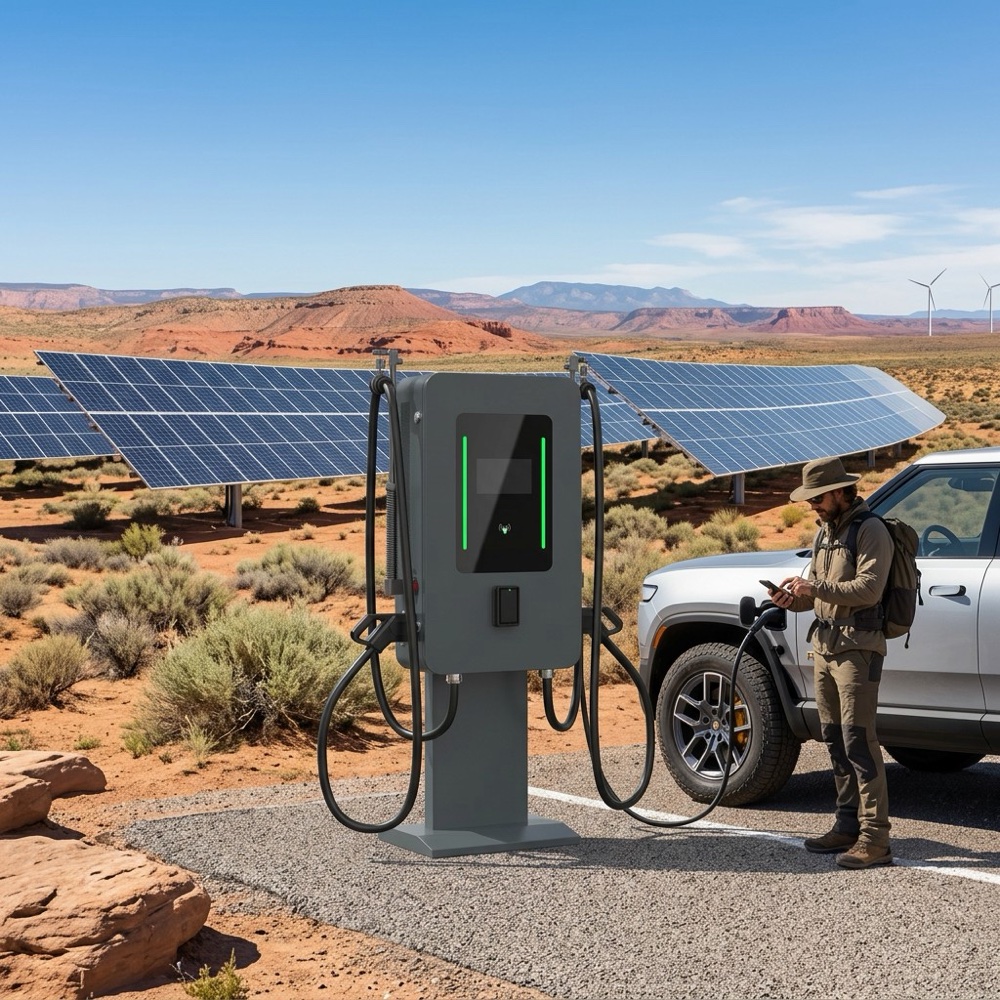
Fuel-Station and Highway Rest-Stop ForecourtsThe classic public-hub use case. Pedestals are island-mounted beside or in place of fuel dispensers, serving drivers who expect fast, reliable, payment-integrated charging. The rugged enclosure tolerates forecourt traffic, fuel-vapour areas (installation zoning permitting), and the weather exposure of an open canopy. Roaming-enabled OCPP puts these chargers on every major app from day one, so a fuel retailer can enter the EV market without building its own software stack. |
|
City-Centre and Municipal Hubs
On-street and car-park hubs face the hardest conditions: salt-treated winter roads, tight spaces, high pedestrian traffic and vandalism risk. The pedestal’s IK10 impact rating, tamper-resistant interface and low-noise operation make it a natural fit. Municipalities also benefit from the configurable power band — a single SKU can serve both a busy transport-hub car park (60 kW) and a quiet residential-adjacent bay (40 kW), standardising procurement and spares.
Fleet Depots and Logistics Yards
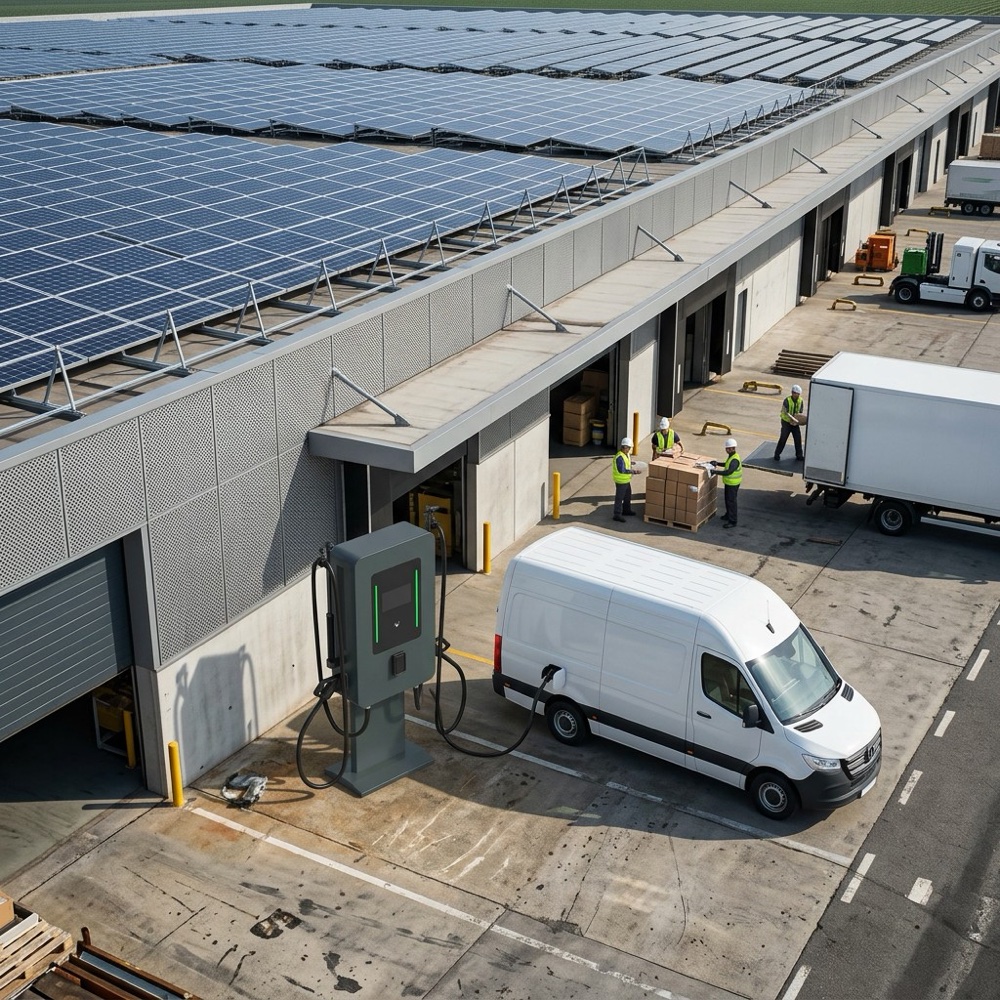
Fleet operators are increasingly building semi-public hubs: depot chargers that also serve the public during off-peak hours, monetising idle capacity. The dual-output pedestal is ideal — two bays per unit, priority mode for the fleet’s own vehicles, public access outside shift windows, and remote power reconfiguration as fleet electrification scales. The 150–1000 V range also covers vans, light trucks and the first electric HGVs at 400 V and 800 V pack voltages.
Retail, Hospitality and Destination Sites
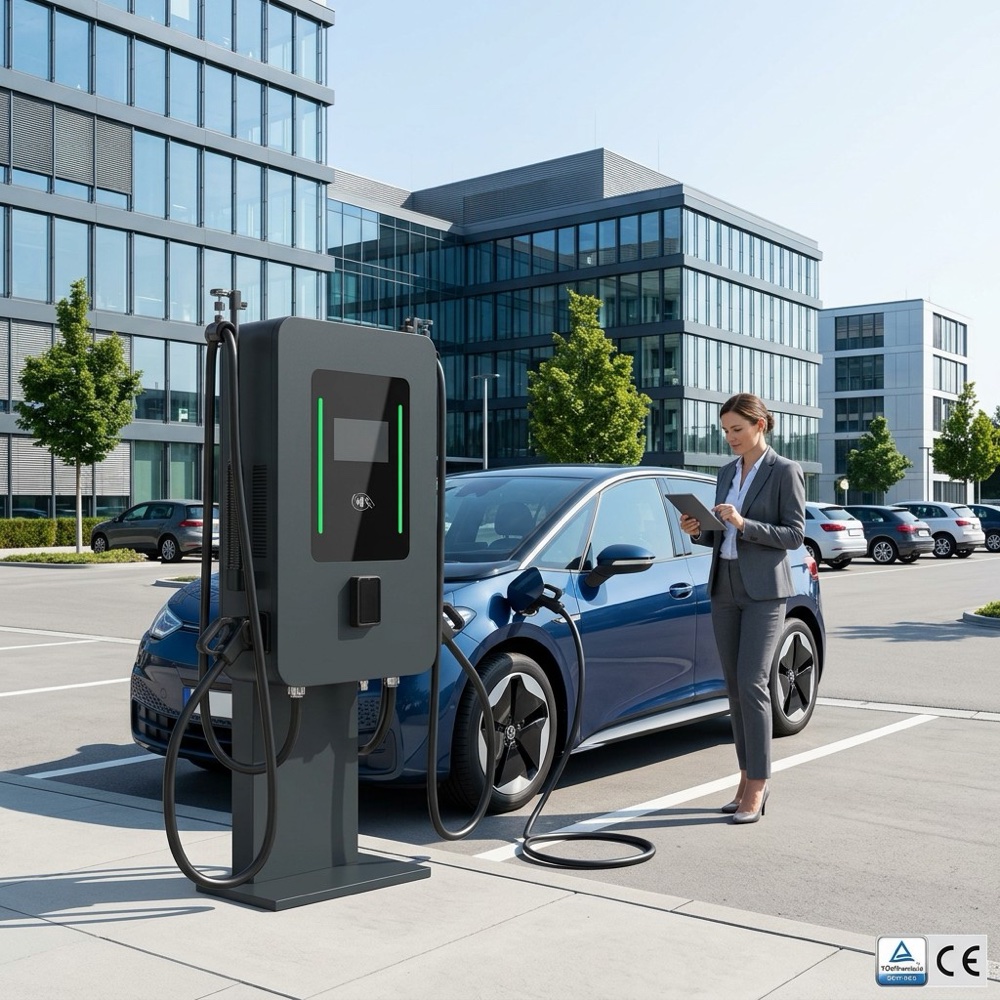
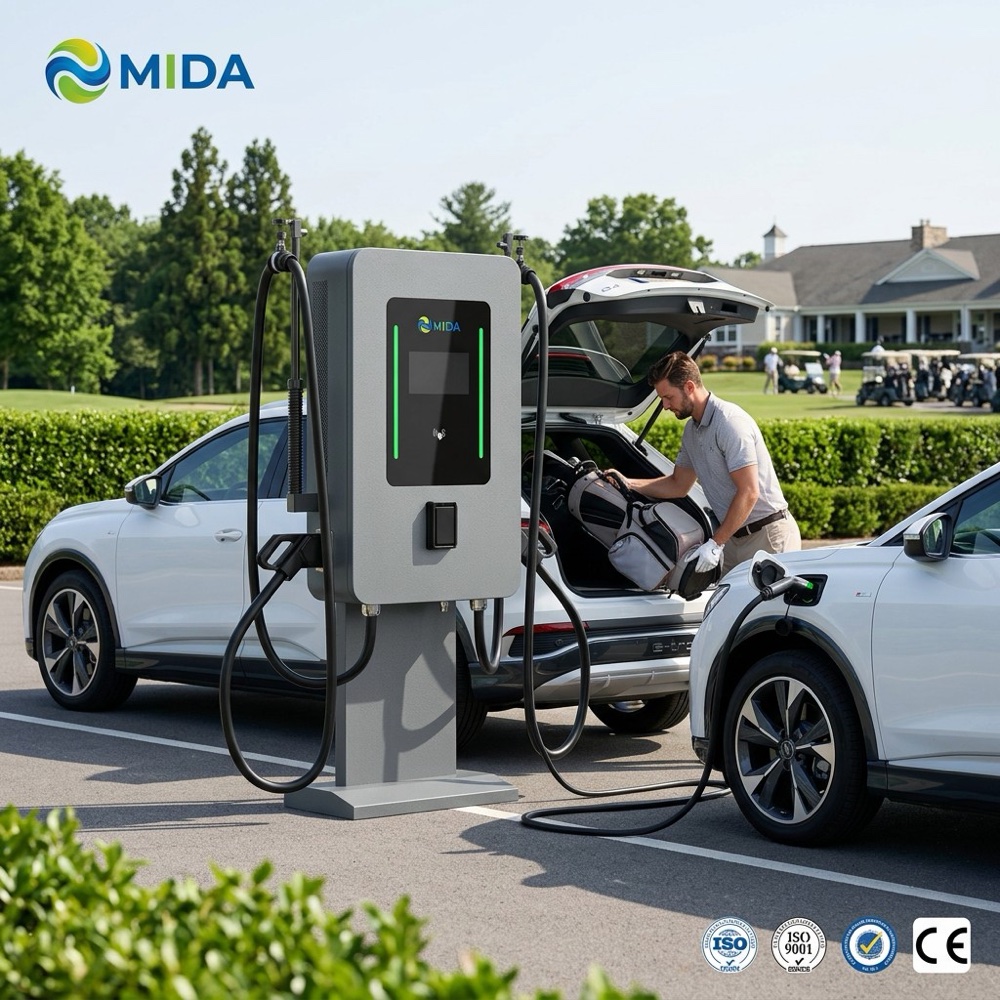
Supermarkets, shopping centres, hotels and leisure venues use public-hub chargers as an amenity and a revenue stream. The pedestal format suits perimeter and car-park-edge siting, the App/RFID access mix accommodates both casual drivers and loyalty-scheme users, and the 40–60 kW band aligns session lengths with typical dwell times while DLB keeps the site’s electrical connection modest.
Technical Specifications at a Glance
| Parameter | MIDA 40kW–60kW Dual Output DC Charger |
|---|---|
| Charging standard | Level 3 DC fast charging (IEC 61851-1 / GB/T 18487.1) |
| Rated output power | 40 kW / 50 kW / 60 kW (software-configurable) |
| Output voltage range | 150 V – 1000 V DC |
| Output current (max, per port) | 250 A (shared power bank; per-port limit configurable) |
| Connector configuration | 2 × CCS2 / 2 × GBT / 1 × CCS2 + 1 × GBT (factory option) |
| Peak efficiency | ≥95.5% |
| Power factor | ≥0.99 (full load, with PFC) |
| Input supply | 400 V ±10%, 3-phase, 50/60 Hz |
| Connectivity | OCPP 1.6J & 2.0.1, RFID (ISO 14443A/B), App, WiFi, 4G |
| User interface | Vandal-resistant 7″ touchscreen, status LEDs, RFID reader, E-stop |
| Mounting | Rugged floor-standing pedestal, plinth-bolted |
| Enclosure protection | IP54 (electronics zone), IK10 (impact) |
| Operating temperature | −25 °C to +55 °C (full power to +45 °C) |
| Certifications | TUV CE (LVD/EMC/RED), UKCA |
| Cable length | 2 × 4.5 m (armoured/cable-managed) |
| Standby power | <50 W |
| Protection | RCD Type A/B, DC leakage, overvoltage, overcurrent, overtemperature, surge (Type 2), door tamper alarm |
Installation, Commissioning and Total Cost of Ownership
Site Preparation and Commissioning
The pedestal installs on a level concrete plinth with four anchor bolts. The site team connects mains supply and earth, fits the SIM (or joins the site WiFi), and the unit runs its internal self-test before the first session. Total commissioning time from delivery to first charge is typically one working day per pedestal, and OCPP registration is standardised across the industry’s major platforms.
Maintenance Model: Remote First, Modular Second
Every pedestal reports continuously to the operations dashboard: module temperatures, connector wear, session outcomes, network quality and cabinet-access events. The MIDA service model is preventive — interventions are scheduled from data trends, not customer complaints. Physical repairs are simplified by a modular bill of materials: swappable power modules, pluggable communication boards and a replaceable display/RFID fascia. Typical on-site repair time is under 30 minutes, after which the unit returns to full dual-port service.
TCO Comparison: Pedestal Dual-Output vs. Two Single-Gun Units
| Cost driver | 2 × single-gun 60 kW pedestals | 1 × MIDA 40–60kW dual-output pedestal |
|---|---|---|
| Hardware (indicative) | €14,000–18,000 | €11,000–14,000 |
| Civils and plinths | 2 plinths, 2 cable runs | 1 plinth, 1 cable run |
| Grid connection | 2 connections | 1 connection |
| Footprint | 2 pedestals | 1 pedestal |
| Annual maintenance visits | 2–3 | 1 (typical) |
| 5-year TCO (indicative) | Higher by 25–40% | Lower |
Scenario: a UK forecourt hub installing 4 pedestals (8 bays) at £12,500 average hardware cost and £4,000 installation each faces roughly £66,000 total capex. At 90 sessions/day across the hub, 25 kWh delivered per session, £0.45/kWh public tariff and £0.18/kWh energy cost, gross revenue approaches £92,000/year — supporting simple payback inside 12–15 months including platform fees and maintenance.
MIDA 40kW–60kW Pedestal vs. the Floor-Mounted 60kW Hub
| Feature | MIDA 60kW Smart (floor-mounted) | MIDA 40–60kW Pedestal (this product) |
|---|---|---|
| Output power | 60 kW fixed | 40 / 50 / 60 kW configurable |
| Enclosure philosophy | Compact commercial cabinet | Hardened public-hub pedestal (IK10) |
| Best-fit environments | Retail car parks, depots, forecourts | Exposed forecourts, street hubs, highways |
| Dual output | Yes | Yes |
| Dynamic Load Balance | Yes (site-wide) | Yes (site-wide) |
| Certifications | TUV CE, UKCA | TUV CE, UKCA |
The two units share the MIDA power platform, connectivity stack and spares family. The choice is environmental: the floor-mounted 60kW hub suits sheltered and semi-sheltered commercial sites; the rugged pedestal is specified where the hardware must survive open-air exposure, casual abuse and heavy public traffic for a decade.
Why Choose MIDA Power
MIDA Power designs and manufactures smart DC charging systems with full vertical integration across power electronics, enclosure engineering and production. The 40kW–60kW Dual Output pedestal station reflects the company’s public-infrastructure philosophy: hardware certified before it ships (TUV CE, UKCA), open at the protocol level (OCPP 1.6J/2.0.1), efficient in daily operation (≥95.5%), and modular enough to keep a hub alive with minimal service intervention. Standard warranty is 2 years, extendable to 3 or 5, with factory-direct technical support and lifetime firmware maintenance.
Related product: MIDA 60kW Smart DC EV Charger — Floor-Mounted Dual CCS2/GBT Hub — the compact floor-mounted variant for sheltered commercial sites.
Frequently Asked Questions
1. Can the output power be changed after installation?
Yes. The 40–60 kW output is software-configurable and can be adjusted remotely via OCPP — for example, raising a site from 40 kW to 60 kW once grid capacity is approved, with no hardware change.
2. How does the charger survive outdoor conditions and vandalism?
The pedestal combines an IK10 impact-rated enclosure (20 J impact resistance), IP54-sealed electronics, tamper-resistant fasteners, a recessed vandal-resistant display and door tamper alarms that alert operators via OCPP if the cabinet is opened.
3. Does it charge 800 V and 900 V electric vehicles?
Yes. The native 150 V–1000 V output envelope covers 400 V, 800 V and 900 V platforms without derating or optional hardware, plus legacy GBT vehicles in the 300–500 V band.
4. How many vehicles can charge at once, and how is power split?
Two vehicles charge simultaneously from the dual outputs. The load-balancing controller splits the 40–60 kW budget — balanced (2 × 30 kW), dynamic priority, or a fixed per-port ratio configured by the operator.
5. What charging network platforms does it work with?
Any OCPP 1.6J or 2.0.1-compliant CPMS — Hubject, Gireve, Monta, Ampcontrol and private fleet back-ends — with no vendor lock-in; platforms can be switched or multi-homed at any time.
6. What certifications are included for European and UK projects?
The charger is TUV CE certified (LVD, EMC, RED) and UKCA certified, meeting the conformity requirements for deployment across the EU and Great Britain without additional work.
7. What is the expected payback for a public hub installation?
At typical UK/EU hub utilisation (60–90 sessions per day per site), simple payback for hardware and installation commonly falls between 12 and 18 months; high-throughput forecourts and subsidised municipal tenders frequently recover investment faster.
Conclusion: The Public-Hub Workhorse
The MIDA 40kW–60kW Dual Output DC Fast Charging Station answers the question every public charging operator is really asking: how do I deploy hardware that makes money for a decade in an environment that is hard on equipment? The answer is a hardened pedestal with software-configurable power, dual-bay economics, a 150–1000 V future-proof power stage, site-wide dynamic load balancing and an open, remotely serviceable connectivity stack — all certified for immediate EU and UK deployment. For forecourts, highway rest areas, city-centre hubs, car parks and fleet depots, it is the rugged workhorse of the public charging transition.
Products categories
-
180kw 240kW DC Ultra Fast EV Charger Station OC...
-
Level 3 EV DC Charger Electric Car Charging Sta...
-
240kw 300kw 360kw 420kW Fast Charging Station F...
-
120KW 160KW 180kW 200kw Fast EV Charger Station...
-
420KW CCS2 New energy electric vehicle Charging...
-
360KW New energy electric vehicle Charging station