


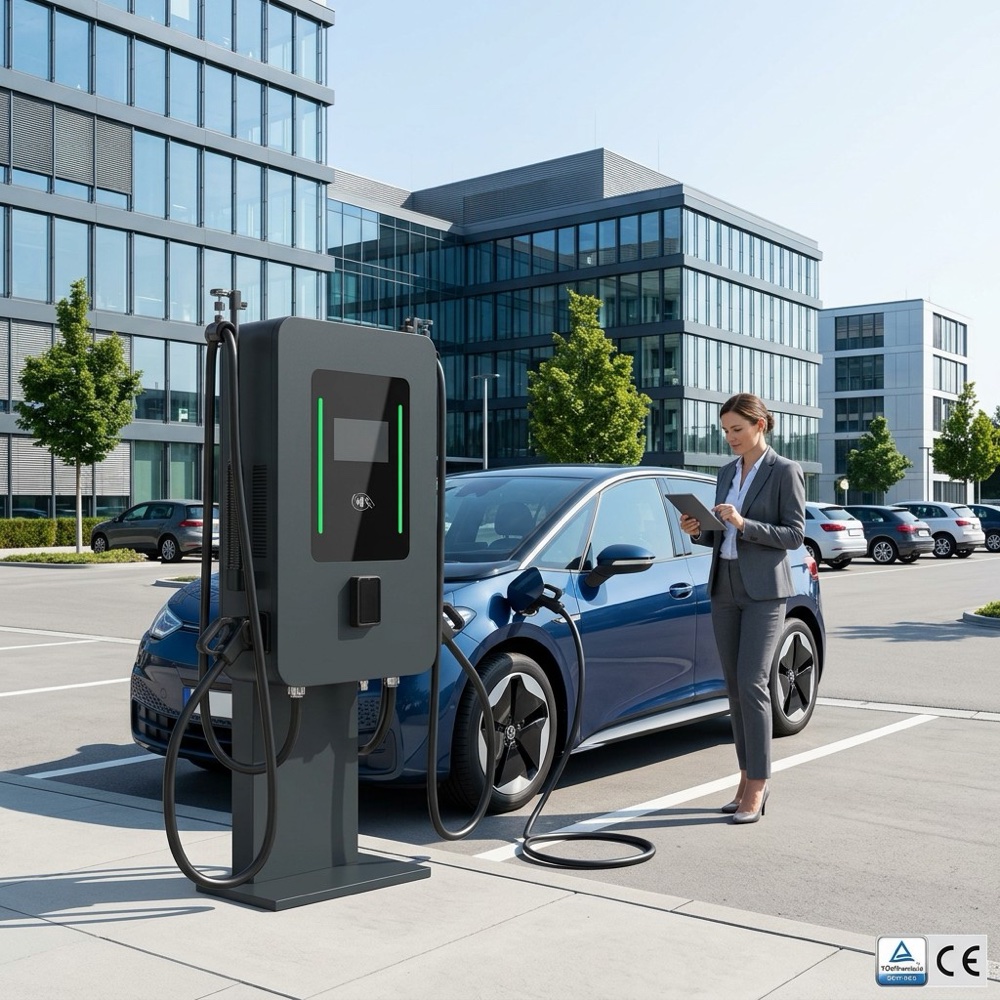
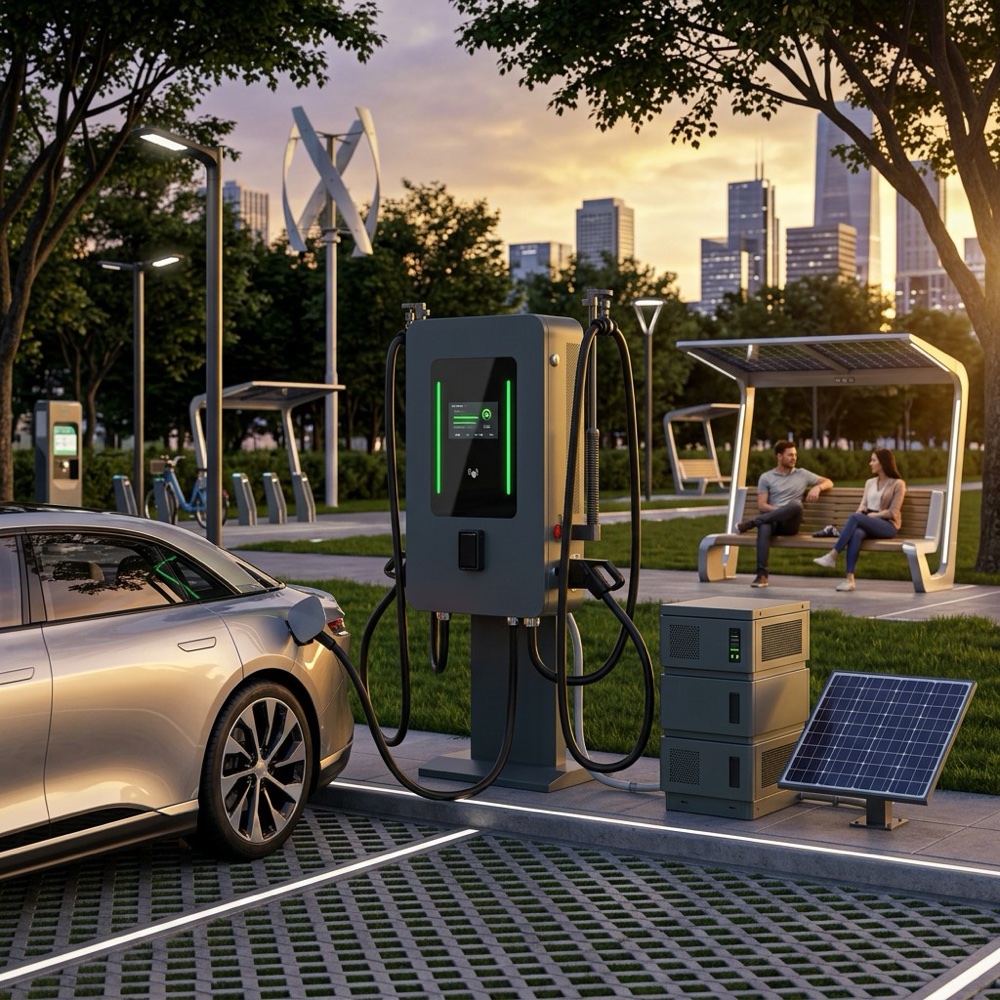
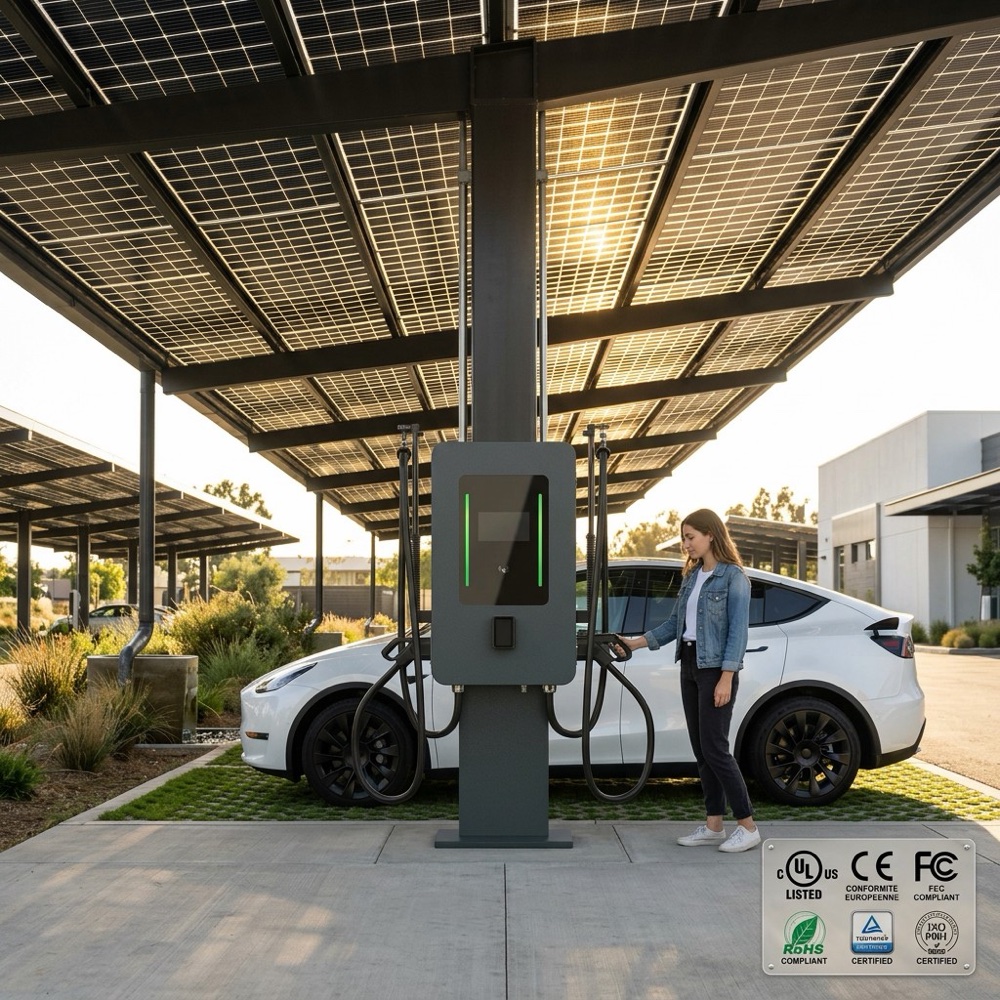
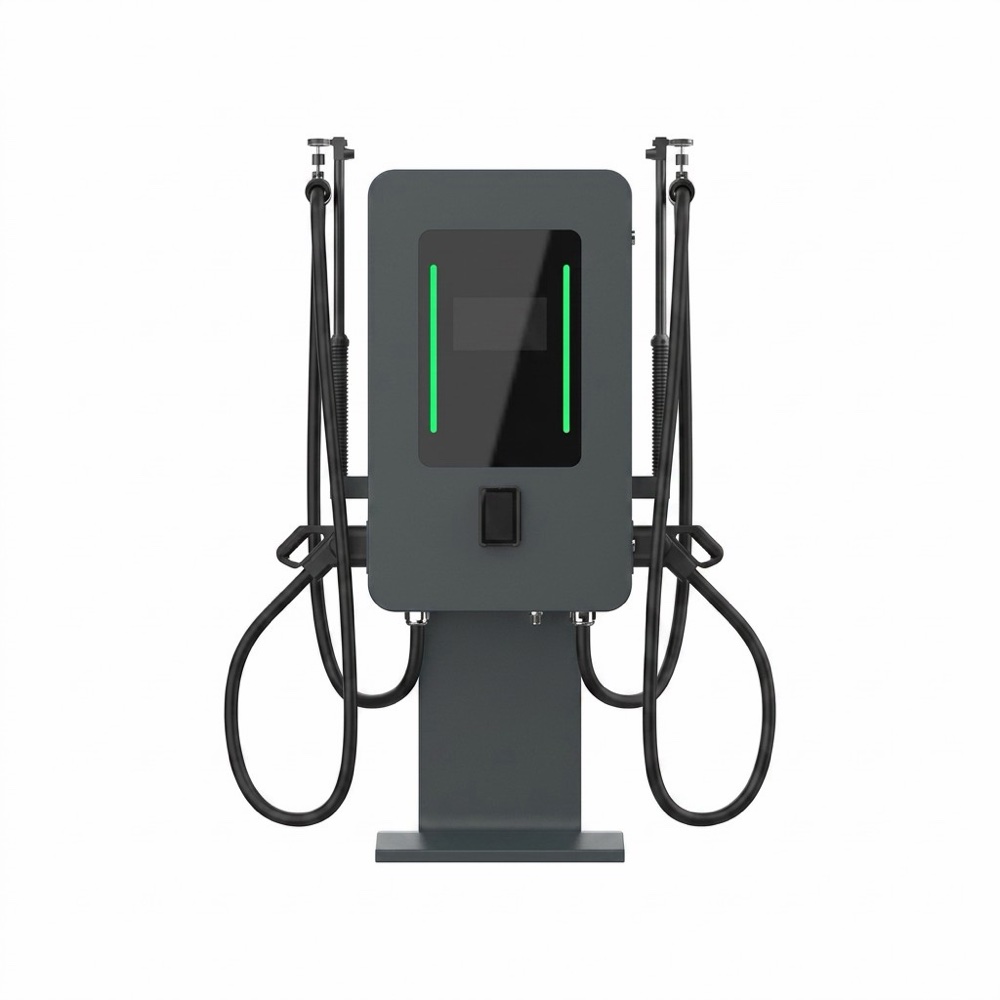
MIDA 40kW Pedestal DC Fast EV Charger — Dual Port Smart Level 3 Station for Parking Lots & Hotels
Quick AnswerThe MIDA 40kW Pedestal DC Fast EV Charger is a compact, self-contained Level 3 (DC) charging station designed specifically for parking lots, hotels, resorts, and destination sites where a full 60–80kW installation is neither necessary nor grid-feasible. Mounted on a sturdy pedestal with a minimal footprint, the unit delivers up to 40kW of DC power across a 150V–1000V output range through two CCS2 ports, enabling two vehicles to charge simultaneously with intelligent power sharing. It integrates with modern charging networks through OCPP 1.6J and OCPP 2.0.1, supports RFID cards and app-based authentication, is ISO 15118 Ready for Plug & Charge, and carries full TUV CE certification. For hotel operators who want to eliminate range anxiety for guests, parking operators who want to monetize every bay, and property owners who want a future-proof amenity without a transformer upgrade, the MIDA 40kW pedestal delivers genuine DC fast charging at an entry-level infrastructure cost — typically installed on an existing 32–63A three-phase supply with minimal civil works. Key Takeaways
|
 |
1. The Missing Middle: Why Hotels and Parking Operators Need a 40kW DC Pedestal
Walk through almost any mid-size European or North American hotel, mall, or municipal parking facility in 2026 and you will see the same infrastructure pattern: a row of 22kW AC chargers that are chronically under-utilized because a meaningful share of guests drive EVs that either cannot reach their destination on a depleted battery or simply will not wait three hours for a meaningful range top-up. At the other extreme sit the 150–350kW highway chargers — spectacular throughput, but with grid-connection costs, demand charges, and civil works that make no economic sense for a hotel parking garage or a suburban lot.
Between those two extremes is the 40kW DC pedestal: a machine that delivers genuine Level 3 DC fast charging — the experience drivers actually ask for — while drawing power from a connection that most existing commercial buildings already have. A 40kW charger on a 32–63A three-phase supply can be installed with a dedicated breaker, a meter, and modest cable work. No transformer upgrade. No 100m of trenching for a new substation feed. No demand-charge shock on the monthly utility bill.
The economics are equally compelling for the property owner. A 40kW DC pedestal converts a parking space into a premium amenity — and increasingly, a revenue stream. Hotels in particular report that EV charging availability is now a stated selection criterion for business and leisure guests, and a DC pedestal at the entrance row or valet bay creates a materially better guest experience than a bank of AC sockets around the corner. For parking operators, 40kW DC slots into the “quick turnover” price tier: a guest can complete a full service transaction — park, shop, dine, or check in — and return to a substantially charged vehicle.
The MIDA 40kW Pedestal was engineered precisely for this role: a compact, quiet, low-maintenance, standards-compliant DC charger that looks right at home in a hotel forecourt, a parking deck, or a resort driveway, and that performs reliably for a decade.
|
2. Technical Specifications at a Glance
Every line in this table is intended to be lifted directly into a site survey or tender document. The two figures that matter most for hotel and parking decision-makers are the 32–63A three-phase supply requirement and the 55 dB(A) noise ceiling — the first determines whether the site can install without an electrical upgrade, and the second determines whether guests in adjacent rooms will ever hear the charger working (they will not, at night). |
3. Dual-Port Design: Two Charging Spaces from One Pedestal
The MIDA 40kW pedestal carries two CCS2 connectors, and here again the architecture is deliberate: a single 40kW power stage, two output ports, and a smart power-sharing controller.
3.1 Smart Power Allocation in Practice
When one vehicle is connected, it receives the full 40kW. When a second vehicle plugs in, the controller assesses both vehicles’ state of charge, charge acceptance curves, and thermal limits, and divides power accordingly — commonly a 25/15kW split, dynamically rebalanced every few seconds. The vehicle closest to completion can be ramped to finish quickly, freeing its bay for the next customer, while the other continues charging steadily.
This is a different economic model from installing two independent 20kW chargers. The dual-port 40kW pedestal gives you one connection, one civil-works package, one service contract, and two charging bays — typically 30–45% lower installed cost per charging point than two separate DC units, while still allowing both bays to be occupied simultaneously.
3.2 Matching the Hotel and Parking Demand Curve
Hotel and parking demand is characterized by predictable peaks: check-out morning rushes, evening check-in waves, and event-day spikes. Dual-port capability absorbs those peaks without double infrastructure. A hotel with eight EV spaces and two 40kW pedestals, for example, can serve four simultaneous DC sessions — enough to cover the overwhelming majority of evening peak demand — while keeping hardware cost, grid load, and visual clutter low.
4. 150V–1000V Output: Ready for Every Vehicle Architecture
The 40kW pedestal spans an output range of 150V–1000V DC, covering the full spectrum of electric vehicles on the road and on order books:
- 400V vehicles — the current mainstream (most volume EVs, vans, and taxis) charge at their native voltage with the converter matching precisely.
- 800V vehicles — newer premium and high-volume models charge without derating, because the power stage supports up to 1000V.
- Hybrids, light commercial, and emerging architectures — fall cleanly within the operating envelope.
For a property owner installing infrastructure in 2026, this range removes the risk of buying equipment that a 2028 vehicle fleet cannot use. The station is built to serve the site for a full commercial depreciation cycle, not just the current model year.
5. ISO 15118 Ready: Plug & Charge Without Friction
ISO 15118 is the standard that governs communication between the vehicle and the charger, and its flagship feature — Plug & Charge — is the single biggest driver-experience improvement in modern EV charging. The vehicle identifies itself cryptographically; the session starts; billing is automatic. No RFID wallet, no app download, no payment terminal.
5.1 What “Ready” Means on This Pedestal
The MIDA 40kW pedestal ships with the ISO 15118 communication stack and the OCPP 2.0.1 security infrastructure required to operate Plug & Charge. When the site’s e-mobility provider or network operator activates PnC in their backend — typically a software-side provisioning of certificates — the pedestal begins authenticating vehicles automatically. This is a software-activation path, not a hardware-retrofit path: the unit is already compliant.
5.2 Why This Matters for Hotels
Hotel guests are the least forgiving of app-based friction. A guest arriving after a long drive, at night, in an unfamiliar city, does not want to register with a third-party charging app to start a session. With Plug & Charge active, the guest simply plugs in and the session is billed to their EV’s charging contract — or, in a hotel-managed setup, reconciled to the room bill. For the hotel operator, ISO 15118 also enables clean separation of guest billing from staff/fleet usage, all managed through the OCPP backend.
6. OCPP 1.6J / 2.0.1: Open Network Integration, Zero Lock-In
A charging asset is only as useful as its network connection. The MIDA 40kW pedestal speaks OCPP 1.6J (the de facto standard deployed across millions of chargers worldwide) and OCPP 2.0.1 (the modern version with hardened security and the Device Model), over 4G cellular or Ethernet.
6.1 Operator Benefits
- Choice of platform: Because OCPP is an open standard, the site owner can select, switch, or even white-label a charging network management platform without touching the hardware.
- Remote operations: Start/stop sessions, modify tariffs, push firmware, read live status, and export meter data — all from a web dashboard.
- Smart charging: OCPP 2.0.1′s Device Model enables fine-grained load management, which is valuable when a hotel runs multiple chargers on a shared supply with other electrical loads (kitchens, HVAC, pools).
- Audit-ready security: TLS 1.3, certificate-based authentication, and signed firmware updates protect the station from tampering and the operator from liability in public deployments.
6.2 A Network Example: Load-Managed Hotel Deployment
A hotel with a 63A three-phase supply and several chargers can use OCPP 2.0.1 smart-charging commands to cap total charging load during breakfast peak or to prioritize a guest whose checkout is imminent. These orchestrated behaviors — increasingly expected by DSOs and demanded by energy-conscious operators — are fully supported by the pedestal’s communication stack.
7. RFID, App, and Contactless Authentication Options
| Authentication Method | Typical Use Case | Key Benefit |
|---|---|---|
| RFID card / fob | Contract fleet drivers, hotel staff, valet | Instant start, per-user billing, works without smartphone |
| Mobile app (CMS partner apps) | Walk-up guests, ad-hoc drivers | Roaming tariffs, QR-based start, digital receipts |
| OCPP remote start / API | Valet desks, front-desk orchestration | Staff can start/stop sessions for guests remotely |
The 7-inch touchscreen keeps the interface simple: plug in, authenticate, and read session progress, live kW, and energy delivered. For valet operations, the remote-start path is particularly valuable — the valet can plug the guest’s vehicle in at the front row and start the session from the desk terminal, so the guest never interacts with the machine at all.
8. Safety, Durability, and TUV CE Certification
Public-facing equipment must be engineered for abuse, weather, and continuous operation — and it must be verifiably safe. The MIDA 40kW pedestal is TUV CE certified under the Low Voltage Directive (2014/35/EU), EMC Directive (2014/30/EU), and Radio Equipment Directive (2014/53/EU), with third-party verification from an independent testing body.
8.1 Built-In Protection Layers
- 6mA DC leakage detection: Automatic disconnection on residual DC fault — the legally and technically essential safeguard for DC charging.
- Ground-fault and insulation monitoring: Detects circuit degradation before it becomes a hazard.
- Overvoltage, undervoltage, and overcurrent protection: Multi-stage protection on the AC and DC sides.
- Over-temperature management: Automatic derating protects electronics during sustained hot-weather operation.
- Type 2 surge protection: Shields against grid transients and lightning-induced surges.
- IP55 enclosure: Dust-protected and water-jet resistant, rated for outdoor, canopy, and parking-deck environments.
- Optional IK10 vandal resistance: For open, unmonitored, or high-traffic installations.
- Emergency stop: Physical E-Stop for immediate output interruption.
8.2 Certification as a Procurement Asset
TUV CE certification is increasingly a non-negotiable in public tenders, utility-subsidized programs, and hotel brand-standard procurement. It provides a defensible, auditable compliance trail — something self-declared “CE” markings cannot offer. The optional MID-compliant meter (Class B) adds billing-grade metrology for tariffed public operation where national regulations require it.
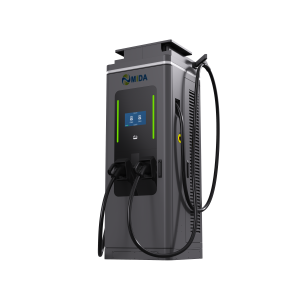
9. Pedestal Design: Compact, Quiet, and Site-Friendly
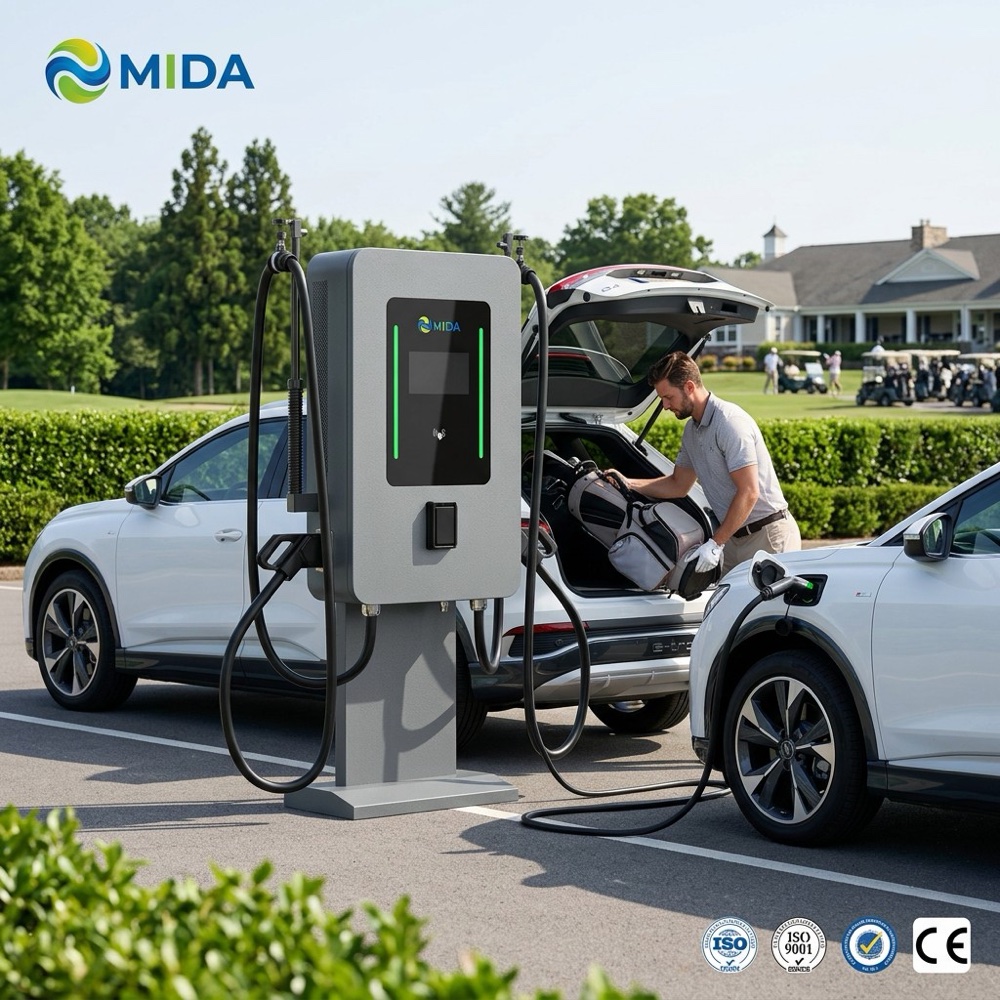
The pedestal form factor is the result of listening to property managers, architects, and parking designers. A pedestal-mounted charger requires no wall, no column, and no structural attachment — it stands on its own base, which means it can be placed at the end of a parking bay, beside a hotel entrance, in a valet lane, or along a lot perimeter, wherever the site plan says charging should live.
9.1 Design Features
- Compact footprint (450 × 280 mm base) — occupies a fraction of a parking bay and never obstructs adjacent spaces.
- Quiet operation — <55 dB(A) at 1m, roughly the level of a quiet conversation; guests in rooms above a garage will not hear it at night.
- Low visual profile (1350mm height) with a clean, neutral enclosure that integrates with branded signage and landscaping.
- Durable construction — corrosion-resistant powder-coated steel, UV-stable, salt-spray tested; built for coastal resorts and northern winters alike.
- Cable management — two CCS2 cables docked in holsters with strain relief, keeping connectors off the ground and minimizing trip hazards.
- Ergonomic connector height — accessible to drivers of sedans, SUVs, vans, and to users in wheelchairs.
9.2 Installation Simplicity
Because the pedestal is surface-mounted on an existing concrete or asphalt pad, installation typically takes a certified electrician less than a day: anchor-bolt the base, terminate the 3-phase supply, provision the network, commission. The commissioning wizard handles CMS registration and certificate provisioning in under 30 minutes. This matters for multi-site hotel groups and parking operators who value consistent, repeatable, low-friction rollouts.
10. The Business Case: 40kW DC Versus the Alternatives
| Factor | 22kW AC Dual-Socket | MIDA 40kW Pedestal (DC) | 60–80kW DC Cabinet |
|---|---|---|---|
| 20%–80% session for 70kWh battery | 2.5 – 3.5 hours | 60–90 minutes | 30–45 minutes |
| Typical AC supply requirement | 32A 3-phase | 32–63A 3-phase | 63–125A 3-phase |
| Typical installed cost (per unit) | €2,500 – €4,500 | €6,500 – €10,000 | €12,000 – €22,000 |
| Daily sessions per space (typical) | 3 – 6 | 8 – 14 | 12 – 20 |
| Guest/driver perceived experience | “Slow AC” | “Real fast charging” | “Very fast” |
| Fit for hotel / parking lot | Functional | Optimal | Often oversized |
The table frames the real decision. An AC charger is cheaper but slow; a 60–80kW cabinet is fast but heavy on grid and capital. The 40kW DC pedestal sits in the sweet spot for the majority of hotel and parking sites: it is genuinely “fast charging” in the eyes of drivers, installs on existing supply in most cases, and monetizes each space several times per day.
10.1 Return-on-Investment Scenarios
- Revenue operation (parking operator, €0.49/kWh tariff, 50kWh/day dispensed): gross revenue ≈ €8,900/year per unit, recovering hardware cost in roughly 10–14 months before energy, service, and platform fees.
- Amenity operation (hotel, free or cost-recovery charging): a 40kW pedestal at the entrance row becomes a booking differentiator; hotels routinely cite EV amenity availability as a top-three factor for EV-driving guests choosing between properties.
- Hybrid operation: many operators run cost-recovery tariffs for guests and paid public rates for non-guests, using OCPP-driven tariff schedules that change automatically by time of day or by user class (guest RFID vs. walk-up).
11. Deployment Scenarios
11.1 Hotels, Resorts, and Serviced Apartments
The guest journey is the design brief: a guest arrives with 15% charge after a long drive, checks in, and expects a usable car in the morning. A 40kW pedestal at the entrance row or valet bay delivers a full charge in 60–90 minutes or a comfortable top-up in the time it takes to check in and have dinner. Quiet operation, tidy cable management, and branded enclosure options keep the forecourt looking like a hotel, not a utility yard.
11.2 Parking Lots and Garages
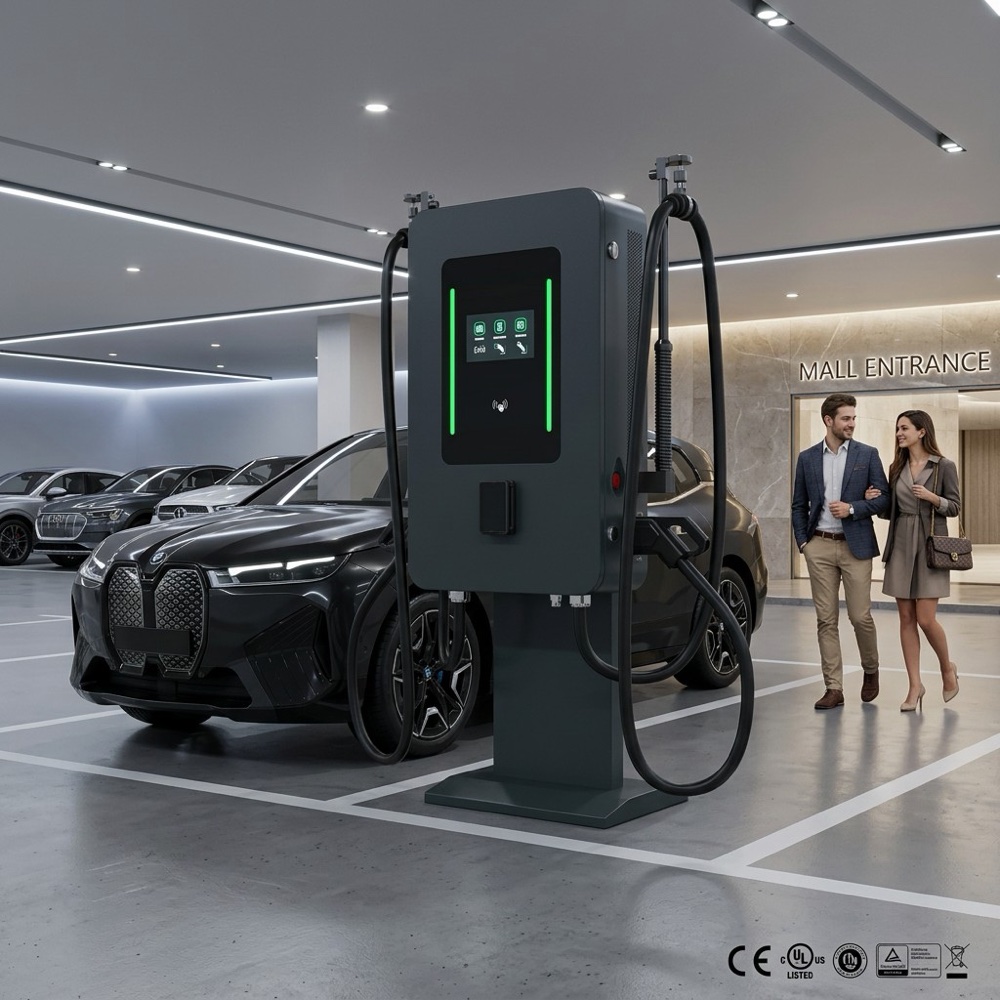
For parking operators, DC fast charging changes the unit economics of a bay. Where an AC bay might host three to six sessions a day, a 40kW DC bay hosts eight to fourteen, and at a higher tariff tier. Dual-port pedestals concentrate that capability in the minimum footprint — critical in garages where every meter of floor space has an opportunity cost.
11.3 Retail and Mixed-Use Destinations
A 40kW dual-port pedestal pairs naturally with a 45–90 minute dwell — the duration of a meal, a shopping trip, or a fitness class. Two units serving four bays cover peak demand without the grid burden of higher-power hardware.
11.4 Small Fleet and Employee Charging
For small fleets (5–15 vehicles) and corporate campuses, the pedestal provides real fast charging for vehicles that return midday for a quick turnaround, while RFID credentials route energy costs to the right department or cost center.
12. Sizing and Selection Guide
| Site Profile | Recommended Configuration |
|---|---|
| Boutique hotel, 5–10 EV guests/night | 1 × MIDA 40kW pedestal (2 bays) |
| Full-service hotel, 15–30 EV guests/night | 2 × MIDA 40kW pedestals (4 bays) |
| Public parking lot, 50–150 spaces | 2–4 × MIDA 40kW pedestals, load-managed |
| Valet operation, entrance-row charging | 1–2 × MIDA 40kW pedestals with remote-start |
| Small fleet depot (5–15 vehicles) | 1–2 × MIDA 40kW pedestals with RFID fleet cards |
| Higher-traffic site with longer sessions | Pair with MIDA 60kW dual gun for peak overflow |
If your site has abundant grid capacity and 30–45 minute dwell profiles, the MIDA 60kW Dual Gun DC Fast Charging Station is the complementary upgrade path. For the typical hotel and parking profile — constrained supply, longer dwell, high aesthetic sensitivity — the 40kW pedestal is the precision fit.
13. FAQ
1. Is 40kW DC charging fast enough for hotel guests and parking customers?
For the vast majority of real-world sessions, yes. A 40kW charge delivers 20%–80% for a 70kWh battery in roughly 60–90 minutes — fast enough for a meal, a check-in, a meeting, or a shopping trip. Compared with a 22kW AC charger (2.5–3.5 hours), it is a step-change in experience.
2. Can both ports charge vehicles at the same time?
Yes. Both CCS2 ports can be active simultaneously, with the controller dynamically sharing the 40kW between sessions (for example 25/15kW) and rebalancing continuously. A single vehicle gets the full 40kW.
3. What electrical supply do I need?
Typically a 32–63A three-phase 400V supply. Many existing commercial supplies can accommodate this without a transformer or service upgrade; a certified electrician should confirm site-specific capacity during the survey.
4. Does the pedestal support Plug & Charge (ISO 15118)?
The unit is ISO 15118 Ready, meaning the hardware and communication stack are in place. Plug & Charge is activated when your network operator provisions certificates and enables PnC in the OCPP 2.0.1 backend.
5. Which charging apps and networks work with this charger?
Any OCPP 1.6J or OCPP 2.0.1 compliant platform. The pedestal is backend-agnostic, so you can choose, switch, or white-label your charging network management provider.
6. Is it certified for outdoor installation?
Yes. The TUV CE-certified unit carries an IP55-rated enclosure, is rated for operation from −30°C to +55°C, and offers an optional IK10 vandal-resistance rating for unmonitored public locations.
7. What does a typical installation involve?
Anchor-bolting the pedestal to a concrete or asphalt surface, terminating the three-phase supply with a dedicated protection group, connecting Ethernet or 4G, and running the commissioning wizard — typically completed by a certified electrician within a day, with no structural or civil works.
14. Conclusion: The Precision Instrument for Parking and Hospitality EV Charging
The MIDA 40kW Pedestal DC Fast EV Charger is the answer to a specific, very common question: how do we offer real fast charging at our property without a transformer upgrade, a construction project, or a six-figure budget? By combining a 40kW DC power stage, a dual-port architecture, a 150V–1000V output range, ISO 15118 Ready Plug & Charge capability, OCPP 1.6J/2.0.1 connectivity, and TUV CE certification in a compact, quiet, pedestal-mounted package, MIDA delivers a charger that is as easy to place as it is to justify on a balance sheet.
For hotels, the pedestal protects the guest experience and the brand standard. For parking operators, it unlocks the revenue and throughput that AC infrastructure simply cannot deliver. And for both, it is an investment made once — standards-compliant, future-proofed, and ready to earn back its cost within the first two years of commercial operation.
Contact the MIDA Power team for a site survey, grid-capacity assessment, and volume pricing for your parking lot or hotel project.
MIDA Power — dependable DC fast charging infrastructure for the places where people actually park.
Products categories
-
180kw 240kW DC Ultra Fast EV Charger Station OC...
-
Level 3 EV DC Charger Electric Car Charging Sta...
-
240kw 300kw 360kw 420kW Fast Charging Station F...
-
120KW 160KW 180kW 200kw Fast EV Charger Station...
-
420KW CCS2 New energy electric vehicle Charging...
-
360KW New energy electric vehicle Charging station