

1. Introduction
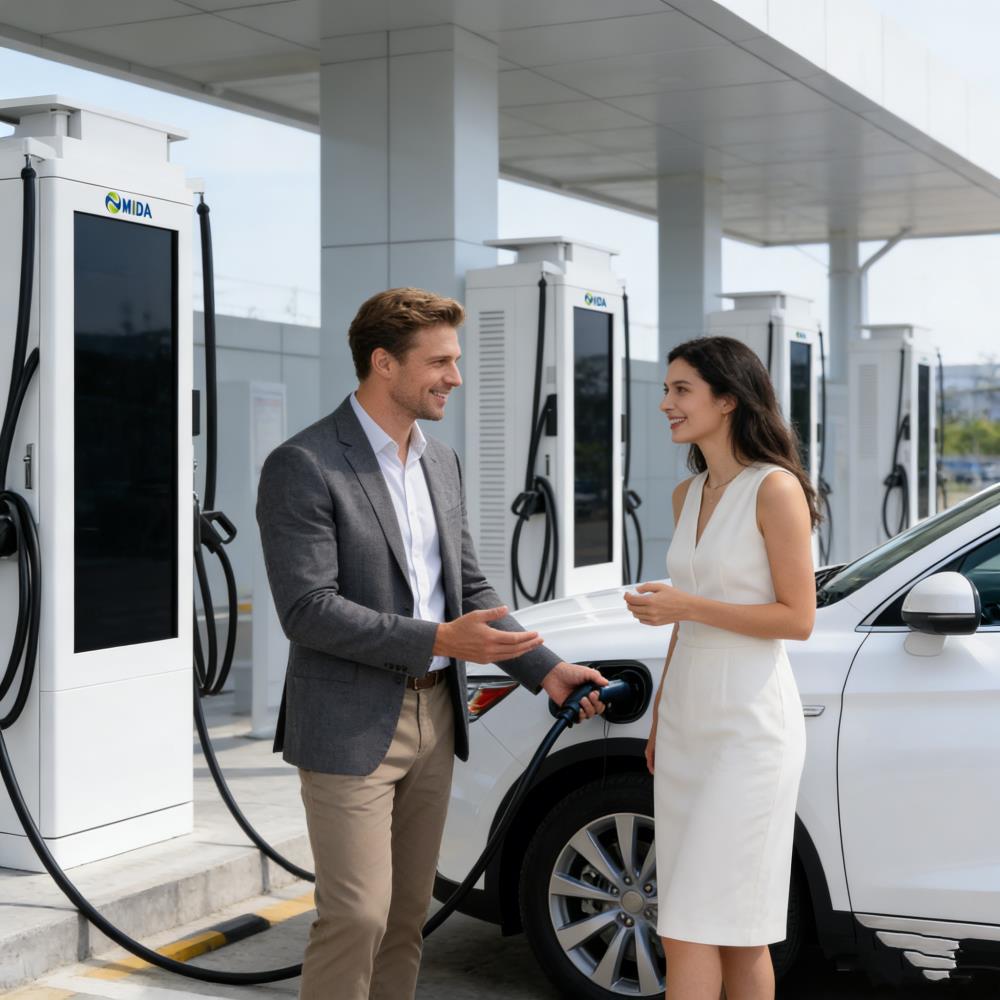
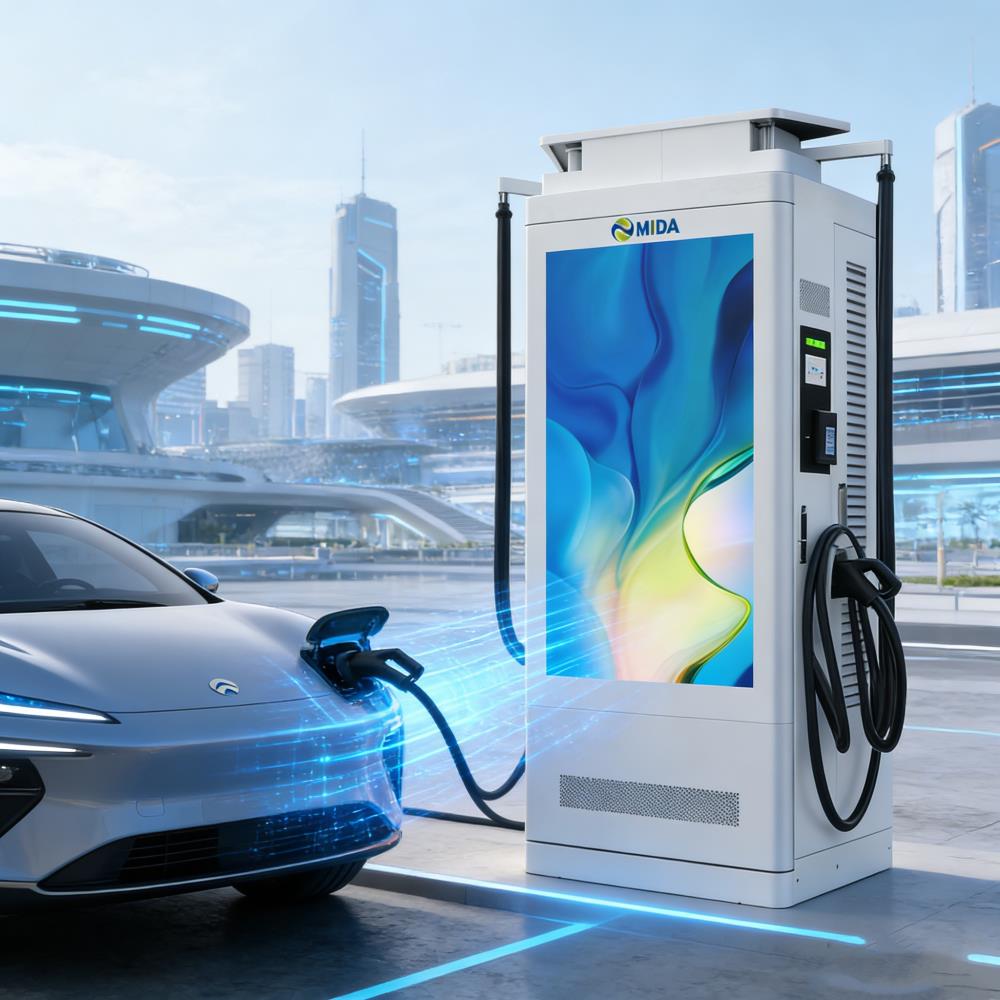
Not every charging site needs 240kW. A large and commercially important segment of the market — urban streets, workplace car parks, hotel forecourts, small retail lots, and apartment-adjacent facilities — operates with constrained grid capacity, shorter dwell expectations, and budgets that demand fast payback on modest capital. For these sites, oversized ultra-fast chargers are not just wasteful; they are often undeliverable, because the local transformer simply cannot support them. The MIDA Floor-mounted 60kW/90kW DC Fast Charger with Touchscreen Advertising Display is engineered precisely for this middle market: enough power to deliver a genuinely useful charge in 30–60 minutes, a footprint that fits any parking bay, and an interactive touchscreen that turns the charging session into a media and engagement opportunity.
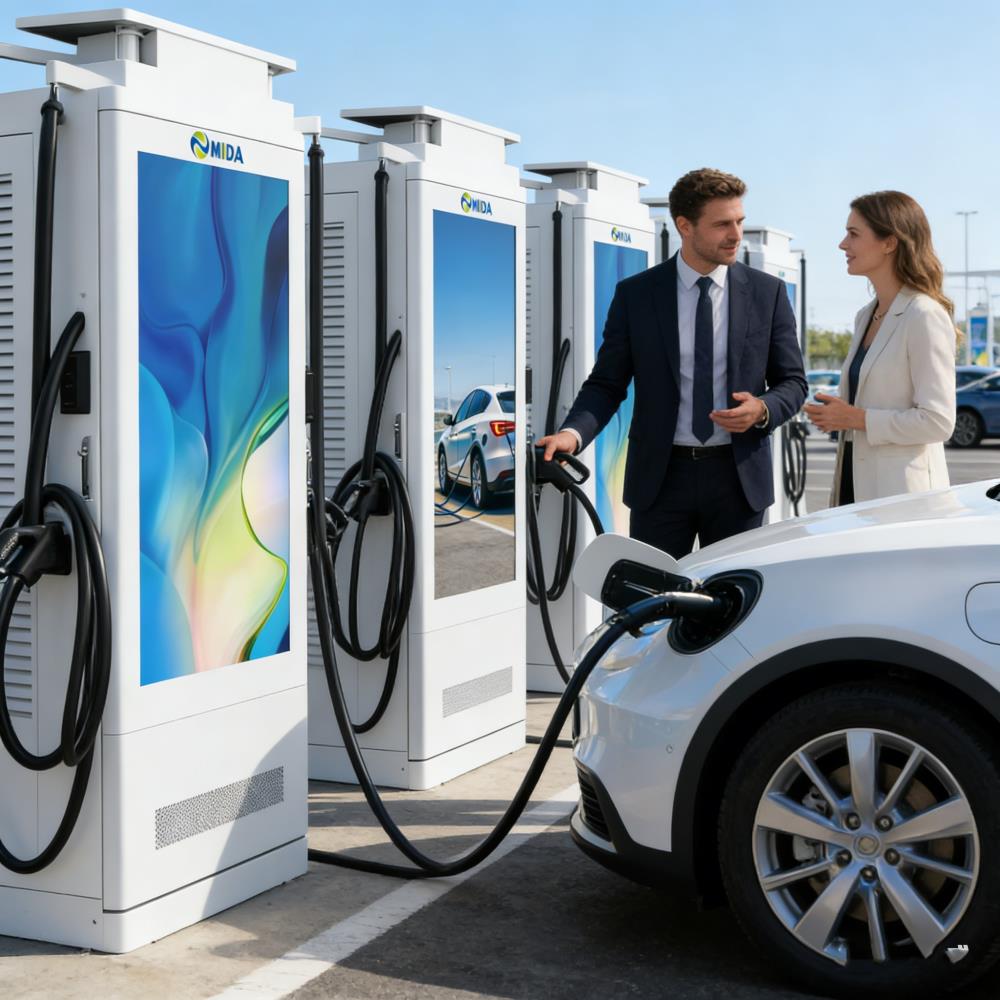
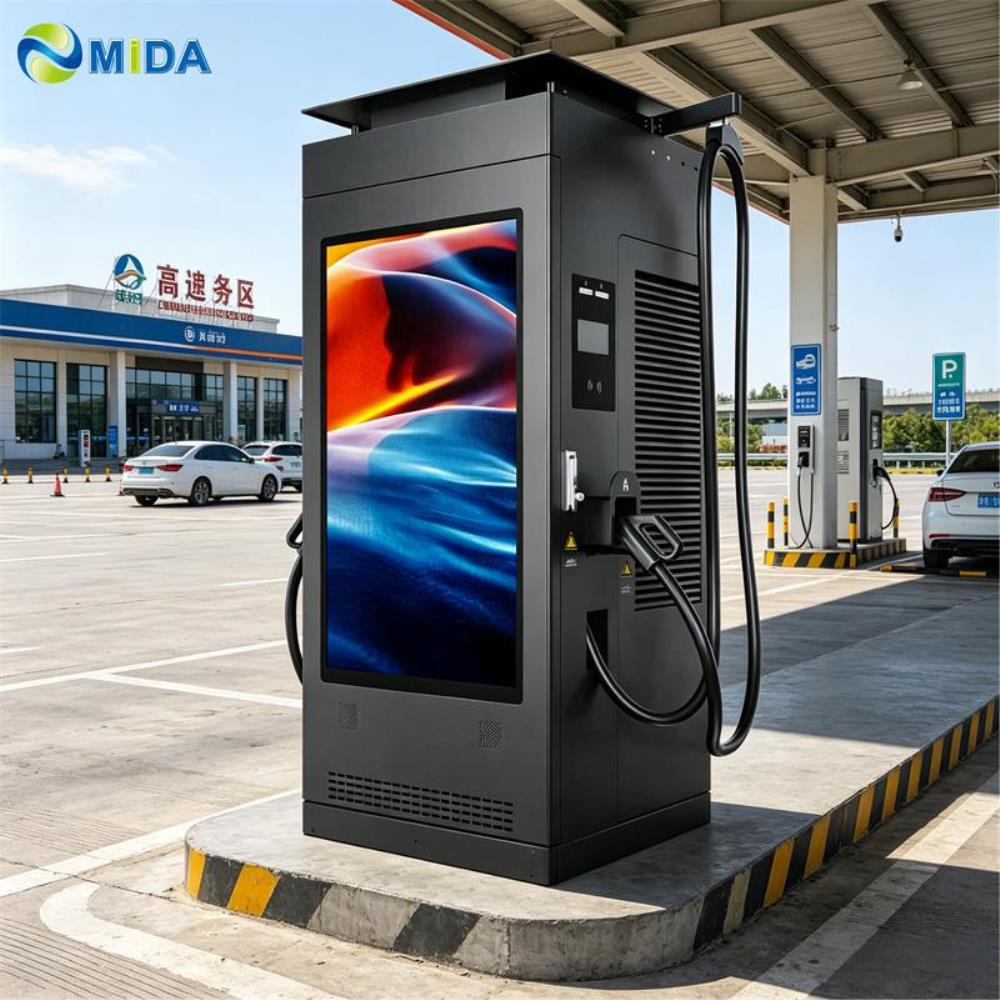
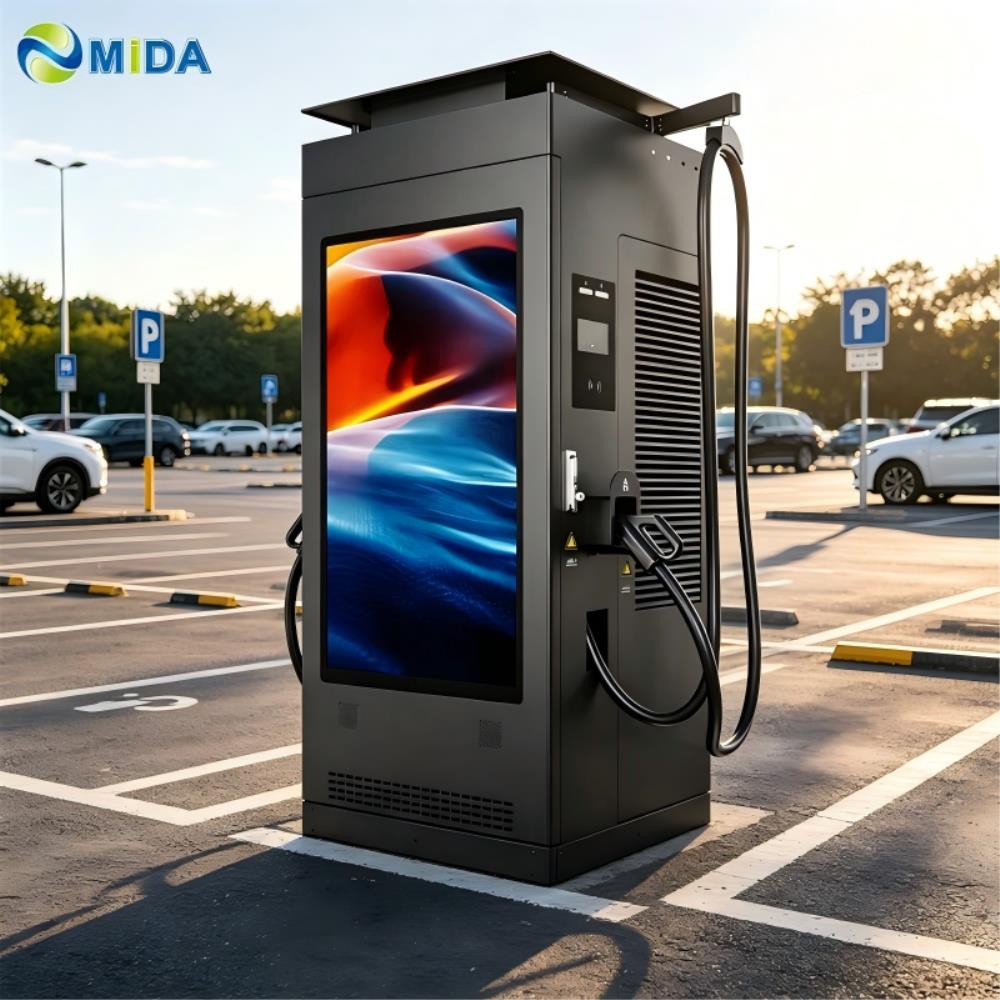
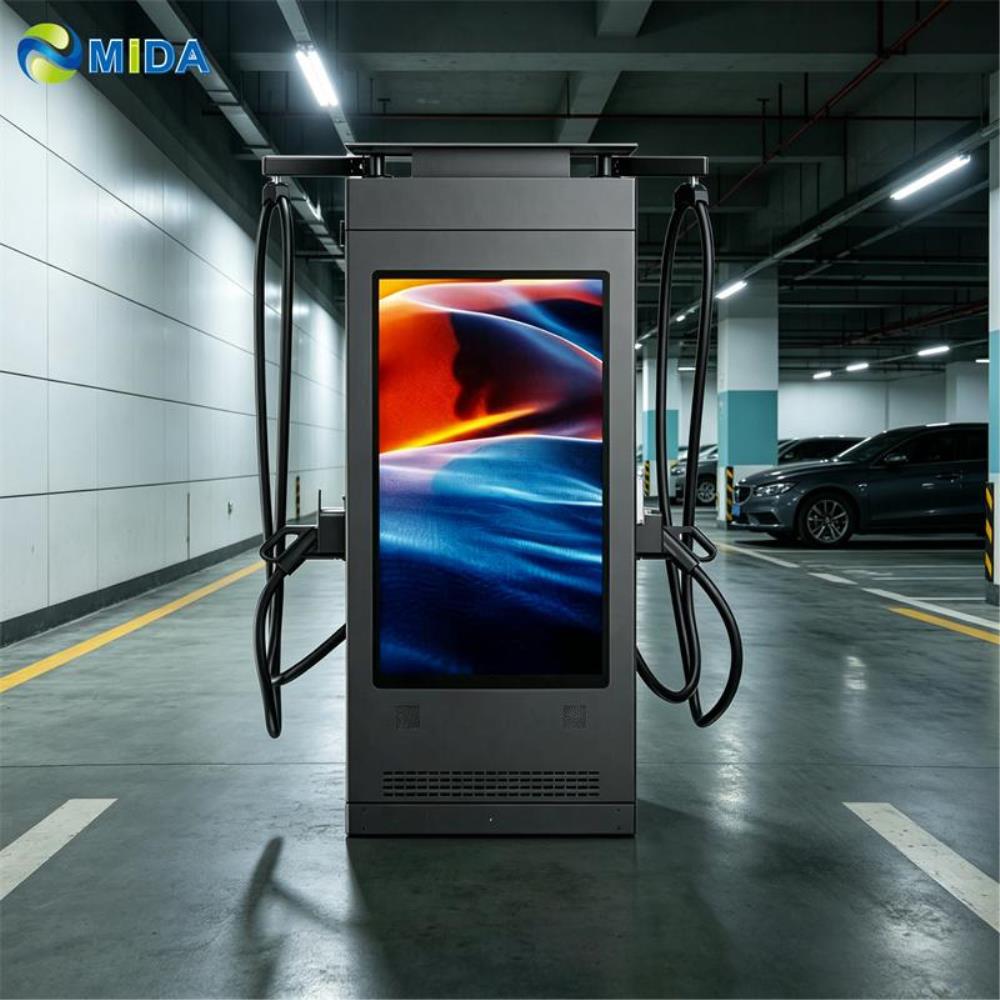
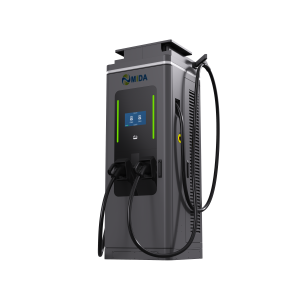
The 60kW and 90kW power levels map directly onto real-world use patterns. A 60kW unit adds roughly 150–200km of range in 30–45 minutes — ample for urban top-ups, workplace sessions, and hotel guests. A 90kW unit compresses that window to 25–35 minutes, approaching the experience of a fast charger while still running on supplies that many existing buildings can provide with modest reinforcement. The floor-mounted format is deliberately simple: no complex canopy integration, no trenching for distribution cabinets — just a self-contained pedestal that a site owner can position in a corner of the car park and connect to the building supply.
Positioning summary: this product is the “democratizer” of the MIDA advertising-charger family. It brings the dual-revenue model — charging income plus advertising income — to sites where a 240kW hub machine would be oversized and overpriced. The touchscreen advertising display is the differentiator: unlike passive displays, the touch interface supports interactive campaigns — coupon redemption, QR-based offers, surveys, wayfinding — which command higher engagement metrics and premium CPMs. With OCPP 1.6J compliance, RFID/QR/app authentication, and the full MIDA backend stack, the unit integrates into any operator’s network with minimal friction. The sections below cover the interactive display economics, power electronics, safety and durability, connectivity, specifications, and deployment playbook.
2. Interactive Advertising Screen: Touchscreen Engagement That Commands Premium Rates
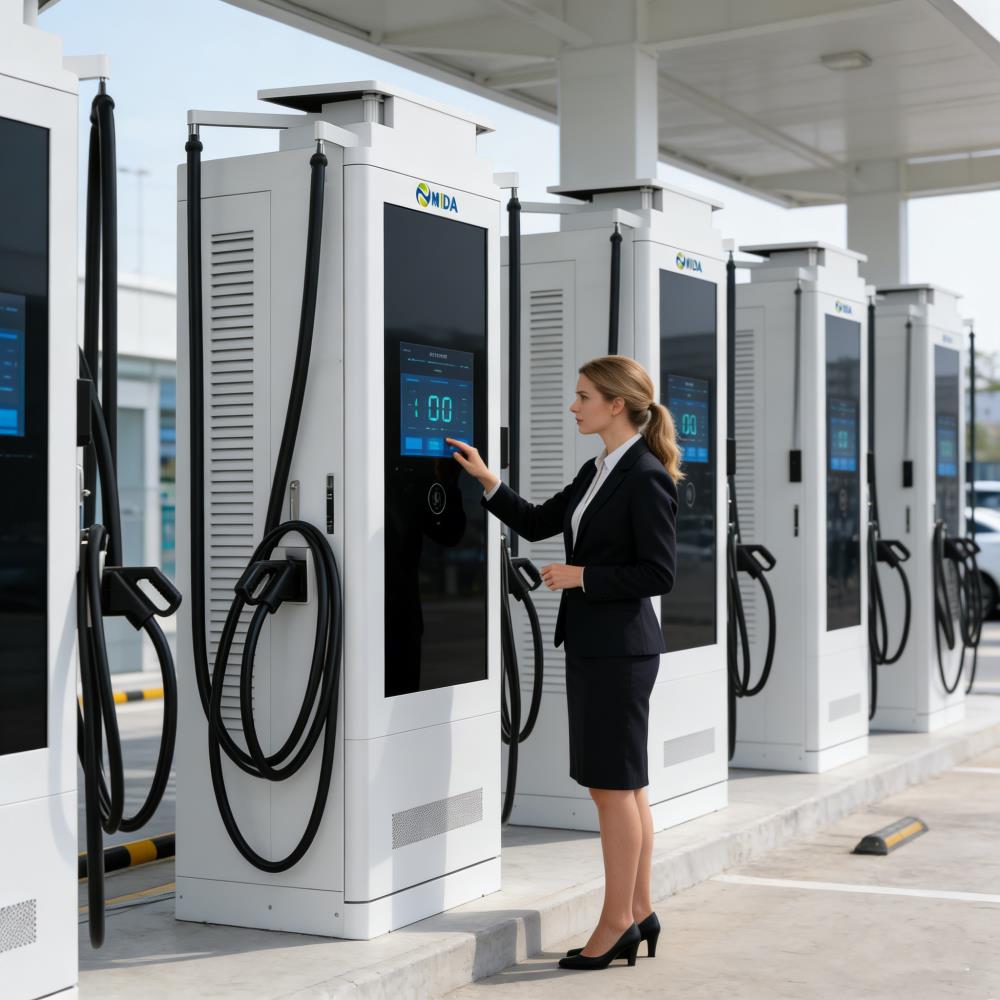
The 21.5-inch or 32-inch touchscreen (configurable) on this charger is the most interactive media surface in the MIDA family. Where larger passive displays broadcast, this screen converses: it responds to touch, delivers interactive content, captures user input, and measures engagement with precision. For advertisers, interactive inventory commands materially higher rates than static or video-only DOOH — commonly 1.5–3× the CPM of passive inventory — because engagement is measurable and verifiable, and because the user has opted into the interaction.
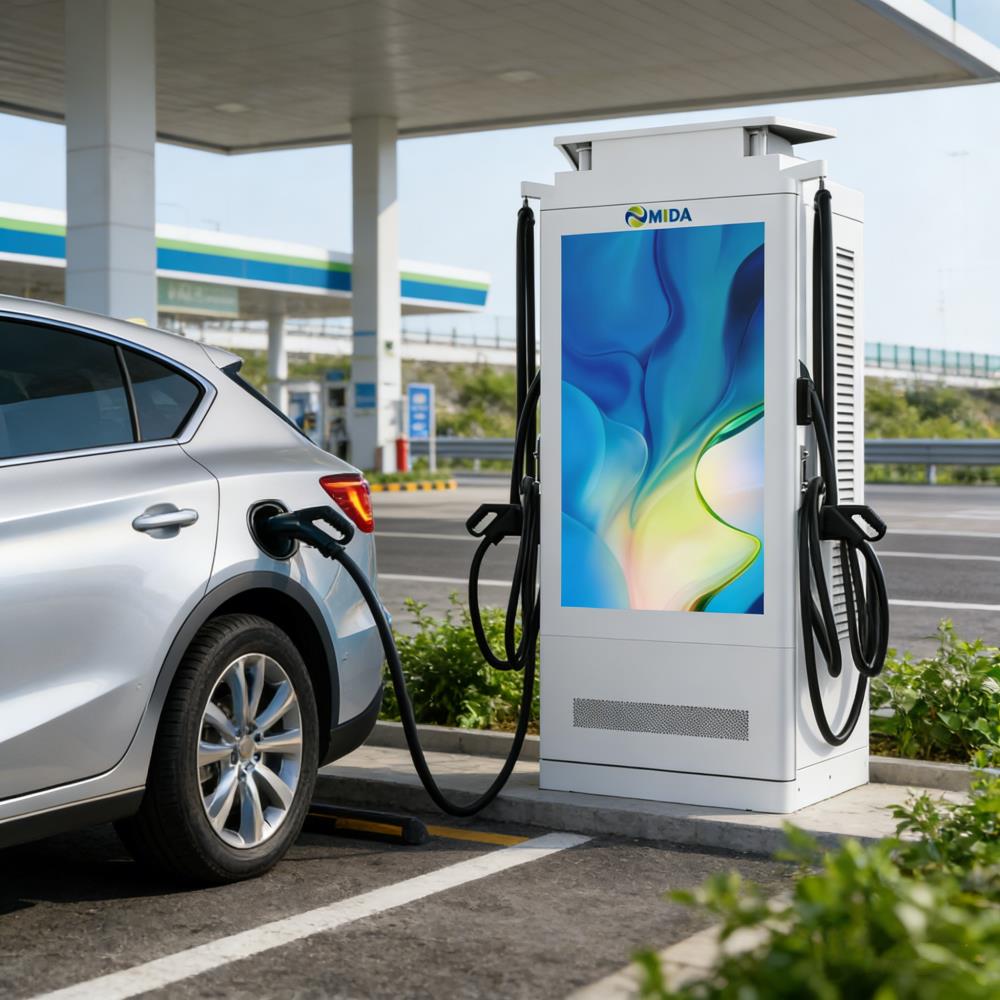
The hardware is outdoor-grade: 1920×1080 resolution, 1500–2000 nits brightness with ambient-light adaptation, projected-capacitive touch that works with gloved hands, and IK10-rated tempered glass over an IP65 housing. The panel is readable in direct sunlight and remains responsive in rain (the touch layer rejects water droplets). The auto-brightness and heat-pipe cooling keep the panel within specification across -25°C to +55°C ambient operation.
The commercial model for interactive screens at 60–90kW sites is distinct from hub advertising. Because sessions are shorter and sites are lower-traffic, the screen’s value comes from interaction quality rather than raw impression volume. Typical deployments:
- Workplace and hotel sites: the screen shows the building’s amenities, local restaurant offers, and taxi/ride-hail QR codes. A guest waiting 40 minutes for a 60kW charge can book a table, order coffee, or redeem a spa voucher — transactions the property monetizes directly or via commission.
- Urban street and small retail sites: the screen runs coupon campaigns — “scan to get 10% off at the café across the street” — with redemption tracked digitally, giving advertisers a closed loop that justifies premium rates.
- Municipal and community sites: the screen doubles as a public information terminal — transit schedules, local events, emergency notices — funded by sponsorship from local businesses.
The CMS supports the interactive workflow: campaign design tools, QR code generation, redemption tracking, multi-tenant scheduling, and day-parting. Split-screen modes keep charging status visible alongside interactive content, and the touch surface can be locked into “information mode” when no campaign is active. Engagement analytics — touches, scans, redemption rates, dwell — are reported per campaign, providing the verification advertisers require.
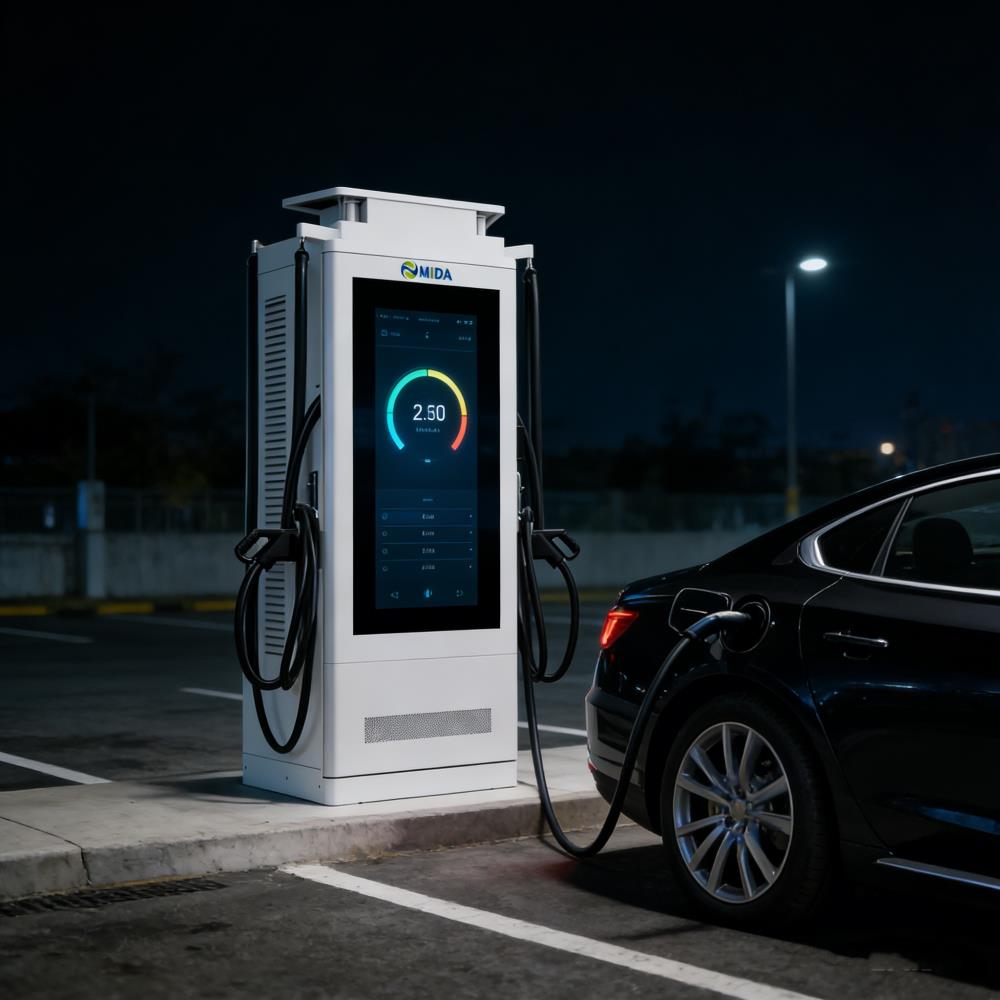
Revenue modeling for a 60–90kW site is conservative but real. A well-positioned urban screen generating 3,000–8,000 daily impressions, with 1–3% interaction rates, supports sponsorship packages of €200–€800 per month from 2–4 local advertisers — often enough to cover 15–30% of the site’s total operating cost, including electricity, in the first year. For sites where the charger itself is a customer-acquisition tool (hotel, gym, restaurant), the interactive screen’s promotion value multiplies the benefit beyond direct media revenue.
3. High-Performance Charging Technology: 60kW/90kW with Wide-Voltage Flexibility
The power stage of the 60/90kW charger is a compact, high-efficiency DC platform with output configurable at 60kW or 90kW (modular slot upgrade on the 90kW variant). The unit supports dual-gun operation on the 90kW configuration — 45kW+45kW to two vehicles, or 90kW to one — and single-gun on the base 60kW model, with an optional second gun for sites where dual-bay flexibility matters. Dynamic power sharing rebalances in real time as vehicles complete their sessions.
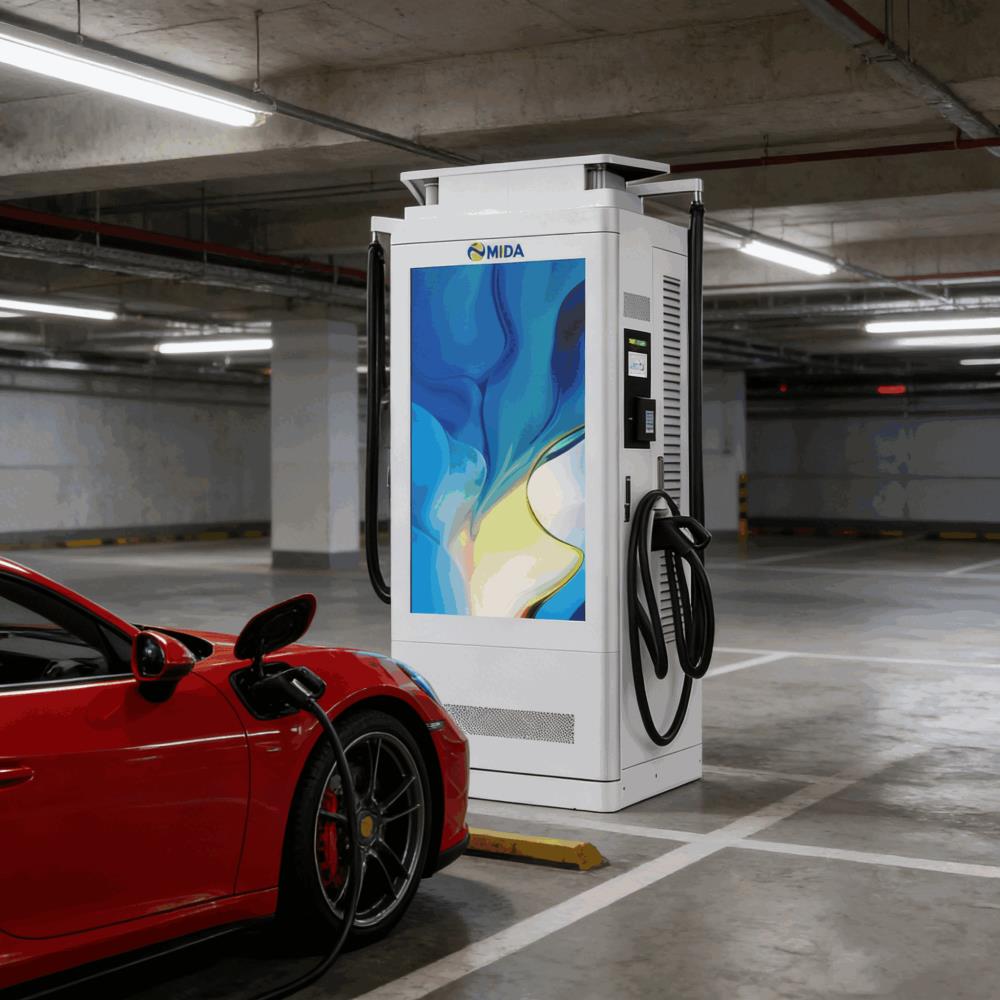
The 150–1000V DC output range is retained across the platform, which matters more than many buyers realize even at these power levels: the voltage range determines which vehicles can use the station at all. A charger capped at 500V cannot serve 800V-architecture vehicles; the MIDA unit serves the entire current and future parc. Per-gun current reaches 150A continuous on the 60kW model and 250A on the 90kW model, comfortably handling passenger EVs and light commercial vehicles. Peak efficiency of 95%+ keeps losses — and the associated heat — low, which is important for installations in semi-enclosed spaces where ventilation is limited.
Input is 400V AC three-phase, 50/60Hz, ±15%, and crucially for this product class, the 60kW configuration can often be served from an existing commercial supply with modest reinforcement — a decisive advantage in urban retrofit projects where grid work is expensive or slow. Optional local load management lets multiple units share a single feeder, and the charger supports scheduled charging windows, time-of-use tariffs, and demand-response participation via OCPP smart-charging extensions.
Connector options are configured at order time: CCS2 for Europe and the Gulf, CCS1 for North America, CHAdeMO-capable variants where required, and NACS adapter readiness. ISO 15118 Plug & Charge is available on request. The charging process includes pre-session contactor checks, insulation monitoring, and graceful thermal derating above 55°C ambient, with cold-weather startup down to -25°C. For a hotel or workplace operator, the practical result is a charger that starts reliably every morning, serves every guest’s vehicle, and delivers a predictable charging experience that builds repeat usage.
4. Safety and Reliability
Safety engineering for a charger that may be installed in a hotel driveway, an office courtyard, or a public street follows the same discipline as the larger models: CE certification (LVD, EMC, RED), UKCA marking, compliance with IEC 61851-1/23, IEC 62196, and ISO 13849, and independent type testing. The protection suite includes AC-side Type II surge protection, Type A RCDs with 6mA DC leakage detection, DC-side insulation monitoring before and during sessions, per-gun contactor weld detection, an emergency stop, and remote de-energization.
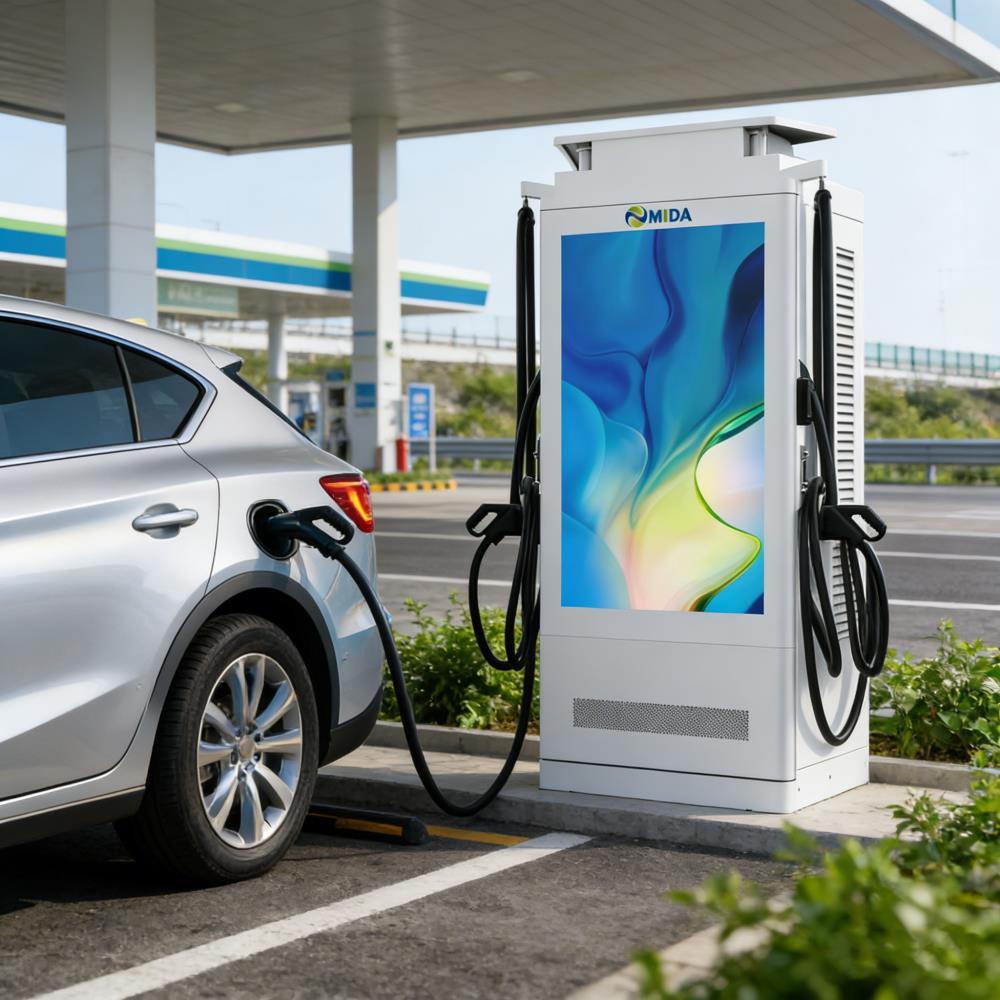
The IP55 cabinet and IP65 touchscreen housing protect against rain, dust, and hose-down cleaning, with IK10 impact ratings resisting accidental damage from vehicles and trolleys — and deliberate vandalism in unattended locations. The floor-mounted pedestal is engineered for stability: a bolted base plate with optional wheel-stop integration keeps the unit securely positioned, and cable management keeps cables off the ground to eliminate trip hazards.
Thermal reliability at these power levels is comparatively benign, but the design still includes intelligent forced-air cooling with variable fan speed, conformal-coated control electronics for humidity resistance, and a design life of 10+ years with conservative component derating. All serviceable components — modules, fans, touchscreen, communication boards — are field-replaceable, and MIDA’s remote diagnostics provide fault alerts and over-the-air firmware updates. For a site owner without dedicated technical staff — a hotel manager, a facility manager — the combination of robustness and remote support means the charger effectively looks after itself.
5. Smart Management and Connectivity
OCPP 1.6J compliance is standard, giving the operator freedom to connect the charger to any OCPP-compliant backend — a white-label platform, a roaming aggregator, or a municipal system — with no vendor lock-in. OCPP 2.0.1 is available on request. Connectivity is redundant: 4G LTE (5G-ready), Wi-Fi, Ethernet, and RS485, with offline session handling and local transaction caching for sites with unreliable networks.
Authentication is flexible: RFID, QR code, mobile app, and Plug & Charge. For a hotel, QR and app charging integrated with the property’s booking system creates a seamless guest experience — the charge is billed to the room, and the receipt appears automatically. For a workplace, RFID fobs linked to employee accounts simplify administration. The backend dashboard provides session monitoring, revenue reporting, utilization analytics, remote configuration, and over-the-air updates — everything an operator needs to manage a distributed estate of chargers from a single screen.
The advertising CMS runs on the same connectivity, logically isolated from the charging system: scheduled campaigns play from local cache even during outages, and media operations never affect charging availability. Campaign analytics (impressions, touches, scans, redemptions) are reported automatically, giving the operator the data needed to renew sponsorships at premium rates.
6. Detailed Technical Specifications
| Parameter | Specification |
|---|---|
| Model | MIDA Floor-mounted 60kW / 90kW DC Fast Charger with Touchscreen Display |
| Output Power | 60kW (single gun) / 90kW (dual gun, dynamic sharing) |
| Input | 400V AC ±15%, 3-phase, 50/60Hz |
| Output Voltage | 150–1000V DC |
| Output Current | Up to 150A (60kW) / 250A per gun (90kW) |
| Charging Connectors | CCS2 / CCS1 / CHAdeMO variant / hybrid; NACS adapter ready |
| Charging Protocols | OCPP 1.6J (2.0.1 optional), DIN 70121, ISO 15118 ready |
| Display | 21.5″ / 32″ touchscreen, 1920×1080, 1500–2000 nits, PCAP touch |
| Display Protection | IK10 tempered glass, IP65 housing |
| Enclosure Rating | IP55 cabinet, IK10 vandal resistance |
| Cooling | Intelligent forced-air; conformal-coated electronics |
| Communication | 4G LTE / 5G-ready, Wi-Fi, Ethernet, RS485; RFID/QR/App/Plug & Charge |
| Efficiency | ≥95% peak |
| Smart Charging | Time-of-use, demand response, load management, scheduled windows |
| Operating Temperature | -25°C to +55°C (graceful derating) |
| Certifications | CE (LVD/EMC/RED), UKCA, IEC 61851-1/23, IEC 62196, ISO 13849 |
| Dimensions (W×H×D) | ~500×1600×300mm, floor-mounted pedestal |
| Warranty | 2-year standard; 5-year extended option |
This specification defines a compact, grid-friendly charger with the same interoperability, safety, and media capabilities as larger siblings. Buyers comparing units in the 60–90kW class should check output voltage range, touchscreen durability, authentication flexibility, and OCPP certification depth.
7. Use Cases & Installation
The 60/90kW touchscreen charger deploys across a wide range of sites:
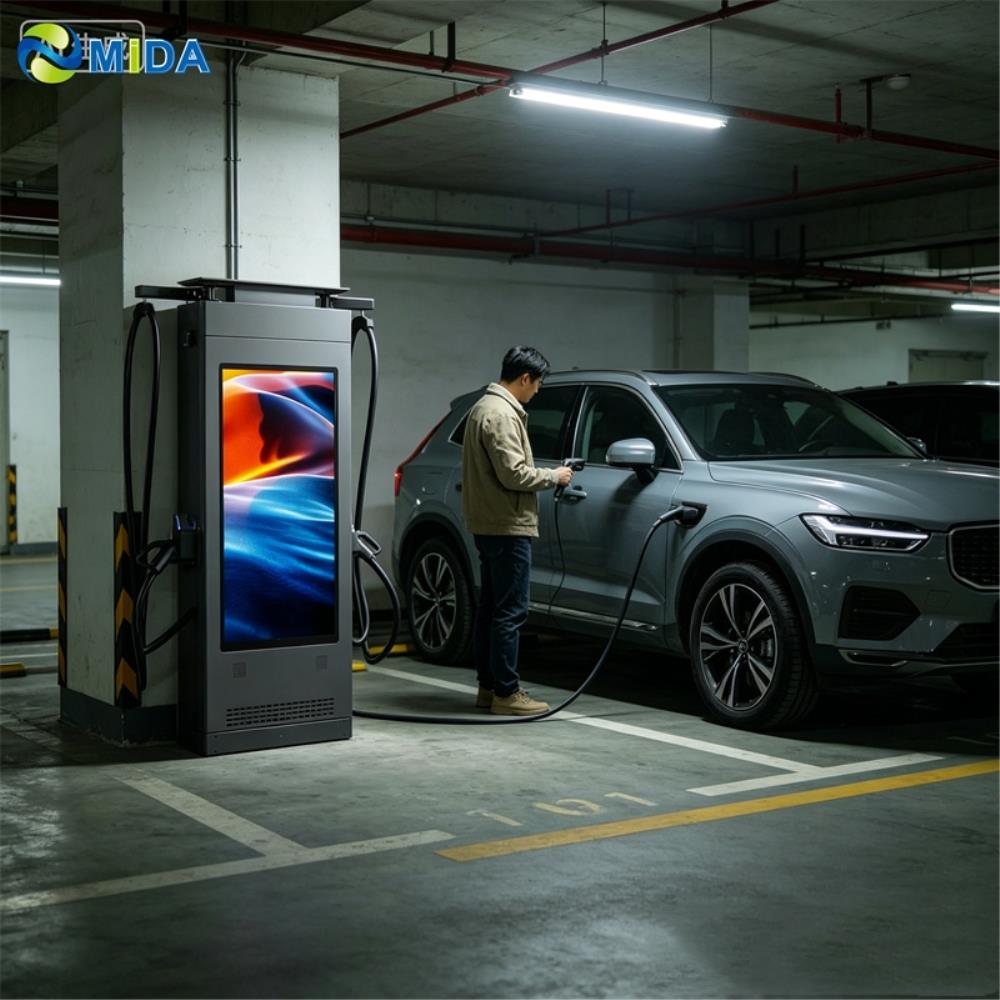
- Hotels & Hospitality — 60kW units in guest parking serve overnight and pre-departure top-ups; the touchscreen promotes the restaurant, spa, and local attractions, creating a guest-experience differentiator and a sponsorship revenue line.
- Workplace & Corporate Campuses — 90kW units with dual guns serve employee fleets and visitor parking; the screen runs internal communications, cafeteria menus, and local business ads.
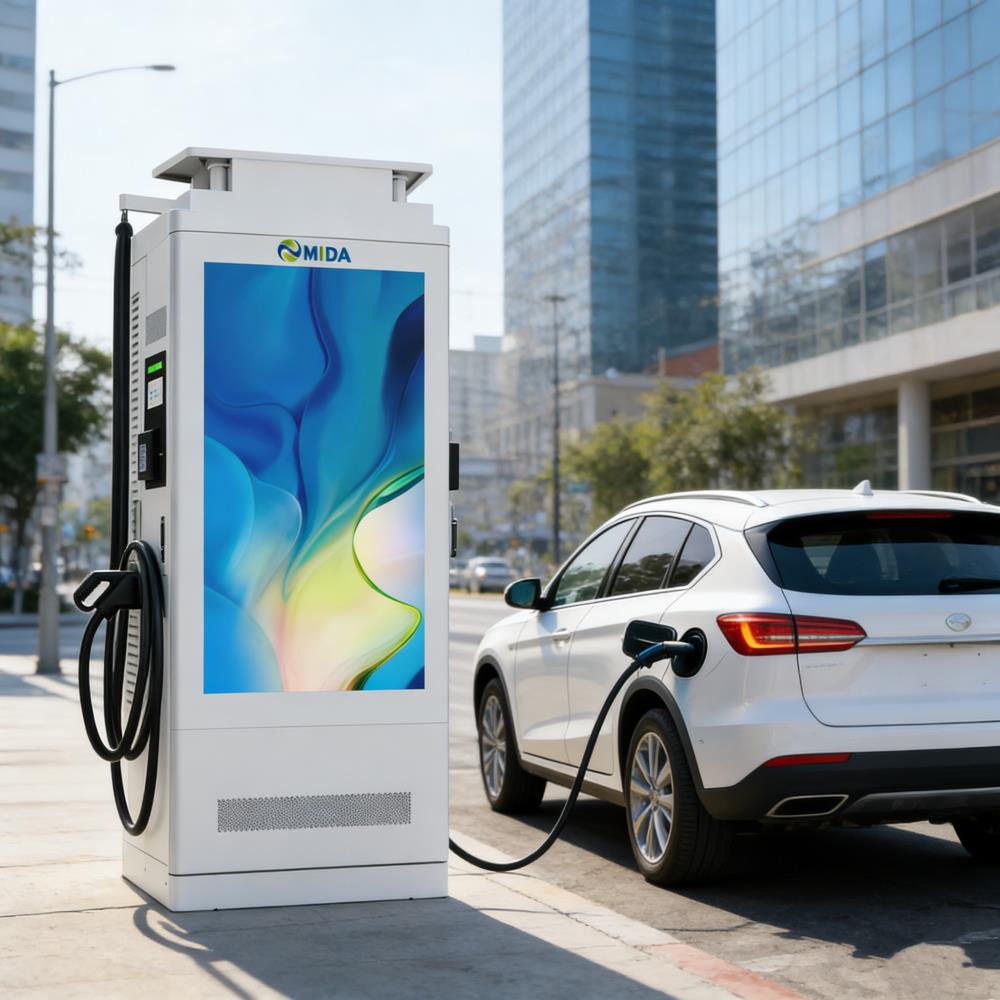
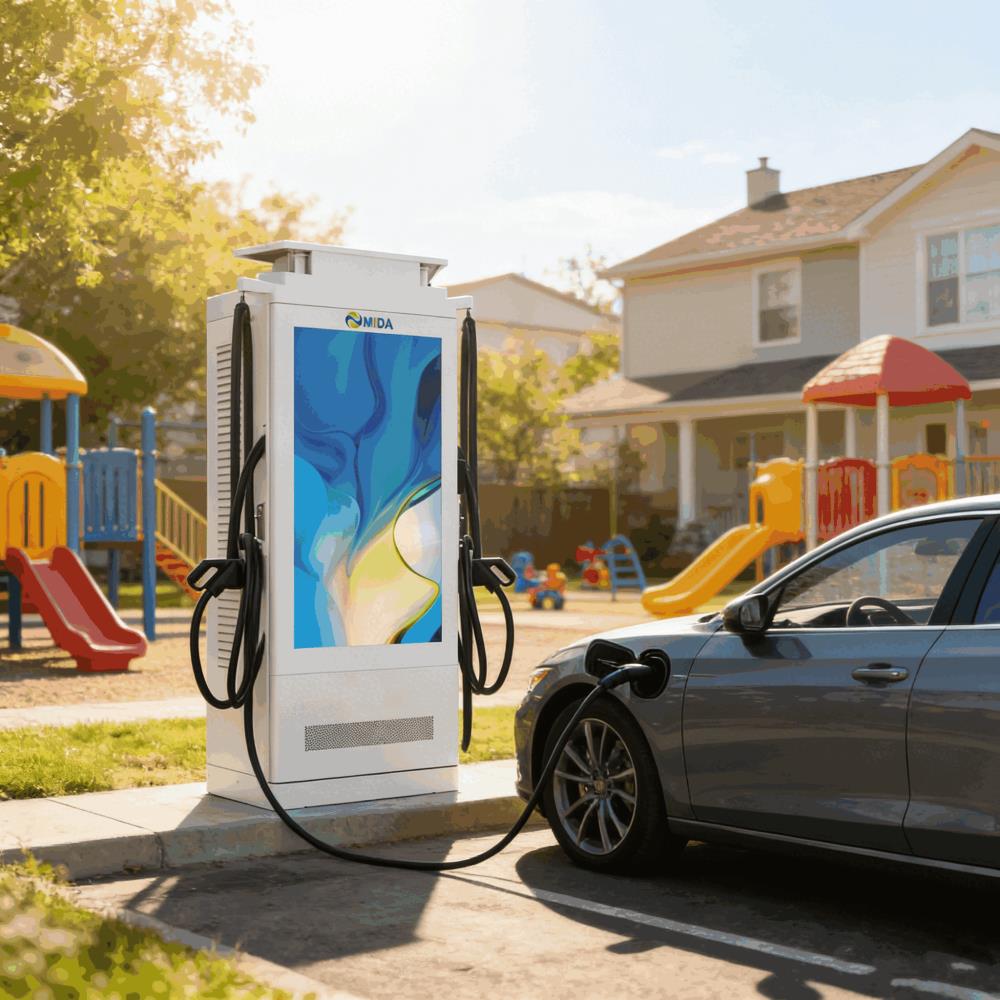
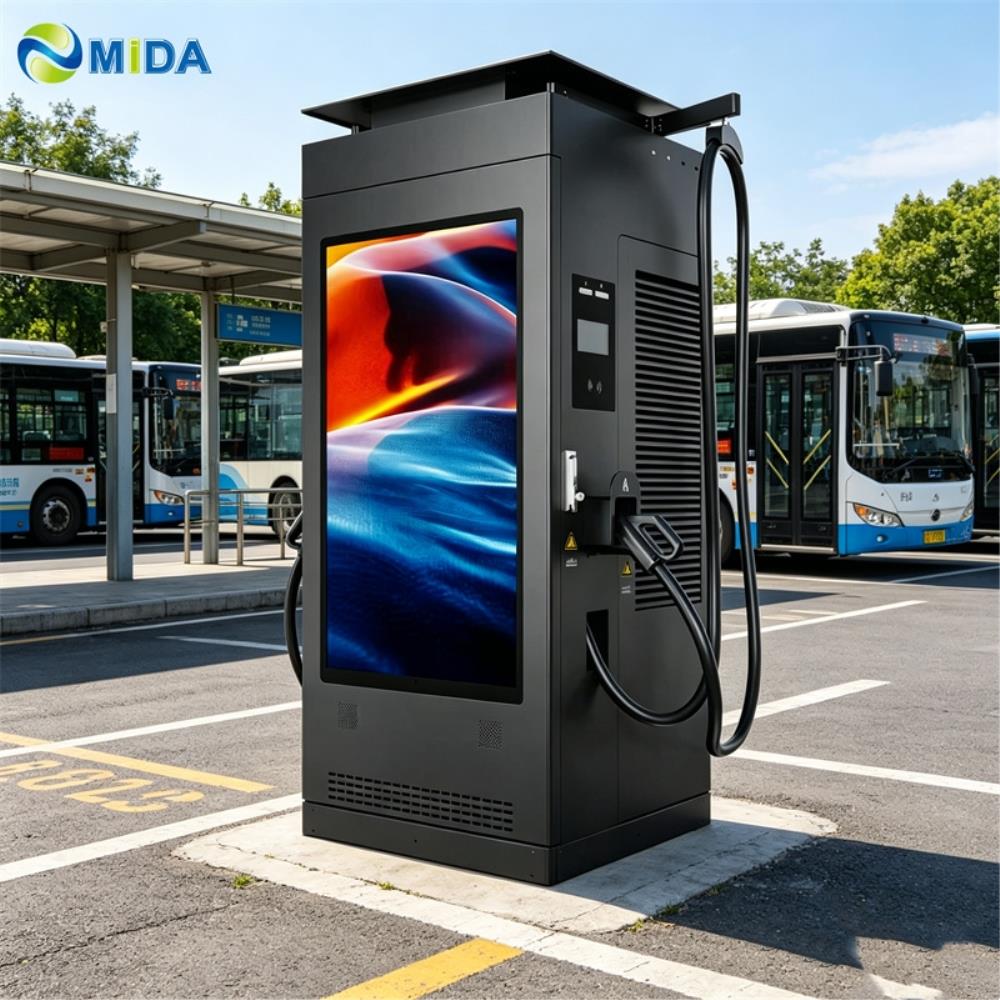
- Urban Streets & Community Lots — 60kW units on public street parking and municipal lots bring fast charging to residents without home charging; the screen serves as a public information terminal funded by local sponsorship.
- Small Retail & Restaurants — 60–90kW units in small car parks convert a modest parking investment into a customer-acquisition tool; the touchscreen delivers redeemable coupons that drive footfall to the counter.
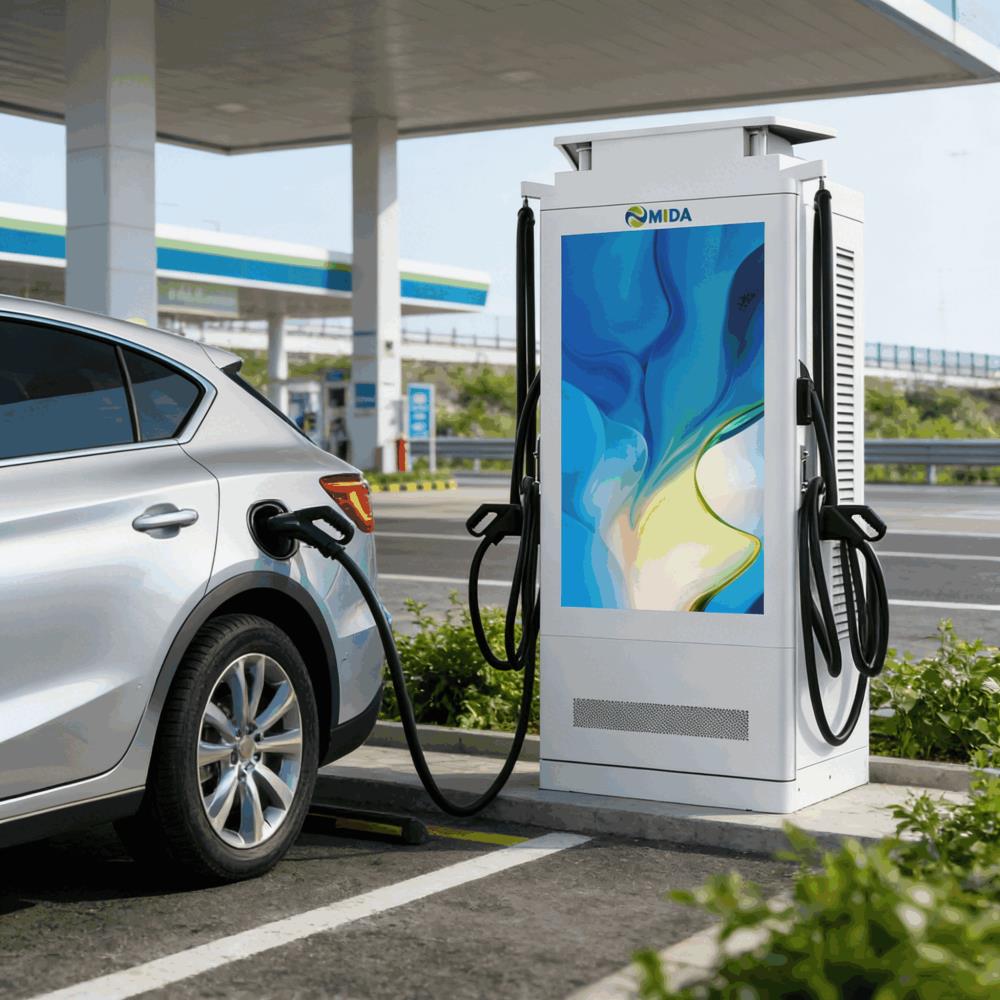
Installation is the simplest in the MIDA range: a concrete pad or reinforced base, an AC feeder from the building supply (with reinforcement survey for 90kW), and commissioning. Typical install time is 1–2 days. Grid considerations favor the 60kW model for constrained sites; load management enables multiple units on a shared feeder. The floor-mounted pedestal requires no canopy, no trenching for a separate distribution cabinet, and no structural integration, making it the lowest-friction path to adding fast charging to an existing building.
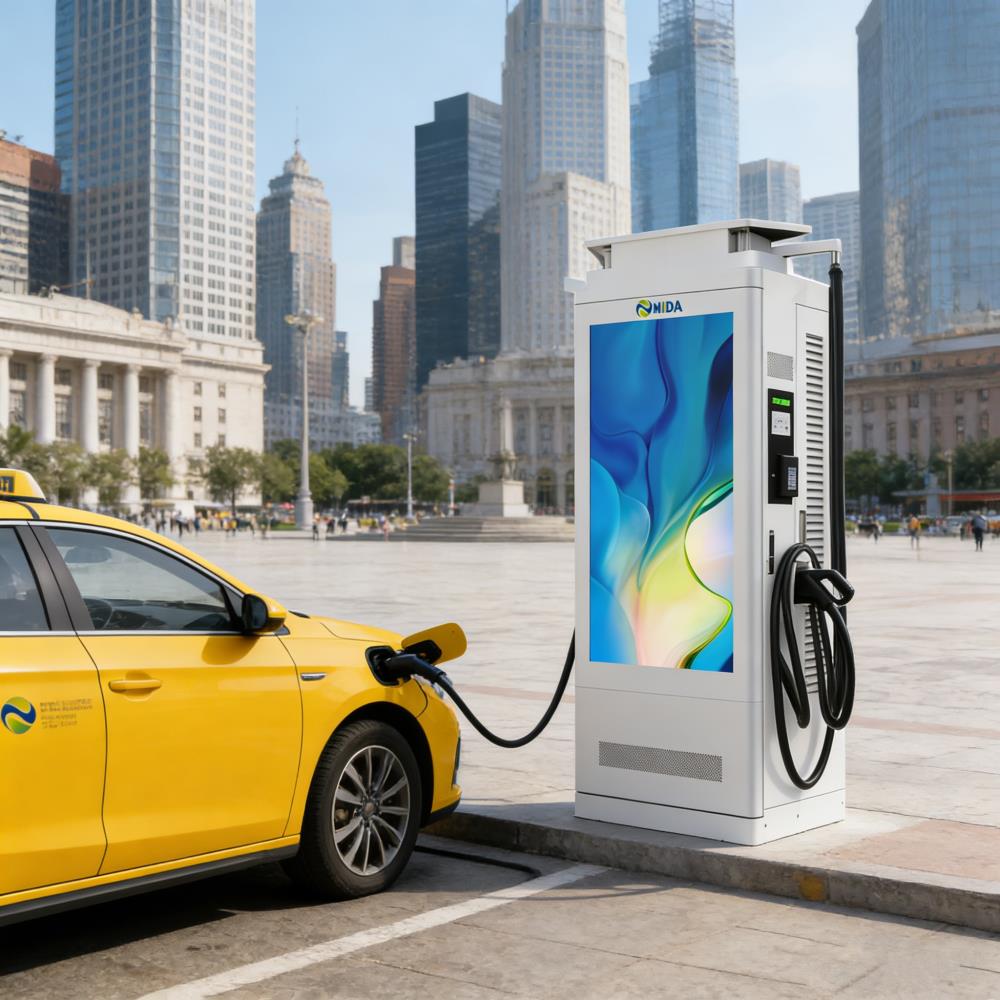
Operationally, expect 4–10 sessions per day in the first year at most destination sites, growing with EV adoption. Maintenance is minimal: quarterly visual checks, annual filter service, remote firmware updates. For a single-site owner, the charger pays for itself through charging revenue plus sponsorship income; for a multi-site operator, the OCPP platform consolidates management into one dashboard.
8. FAQ
Q1: Why choose 60kW or 90kW instead of a larger fast charger? Because the site’s grid capacity and use pattern dictate the right size. 60kW adds 150–200km in 30–45 minutes; 90kW does it in 25–35 minutes. Both install on existing commercial supplies with minimal reinforcement, unlike ultra-fast units that need transformer upgrades.
Q2: What makes a touchscreen more valuable than a passive display? Interactive campaigns — coupons, QR redemptions, surveys, wayfinding — achieve measurable engagement that commands 1.5–3× the CPM of passive DOOH, and redemption tracking gives advertisers a closed loop they cannot get from broadcast screens.
Q3: Can the touchscreen operate in rain and cold? Yes. The projected-capacitive touch layer works with gloved hands and rejects water droplets; the panel is IP65-rated with IK10 glass and operates from -25°C to +55°C with auto-brightness adaptation.
Q4: Is this charger compatible with all EVs? Yes — the 150–1000V output range serves 400V and 800V architectures, and connector options (CCS2, CCS1, CHAdeMO variant, NACS-ready) are configured to your market at order time.
Q5: Can I integrate it with my hotel or workplace systems? Yes. OCPP 1.6J connects to any compliant backend, and QR/app authentication can be linked to your booking or HR systems so charges are billed to rooms or employee accounts automatically.
Q6: How much does the screen cost to run? Roughly 120–200W average with auto-dimming — under 1% of the station’s throughput energy — and the screen is off or dimmed during low-traffic night hours automatically.
Q7: What is the payback period for a typical site? Charging revenue plus sponsorship income at a well-positioned site typically supports payback in 3–5 years; the interactive screen often covers 15–30% of total operating costs from year one.
Products categories
-
180kw 240kW DC Ultra Fast EV Charger Station OC...
-
Level 3 EV DC Charger Electric Car Charging Sta...
-
240kw 300kw 360kw 420kW Fast Charging Station F...
-
120KW 160KW 180kW 200kw Fast EV Charger Station...
-
420KW CCS2 New energy electric vehicle Charging...
-
360KW New energy electric vehicle Charging station