

1. Introduction
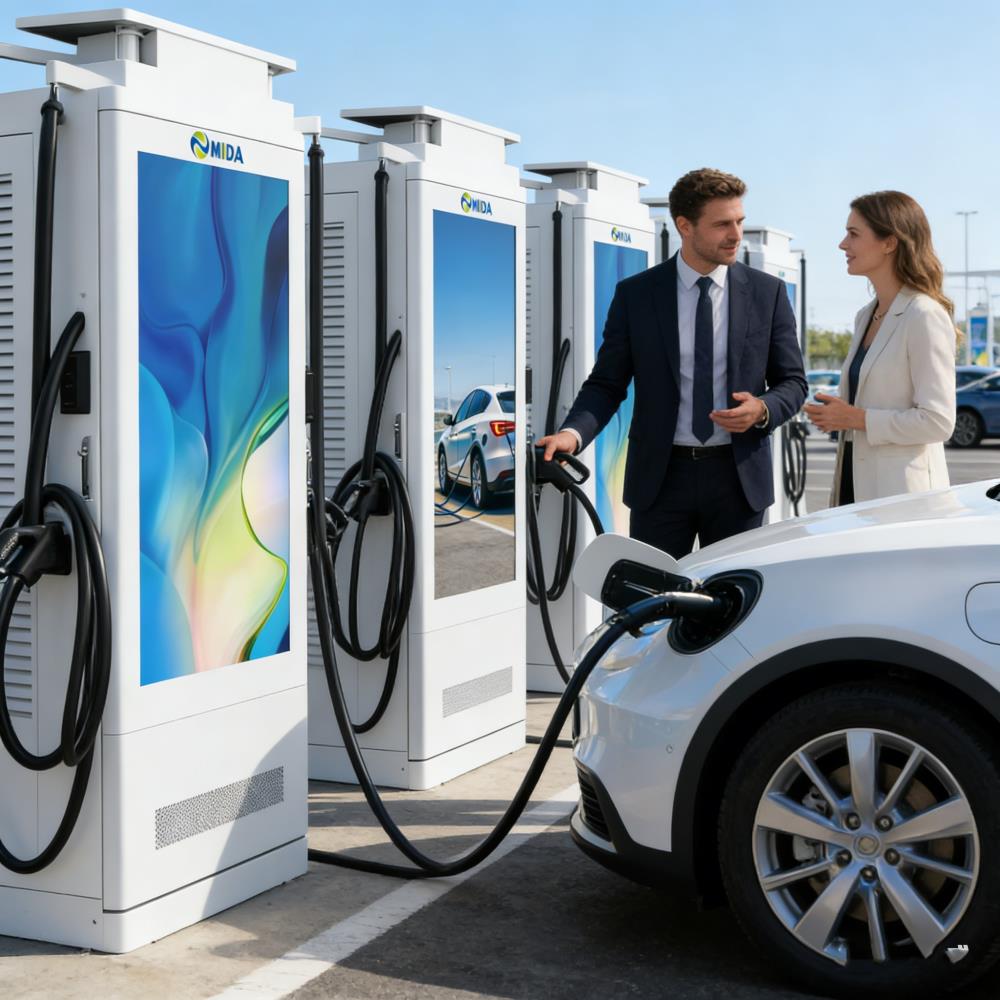
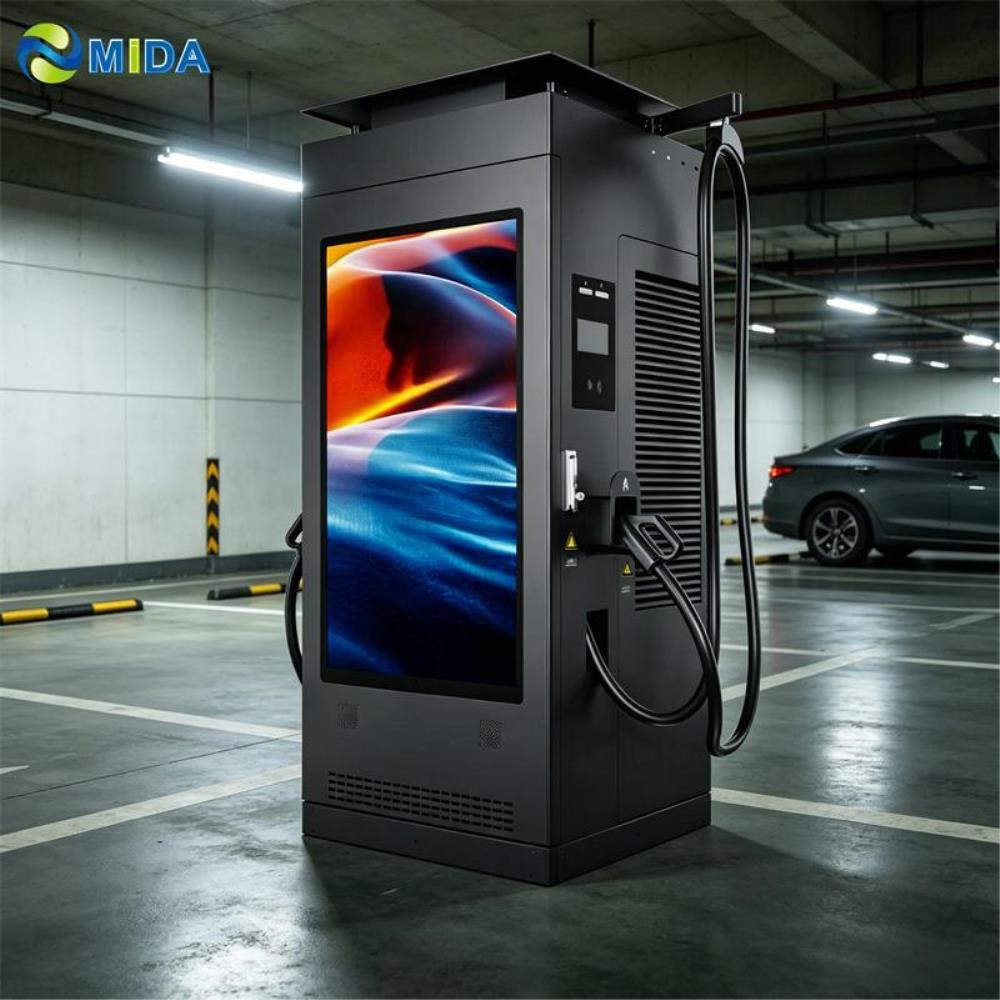
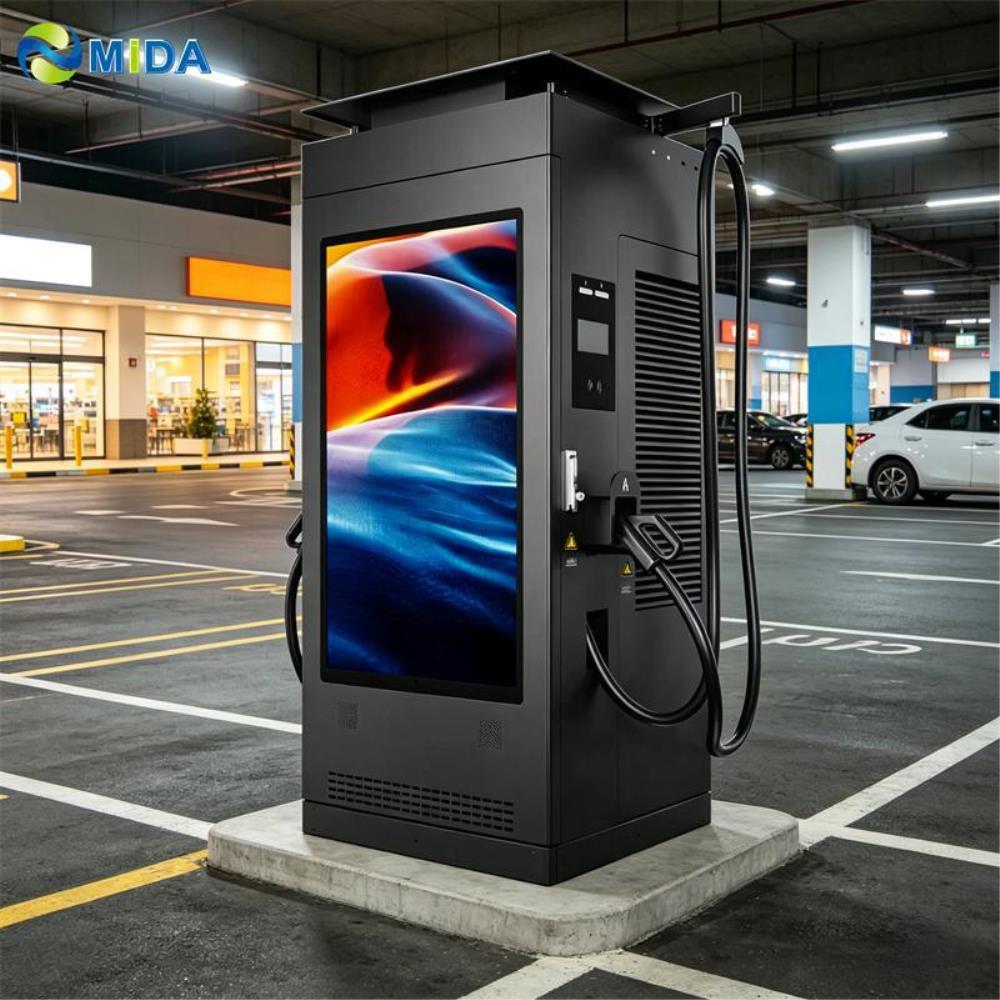
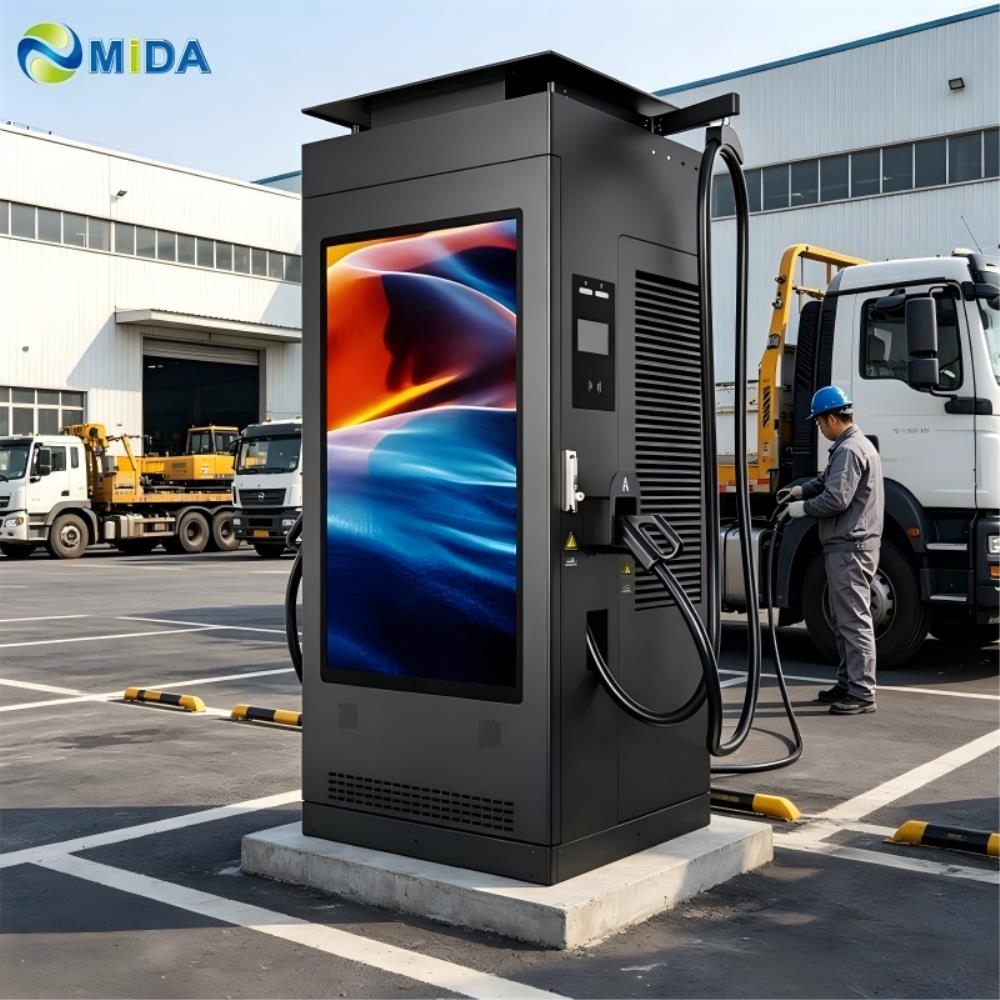
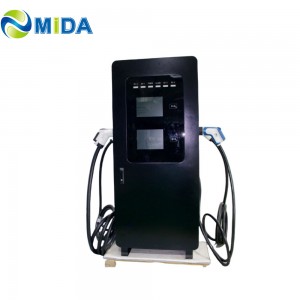
Public EV charging hubs are emerging as the defining infrastructure archetype of the late 2020s. Unlike destination chargers tucked into retail car parks, a charging hub is a dedicated site — often with six to twenty high-power dispensers — built to serve high volumes of vehicles with rapid turnaround. The economics of a hub are unforgiving: every bay must maximize sessions per day, every kilowatt must be delivered efficiently, and the site must offer drivers a compelling reason to queue there rather than at a competitor. The MIDA 240kW Ultra-Fast DC Charging Pile with Integrated Advertising Screen is engineered specifically for this environment, where speed, throughput, and ancillary revenue decide whether a hub becomes profitable in three years or never.
Global deployment data is unambiguous about the direction of travel: ultra-fast charging (150kW+) is the fastest-growing segment of public infrastructure, driven by larger battery packs, 800V vehicle architectures, and driver expectations of sub-30-minute charging stops. A 240kW unit occupies the sweet spot of this segment — it delivers meaningful “range in the time it takes to buy a coffee” performance while remaining deployable on standard commercial three-phase supplies with appropriate transformer capacity. The integrated advertising screen is not an accessory here; it is a structural element of the hub’s business model. Hub operators face thin per-kWh margins in competitive markets, and media revenue from screens is one of the few levers that moves the P&L at scale.
Positioning summary: this product is the anchor unit for professional charging hubs — highway service areas, city-edge “charging plazas,” fleet depots, and airport-adjacent facilities. It combines the highest power tier of the MIDA family with a large-format advertising display, dual-gun capability, and the management software stack needed to run a multi-unit site profitably. For a hub operator planning a 10-dispenser site, the 240kW advertising pile is the workhorse that delivers the throughput per square meter and the media income per square meter that make the site’s financial model work. The sections below analyze the display economics, the power electronics, the safety case, the software platform, the full specification, and the deployment playbook.

2. Interactive Advertising Screen: Monetizing Hub Traffic at Scale
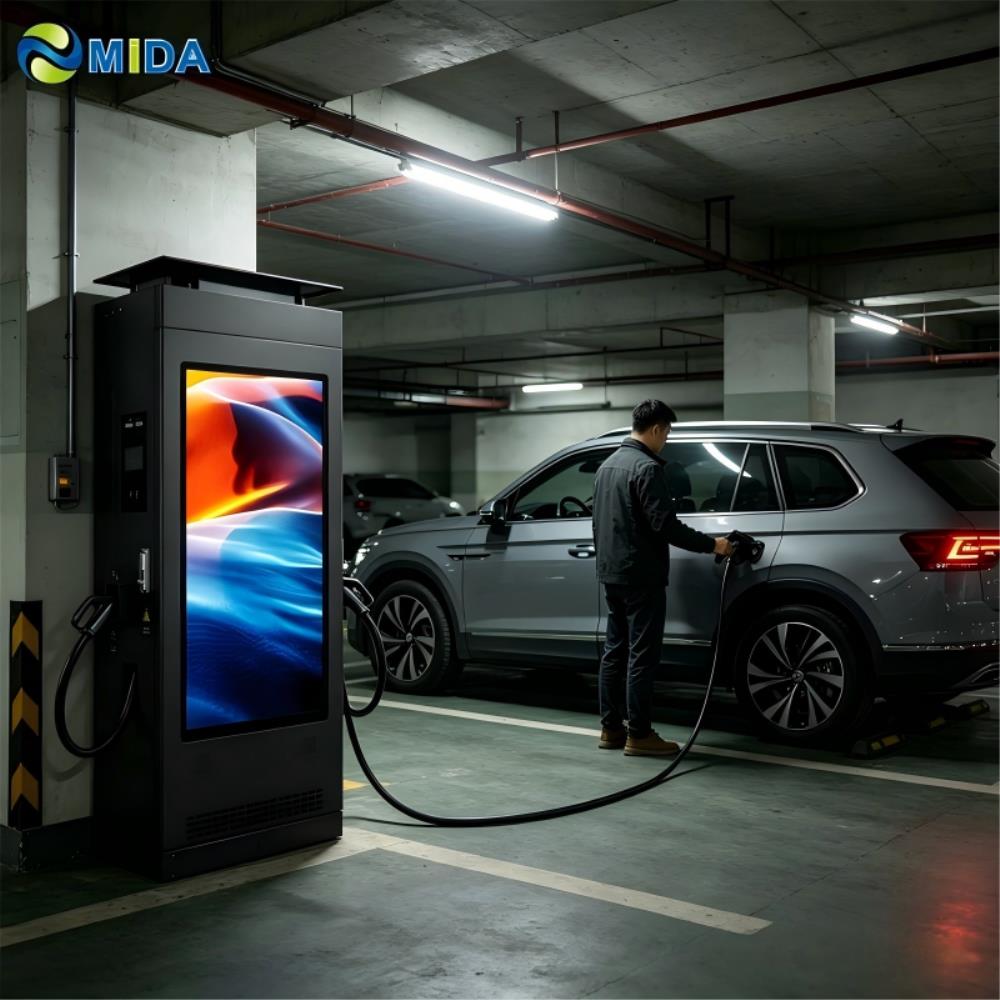
A charging hub differs from a mall installation in one crucial respect: the audience is there for a purpose, with a defined dwell window, and they are physically present beside the charger for the entire session. This is the highest-quality advertising environment in the DOOH universe — a seated, stationary, high-attention audience with disposable income. The MIDA 240kW pile capitalizes on this with a large-format integrated display that keeps the driver informed and engaged for the full 20–30 minute session.
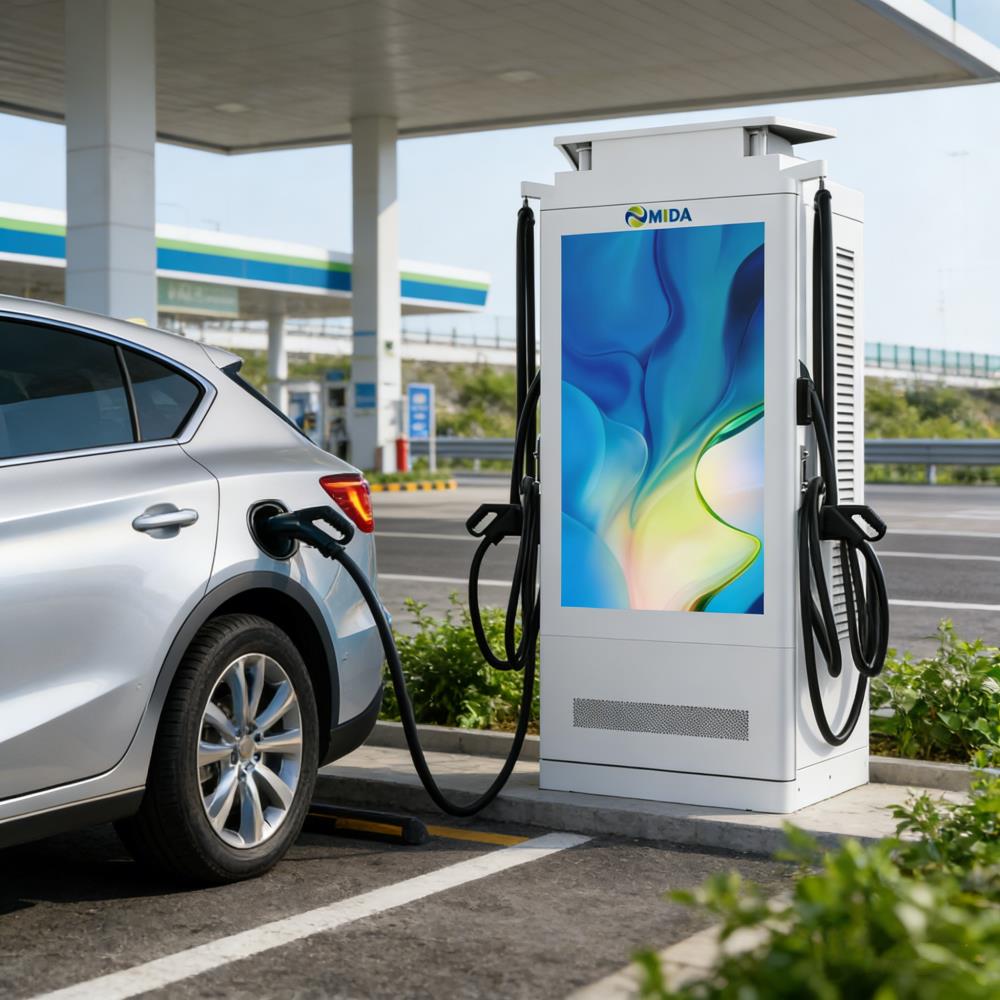
The display on this model is configured at 55-inch class (with 43-inch and 65-inch options on request), 1920×1080 Full-HD, and 2000–2500 nits peak brightness for full daylight visibility on exposed hub sites. The panel is protected by 4–6mm tempered glass with IK10 impact rating in an IP65 housing, and its ambient-light sensor and heat-pipe cooling keep it operating within specification in the full range of weather and temperature conditions a hub site will experience, from desert summer to alpine winter. The CMS supports the full toolkit: multi-tenant scheduling, programmatic ad server integration, day-parting, geo-fencing, split-screen charging status, and dynamic content widgets such as live energy prices, weather, and local offers.
The profit potential at hub scale deserves a dedicated analysis. Consider a 10-bay hub with ten 240kW advertising piles. Each screen captures the attention of every driver using that bay — typically 15–25 sessions per bay per day at high utilization — plus passengers and queuing vehicles. A conservative 12,000–30,000 impressions per screen per day at a blended €10–€15 CPM yields €120–€450 per screen per day in gross media value. Across ten screens, that is €1,200–€4,500 per day of gross media inventory — before considering that hub operators can also sell sponsorship of the entire site (“powered by” branding on all screens) and data-driven targeting packages. In competitive markets where charging margins are compressed to €0.05–€0.10 per kWh, media revenue can represent 30–50% of the site’s total gross profit by year two.
Three revenue layers are available to the hub operator:
- Layer 1 — Direct ad sales: local businesses, FMCG, automotive brands, and travel-related services buy time slots, typically in monthly packages.
- Layer 2 — Programmatic fill: unsold inventory is offered through DOOH programmatic platforms, ensuring a baseline yield with zero sales effort.
- Layer 3 — Site-level sponsorship and data: whole-site naming rights and anonymized audience analytics (GDPR-compliant) command premium packages.
Operationally, the CMS separates media and charging functions so that a content upload or network glitch never disrupts a charging session, and split-screen layouts guarantee that the driver always sees live session data — power, state of charge, cost, time remaining — alongside the advertising content. Hub operators should treat the screen network as a portfolio: content rotation, impression reporting, and advertiser management become a defined workstream, often generating more margin per square meter than the charging itself.
3. High-Performance Charging Technology: 240kW Ultra-Fast Output
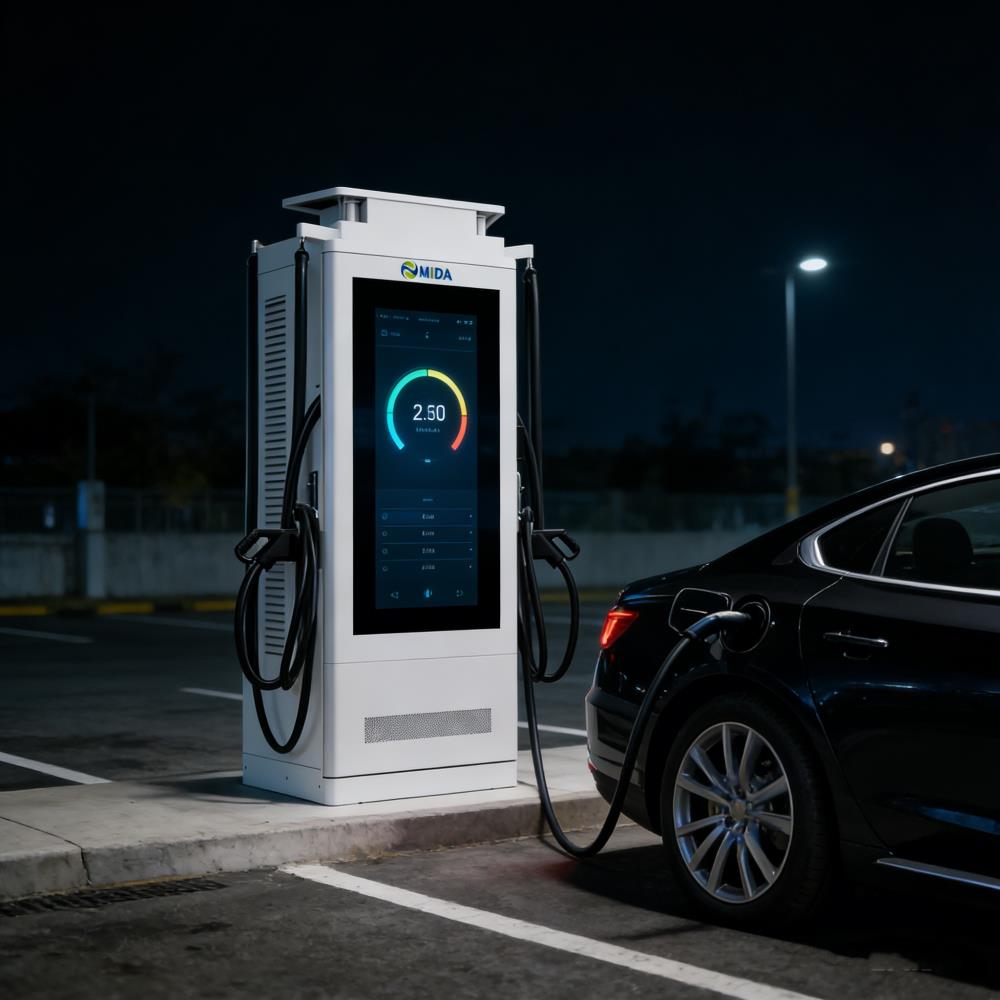
The power architecture of this pile is designed for one objective: maximum delivered energy per bay per day. The 240kW output is produced by hot-swappable power modules arranged in a redundant, N+1-friendly configuration, so a module failure reduces capacity but does not take the bay offline. The cabinet supports dual-gun operation with dynamic power sharing — 120kW+120kW to two vehicles, 180kW+60kW, or the full 240kW to a single vehicle — with real-time rebalancing as sessions progress. For a hub operator, this flexibility means the pile is never idle while a low-power vehicle occupies a bay: the second gun picks up the slack.
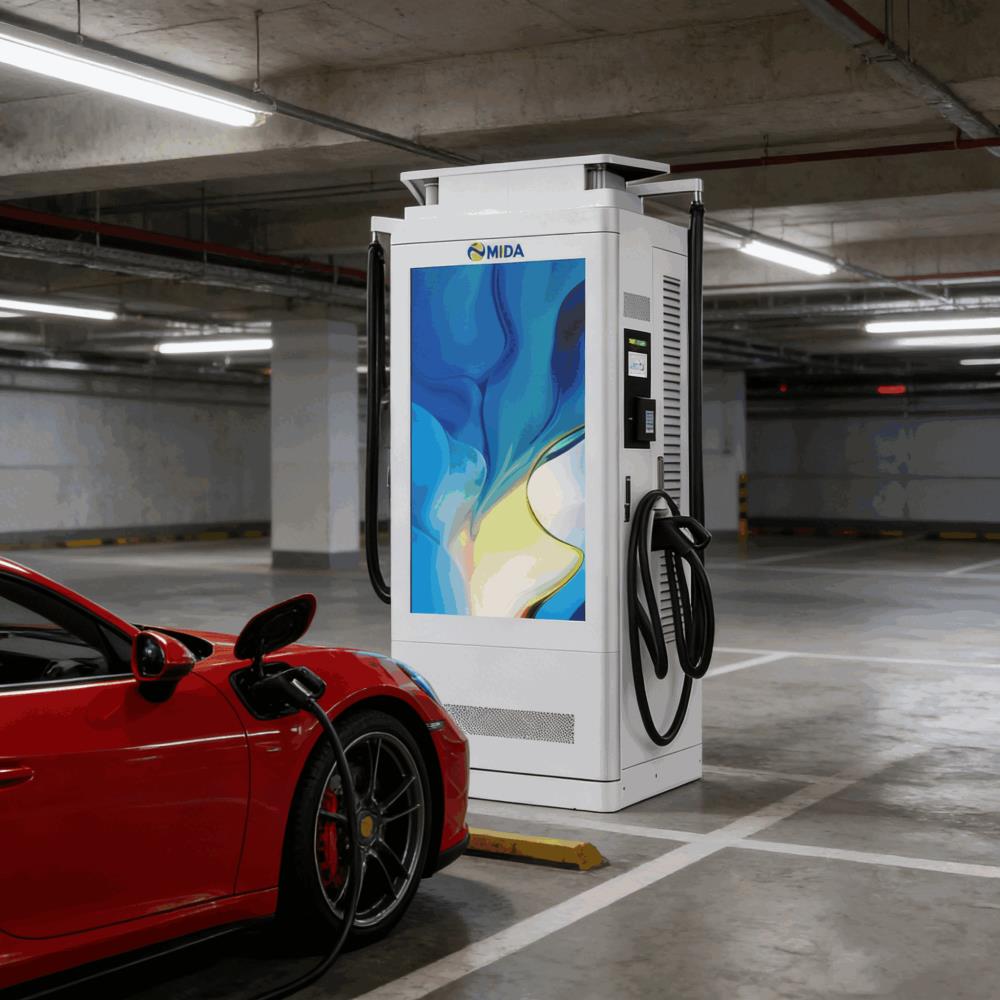
The 150–1000V DC output range is essential for a 240kW product. Modern 800V-architecture EVs require charge voltages above 900V to draw their peak power; a pile capped at 750V or 500V would deliver only a fraction of its rated power to precisely the vehicles most likely to use a hub — premium long-range EVs whose drivers value speed. With the 1000V rail, the MIDA pile delivers its full rated current to both 400V and 800V platforms, with the charging curve negotiated per DIN 70121 / ISO 15118. Maximum continuous current per gun reaches 250A (600A combined in split mode), and peak module efficiency of 95–96% keeps energy losses and cooling load low — important at hub scale where hundreds of MWh flow through the site each month.
Input power requirements follow hub reality: 400V AC three-phase, 50/60Hz, ±15%, with transformer sizing per site plan. The pile integrates with site-level load management and energy storage systems: in a hub with solar generation or battery buffering, the MIDA pile can be configured to prioritize renewable energy and manage peak demand, cutting energy procurement costs that are typically the largest operating expense of a hub. Smart-charging features via OCPP allow the hub operator to set time-of-use pricing, demand-response participation, and per-session power limits to protect the site transformer.
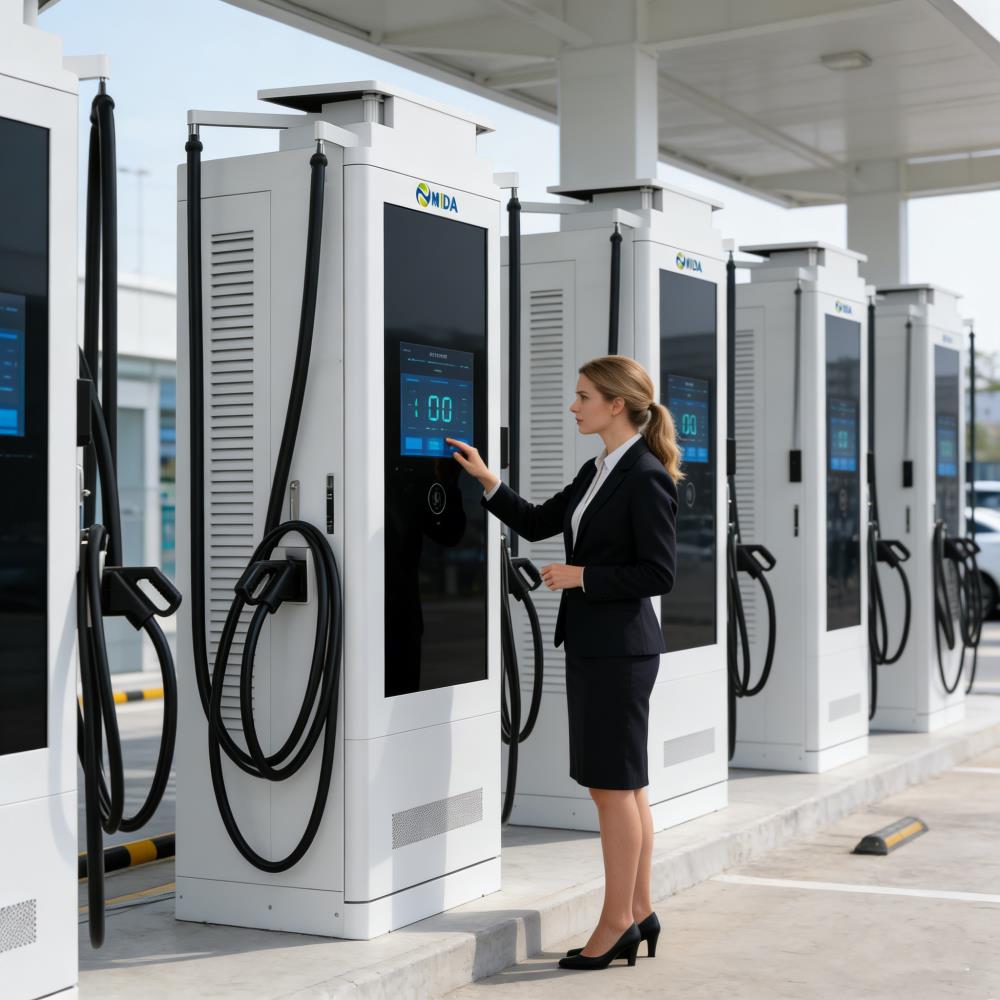
Connector configuration is flexible at order time: dual CCS2 (Europe/Gulf), dual CCS1 (North America), hybrid combinations, and NACS adapter readiness. ISO 15118 Plug & Charge support enables seamless authentication and billing for vehicles equipped with the capability, reducing friction at high-turnover sites. Pre-session safety checks, contactor weld detection, insulation monitoring, and emergency stop are integrated into the charging logic, and the unit is designed for the 24/7 duty cycle of a public hub, with cold-weather startup down to -25°C and graceful derating above 55°C ambient.
4. Safety and Reliability
A public hub pile operates in an exposed environment with untrained users, queuing vehicles, and 24/7 duty — the safety and reliability bar is correspondingly high. The MIDA 240kW pile is CE certified (LVD, EMC, RED), UKCA marked, and designed to IEC 61851-1/23, IEC 62196, and ISO 13849, with complete technical documentation for permitting and insurance. Independent type testing verifies the electrical safety, EMC, and functional safety properties before the product is offered for sale.
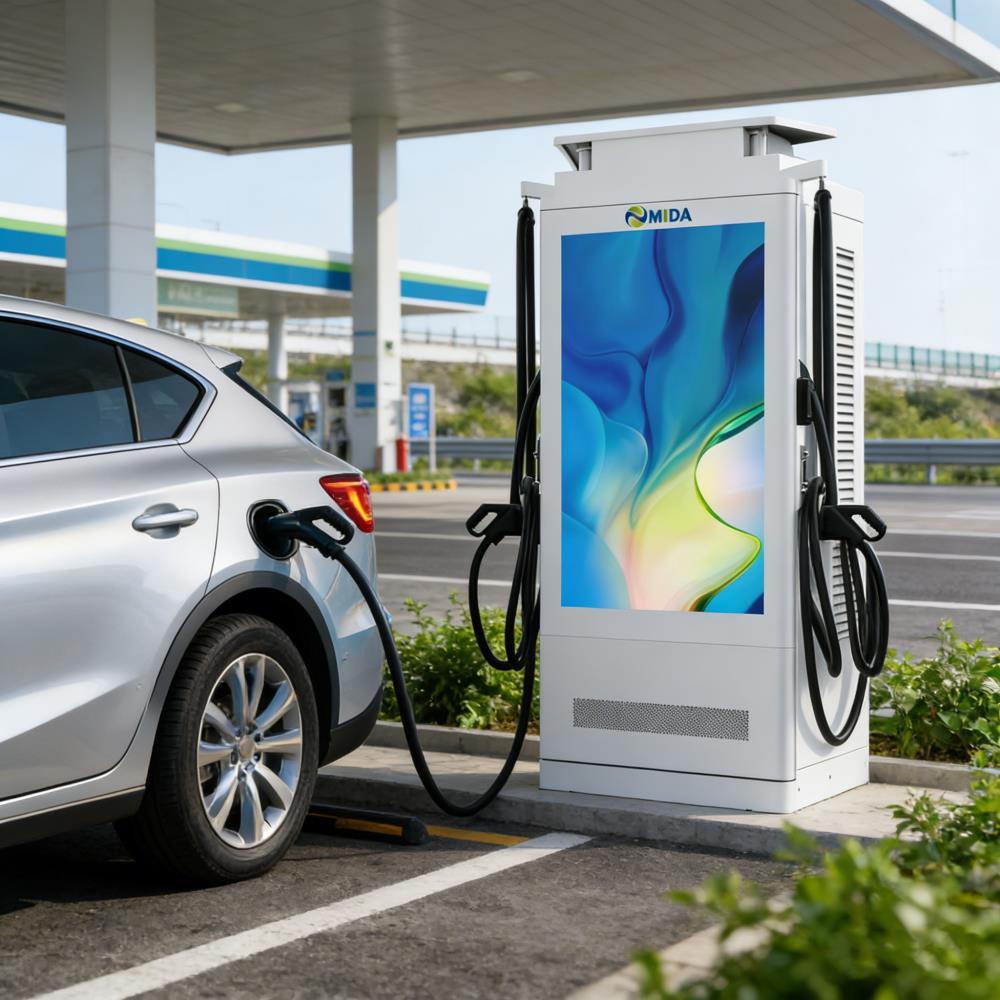
Protection layers include AC-side Type II surge protection, Type A RCDs with 6mA DC fault detection, DC-side insulation monitoring before and during every session, per-gun contactor weld monitoring, emergency stop, and remote de-energization. The IP55 cabinet and IP65 display housing resist rain, dust, hose-down cleaning, and coastal corrosion (marine-grade coating on structural parts), and IK10 impact ratings on cabinet and screen protect against accidental and deliberate damage. For hub sites, which are often unattended at night, the physical resilience of the pile is a first-line defense against vandalism and weather damage that would otherwise create downtime.
Thermal management is a differentiator at 240kW. The power modules use intelligent forced-air cooling with variable-speed fans and heat-pipe-assisted heat extraction; the display has its own independent cooling loop. The control system applies model-based derating that protects component lifetime while maximizing availability — the pile delivers as much power as the environment allows, rather than shutting down at an arbitrary temperature threshold. Redundancy extends to communications (4G/5G, Wi-Fi, Ethernet) and power modules (N+1), and every field-serviceable component is modular and hot-swappable, keeping mean time to repair to a single technician visit in most scenarios.
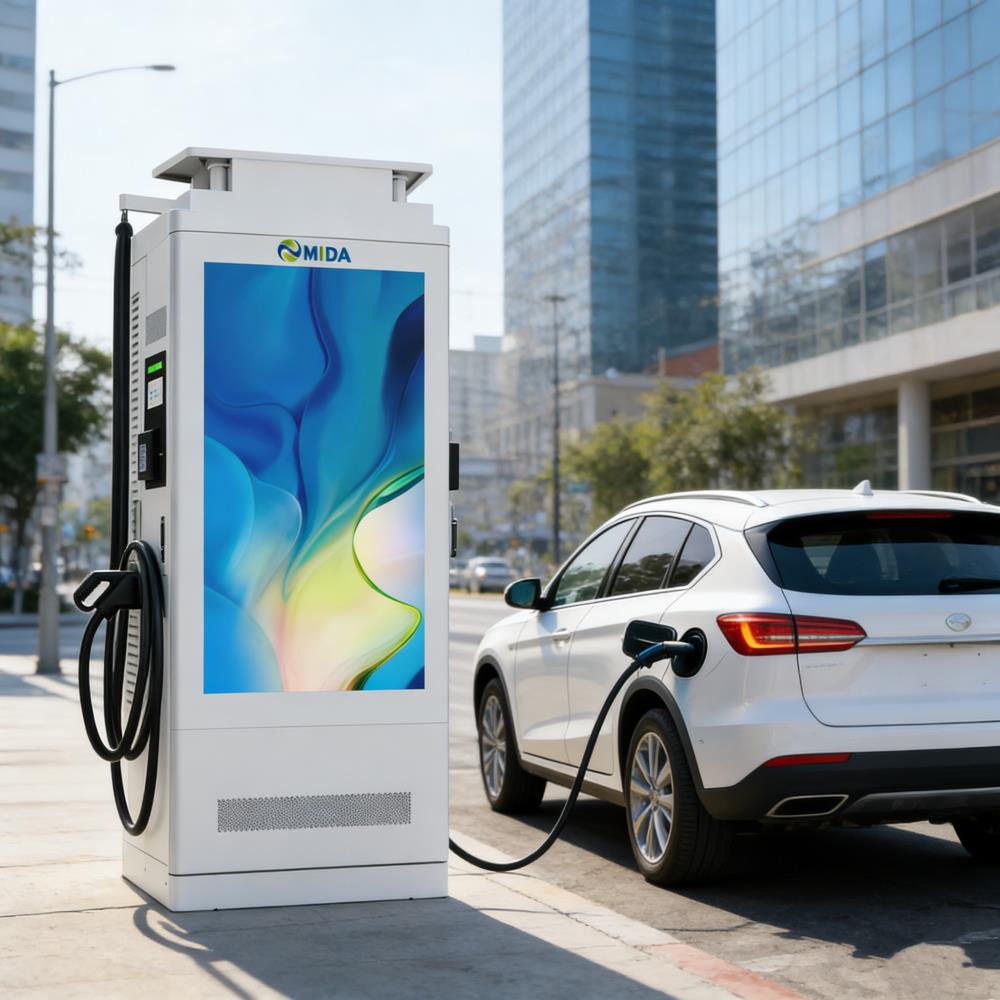
For a hub operator, reliability translates directly into revenue: each hour of downtime is lost sessions and lost ad impressions. MIDA’s remote diagnostics platform monitors every pile in the network, pushes fault alerts with actionable error codes, and enables over-the-air fixes for firmware-level issues. Combined with a design life of 10+ years, conservative component derating, and a service network with stocked spares, the 240kW pile is built to sustain the >98% uptime that hub financial models assume.
5. Smart Management and Connectivity
Hub operation is a software business. The MIDA 240kW pile runs OCPP 1.6J natively (OCPP 2.0.1 on request), connecting to any major Charge Point Management System, roaming hub, or white-label backend. This is the foundation for the features a hub needs: dynamic pricing, roaming integration, remote diagnostics, and centralized fleet monitoring.
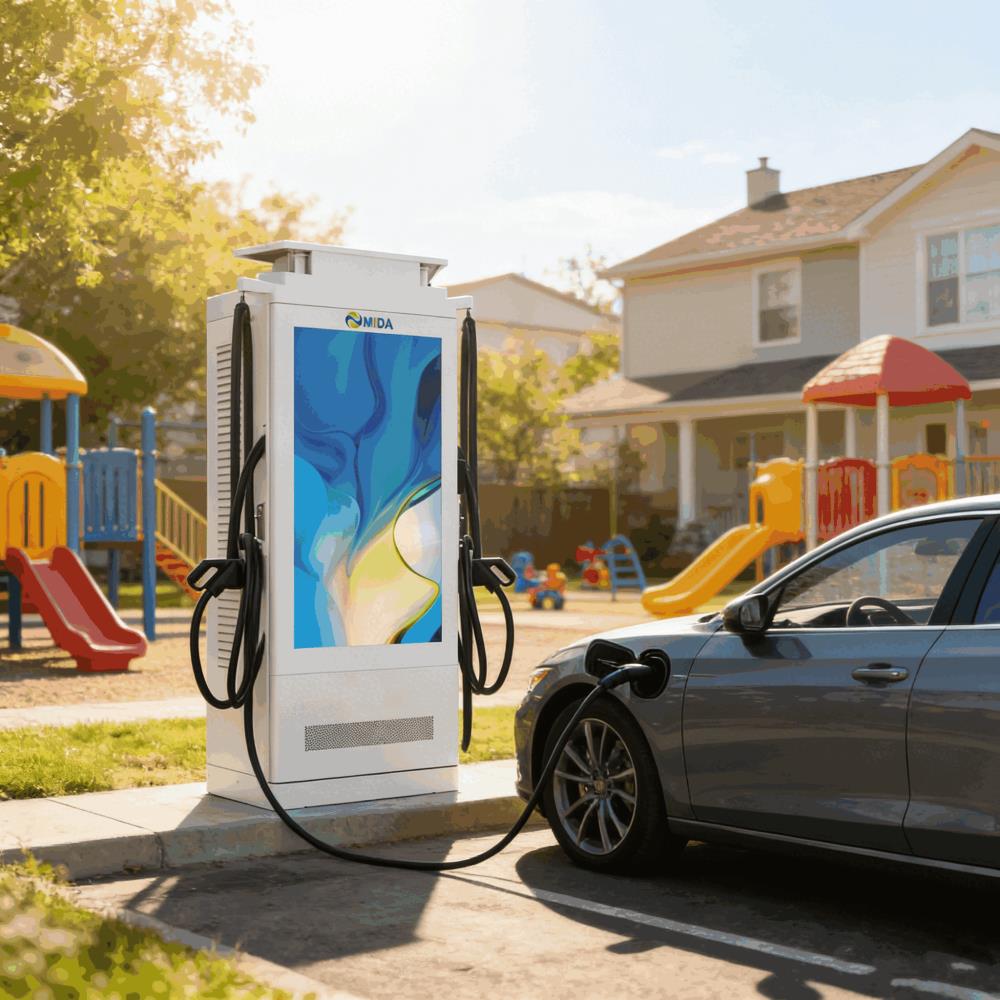
Connectivity is redundant — 4G LTE (5G-ready), Wi-Fi, Ethernet, RS485 — with offline session handling and local transaction caching for resilience. Authentication options cover RFID, QR, mobile app, and Plug & Charge, and the hub operator can configure which methods are active per site. The backend dashboard gives a network-wide view: live sessions, power distribution, energy delivered, revenue, utilization per bay, fault status, and impression counts from the screens. Reporting is exportable for finance and investor reporting.
The smart-charging toolkit is central to hub economics: time-of-use tariffs, demand-response participation, solar-plus-storage coordination, and per-site load management. The pile can also be configured to prioritize sessions by energy need or customer tier — useful for fleet contracts. Over-the-air firmware updates keep all piles in the network current without site visits, and role-based access control lets the operator separate media sales, site operations, and finance teams.
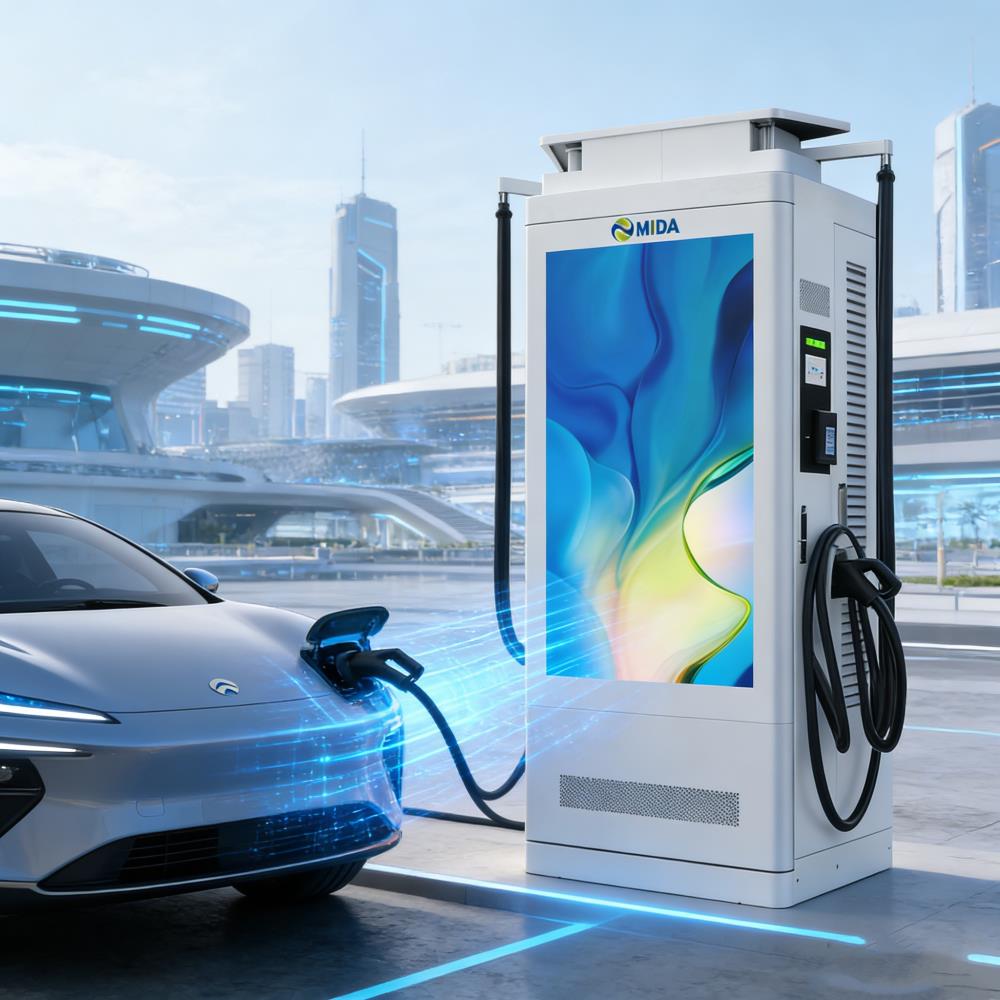
For the advertising function, the CMS operates through the same network but as a logically isolated subsystem: content plays from local cache during outages, charging never depends on the media system, and media never interrupts charging. Impression analytics, day-part performance, and advertiser reporting are generated automatically, feeding both the sales team and the finance team. The result is a single connected platform that manages energy, revenue, media, and maintenance across an entire hub network from one dashboard.
6. Detailed Technical Specifications
| Parameter | Specification |
|---|---|
| Model | MIDA 240kW Ultra-Fast DC Charging Pile with Integrated Advertising Screen |
| Output Power | 240kW (modular, hot-swappable, N+1 capable) |
| Input | 400V AC ±15%, 3-phase, 50/60Hz |
| Output Voltage | 150–1000V DC |
| Output Current | Up to 250A per gun; up to 600A combined in split mode |
| Charging Connectors | Dual CCS2 / Dual CCS1 / Hybrid; GBT & NACS adapter ready |
| Charging Protocols | OCPP 1.6J (2.0.1 optional), DIN 70121, ISO 15118 Plug & Charge ready |
| Display | 55-inch (43″/65″ optional), 1920×1080 FHD, 2000–2500 nits |
| Display Protection | 4–6mm tempered glass, IK10, IP65 housing |
| Enclosure Rating | IP55 cabinet, IK10 vandal resistance |
| Cooling | Intelligent forced-air + heat-pipe; model-based derating |
| Communication | 4G LTE / 5G-ready, Wi-Fi, Ethernet, RS485; RFID/QR/App/Plug & Charge |
| Efficiency | ≥95% peak module efficiency |
| Smart Charging | Time-of-use, demand response, solar/storage coordination, load management |
| Operating Temperature | -25°C to +55°C (graceful derating) |
| Certifications | CE (LVD/EMC/RED), UKCA, IEC 61851-1/23, IEC 62196, ISO 13849 |
| Dimensions (W×H×D) | ~900×2200×500mm, floor-mounted |
| Warranty | 2-year standard; 5-year extended option |
The specification set above defines a professional-grade hub asset: full-power delivery to 800V vehicles, dual-gun throughput, redundant modules, outdoor environmental ratings, and a media surface sized for high-value advertising. Hub operators comparing equipment should validate output voltage ceiling, power-sharing behavior under mixed loads, module redundancy, and CMS capabilities alongside raw kilowatts.
7. Use Cases & Installation
The 240kW advertising pile is purpose-built for high-throughput public sites:
- Highway Service Areas & Motorway Rest Stops — Maximum turnover and captive audiences; 240kW delivers 250–300km in 15–20 minutes; advertising rates are highest at these locations; dual-gun design keeps queues moving.
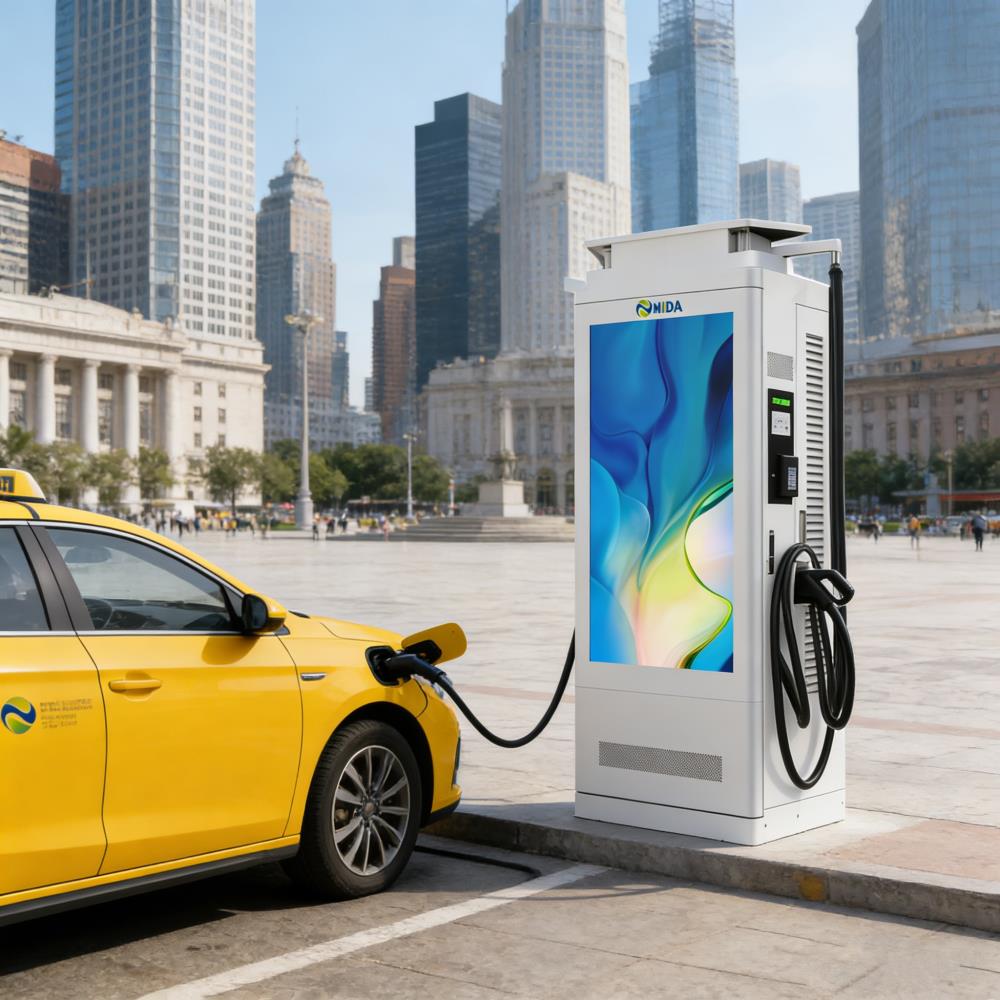
- City-Edge Charging Plazas — Dedicated multi-bay sites near ring roads serve residents without home charging and ride-share fleets; media revenue diversifies income beyond kWh margins.
- Fleet & Ride-Hail Depots — 240kW piles deliver rapid turnaround between shifts; the screen can show fleet operator messaging, safety notices, and driver information between sessions.
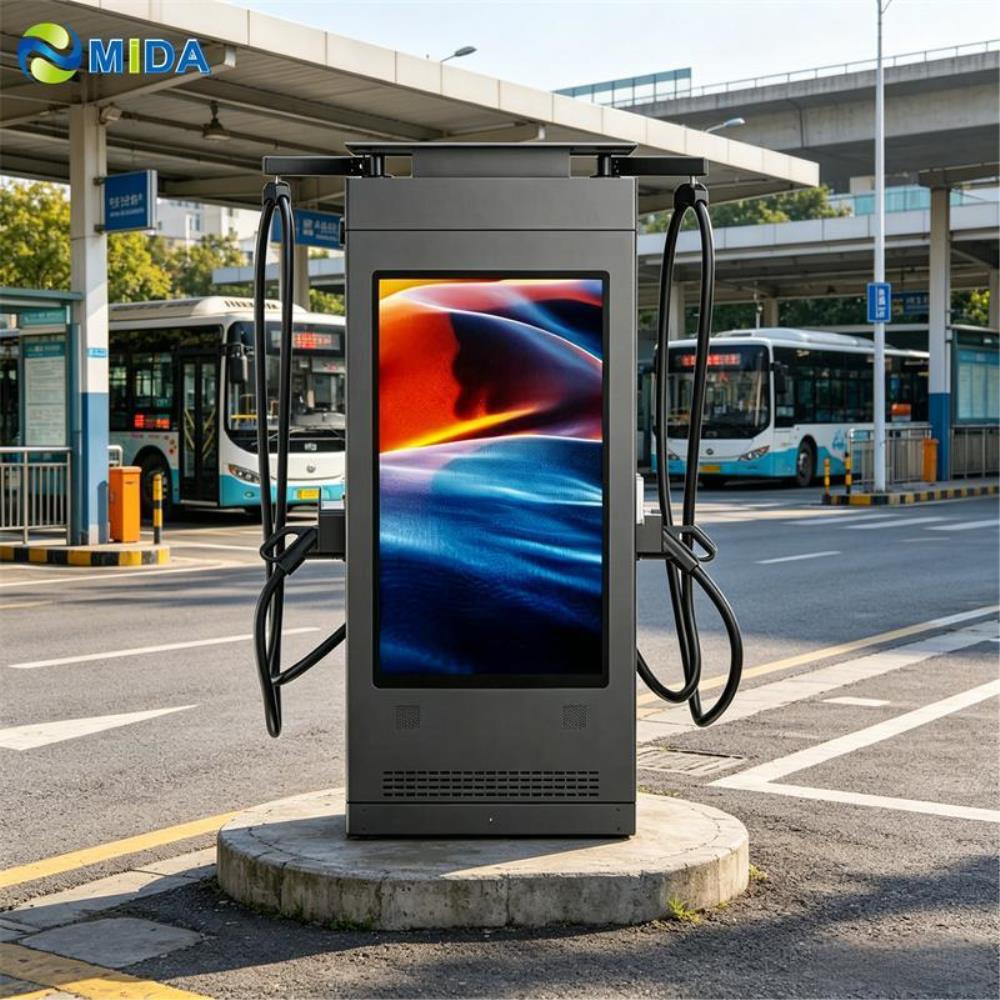
- Airport & Transit-adjacent Facilities — Long-dwell adjacent parking combined with fast-turnaround drop-off zones; screens serve traveler-relevant advertising and flight information widgets.
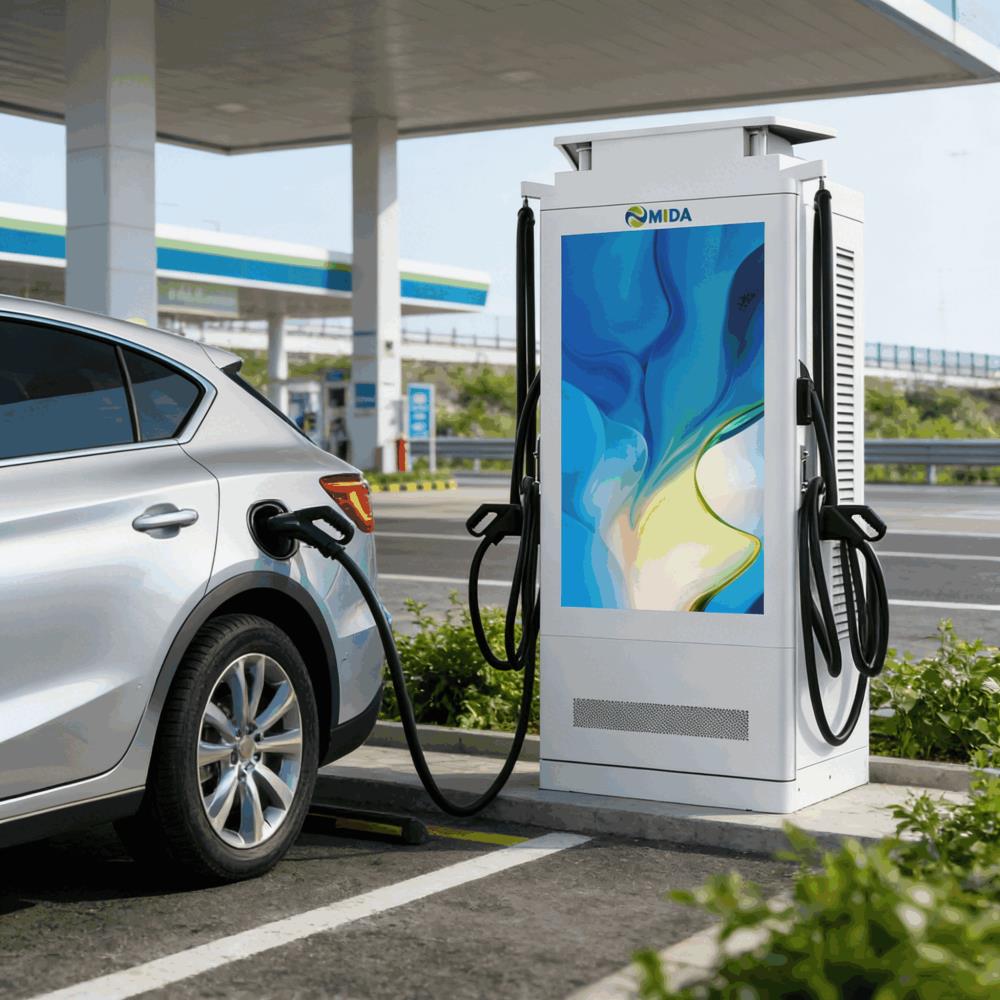
Installation for a hub site is a civil engineering project managed by professionals: transformer sizing and grid connection (typically 250–315kVA per 240kW pile including headroom), concrete foundations, cable trenches, site lighting, safety bollards, and signage. The piles ship as integrated cabinets, reducing assembly on site; commissioning covers connectivity, backend registration, load management configuration, and full-power testing. Hub operators typically stage installation in phases, adding piles as utilization grows.
Operationally, target utilization is 15–25 sessions per bay per day in mature markets. Maintenance follows a quarterly inspection cycle with annual cooling-system service; firmware and content updates are remote. MIDA provides network-level remote monitoring, spare module stock, and regional service coverage, keeping the hub’s availability and media yield at plan.
8. FAQ
Q1: How many vehicles can one pile serve per day? With dual guns and 240kW output, a well-located pile sustains 15–25 sessions per day per bay in mature markets, delivering 500–900kWh daily depending on session size and utilization.
Q2: What is the real-world charging speed for an 800V EV? A modern 800V vehicle can draw the full 240kW, adding roughly 250–300km of range in 15–20 minutes, subject to the vehicle’s own charging curve and battery state of charge.
Q3: How does advertising revenue compare with charging margin at a hub? At competitive per-kWh margins (€0.05–€0.10), media revenue can represent 30–50% of a hub’s gross profit by year two, with each screen generating €120–€450 per day of gross media value at typical CPMs.
Q4: Can the screen show charging information for drivers? Yes — split-screen mode permanently displays live session data (power, state of charge, cost, time remaining) alongside advertising content, so drivers never lose sight of critical information.
Q5: What grid infrastructure does a 240kW pile require? A dedicated three-phase connection with transformer capacity of roughly 250–315kVA per pile, including headroom; site-level load management coordinates multiple piles on shared capacity.
Q6: Which connectors and standards are supported? Dual CCS2 is standard for Europe and the Gulf; CCS1, hybrid, GBT, and NACS-ready options cover other markets. OCPP 1.6J, DIN 70121, and ISO 15118 Plug & Charge are supported.
Q7: What happens if a power module fails? The modular, N+1-capable design means the pile continues operating at reduced capacity while the module is hot-swapped — typically a single technician visit — minimizing downtime and protecting hub revenue.
Products categories
-
180kw 240kW DC Ultra Fast EV Charger Station OC...
-
Level 3 EV DC Charger Electric Car Charging Sta...
-
240kw 300kw 360kw 420kW Fast Charging Station F...
-
120KW 160KW 180kW 200kw Fast EV Charger Station...
-
420KW CCS2 New energy electric vehicle Charging...
-
360KW New energy electric vehicle Charging station