

1. Introduction
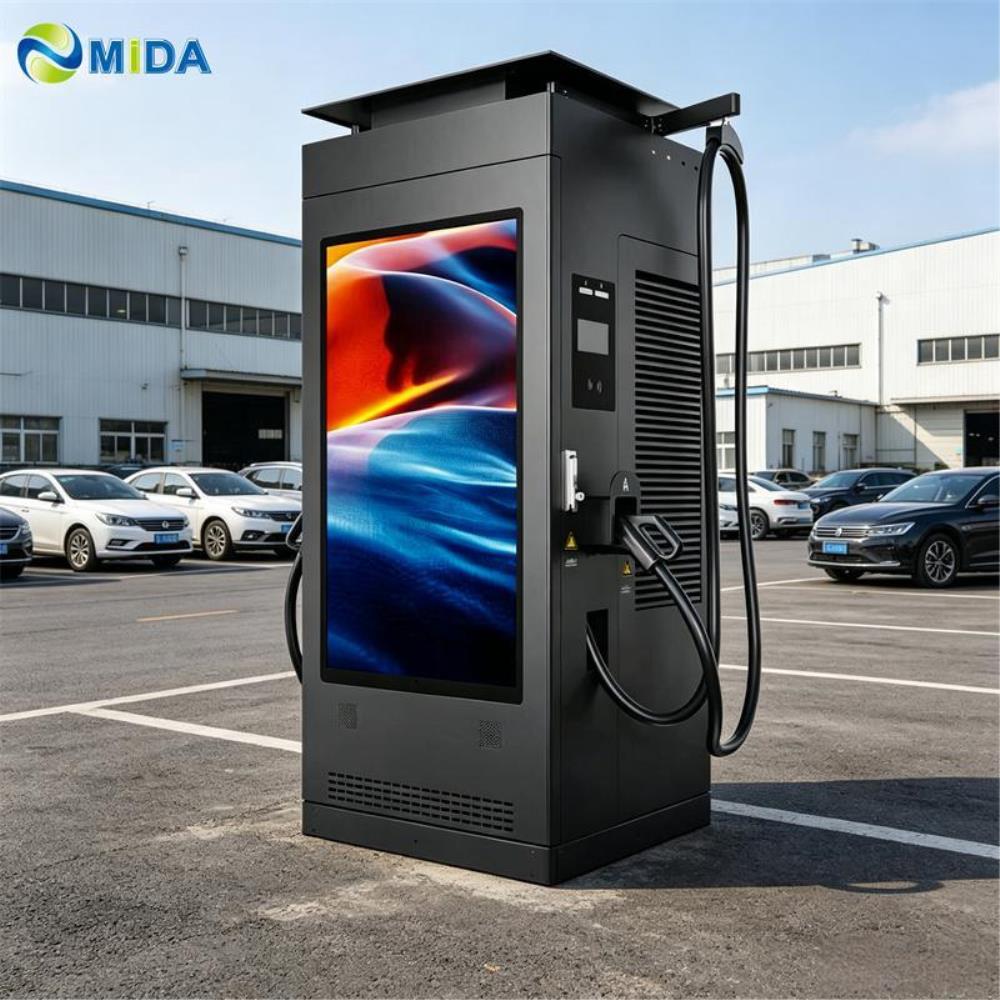
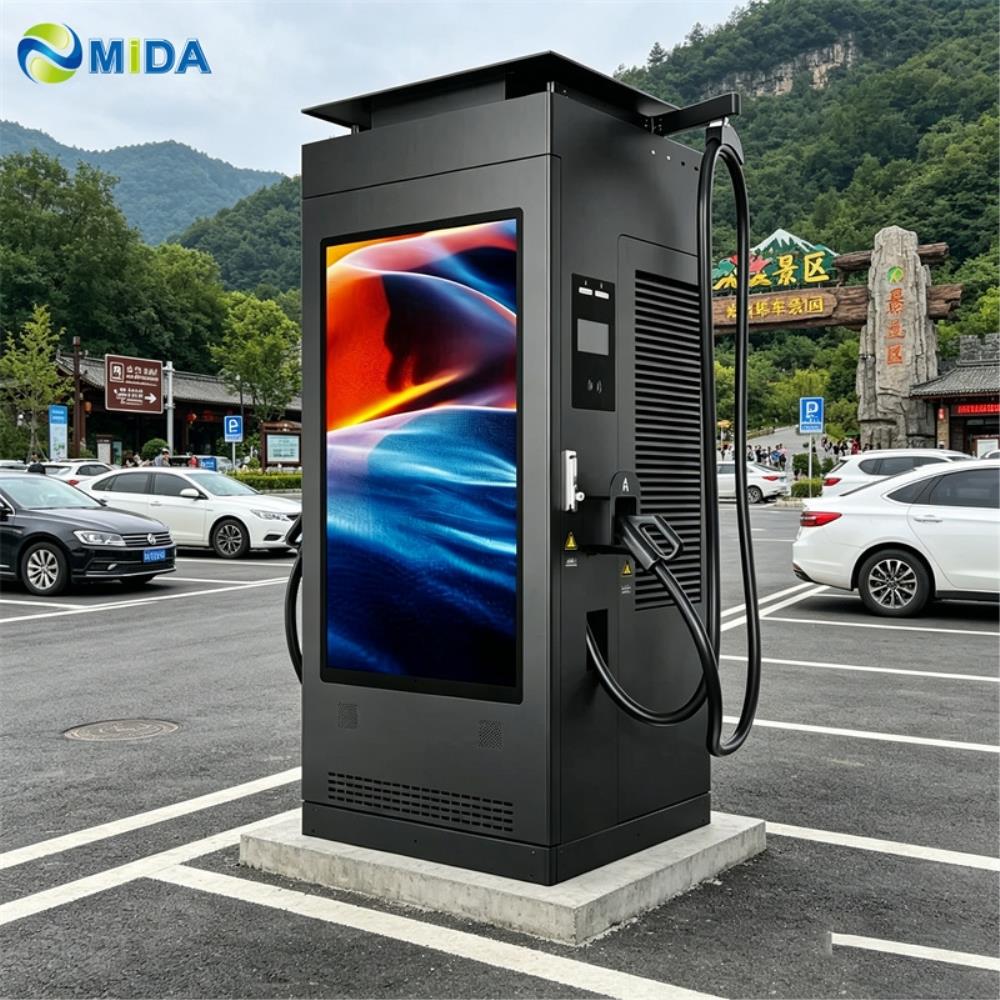
Retail parking lots are the most numerous, most visited, and most commercially undervalued real estate in the urban landscape. Every day, millions of drivers park at supermarkets, shopping centers, big-box retailers, and strip malls — and increasingly, a growing share of those drivers arrive in electric vehicles with a battery to replenish. For retail landlords and operators, EV charging in the parking lot is no longer optional: it is a tenant expectation, a lease differentiator, and a foot-traffic driver. The MIDA 180kW Smart DC EV Charging Station with High-Brightness Advertising Screen is designed to make that infrastructure not just a cost of doing business, but a profit center in its own right.
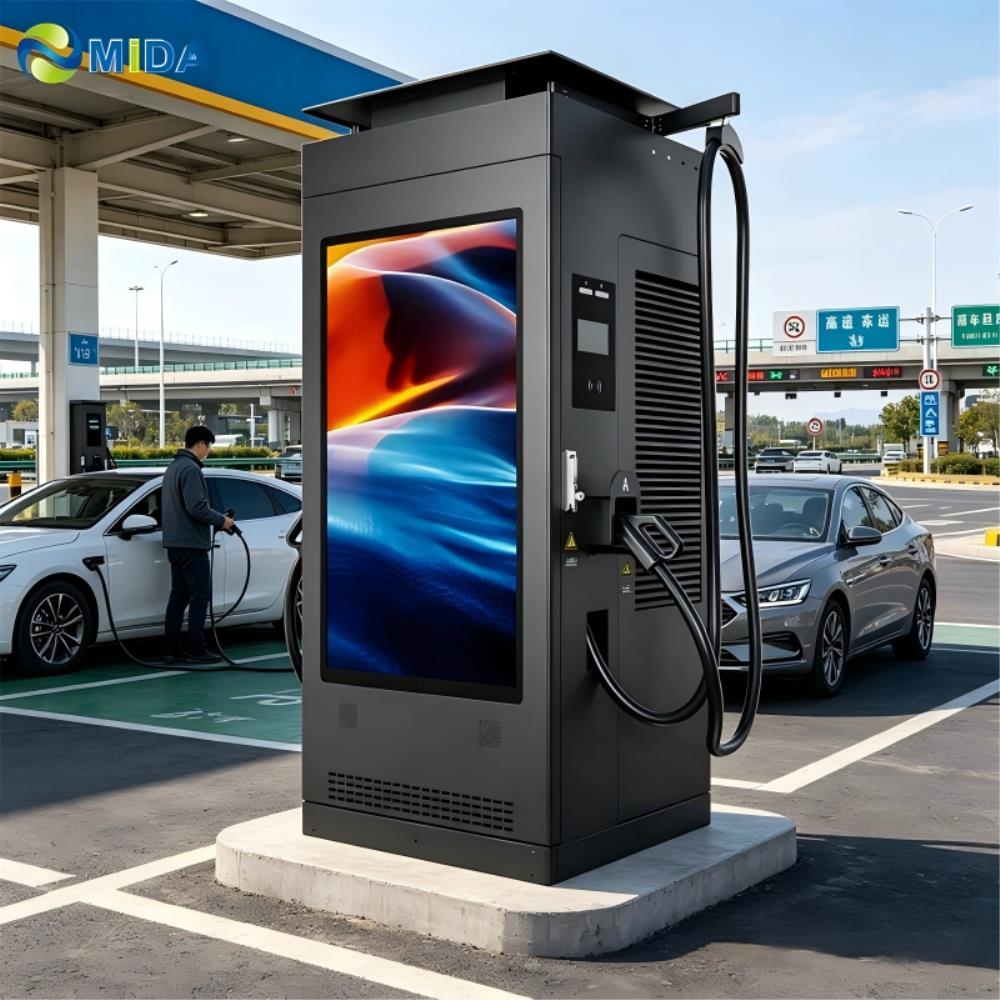
The 180kW power level is the optimum point for retail parking economics. It delivers a substantial charge — roughly 200–250km of range in 20–30 minutes — in the window of a typical shopping trip, which keeps bays turning over without demanding the transformer capacity and capital outlay of 240kW+ equipment. At the same time, 180kW is fast enough to satisfy the “I need a real charge, not a trickle” expectation of modern EV drivers, who increasingly plan errands around charging stops. The high-brightness advertising screen is the second pillar of the product’s value proposition: in a retail parking lot, the screen’s audience includes not just the charging driver but every shopper walking to and from the store entrance, multiplying the media value of every installed unit.
Positioning summary: this station converts a retail parking lot into a three-layer asset — a charging service that generates kWh revenue, a media channel that generates advertising revenue, and a customer-experience feature that lifts footfall and dwell time for the entire property. It is the product a retail landlord installs across a portfolio of sites, or a supermarket chain deploys at 200 stores, to turn parking infrastructure from overhead into income. The following sections analyze the display technology, the charging performance, safety and durability, the smart management stack, the technical specification, and the retail deployment playbook.
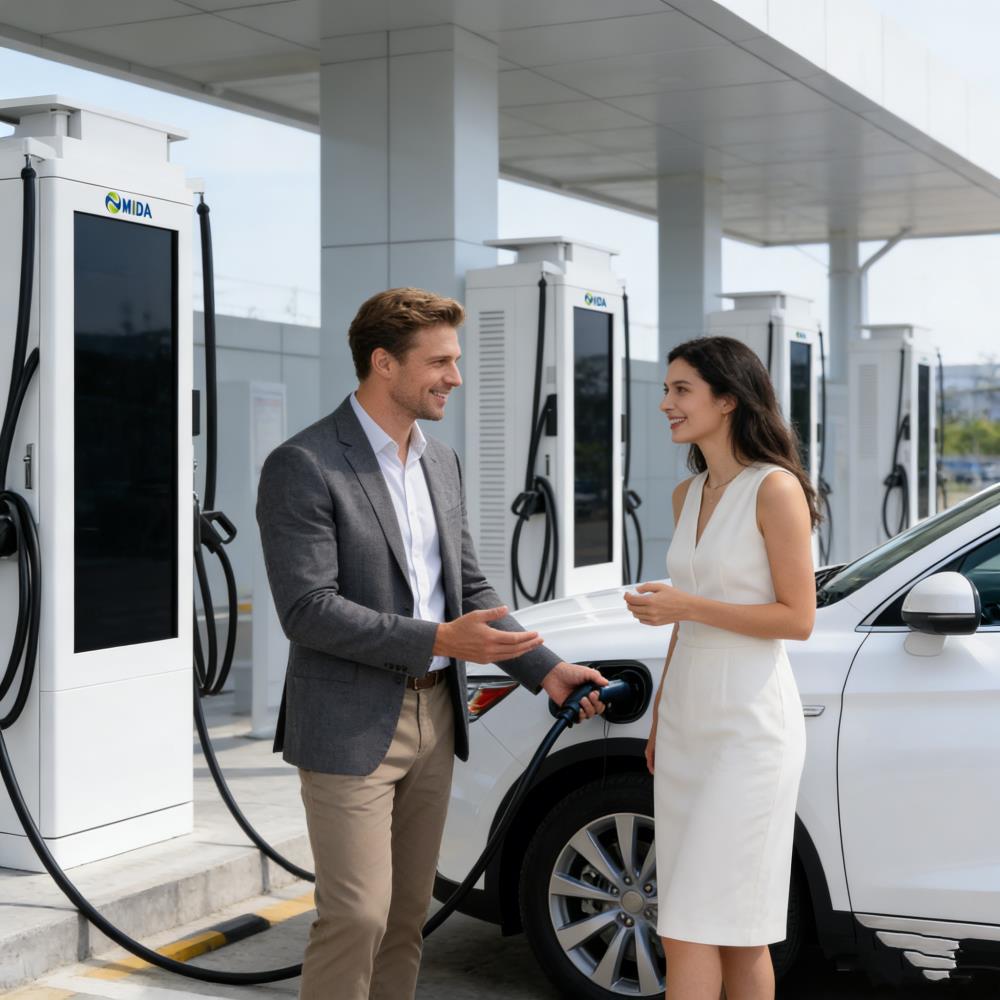
2. Interactive Advertising Screen: High-Brightness Media for the Retail Forecourt
The advertising screen on the 180kW retail station is built for one of the most challenging visual environments in outdoor media: a sunlit asphalt parking lot, where glare is brutal and attention is split between shopping lists, children, and trolleys. The MIDA display answers this with a 55-inch Full-HD panel rated at 2500 nits peak brightness — among the highest in the product family — ensuring that content remains vivid and readable even in direct midday sun on light-colored asphalt. An ambient light sensor continuously adjusts backlight levels, ramping to full output in daylight and dimming at night to save energy and respect light-pollution rules.
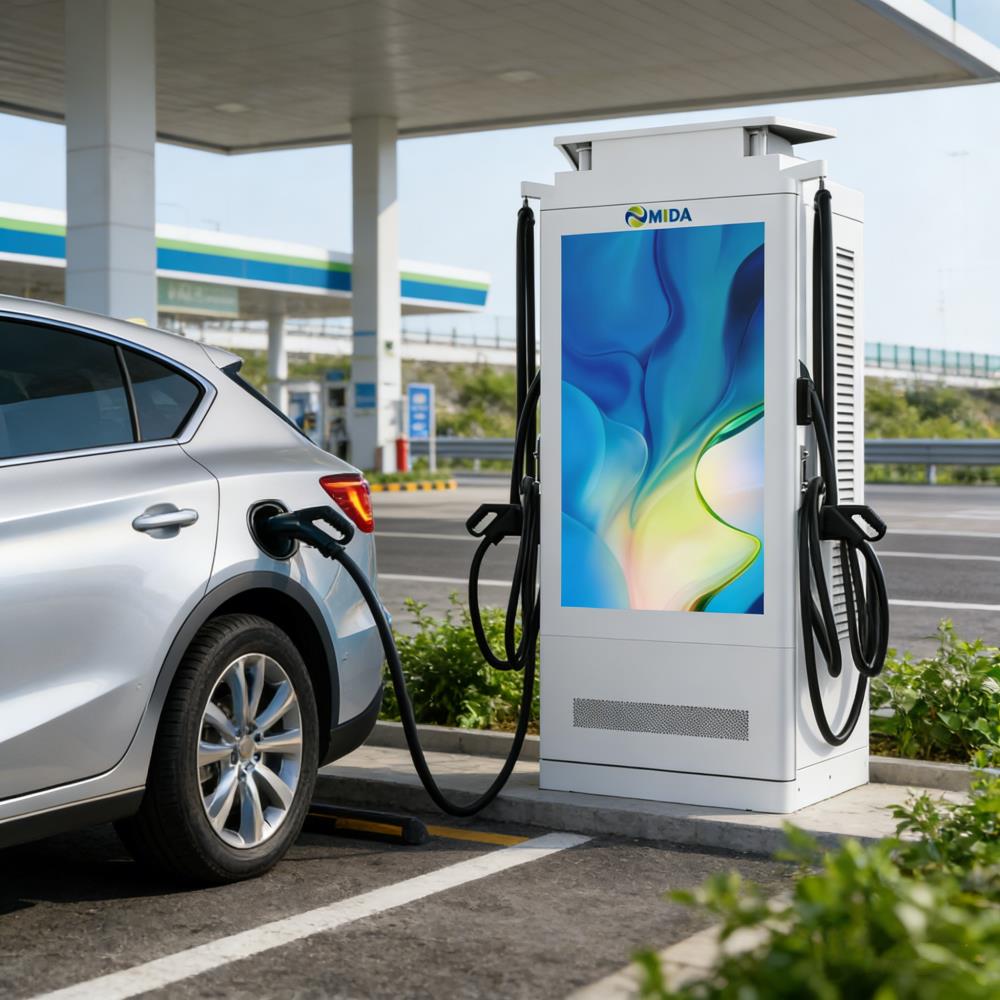
The display’s audience model is what makes retail parking uniquely valuable to advertisers. Each charging session anchors a driver (and often passengers) beside the screen for 20–30 minutes, while simultaneous pedestrian traffic from the store entrance adds thousands of passing impressions. A station positioned on the walking route between parking and entrance can log 10,000–25,000 daily impressions in a busy retail lot. At retail-location CPMs of €8–€20 for full-motion inventory, gross media value of €80–€500 per screen per day is realistic — and because the retail landlord controls the site, they capture this value directly rather than through an intermediary.
The content strategy for retail parking differs from other contexts. The most effective deployments combine:
- Anchor tenant promotions: the supermarket or big-box retailer reserves prime slots for weekly offers, new-product launches, and loyalty-program pushes — internal value that lifts same-store sales directly.
- Adjacent business advertising: cafés, pharmacies, gyms, and services in the same complex buy slots, creating a landlord-controlled local ad network.
- National brand campaigns: FMCG, telecom, and automotive brands purchase programmatic or direct inventory for broad reach.
- Community and wayfinding content: store directories, opening hours, local events, and weather keep the screen useful even when no vehicle is charging.
The CMS supports all of it: multi-tenant playlists, day-parting (breakfast, lunch, evening peaks), geo-fenced campaigns, split-screen charging status, and live data widgets. Hardware protection matches the environment: IK10-rated tempered glass, IP65 display housing, heat-pipe cooling, and a 50,000-hour rated lifetime.
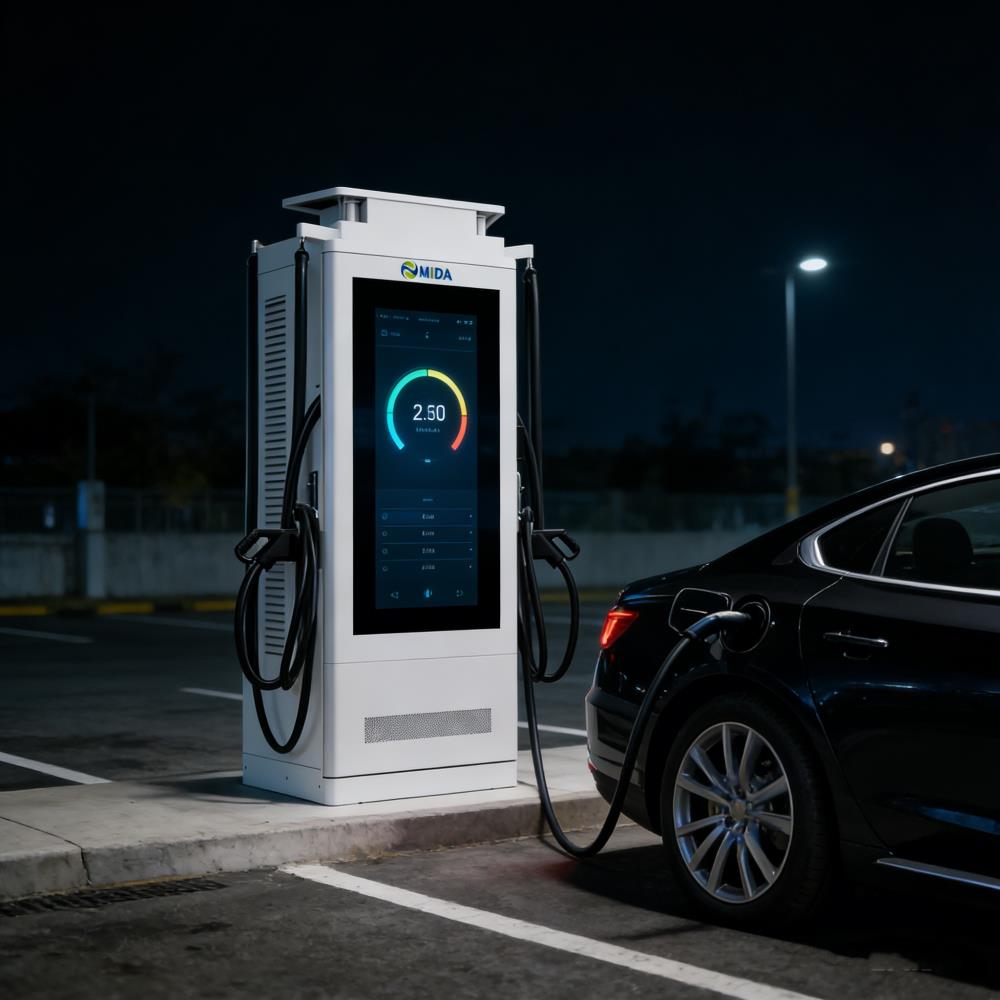
From a profit standpoint, retail operators should treat the screen network as a portfolio with compounding value. A landlord with 20 stations across five sites can package regional advertising across the entire network, commanding higher rates than single-site inventory, and can offer sponsors “eyes on” metrics verified by the CMS. Combined with charging revenue, the media line typically compresses the station payback to 30–42 months in retail contexts, versus 48–60 months for screen-less units.
3. High-Performance Charging Technology: 180kW with Dual-Gun Throughput
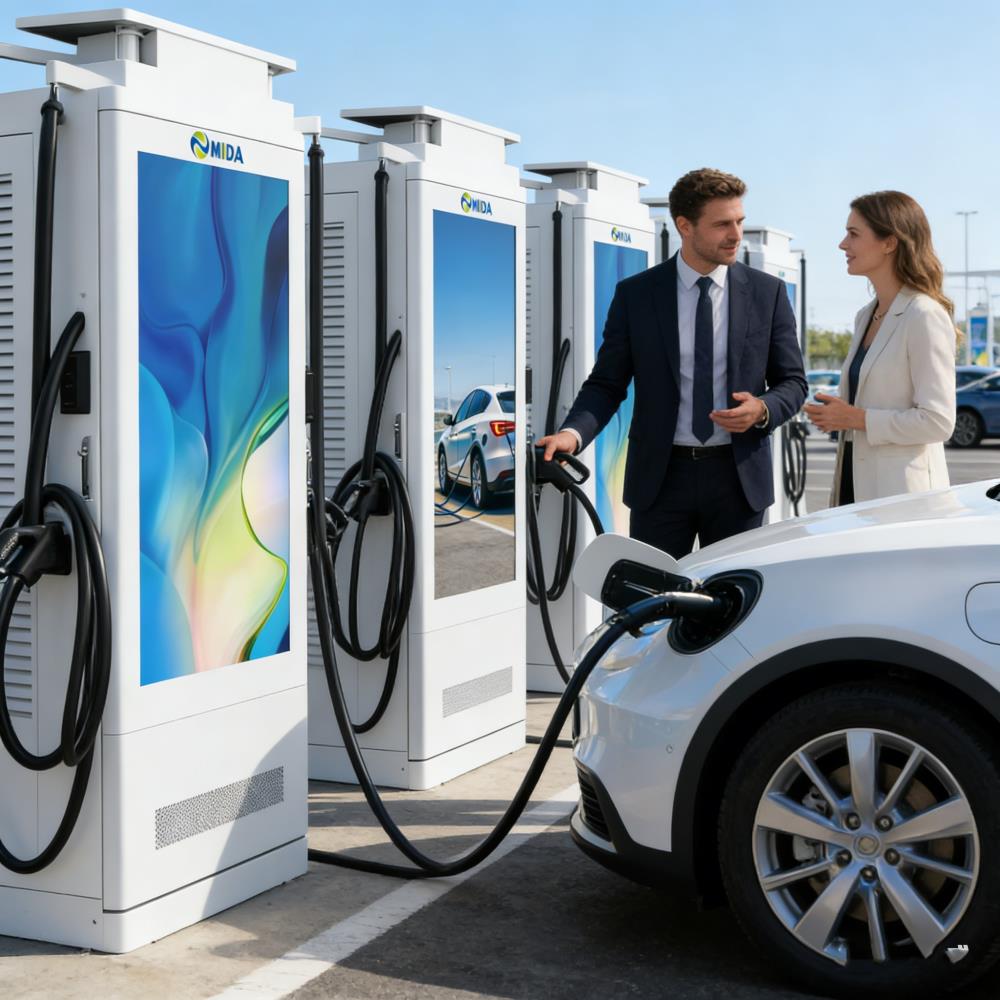
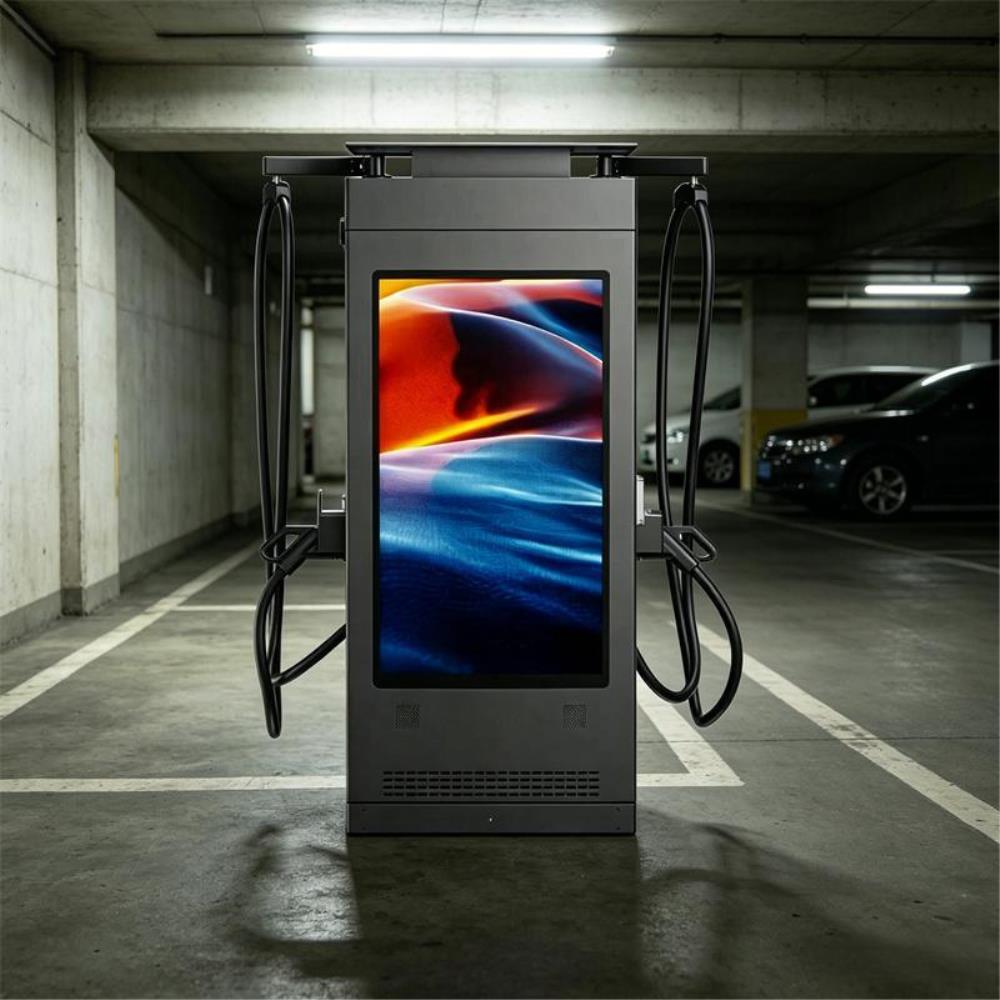
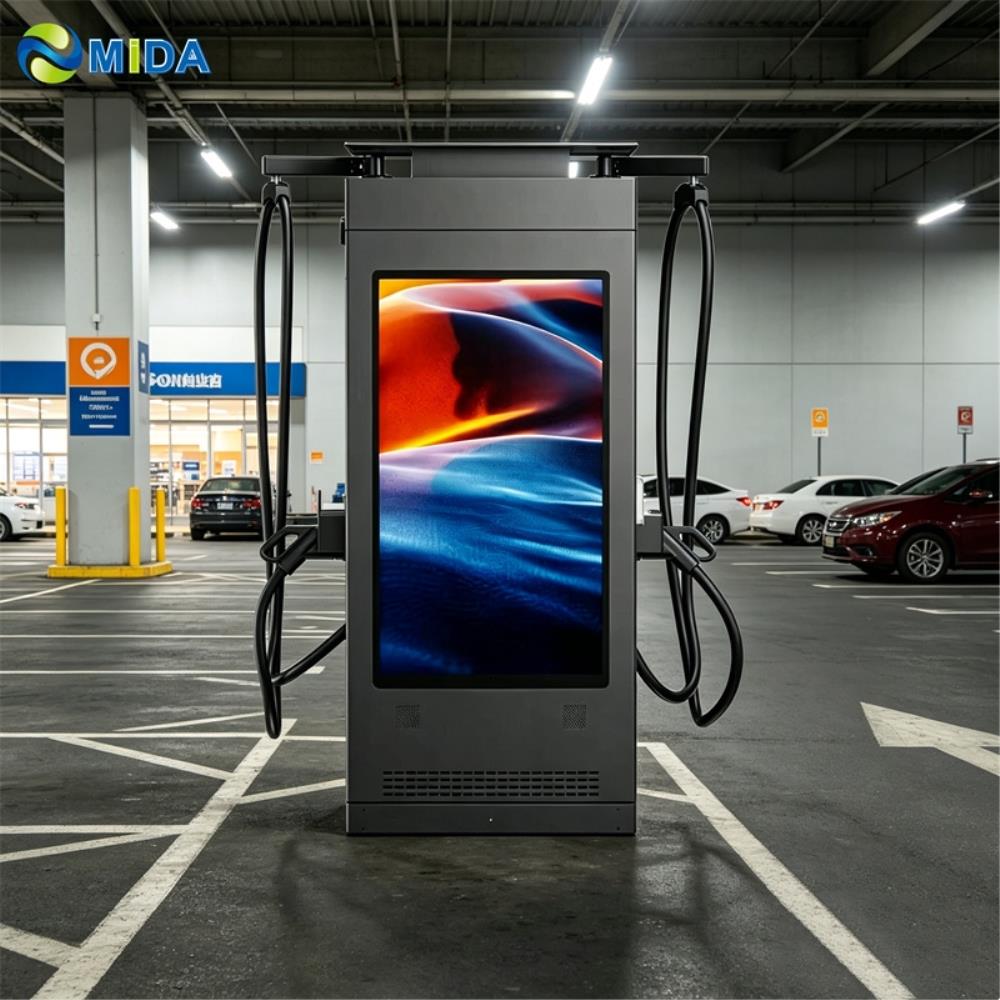
The 180kW power stage uses the same modular, hot-swappable platform as the rest of the MIDA family, with output configurable in steps down to 120kW where grid capacity is tighter. Dual guns are standard, with dynamic power sharing: 90kW+90kW to two vehicles, 120kW+60kW, or the full 180kW to a single vehicle. In a retail parking lot, where sessions cluster around shopping peaks, the dual-gun design effectively doubles the throughput of the bay during rush hours and reduces queue frustration — both of which protect the station’s revenue and its reputation.
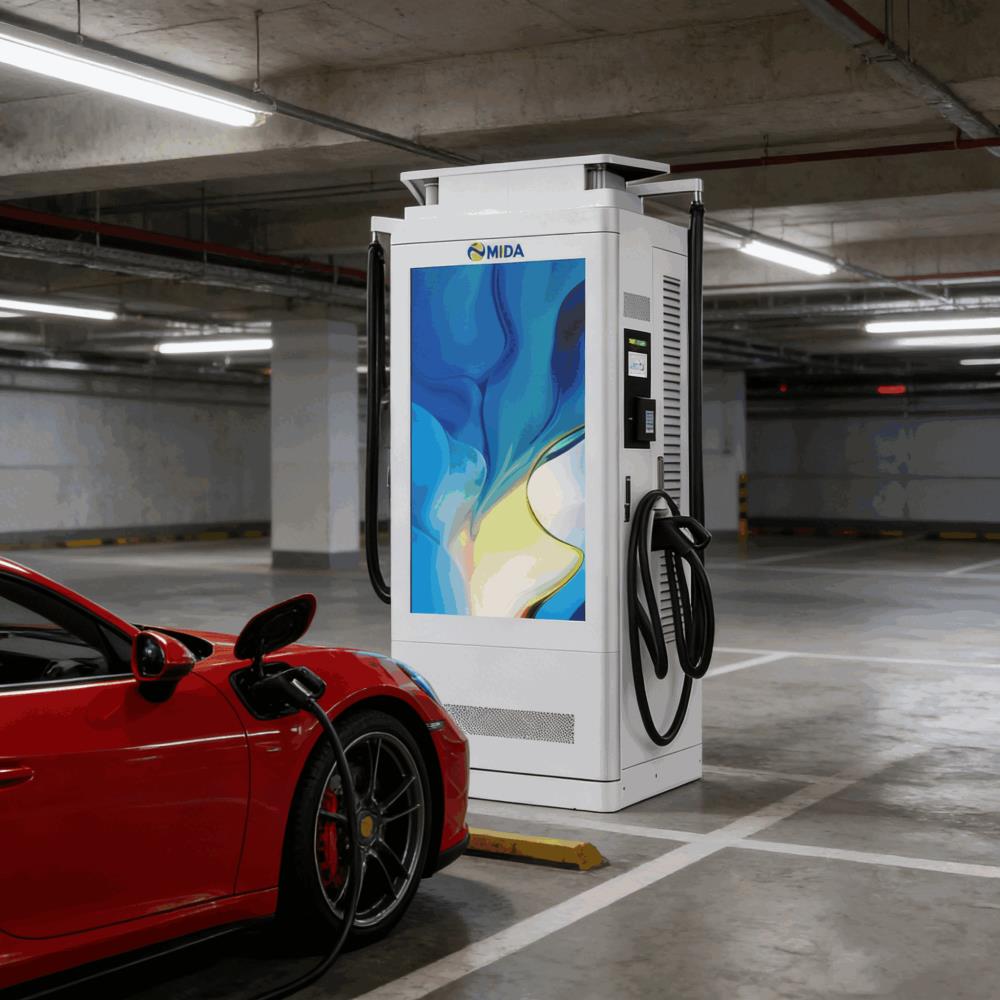
The 150–1000V DC output range ensures compatibility with the entire current and future vehicle parc, including 800V-architecture models that require charge voltages above 900V to reach rated power. Per-gun current reaches 250A continuous, handling large SUVs and vans — the vehicle classes most common in retail parking. Peak module efficiency of 95–96% keeps energy losses and heat low, and the station’s smart-charging features allow the operator to coordinate with site-level load management so multiple units share a constrained transformer without tripping.
Input is 400V AC three-phase, 50/60Hz, ±15%. The 180kW tier typically requires a dedicated feeder or transformer reinforcement at retail sites — a manageable and well-understood cost that the media revenue stream helps offset. Connector configuration is set at order: dual CCS2 for Europe and the Gulf, CCS1 for North America, hybrid options, and NACS adapter readiness. ISO 15118 Plug & Charge is available on request, and the station supports RFID, QR, and app authentication out of the box.
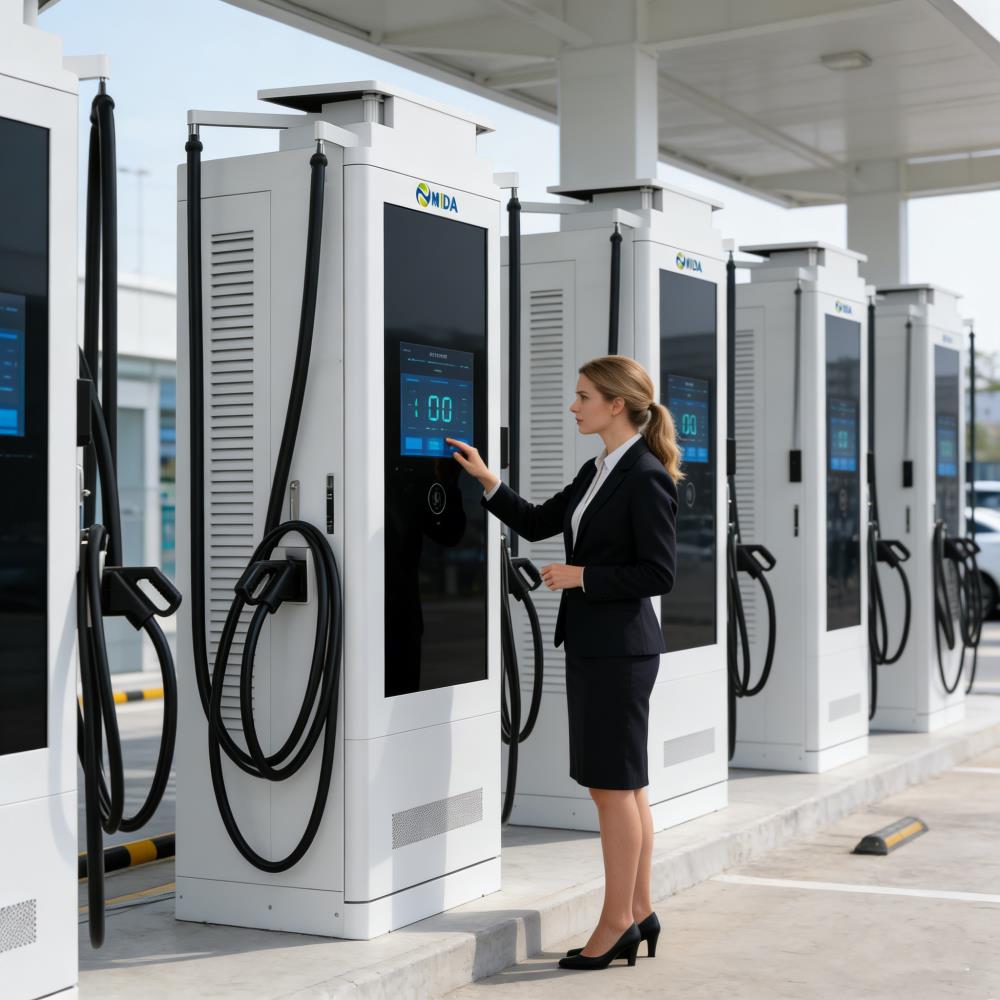
The charging experience is engineered for the retail setting: the driver parks, plugs, and walks into the store; the screen confirms the session and shows live progress; the backend bills on return. Pre-session contactor checks, insulation monitoring, emergency stop, and graceful thermal derating above 55°C ambient ensure the unit operates safely and continuously through summer peak shopping weekends, with cold-weather startup to -25°C for winter markets.
4. Safety and Reliability
Retail parking lots are public spaces with high incidental traffic — trolleys, delivery carts, forklifts in stockrooms, and children at play — and the safety bar is set accordingly. The MIDA 180kW station is CE certified (LVD, EMC, RED), UKCA marked, and compliant with IEC 61851-1/23, IEC 62196, and ISO 13849, with independent type testing and full documentation for permitting and insurance.
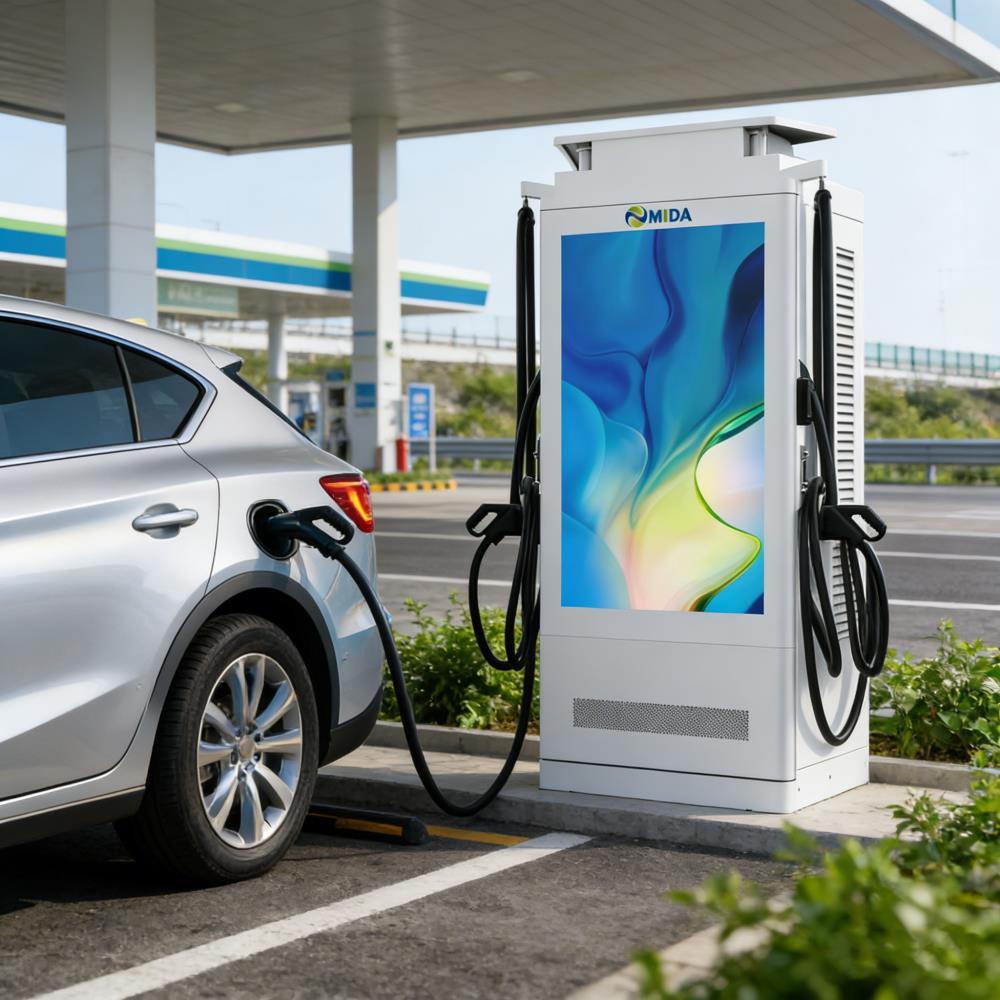
The protection architecture is layered: AC-side Type II surge protection; Type A RCDs with 6mA DC fault detection; DC-side insulation monitoring before and during every session; per-gun contactor weld detection; emergency stop; and remote de-energization. The IP55 cabinet and IP65 display housing resist rain, dust, and hose-down cleaning, and the IK10 ratings on cabinet and screen glass protect against trolley impacts and vandalism. The floor-mounted cabinet is bolted to a concrete pad with optional bollards, and cable management keeps charging cables off the ground when idle.
Thermal design is matched to the retail duty cycle: intelligent forced-air cooling with variable-speed fans, conformal-coated electronics, and conservative component derating deliver a 10+ year design life. All serviceable parts — modules, fans, display, communication boards — are field-replaceable, and MIDA’s remote diagnostics platform monitors every unit, pushes fault alerts, and applies firmware updates over the air. For a retail network running dozens of sites without dedicated technical staff, the result is predictable uptime and minimal maintenance cost.
5. Smart Management and Connectivity
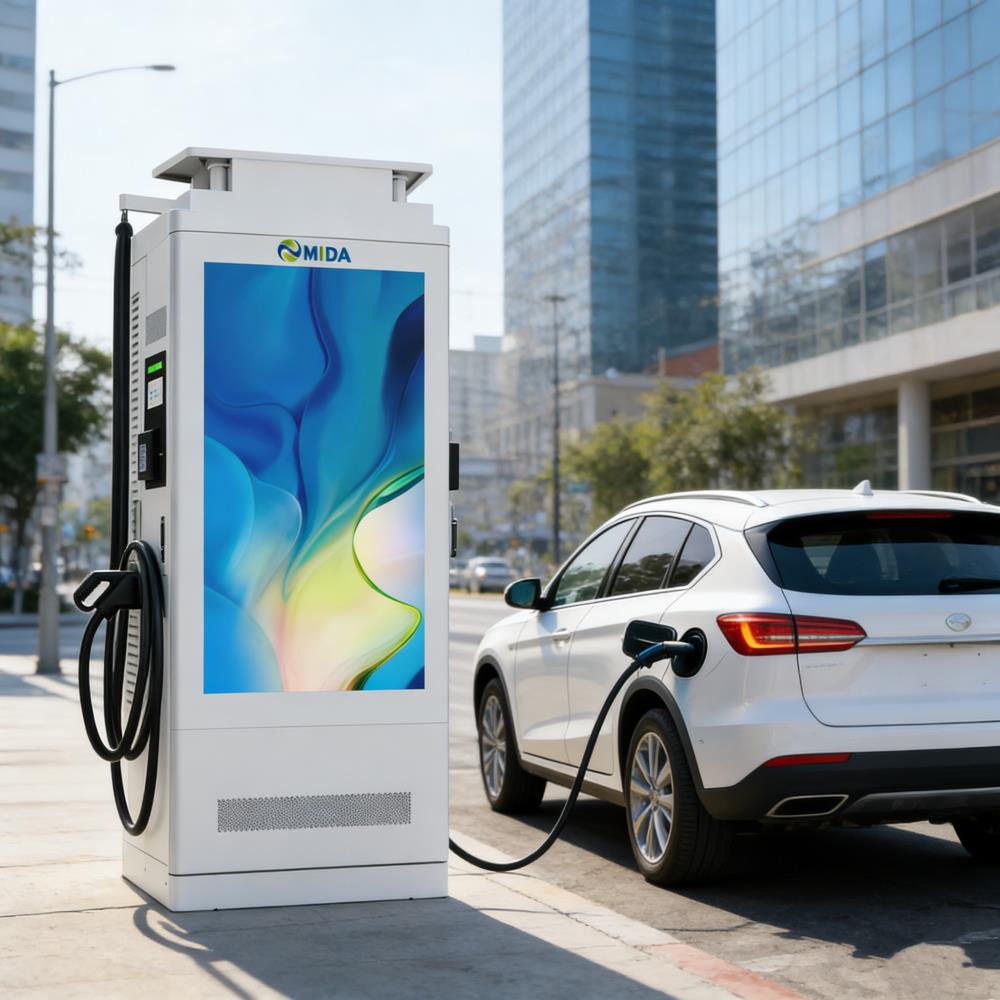
The “smart” in this station’s name is operational, not cosmetic. OCPP 1.6J compliance (2.0.1 on request) connects the unit to any compliant Charge Point Management System, enabling roaming, dynamic pricing, and centralized management. Connectivity is redundant — 4G LTE (5G-ready), Wi-Fi, Ethernet, RS485 — with offline session handling and local caching for resilience.
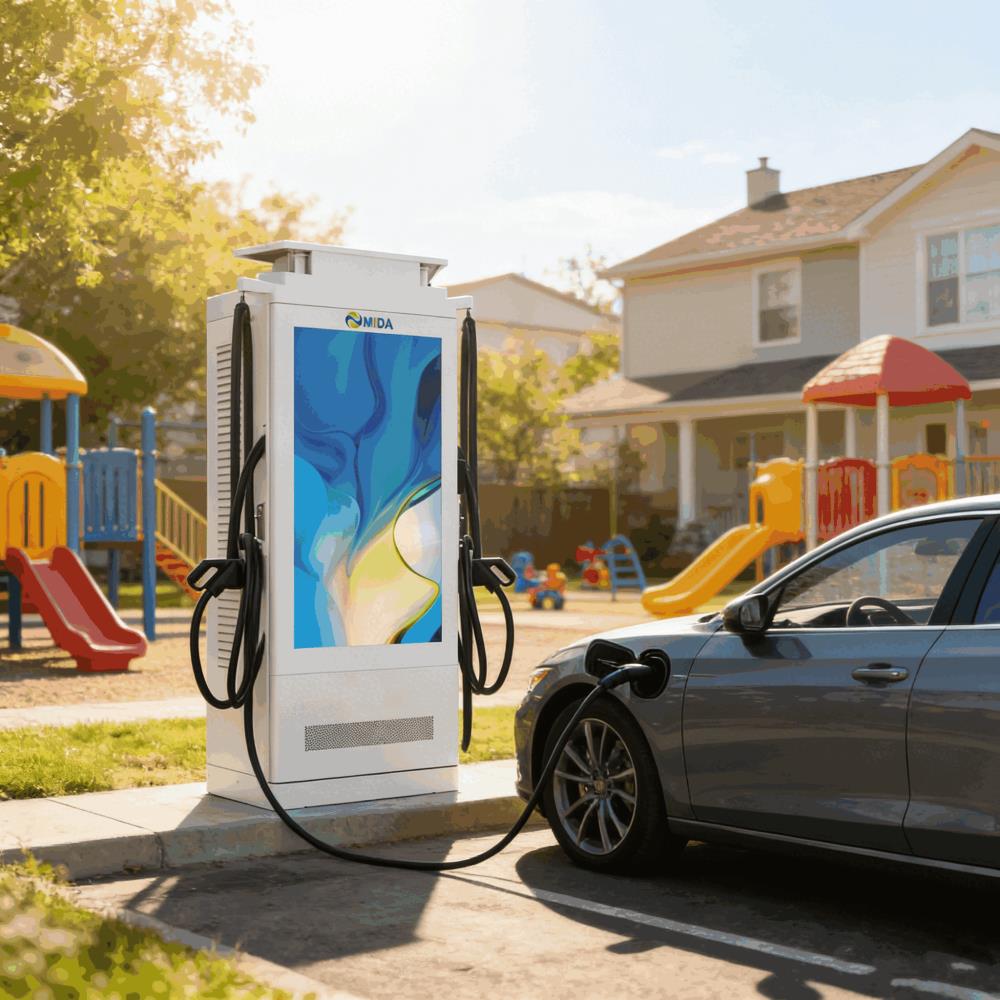
The backend dashboard gives a network-wide view of sessions, power, energy, revenue, utilization, and faults, with exportable reporting for finance. Remote operations include over-the-air firmware updates, tariff configuration (time-of-use, session fees, dynamic pricing), power-limit adjustments, and load management across multiple units per site. Authentication supports RFID, QR, app, and Plug & Charge, and the operator can configure the mix per site.
For the advertising function, the CMS runs on the same connectivity with logical isolation: campaigns play from local cache during outages, and media never interferes with charging. Impression and engagement analytics feed advertiser reporting automatically. The combined platform lets a retail landlord operate charging and media as two coordinated P&L lines from one dashboard — energy revenue, media revenue, and site performance in a single view.
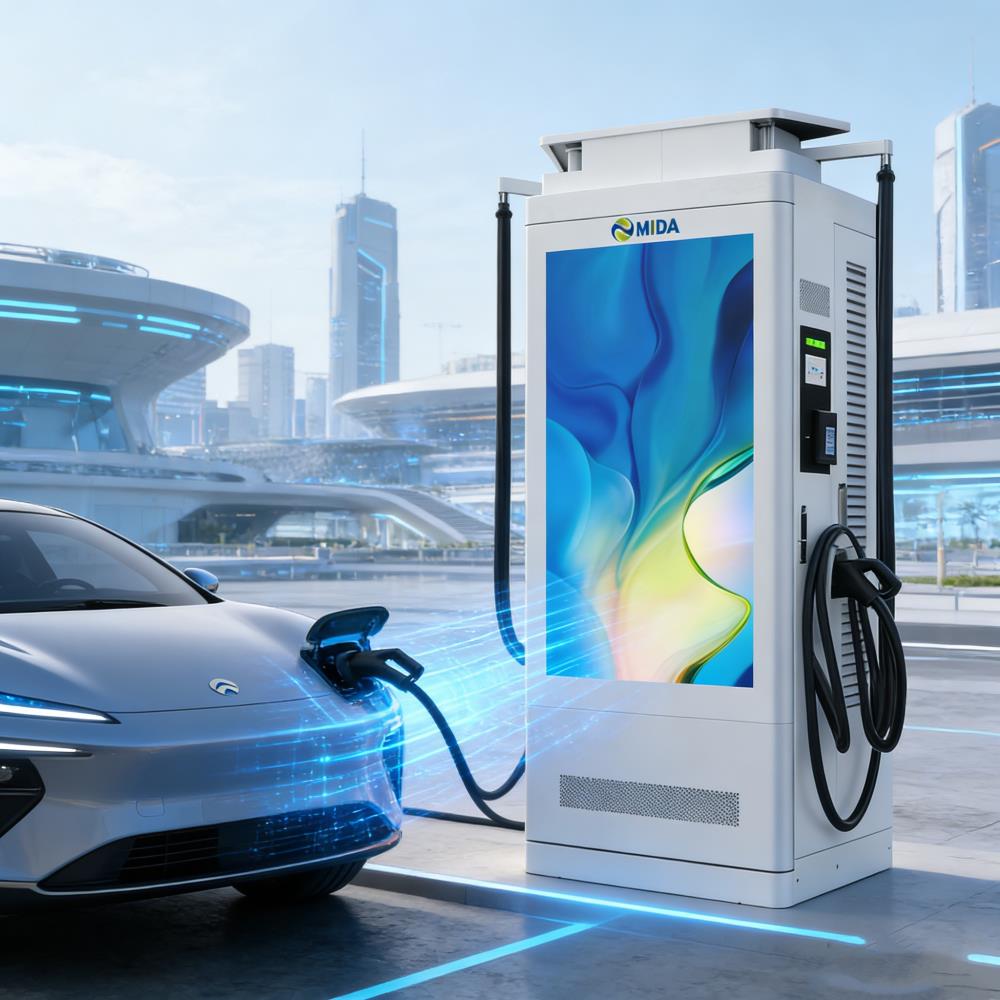
6. Detailed Technical Specifications
| Parameter | Specification |
|---|---|
| Model | MIDA 180kW Smart DC EV Charging Station with High-Brightness Advertising Screen |
| Output Power | 180kW (derate options to 120kW; modular upgrades) |
| Input | 400V AC ±15%, 3-phase, 50/60Hz |
| Output Voltage | 150–1000V DC |
| Output Current | Up to 250A per gun |
| Charging Connectors | Dual CCS2 / Dual CCS1 / Hybrid; GBT & NACS adapter ready |
| Charging Protocols | OCPP 1.6J (2.0.1 optional), DIN 70121, ISO 15118 Plug & Charge ready |
| Display | 55-inch TFT-LCD, 1920×1080 FHD, 2500 nits high-brightness, auto-dimming |
| Display Protection | 4–6mm tempered glass, IK10, IP65 housing |
| Enclosure Rating | IP55 cabinet, IK10 vandal resistance |
| Cooling | Intelligent forced-air + heat-pipe (display) |
| Communication | 4G LTE / 5G-ready, Wi-Fi, Ethernet, RS485; RFID/QR/App/Plug & Charge |
| Efficiency | ≥95% peak module efficiency |
| Smart Charging | Time-of-use, demand response, load management, scheduled windows |
| Operating Temperature | -25°C to +55°C (graceful derating) |
| Certifications | CE (LVD/EMC/RED), UKCA, IEC 61851-1/23, IEC 62196, ISO 13849 |
| Dimensions (W×H×D) | ~800×2100×450mm, floor-mounted |
| Warranty | 2-year standard; 5-year extended option |
The specification defines a station purpose-built for retail parking: high-brightness display for sunlit forecourts, dual-gun throughput for shopping-peak clusters, wide-voltage compatibility for the full vehicle parc, and complete certification for portfolio-scale deployment.
7. Use Cases & Installation
The 180kW high-brightness station serves the retail ecosystem across several archetypes:
- Supermarket & Hypermarket Lots — Stations on the walking route between parking and entrance; the screen promotes weekly offers and partner brands; dual guns handle shopping-peak clusters; 180kW matches the 30–45 minute shop-and-charge dwell.
- Shopping Center & Mall Parking — 180kW units on prime parking levels near elevators; the screen rotates tenant promotions and wayfinding; media revenue is shared between landlord and CPO partner per the lease model.
- Big-Box Retail & DIY Stores — Stations at warehouse-style retailers where customers load large items; the screen shows product demos, loyalty programs, and local service ads during the longer dwell of heavy-item purchases.
- Retail Parks & Outlet Villages — Portfolio deployments across multi-store complexes; the landlord packages advertising across all screens, creating a regional media network that commands premium rates.
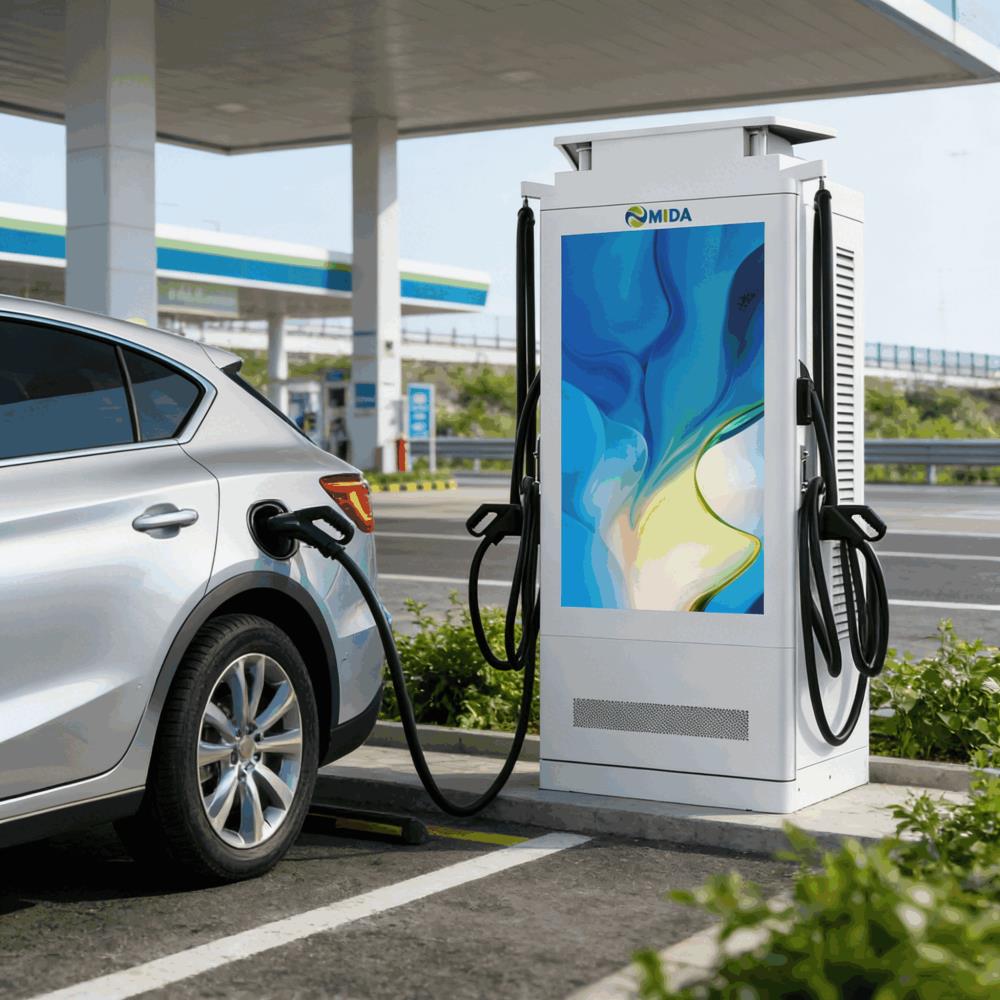
Installation follows the standard sequence: site survey for grid capacity (180kW typically needs a dedicated feeder or transformer reinforcement, 120kW derate options fit existing supplies), concrete pad or plinth, cable runs, and commissioning. The integrated cabinet minimizes on-site assembly; commissioning covers connectivity, backend registration, tariff and load-management configuration, and a full-power test. Typical install time is 1–3 days per site.
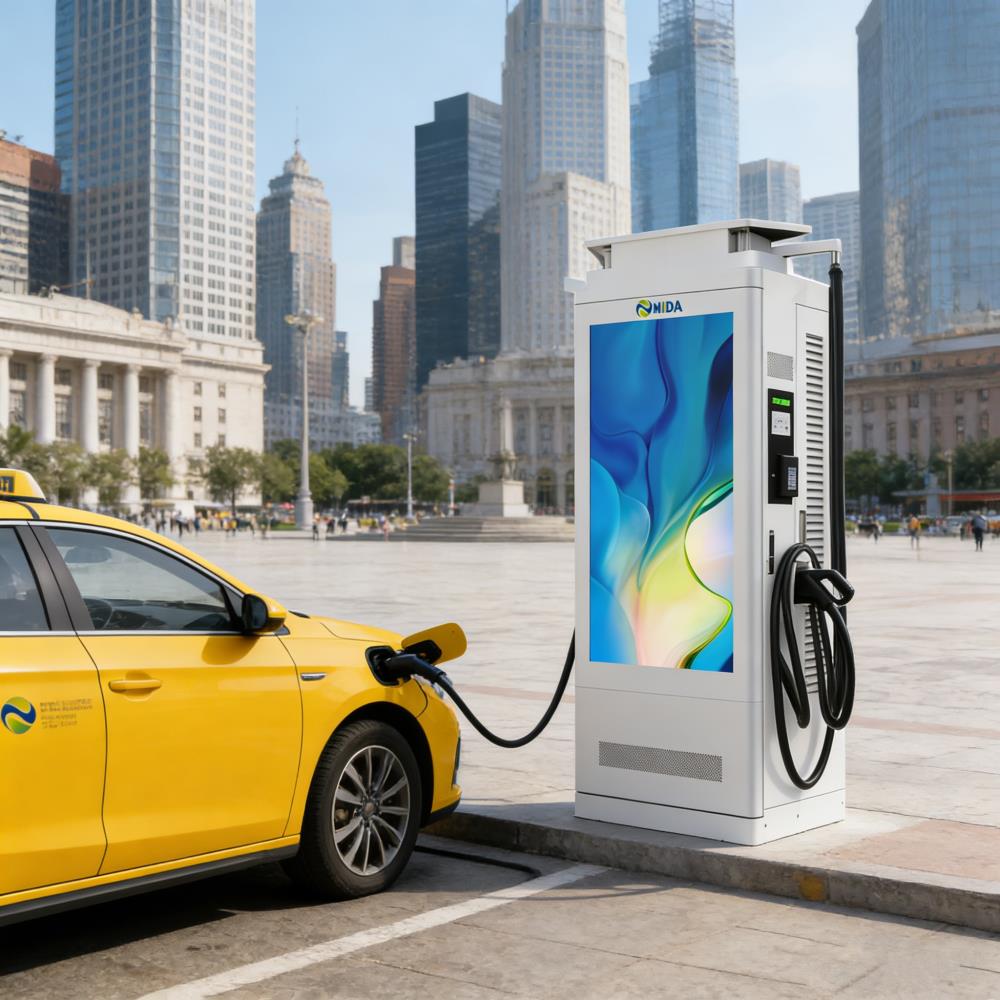
Operationally, expect 8–14 sessions per day per bay in year one at most retail sites, scaling with EV adoption and roaming visibility. Maintenance is quarterly inspection plus annual filter service, with remote firmware and content updates. For retail landlords, the business case combines three revenue effects — kWh margin, media income, and incremental store sales — which together typically support a 30–42 month payback.
8. FAQ
Q1: Why 180kW for a retail parking lot? 180kW delivers 200–250km of range in 20–30 minutes — matching the typical shopping trip — while keeping capital and grid costs below ultra-fast 240kW+ equipment. Dual guns double bay throughput during peak hours.
Q2: How bright is the screen and why does it matter? 2500 nits peak brightness keeps content readable in direct sunlight on light asphalt — the hardest visual environment for outdoor screens. Auto-dimming reduces output at night for energy savings and light-pollution compliance.
Q3: Who buys advertising on a retail parking screen? Anchor retailers (internal promotions), adjacent businesses (local ad network), national brands (FMCG, telecom, auto), and programmatic platforms filling unsold inventory — with the landlord controlling priority and pricing.
Q4: Can the screen show charging progress for drivers? Yes — split-screen mode permanently displays live session data (power, state of charge, cost, time remaining) alongside advertising, so drivers always see their charging status at a glance.
Q5: What grid capacity does a 180kW station need? A dedicated three-phase feeder with transformer capacity of roughly 190–230kVA including headroom; the 120kW derate option fits existing supplies. Load management coordinates multiple units on shared capacity.
Q6: Which connectors and standards are supported? Dual CCS2 (Europe/Gulf), dual CCS1 (North America), hybrid options, GBT and NACS adapter readiness; OCPP 1.6J, DIN 70121, and ISO 15118 Plug & Charge are supported.
Q7: How does the media revenue affect payback? At typical retail CPMs, media revenue of €80–€500 per screen per day compresses station payback from 48–60 months to 30–42 months, and the screen also lifts store sales through targeted tenant promotion.
Products categories
-
180kw 240kW DC Ultra Fast EV Charger Station OC...
-
Level 3 EV DC Charger Electric Car Charging Sta...
-
240kw 300kw 360kw 420kW Fast Charging Station F...
-
120KW 160KW 180kW 200kw Fast EV Charger Station...
-
420KW CCS2 New energy electric vehicle Charging...
-
360KW New energy electric vehicle Charging station