

Quick Answer
20-40kW wall mounted DC charging stations are the fastest-growing segment in public EV charging infrastructure because they deliver true DC fast charging — a 40kW unit adds roughly 120-160 km of range in 30 minutes for a typical passenger EV — at a fraction of the footprint, capital cost, and grid requirement of 60-150kW cabinets. For operators, the decisive factors are: confirming three-phase grid capacity (typically 32-63A per unit), selecting CCS2/CHAdeMO multi-standard connectors, deploying OCPP 1.6-compliant units for network integration, and engineering for IP54+ outdoor endurance. This guide walks through technology selection, electrical prerequisites, step-by-step installation, cost modelling, and maintenance so facility owners, utilities, and charge point operators can deploy reliable, revenue-ready stations in as little as 2-4 weeks.
Key Takeaways
- Rapid charging economics: 20-40kW wall-mounted DC chargers charge 3-5x faster than AC wallboxes while costing a fraction of high-power cabinets, making them the highest-ROI tier for curbside, retail, fleet, and hospitality sites.
- Grid is the #1 determinant: verify three-phase supply, upstream breaker capacity, and earthing before purchase — a unit is only as fast as the connection behind it.
- Interoperability wins: CCS2 and CHAdeMO multi-standard connectivity plus OCPP 1.6 compliance maximize vehicle coverage and let you plug into any major charging network or back-end platform.
- Proven 5-step installation sequence: site survey → permits and compliance → electrical works → mounting and commissioning → remote network activation.
- Payback in 2-4 years: for high-traffic public locations, TCO modelling driven by uptime and utilization typically returns investment within 2-4 years, with 50kW upgrade paths protecting future capacity.
Why 20-40kW Wall Mounted DC Chargers Dominate Rapid Public Infrastructure
The 2026 market reality
Public charging demand in 2026 is no longer driven by early adopters topping up overnight. It is driven by commercial fleets, ride-hail drivers, urban commuters, and destination shoppers who need *rapid* energy delivery in 20-45 minute dwell windows. According to industry tracking, DC fast chargers in the 20-50kW class now account for the majority of new public charging points outside highway corridors, precisely because they hit the sweet spot between charging speed and infrastructure cost.
For a charge point operator (CPO), the math is compelling. A 120kW cabinet requires a dedicated transformer or heavily reinforced three-phase connection, significant civil works, and a capital outlay several times higher than a 20-40kW unit. A wall-mounted 20-40kW charger, by contrast, can often be fed from an existing commercial three-phase supply with modest upgrades, mounted on an existing wall or pillar, and commissioned in days rather than months.
What “rapid” means in real-world terms
The word “rapid” in public charging nomenclature has drifted upward in recent years, but for the 20-40kW class it still describes a genuinely useful charge session:
- 20kW: approximately 60-80 km of range added per hour of charging.
- 30kW: approximately 90-120 km of range per hour — sufficient for a full daily commute in 30-40 minutes.
- 40kW: approximately 120-160 km per hour, enabling most passenger EVs to reach 80% state of charge in 40-60 minutes from a low starting point.
Because most urban charging sessions are 30-60 minutes by design (shopping, dining, meetings), a 40kW unit delivers the complete session within the natural dwell time — which is exactly why this class is called *rapid* public infrastructure rather than destination AC trickle charging.
Where wall-mounted DC beats pedestal and high-power cabinets
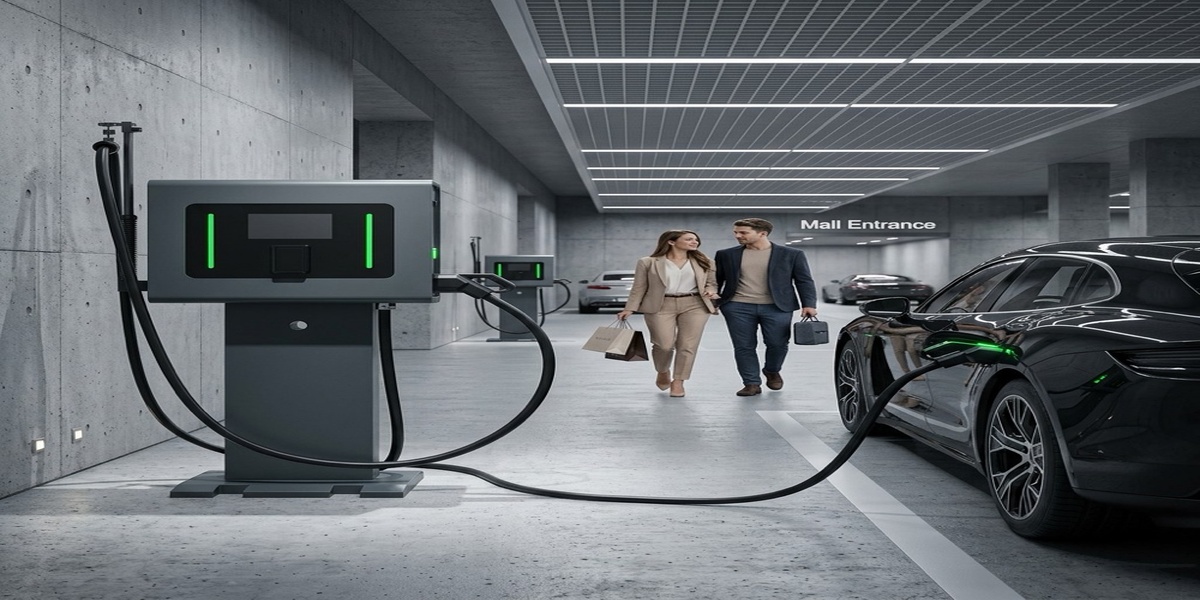
Wall-mounted units occupy no ground footprint, resist vehicle impact by design, and cost less to install because they reuse existing building structure. They are the pragmatic choice for:
- Parking garages with masonry or concrete walls (underground and above-ground).
- Retail and hospitality forecourts where floor space has commercial value.
- Fleet depots where chargers mount on depot walls along a charging lane.
- Curbside and street-level installations where a pedestal would obstruct pedestrian flow.
When site constraints push you toward a pillar-mounted or freestanding variant, the same power electronics platform is available in those form factors — the key is matching the enclosure to the environment, not compromising on power or protocol support. For deployments needing wall, pillar, or pole mounting flexibility, a DC Wallbox CCS2 unit in the 30-50kW range gives operators one hardware platform across multiple site types.
Core Technology: What Sets a Wall Mounted DC Charging Station Apart
AC vs DC — the charging curve difference
An AC wallbox simply passes utility power to the vehicle’s onboard charger, which typically maxes out at 7-22kW. A wall-mounted DC charging station bypasses the onboard charger entirely: it converts three-phase AC to DC inside the station’s power modules and feeds the battery directly. This is why a 40kW DC station delivers 2-6x the effective power of an AC wallbox at the same connection — and why DC is the only practical path to sub-60-minute public charging.
Connector strategy: CCS2, CHAdeMO, and dual-gun operation
European and most export markets converge on CCS2 (Combined Charging System Type 2) as the dominant standard, but CHAdeMO remains relevant for legacy Japanese vehicles and some bus fleets. A dual-gun configuration (CCS2 + CHAdeMO) turns a single station into a universal compatibility point:
- Single vehicles connect to the matching gun; the station negotiates the correct power profile.
- Smart power sharing can split output between two vehicles simultaneously — e.g., 20kW to each vehicle from a 40kW station — which raises utilization at busy sites.
- CCS2-only units reduce cost where the vehicle population is known (e.g., private fleet depots).
For maximum market coverage at public sites, choose a station with both CCS2 and CHAdeMO capability, such as the Wall Mounted DC Charging Station with CCS2 gun and OCPP 1.6, which also supports GB/T configurations for markets that require them.
OCPP 1.6 and network integration
Open Charge Point Protocol (OCPP) 1.6 is the de facto standard for CPO back-end integration in 2026. OCPP 1.6 compliance means the station can be onboarded to virtually any charging network operator (ChargePoint, Monta, Virta, or proprietary platforms) without hardware changes. Look for these protocol features:
- OCPP 1.6J (JSON over WebSocket): modern, firewall-friendly transport.
- Remote start/stop and transaction data: essential for billing and roaming.
- Smart charging commands: enable load management and demand response from the network side.
- Firmware-over-the-air (FOTA): lets you push updates remotely instead of dispatching a technician.
An OCPP-compliant unit is an asset; a proprietary-locked unit is a liability the moment you want to switch networks or aggregate utilization data.
Technical specification comparison
tr>tr>tr>tr>tr>tr>tr>tr>tr>tr>tr>tr>
| Specification | 20kW Wall-Mount | 30kW Wall-Mount | 40kW Wall-Mount (Dual-Gun) | ||
| Output power | 20kW | 30kW | 40kW (20kW + 20kW shared) | ||
| Input | 3-phase, 400V AC ±15%, 50/60Hz | 3-phase, 400V AC ±15%, 50/60Hz | 3-phase, 400V AC ±15%, 50/60Hz | ||
| DC output voltage | 200-1000V | 200-1000V | 200-1000V | ||
| DC output current (max) | 60A | 100A | 133A (per-gun configurable) | ||
| Connectors | CCS2 / GB/T | CCS2 / CHAdeMO | CCS2 + CHAdeMO dual gun | ||
| Protocol | OCPP 1.6J | OCPP 1.6J | OCPP 1.6J | ||
| Protection rating | IP54 | IP54 / IK10 | IP54 / IK10 | ||
| Display & interface | 7″ touchscreen, RFID | 7″ touchscreen, RFID | 7″ touchscreen, RFID | ||
| Communication | 4G / Wi-Fi / Ethernet | 4G / Wi-Fi / Ethernet | 4G / Wi-Fi / Ethernet | ||
| Operating temperature | -25°C to +55°C | -25°C to +55°C | -25°C to +55°C | ||
| Certifications | CE, RCM, UKCA | CE, RCM, UKCA | CE, RCM, UKCA |
These figures are indicative of the current mainstream specification envelope; always validate the datasheet against your grid conditions and target vehicle mix before tendering.
Site Assessment and Electrical Prerequisites
Grid capacity and connection
The single most common installation failure is underestimating the supply. A 40kW DC station at 400V three-phase draws approximately 58A per phase at full load; a 30kW unit draws approximately 43A. Before any equipment order:
- Obtain the site’s utility connection capacity and existing demand profile.
- Verify the upstream breaker and cable rating can sustain continuous full-load current (DC chargers run at high duty cycles, unlike intermittent HVAC loads).
- Confirm earthing topology (TN-S, TN-C-S, or TT) and residual current device (RCD) requirements per IEC 60364 and local code.
- Check for available spare capacity versus the need for a supply upgrade, which adds 4-12 weeks to project timelines.
Where multiple stations share one connection, an upstream load management controller can cap aggregate draw and allow more stations per site than the raw connection would suggest.
Load management
Load management is no longer optional for multi-station sites. A controller or the stations’ built-in OCPP smart-charging functions can:
- Limit total site draw to a contractual maximum (e.g., 63A per station, staggered).
- Prioritize vehicles based on departure time or session state of charge.
- Dynamically rebalance power between CCS2 and CHAdeMO guns as sessions start and stop.
For a 2-4 station site fed by a single commercial supply, load management is the difference between a 2-station deployment and a 4-station deployment on identical grid capacity.
Environmental and mechanical requirements
Wall-mounted outdoor units must survive years of weather, vibration, and vandalism. Minimum engineering requirements:
- IP54 ingress protection (dust-protected, splash-proof) as a baseline; IP55 for exposed coastal or high-rainfall sites.
- IK10 impact rating for public-facing locations exposed to vehicles or deliberate damage.
- Operating temperature range covering your climate — note that sustained -25°C to +55°C operation requires proper thermal management inside the enclosure.
- Adequate wall strength: concrete or masonry rated for the unit’s weight plus cable strain; verify before drilling.
The Step-by-Step Installation Process
Step 1: Permits and compliance
Charging infrastructure sits at the intersection of electrical, building, and sometimes parking regulations. Confirm in advance: electrical installation certification (e.g., IEC 61851-1 for conductive charging systems), local fire and building permits for wall penetrations and cable routing, and any municipal requirements for public charging accessibility and signage. Budget 2-8 weeks depending on jurisdiction — this is the most variable timeline item in the entire project.
Step 2: Civil and electrical works
- Install or upgrade the three-phase distribution board, upstream breaker, and RCD/Type B protection appropriate for DC charging (Type A RCDs are insufficient for DC leakage currents in many configurations).
- Route AC supply cabling to the mounting position with correct derating factors for cable runs through walls and conduits.
- For outdoor sites, install the cable entry glands and drainage provisions exactly per manufacturer guidance to preserve the IP rating.
Step 3: Mounting and cabling
Mount the 20kw 30kw 40kw DC Charger on a flat, load-bearing wall using the supplied bracket and M10+ anchors torqued to specification. Leave service clearance (typically 600mm front access) for maintenance. Connect the AC input, then the DC output cables to the connector guns, verifying polarity and torque on every power terminal — loose DC connections are a leading cause of thermal faults.
Step 4: Commissioning and testing
Commissioning verifies that the station is safe and functional before public use:
- Insulation resistance and earth continuity tests per IEC 60364-6.
- Power-on self-test and DC leakage current check.
- Test charge with a CCS2 test vehicle or load bank at 20%, 50%, and 100% output.
- Verify emergency stop, RCD trip behavior, and RFID reader operation.
- Confirm metering accuracy where billing is enabled.
Step 5: Network activation and go-live
Register the station on the OCPP back-end, configure tariffs and access control (RFID, app, or Plug & Charge via ISO 15118 where supported), push the latest firmware, and run a remote start/stop transaction from the network dashboard. Only then open the station to public use, and schedule a post-launch inspection at 30 days to catch early connector wear or thermal anomalies.
Cost Modelling and ROI for Charge Point Operators
Indicative deployment cost
tr>tr>tr>tr>tr>tr>
| Cost component | 20kW unit | 30kW unit | 40kW dual-gun unit | ||
| Hardware (station, guns, brackets) | $4,500-$6,500 | $6,000-$8,500 | $8,000-$11,000 | ||
| Electrical works (supply, protection, cabling) | $1,500-$3,500 | $2,000-$4,500 | $2,500-$5,500 | ||
| Civil works, mounting, permits | $800-$2,000 | $1,000-$2,500 | $1,200-$3,000 | ||
| Network onboarding & commissioning | $500-$1,500 | $500-$1,500 | $500-$1,500 | ||
| Total installed (typical)** | **$7,300-$13,500** | **$9,500-$17,000** | **$12,200-$21,000 |
Revenue and payback levers
At a retail or parking location with 4-6 sessions per day at 20-30kWh each and a retail margin of $0.15-$0.25/kWh, a single 40kW station generates roughly $4,500-$13,000 of gross margin per year before energy cost. Payback typically lands between 2-4 years when uptime exceeds 95% and utilization reaches 15-20%. The levers that matter most:
- Uptime: every hour offline is lost margin; choose stations with remote diagnostics and FOTA.
- Utilization: dual-gun stations capture more sessions per parking bay.
- Grid fees: off-peak scheduling via OCPP smart charging cuts energy cost 20-40%.
- Funding: many jurisdictions offer grants or tax incentives covering 30-75% of installed cost for public infrastructure — apply before finalizing budgets.
Where two sessions must run concurrently at a single bay, a DC Wallbox CCS2 with dual-gun power sharing lets one 40-50kW connection serve two vehicles, roughly doubling revenue potential per parking space compared with a single-gun configuration.
Operation, Maintenance, and Future-Proofing
Uptime and preventive maintenance
Public charging economics are built on uptime. Establish a maintenance plan covering: quarterly visual and thermal inspection of connectors and cables (connector wear is the #1 replaceable component), annual electrical retesting and torque verification, filter and ventilation cleaning to prevent dust-induced derating, and remote monitoring thresholds that alert on undervoltage, overtemperature, and communication loss. With this regime, modern wall-mounted DC stations routinely achieve 95-98% uptime.
Scalability: from 20kW to 50kW
The 20-40kW envelope is not a dead end. Because the wall-mounted platform is modular, operators can:
- Deploy 20kW now where grid capacity is tight, then upgrade power modules as demand grows.
- Standardize on a 40-50kW platform site-wide so spare parts, training, and OCPP configuration are identical across the network.
- Add stations incrementally behind a load management controller instead of over-building on day one.
Choosing a platform with a 50kW ceiling at the outset protects against the 2027+ vehicle mix, where longer-range EVs with higher battery capacities will pull more energy per session.
Selection Checklist: Choosing the Right 20-40kW Unit
Before issuing a purchase order, verify the Wall Mounted DC Charging Station you select against this checklist:
- [ ] Three-phase input voltage range matches site supply (400V ±15% typical).
- [ ] Output voltage range covers the full vehicle battery envelope (200-1000V recommended for 800V-platform EVs).
- [ ] Connector strategy: CCS2-only, CCS2 + CHAdeMO, or GB/T — matched to your vehicle mix.
- [ ] OCPP 1.6J compliance with remote start/stop, transactions, and FOTA.
- [ ] IP54+ and IK10 ratings for the intended outdoor environment.
- [ ] Operating temperature range covers your climate extremes.
- [ ] RFID, app, and optional Plug & Charge access control.
- [ ] Certifications (CE, RCM, UKCA) valid for your export market.
- [ ] Supplier track record: production capacity, spare parts availability, and support SLA.
Frequently Asked Questions
1. Can a 20-40kW wall mounted DC charger be installed indoors?
Yes. Units rated IP54 or higher are suitable for both indoor parking garages and sheltered outdoor locations. Indoors, you typically save on weatherproofing measures, but must still comply with ventilation and emergency-stop requirements in enclosed spaces.
2. How much three-phase supply do I need for a 40kW station?
A 40kW DC station at 400V three-phase draws roughly 58A per phase at full load. You need a supply, upstream breaker, and cabling rated for continuous operation at that current, plus RCD/Type B protection per IEC 60364 and local electrical code.
3. What is the difference between a 40kW DC station and a 22kW AC wallbox?
A DC station rectifies power inside the unit and feeds the battery directly, bypassing the vehicle’s onboard charger, delivering up to 40kW. A 22kW AC wallbox relies on the onboard charger and typically delivers 11-22kW — so the DC station charges roughly 2-4x faster at the same connection class.
4. Can one station charge two vehicles at the same time?
Yes, if the station supports dual-gun operation with smart power sharing. A 40kW dual-gun unit can split output (for example 20kW + 20kW) between a CCS2 vehicle and a CHAdeMO vehicle simultaneously, which improves site utilization.
5. Do I need OCPP compatibility, and what does OCPP 1.6 give me?
OCPP 1.6 is the standard protocol that lets your station connect to any major charging network or back-end platform. It enables remote start/stop, transaction billing, load management, and firmware updates — without OCPP, you are locked to a single proprietary vendor.
6. How long does installation take?
On-site installation typically takes 1-3 days for a single unit once permits and electrical works are cleared. The full project timeline — from site survey to network go-live — usually spans 2-8 weeks, with permit approval being the most variable step.
7. What maintenance does a wall mounted DC charger require?
Quarterly visual and thermal checks of connectors and cables, annual electrical retesting, filter cleaning, and remote monitoring via OCPP. Connectors are the primary wear component and are field-replaceable; with this regime, 95-98% uptime is realistic.
Post time: Aug-21-2026