

Key Takeaways
- Daylight Readability: Minimum 2000 nits brightness is required for outdoor visibility.
- Ruggedized Enclosure: IK10 and IP65 ratings are mandatory for public reliability.
- Thermal Management: Active cooling prevents screen “blacking” due to solar heat gain.
The integration of a digital display into a high-power DC charger presents unique engineering challenges. The screen generates heat, and so do the 120kW+ power modules inside the cabinet. MIDA’s design utilizes a split-ventilation system where the display has its own dedicated thermal loop. Furthermore, the glass must be anti-reflective and anti-glare to ensure that ad content remains crisp from all angles.
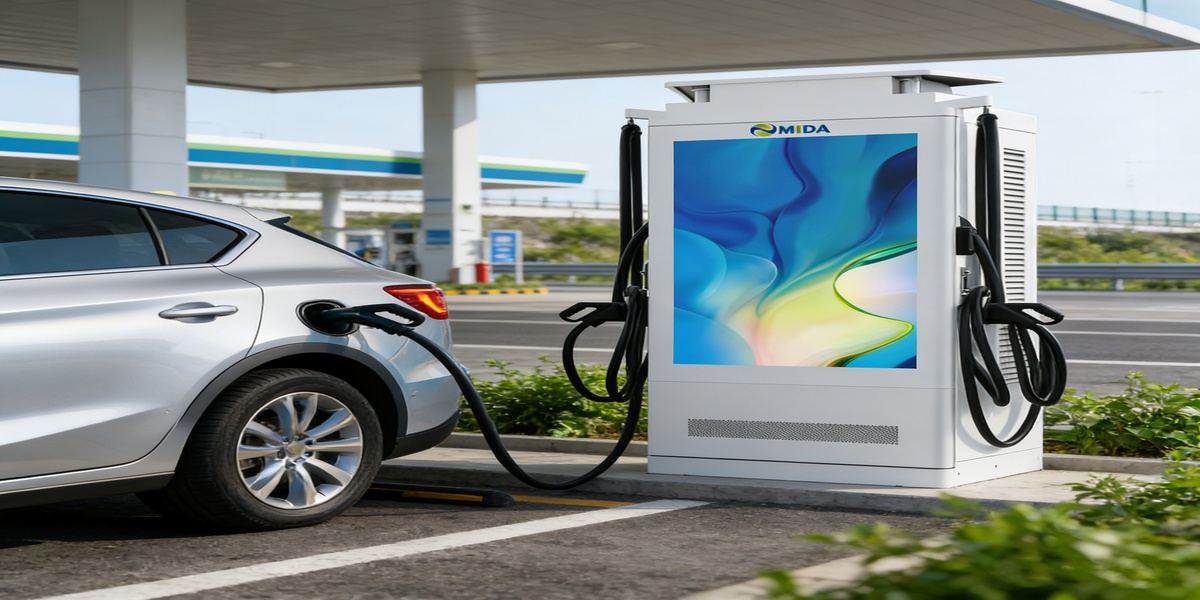
For longevity, the LED backlight should have a half-life of at least 50,000 hours, and the controller must support hardware monitoring to alert the operator of any pixels or fan failures.
FAQ
Q: What is ‘Nits’ in screen technology?
A: It is a unit of measurement for brightness; outdoor screens require at least 2000 nits.
Q: How does the screen stay cool in summer?
A: Through internal fans or air conditioning that cycles air between the glass and the panel.
Q: Is the glass easy to break?
A: No, it is 6mm thick tempered glass designed to withstand heavy impacts.
Q: What happens if it rains?
A: The screen is completely sealed (IP65) and will function normally in heavy rain.
Q: Does the screen have a warranty?
A: Typically, professional screens come with a 2-3 year industrial warranty.
Q: Can I change the screen brightness?
A: Yes, it can be set to adjust automatically based on ambient light levels.
Q: What is an IK10 rating?
A: It is the highest level of protection against external mechanical impact.
Post time: Aug-19-2026