

Quick Answer
Urban EV deployment is stalling not because of demand, but because of a missing charging layer: mid-power DC. A 20kW to 40kW wall mounted DC charging station bridges the gap between slow overnight AC (7–22kW) and expensive high-power DC (120kW+) infrastructure, delivering a usable charge in 45–120 minutes at roughly 30–50% of the capital cost per port of a high-power cabinet. Compact, wall-mounted units with CCS2/CHAdeMO/GB/T connectivity and OCPP 1.6 smart management allow municipalities, parking operators, retail chains and fleet managers to deploy reliable charging in spaces where large cabinets physically cannot fit. This article breaks down the technical specifications, urban deployment scenarios, financial case and selection criteria for this fast-growing segment of commercial EV charging infrastructure.
Key Takeaways
- The 20–40kW wall-mounted DC segment fills the “destination charging gap” between AC slow charging and highway fast charging, at 30–50% of the CapEx per port of a 60–120kW floor-standing cabinet.
- Compact form factors with IP54+ enclosures, IK10 impact ratings and 25–45kg wall mounting enable deployment in underground garages, curbside poles and retail lots where footprint, noise and planning constraints rule out large cabinets.
- Multi-standard connectivity (CCS2, CHAdeMO, GB/T) combined with OCPP 1.6/1.6J telemetry makes these stations plug-and-play with existing charging management software (CMS) and grid load-management schemes.
- Total cost of ownership is dominated by installation and grid connection, not hardware — units with integrated metering, RCD protection and RFID authentication dramatically reduce civil works and permitting lead times.
- A well-planned network of 20–40kW units can sustain 25–45% utilization in urban destination settings, enabling payback in 3–5 years under realistic tariffs and occupancy models.
The Urban Charging Bottleneck: Why Mid-Power DC Is the Missing Layer
Every major city faces the same paradox: EV adoption is accelerating faster than the charging network that must support it. Regulatory frameworks are tightening the math. Under the EU’s Alternative Fuels Infrastructure Regulation (AFIR), Member States must deliver at least 1.3 kW of publicly accessible charging capacity per battery-electric vehicle by 2025, rising to 1.5 kW by 2030 — targets that assume a dense, distributed network rather than a handful of megacharging hubs.
The problem is that most urban charging architecture has been built around two extremes. At one end sits slow AC charging (7–22kW), which is cheap but impractical for daytime users: a typical city EV needs 4–10 hours to recover meaningful range, making AC viable only for overnight or all-day parking. At the other end sits high-power DC (120–350kW), which charges in minutes but demands massive grid connections, transformer upgrades, large equipment footprints, cooling systems and capital outlays that are uneconomic for most urban sites. The result is a structural mismatch: too many slow stalls that deliver negligible daily throughput, and too few high-power hubs to absorb daytime demand spikes.
The 20kW to 40kW power band resolves this mismatch. A Wall Mounted DC Charging Station in this range delivers roughly 80–150 km of range per hour of charging — enough to complete a meaningful top-up during a grocery visit, a restaurant meal, a work shift or a 2-hour parking session. Because the units are wall or pillar mounted, they occupy negligible floor space, emit no audible compressor noise, and connect to standard three-phase supply (typically 32–63A per unit), dramatically simplifying permitting.
In short, mid-power DC is the density layer of the urban charging ecosystem: many small, cheap, smart stations distributed where vehicles already park, instead of a few expensive ones clustered where real estate and grid capacity happen to allow.
Technical Deep Dive: Anatomy of a 20kW–40kW Wall Mounted DC Charger
To specify equipment with confidence, procurement teams need to understand what separates a professional-grade unit from consumer hardware. Five subsystems define the performance envelope.
Power architecture and efficiency
A modern 20kW–40kW wall-mounted DC charger is built around a modular high-frequency power module architecture with >94% peak efficiency. Three specifications matter most:
- Power factor correction (PFC): expect ≥0.99 input power factor and total harmonic distortion (THD) below 5%, which keeps the unit friendly to weak urban grids and avoids penalties from distribution network operators.
- Dynamic power sharing: dual-gun models distribute power intelligently — a 40kW unit can deliver 40kW to one vehicle or split 20kW/20kW across two. This flexibility raises hardware utilization in mixed-occupancy sites.
- Derating behavior: quality units maintain full output from roughly -20°C up to 45°C ambient, with controlled derating above that. Verify the operating envelope against your climate zone before committing.
Connectors and protocol coverage
Urban fleets are heterogeneous by definition. A single-site install may need to serve a European CCS2 fleet, Japanese CHAdeMO imports and GB/T vehicles in the same garage. Look for units that support:
- CCS2 as the default European standard, with dynamic cable management and secure locking connectors.
- CHAdeMO** and **GB/T as optional second-gun configurations (e.g., CCS2+CCS2 or CCS2+CHAdeMO), enabling one station to serve every vehicle class on site.
- ISO 15118 readiness for future Plug & Charge (PnC) authentication, where the vehicle identifies itself via the charging cable — eliminating card readers and app friction entirely.
The DC Wallbox CCS2 family demonstrates exactly this configuration flexibility: the same wall-mounted platform can be specified in 30kW, 40kW and 50kW outputs with CCS2/CHAdeMO combos, so a network operator standardizes on one enclosure across sites with different power budgets.
Smart charging and grid integration (OCPP 1.6)
In urban environments, a charger is only as valuable as its software integration. OCPP 1.6J (JSON) compliance is the non-negotiable baseline: it guarantees interoperability with any certified charging management system (CMS) from vendors such as ChargePoint, Driivz, Ampcontrol or Monta, and supports:
- Remote monitoring and diagnostics — real-time status, fault alerts and over-the-air firmware updates.
- Load management — dynamic power capping across multiple units behind one grid connection, so a site with eight 30kW chargers can share a single 100A feed without tripping breakers.
- Scheduled and tariff-aware charging — shifting sessions to off-peak periods to cut energy cost by 20–40%.
- Authentication and billing — RFID cards, mobile app QR codes and roaming network integration (e.g., Hubject, Gireve) for public operation.
Mechanical and environmental design
Urban installation sites are unforgiving: damp underground garages, dust-laden curbs, temperature swings and deliberate or accidental impact. Professional-grade wall-mounted stations therefore carry:
- IP54 to IP55** ingress protection and **IK10 impact resistance.
- -25°C to +55°C operating ranges with active thermal management.
- Noise output below 55dB — critical for residential adjacency and night-time operation in mixed-use buildings.
- Weight of 25–45kg with reinforced wall/pillar mounting brackets, plus integrated cable management to prevent trip hazards and cable theft.
These parameters matter because urban O&M visits are expensive — every failure that requires a truck roll in a city center costs more than the same intervention in a suburban lot.
Where 20kW–40kW Wall Mounted DC Chargers Win: Urban Deployment Scenarios
The versatility of the segment is best understood through the four dominant urban use cases.
Destination charging: retail, hospitality and commercial parking
For supermarkets, shopping centers, hotels and gyms, the dwell time of a typical visit (60–150 minutes) aligns almost perfectly with a 30–40kW DC session. A shopper arriving with 20% state of charge can leave with 70–80% after a single visit. These sites rarely have the grid capacity for high-power DC, and they cannot afford the lost parking revenue that large cabinets consume. Wall-mounted units mount on existing structural columns or walls, preserving parking space count — a decisive factor for revenue-per-square-meter economics.
Workplace and small fleet depots
Employers installing chargers as a retention and sustainability benefit face a different constraint: daytime charging of many vehicles, often in basement garages. A bank of 20–30kW wall units with dynamic load management delivers 2–4 sessions per stall per day — sufficient for employee top-ups and small commercial fleets (delivery vans, service vehicles) that return to base between shifts. OCPP reporting also enables transparent energy allocation for employee billing or fleet cost recovery.
Municipal curbside and public lots
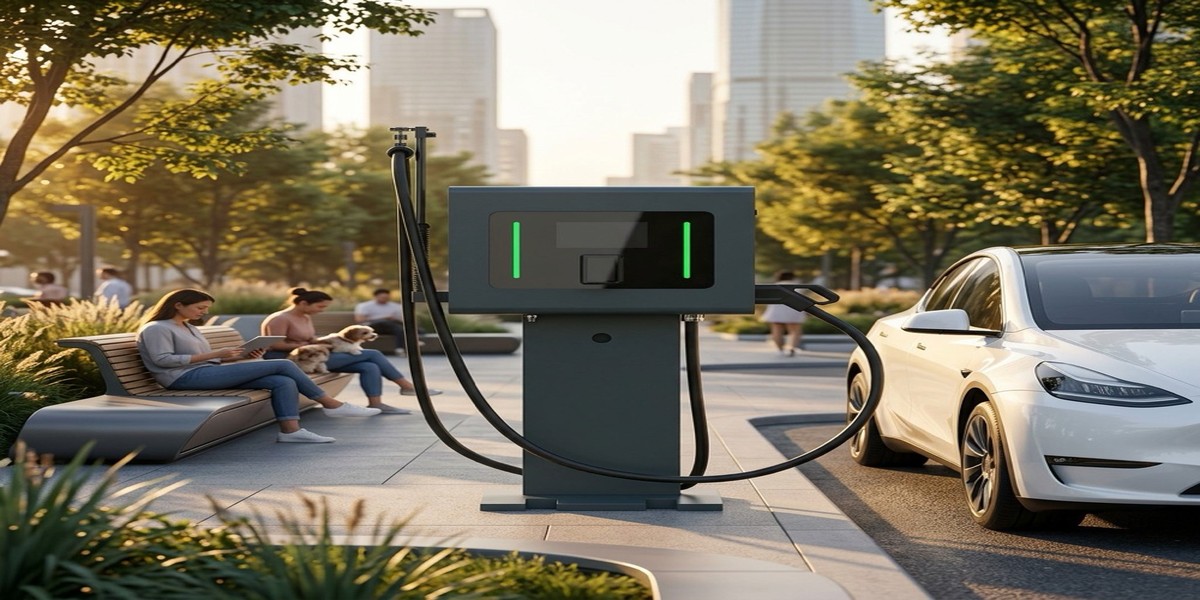
Cities deploying public charging under AFIR-style mandates need maximum coverage per euro of public money. A 20kw 30kw 40kw DC Charger mounted on streetlight columns or dedicated pillars converts existing curbside parking into charging infrastructure without footprint expansion. Because these units draw modest power (32–63A three-phase), they can often be fed from existing distribution cabinets — the single largest cost-reduction lever in municipal deployment.
Residential communities and multi-dwelling units
Apartment dwellers remain the most underserved urban segment. Housing associations and property managers are increasingly installing shared 20–40kW wall units in underground garages, serving 4–8 households per port through scheduled sessions and RFID access control. Mid-power DC avoids the need for per-bay AC infrastructure rewiring and gives residents rapid top-ups during evening peaks without waiting overnight.
Urban Application Comparison
The table below compares the four deployment archetypes across the criteria that drive equipment selection.
tr>tr>tr>tr>tr>
| Application scenario | Typical location | Dwell / session time | Ideal power per unit | Units per site | Primary constraint | Typical business model | Realistic utilization | ||
| Retail & hospitality destination | Supermarket/hotel/ gym parking decks | 60–150 min | 30–40kW | 2–8 | Grid capacity, parking space loss | CPO-owned, pay-per-use or partnership | 30–45% | ||
| Workplace & small fleet depot | Employee garages, depot yards | 3–8 hours (multiple sessions) | 20–30kW | 4–20 | Load management across units | Employer-funded, employee billing | 25–40% | ||
| Municipal curbside & public lots | Streetlight pillars, public parking | 1–4 hours | 20–40kW | 10–100 (network) | Permitting, distribution feed | Tender/concession, public CPO | 20–35% | ||
| Residential communities (MDU) | Apartment underground garages | Overnight + evening peaks | 20–30kW | 1–6 | Shared grid connection, access control | Property manager, resident subscription | 25–35% |
Two insights stand out. First, the 30–40kW sweet spot serves the highest-value destination segment (retail/hospitality), where utilization and revenue per session are strongest. Second, in every archetype the limiting factor is the grid connection, not the charger — which is why integrated metering, RCD protection and OCPP-based load management are more important differentiators than peak kW ratings alone.
Financial and Operational Decision Framework
Capital expenditure and total cost of ownership
For an urban site, hardware is typically 40–55% of first-year cost. A realistic budget for a turnkey 40kW wall-mounted station is:
- Hardware: $3,500–$6,500 per unit depending on configuration (dual-gun, metering, authentication options).
- Installation and civils: $2,000–$5,000 per unit in existing buildings (mounting, cable runs, protection); $5,000–$12,000 where new distribution or trenching is required.
- Grid connection/upgrade: $0–$8,000 depending on existing spare capacity and utility fees.
- Annual O&M: $300–$800 per unit (energy management software, insurance, maintenance contract).
Because wall-mounted units avoid floor pads, bollards and large enclosures, installation costs run 30–50% below equivalent floor-standing cabinets — the decisive TCO advantage for multi-unit urban sites.
Grid connection and permitting
Permitting is the true bottleneck in urban projects. Wall-mounted mid-power DC shortens the critical path in three ways: lower connection capacity requests (many municipalities fast-track sub-100A three-phase connections), reduced fire and structural engineering review (no floor loading, no large enclosure), and noise compliance (no compressor units). Operators should still budget 8–16 weeks for utility coordination in dense districts and engage the distribution network operator during site selection, not after.
Operations: uptime is revenue
In public operation, every percentage point of uptime maps directly to revenue. Choose stations with:
- Remote reboot and firmware update capability via OCPP.
- Redundant communication paths (4G with Wi-Fi fallback).
- On-site diagnostics that distinguish network faults from hardware faults, so technicians arrive with the right parts.
Designing a Scalable Urban Network: Architecture Principles
A network of 20–40kW wall units succeeds or fails on architecture, not hardware choice. Four principles govern:
- Right-size power per site. Model dwell time and session demand before specifying: a gym with 90-minute sessions needs 40kW; an office with 6-hour sessions is better served by 20kW units plus load management. Oversizing destroys ROI; undersizing destroys utilization.
- Standardize the platform. One enclosure family (e.g., 30/40/50kW variants of the same DC Wallbox CCS2 series) across all sites cuts spare-parts inventory, technician training and CMS integration effort.
- Design for load management from day one. Even if a site starts with two units, spec a controller and comms backbone that handles eight. Retrofitting load management is disproportionately expensive.
- Future-proof the enclosure. Choose units with upgradeable power modules and ISO 15118-ready controllers so the hardware installed today can absorb Plug & Charge, V2G pilots and higher power classes tomorrow.
Conclusion: Selecting the Right Wall Mounted DC Charger for Your Urban Project
The 20kW–40kW wall-mounted segment is no longer a niche compromise — it is the workhorse of urban EV infrastructure. It delivers the throughput of DC with the footprint, noise and connection profile of AC, at a capital cost that survives municipal and private-sector scrutiny. When evaluating suppliers, score candidates on: dual-gun flexibility and connector coverage (CCS2/CHAdeMO/GB/T), OCPP 1.6 compliance with proven CMS interoperability, IP54+/IK10 mechanical robustness, module-level serviceability, and certification status (CE, UKCA, UL or equivalent for your target market).
For teams standardizing on a proven platform, the Wall Mounted DC Charging Station range in 20/30/40kW configurations — and its higher-output DC Wallbox CCS2 siblings up to 50kW — covers the full urban spectrum from apartment garages to high-traffic retail hubs. Deploy mid-power DC where vehicles park, connect it to a competent CMS, and the utilization and payback math will follow.
FAQ
1. How long does a 20kW–40kW DC charger take to charge an EV?
A typical 60kWh battery EV gains roughly 80–150 km of range per hour of charging. Expect a 20–80% top-up in 45–120 minutes depending on battery size, state of charge and vehicle acceptance rate — ideal for destination, workplace and parking applications.
2. Can one wall mounted DC charging station serve multiple vehicles?
Yes. Dual-gun models with dynamic power sharing can charge two vehicles simultaneously (e.g., 20kW/20kW split on a 40kW unit), and a single port typically serves 3–6 sessions per day at urban utilization levels.
3. What is the difference between a wall-mounted and a floor-standing DC charger?
Wall-mounted units (25–45kg) attach to existing walls or pillars, occupy zero floor space and install with minimal civils, while floor-standing cabinets (150kg+) require pads, bollards and more extensive site preparation. Wall-mounted is preferred where footprint and installation cost are constrained.
4. Do these chargers work with all EVs?
With CCS2, CHAdeMO and GB/T connector options — including dual-gun combinations — a single station platform can serve virtually every electric car and light commercial vehicle on the road, across European, Asian and Chinese standards.
5. What grid connection does a 40kW DC charger require?
A 40kW three-phase unit draws roughly 58–63A at 400V. Most sites require a dedicated three-phase breaker and RCD, and typically qualify for fast-track connection because they stay below common 100A distribution thresholds.
6. Can the chargers be monitored, billed and managed remotely?
Yes. OCPP 1.6J-compliant units connect to any certified charging management system for remote monitoring, dynamic load management, scheduled charging, RFID/APP authentication, roaming billing and over-the-air firmware updates.
7. What are the installation and permitting requirements in urban locations?
Typical requirements include electrical certification (CE/UKCA or local equivalent), a permitted grid connection (often fast-tracked for
Post time: Aug-21-2026