

Quick Answer
Compact 20kW, 30kW, and 40kW DC charging stations are the fastest practical charging solution for commercial workplace fleets that park for 1–8 hours, without the grid upgrades, permitting, and capital cost of 150kW+ fast chargers. A 40kW DC unit adds roughly 100–130 miles of range per hour, allowing a mid-size electric van to recover a 20–80% charge in 40–100 minutes depending on battery size. These wall-mounted units run on standard 400V three-phase supplies, integrate with OCPP 1.6J fleet telematics, and cost a fraction of high-power cabinets to deploy across depots, warehouses, and corporate parking facilities. Choosing between 20kW, 30kW, and 40kW depends on fleet dwell time, vehicle battery capacity, and available site power—not raw power alone.
Key Takeaways
- Match power to dwell time: 20kW units suit vehicles parked 6+ hours, 30kW suits 4–6 hour windows, and 40kW covers 2–4 hour turnarounds, including back-to-back shift changes.
- DC bypasses the onboard charger bottleneck: unlike 7–22kW AC charging, a compact DC station converts grid power directly to the battery, delivering 2–4x faster energy transfer on the same low-voltage three-phase supply.
- Wall-mounted DC lowers infrastructure cost: no high-voltage transformers, minimal civil works, and per-stall capital costs roughly 80–90% below 150kW+ fast-charging cabinets.
- OCPP 1.6J compliance is the integration enabler: load management, off-peak scheduling, RFID access control, and real-time fleet telematics all run through the open protocol.
- Right-sizing is a data exercise: charging time is governed by battery capacity, SOC window, and the taper curve—plan around the 20–80% band and your fleet’s actual parked hours.
—
Why Workplace DC Charging Is the New Benchmark for Fleet Operations
Commercial fleet operators are systematically replacing Level 2 AC chargers with compact DC stations because dwell-time windows are shrinking while vehicle battery capacities keep growing. A modern 60–100kWh electric van cannot be replenished in a 4-hour overnight window by a 22kW AC wallbox—it needs 3–6 hours just to recover a 20–80% charge—and fleets running back-to-back shifts, multi-drop delivery routes, or 24-hour depots simply do not have that luxury.
Consider a last-mile delivery operator with 15 electric vans, each with a 60kWh battery. On 22kW AC chargers, a single 20–80% session takes roughly 2 hours and 40 minutes. With 15 vehicles rotating through a 10-stall bay between a 4pm return and a 6am dispatch, the queue math fails: the last van does not get plugged in until late evening. The same site fitted with 30kW and 40kW DC units cuts each session to 80 minutes or less, clears the queue by 9pm, and creates spare capacity for midday opportunity charging.
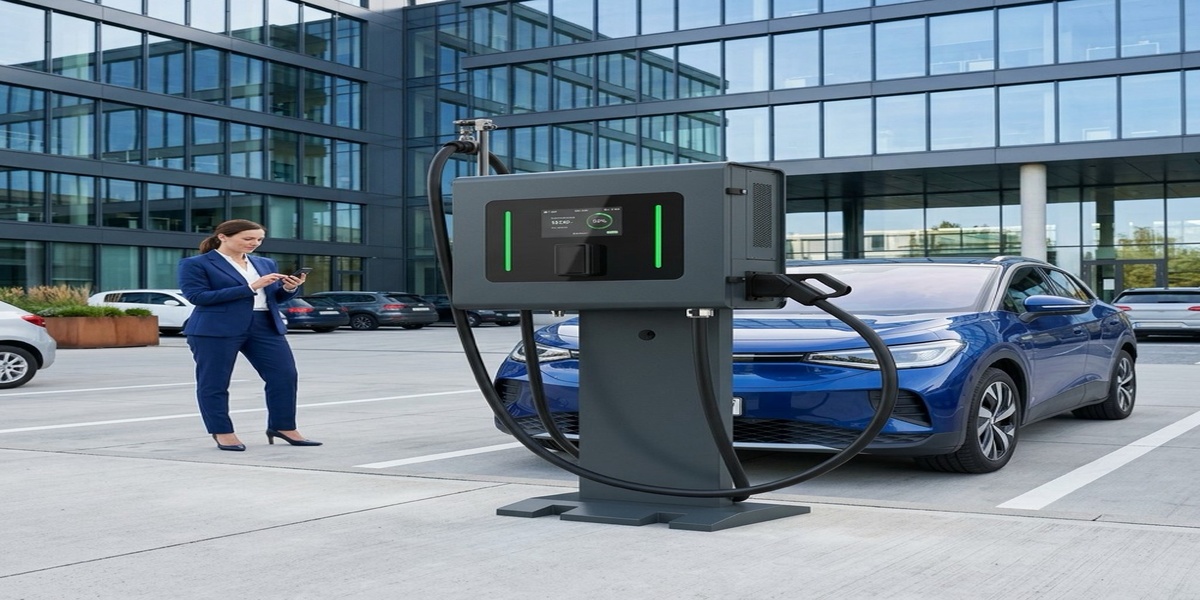
The economic logic is equally compelling. With AC charging, the only lever is adding more stalls; with compact DC, you extract two to three times the daily throughput from the same parking bays. This is why wall-mount form factors such as the DC Wallbox CCS2 have become the default specification for depot and corporate parking retrofits: they deliver genuine DC fast-charging capability on the same electrical footprint that a large AC installation would occupy.
—
What 20kW, 30kW, and 40kW DC Ratings Actually Mean
DC vs. AC: The Onboard Charger Bottleneck
The single most misunderstood fact in workplace charging is that the vehicle’s onboard charger, not the wallbox, determines AC charge speed. Every plug-in vehicle carries an onboard AC-to-DC converter, typically rated between 3.7kW and 22kW, which throttles all AC charging to that limit regardless of what the wallbox can output.
DC charging removes this bottleneck entirely. The station converts grid AC to DC and feeds the battery directly, so the practical ceiling becomes the battery management system’s (BMS) acceptance rate—which for most commercial EVs is 40–80kW in the mid-SOC band. A 40kW DC station can therefore charge a 60kWh van two to four times faster than a 22kW AC wallbox, even when both are fed from an identical 400V three-phase circuit.
Real-World Power Delivery and the Taper Curve
A DC station rarely delivers its nameplate power for the entire session. Charging follows a characteristic curve: full rated power through the 20–80% SOC band, followed by a progressive taper as the battery approaches full to protect cell chemistry and extend cycle life. Energy conversion efficiency for compact air-cooled DC units is typically 88–92% from grid to battery.
The practical planning rule is to size charging around the 20–80% SOC window and to expect approximately 90% net efficiency. The expected session time can be estimated as:
Charging time ≈ (Battery capacity × 0.6) ÷ (Rated power × 0.90)
This formula underpins every comparison in the next section and gives fleet managers a defensible basis for infrastructure sizing rather than guesswork.
—
Charging Time by Battery Size: A Data-Driven Comparison
A 40kW station adds roughly 100–130 miles of range per hour to a typical commercial EV, while a 20kW unit adds 60–70 miles per hour—and that speed differential translates directly into the parking-time windows shown below. The table assumes a 20–80% usable SOC window, 90% grid-to-battery efficiency, and no temperature derating, which is a fair approximation for temperate-climate depot operation.
tr>tr>tr>tr>tr>
| Battery Capacity (Vehicle Class) | Charge Energy Needed (20–80%) | 20 kW Station | 30 kW Station | 40 kW Station | ||
| 40 kWh (compact EV, small van) | 24 kWh | 80 min | 53 min | 40 min | ||
| 60 kWh (mid-size EV, delivery van) | 36 kWh | 120 min | 80 min | 60 min | ||
| 80 kWh (large SUV, light truck) | 48 kWh | 160 min | 107 min | 80 min | ||
| 100 kWh (long-range van, class-3 truck) | 60 kWh | 200 min | 133 min | 100 min |
Three conclusions follow directly from this data. First, a 20kW station is only viable where vehicles are parked for two hours or more per session. Second, moving from 20kW to 40kW cuts session time by roughly 50% across every battery size, which is the single highest-leverage infrastructure decision a fleet can make. Third, for batteries above 80kWh, a 40kW unit is effectively the minimum for any shift-change scenario shorter than two hours, because even at full rating the session lasts at least 80 minutes.
It is also worth noting the range-recovery dimension. At an average consumption of 0.30kWh per mile for a mid-size van, one hour at 40kW (≈36kWh delivered to the battery) restores about 120 miles, whereas one hour at 20kW restores about 60 miles. For multi-drop routes of 80–150 miles per day, this is the difference between a full recovery every night and a slow battery deficit that compounds across the week.
—
Right-Sizing Charging Power for Your Fleet’s Duty Cycle
Measure Dwell Time Before Choosing Power
The correct power rating is a function of parked time, not vehicle count. Fleet managers should audit a minimum of two weeks of telematics data to map how long each vehicle actually sits connected to a charger. The decision rules that follow from the charging table are simple: dwell of 6+ hours supports 20kW units; dwell of 4–6 hours points to 30kW; dwell of 2–4 hours demands 40kW to guarantee a full 20–80% recovery within the window.
An 80kWh van illustrates the stakes. At 20kW it needs 160 minutes for a 20–80% session; at 40kW it needs 80 minutes. If that van returns to the depot at 4pm and departs at 6pm, only the 40kW configuration keeps it mission-ready without dipping into the expensive taper zone above 80% SOC.
Opportunity Charging Between Shifts
Compact DC stations unlock a practice that AC infrastructure cannot support: opportunity charging during breaks and load-outs. A 15-minute coffee break at 40kW puts roughly 9kWh into the battery—about 30 miles of range—whereas the same break at 20kW adds only 4.5kWh, or roughly 15 miles. For fleets with unpredictable route extensions, this mid-day safety margin eliminates most range-anxiety events and reduces the need to oversize battery packs at vehicle purchase time.
Site Power Capacity and Load Management
Every power rating has a concrete grid footprint on a 400V three-phase supply: a 20kW stall draws approximately 32A, a 30kW stall approximately 48A, and a 40kW stall approximately 63A. Sites must budget for the aggregate draw of all stalls plus the facility baseline load, and peak-demand tariffs can punish naive installations. The standard mitigation is OCPP-based load management: the charging network continuously measures site consumption and throttles individual stations so the fleet never crosses the contracted demand threshold. A well-configured 40kW-capable network can serve more vehicles in a day than a fixed-power equivalent, because stations dynamically share the available site capacity.
—
Total Cost of Ownership: Why Compact DC Beats Both AC and High-Power DC
The lifetime cost comparison between AC Level 2, compact DC, and high-power DC favors compact DC for every workplace scenario except highway-corridor public charging. The table below summarizes the main cost drivers.
tr>tr>tr>tr>tr>tr>
| Cost Driver | AC Level 2 (11–22 kW) | Compact DC (20–40 kW) | High-Power DC (120–350 kW) | ||
| Equipment cost per stall | €800–2,500 | €4,000–9,000 | €40,000–90,000+ | ||
| Grid works | Minimal | Standard 400V 3-phase, no transformer | Often HV transformer and utility upgrade | ||
| Installation complexity | Low (electrician only) | Moderate (bracket mount, breaker, comms) | High (civil works, cooling, permits) | ||
| Time to add 100 miles of range | 4–6 hours | 45–90 minutes | 15–30 minutes | ||
| Typical fleet role | Overnight soak charging | Shift-change and opportunity charging | En-route fast charging |
Energy Cost Arithmetic
Workplace charging’s biggest financial advantage is buying energy at commercial or off-peak rates instead of public DC prices. In most European markets, the spread is €0.25–0.45 per kWh between depot charging (€0.10–0.15/kWh off-peak) and public fast charging (€0.40–0.60/kWh). A 10-van fleet consuming 300kWh per day saves €75–135 per day—€27,000–49,000 per year—which typically covers the entire equipment and installation cost of five compact 40kW stations in under 18 months.
Reliability and Maintenance Profile
Compact wall-mounted DC units are engineered for continuous commercial duty with air cooling rather than liquid cooling loops, which removes the most common maintenance failure point on high-power cabinets. The absence of transformers, the smaller current path, and the modular power architecture of a Wall Mounted DC Charging Station translate into lower mean-time-between-failure expectations and minimal planned maintenance—typically an annual inspection and filter cleaning rather than quarterly service contracts.
—
Installation and Site Readiness for Wall-Mounted DC Units
Wall-mounted 20–40kW DC stations are deliberately designed to reduce the civil-engineering burden that historically made DC charging a depot-scale project. The practical site checklist is compact:
- Electrical supply: a dedicated 400V three-phase circuit with breaker sizing matched to the unit (32A, 48A, or 63A) and a Type B residual current device.
- Mounting: a reinforced wall or steel pillar bracket rated for the unit weight, with clearance for the tethered cable and connector holster.
- Environment: most commercial units are rated IP54–IP65 for outdoor and semi-indoor mounting, with an operating range of roughly -25°C to +55°C; avoid enclosed alcoves without airflow on fan-cooled models.
- Earthing and protection: proper PE bonding, surge protection at the distribution board, and cable armoring where runs are exposed to vehicle traffic.
- Connectivity: Ethernet or 4G backhaul for OCPP telemetry, plus RFID reader and kWh meter (MID-certified where billing is required).
Because each station is a self-contained, bracket-mounted appliance rather than a floor-standing cabinet, retrofitting a Wall Mounted DC Charging Station into an existing parking garage or loading dock typically takes one electrical crew day per unit—including commissioning—which is a decisive advantage when scaling from a pilot of two units to a depot-wide rollout.
—
Smart Charging, Telematics, and OCPP Integration
Open-protocol compliance is the non-negotiable requirement for fleet-scale deployment. OCPP 1.6J support enables four capabilities that directly affect operational efficiency: centralized scheduling (charging prioritized for earliest-departing vehicles), dynamic load management against site demand, remote firmware updates and fault diagnostics, and per-session energy metering for cost allocation across business units.
For fleets running dispatch software, OCPP integration means every charging session is visible as live telemetry—SOC on plug-in, power delivered, session duration, and cost—so route planners can make departure-time decisions on real data rather than estimates. The roadmap to ISO 15118 Plug & Charge will remove RFID cards entirely by authenticating vehicles cryptographically at the connector, and OCPP 2.0.1 already supports the messaging needed to manage that transition. Any station purchased today should at minimum be OCPP 1.6J-certified and field-upgradeable, which is standard across the DC Wallbox CCS2 platform family.
—
Choosing Between 20kW, 30kW, and 40kW: A Decision Framework
There is no universally correct rating; there is only the rating that matches the fleet’s operating pattern. The framework below condenses the analysis into actionable guidance.
tr>tr>tr>tr>tr>
| Fleet Profile | Recommended Rating | Rationale | ||
| Overnight-only parking, 6+ hours, batteries ≤ 60 kWh | 20 kW | Lowest CapEx; full recovery within window; more stalls per site | ||
| Mixed fleet, 4–6 hour windows, standard 60–80 kWh packs | 30 kW | Best balance of speed and cost; covers most delivery fleets | ||
| Back-to-back shifts, 2–4 hour turnarounds, batteries ≥ 80 kWh | 40 kW | Guarantees 20–80% recovery; enables opportunity charging | ||
| High-utilization depot with dynamic scheduling | 40 kW + load management | Maximizes daily throughput per stall; defers grid upgrades |
The final recommendation should be validated against three numbers: the fleet’s longest tolerated session time, the largest battery in the fleet, and the site’s contracted power capacity. Where these conflict, prefer the higher rating with load management enabled—the software throttles the unit during non-critical hours while preserving full speed when vehicles actually need it. For depots standardizing across multiple sites, a unified specification around a single 20kw 30kw 40kw DC Charger family simplifies spare-part stocking, electrician training, and OCPP platform administration.
—
Frequently Asked Questions
How long does it take to charge a 60kWh EV battery from 20% to 80% with a 30kW DC charger?
Approximately 80 minutes, assuming 90% conversion efficiency. The same session takes 120 minutes on a 20kW unit and 60 minutes on a 40kW unit, so the choice of station power directly determines whether a vehicle fits into a two-hour or four-hour parking window.
What is the practical difference between a 20kW, 30kW, and 40kW DC charging station?
The difference is charging speed and grid draw: a 40kW station delivers twice the energy of a 20kW station in the same time and requires roughly twice the supply current (63A versus 32A on a 400V three-phase feed). Speed matters most for large batteries and short dwell times; grid draw matters for sites near their capacity limit.
Can a 20kW DC wallbox charge a vehicle faster than a 22kW AC charger?
Yes. DC charging bypasses the vehicle’s onboard charger, which is the limiting factor in AC charging. A 20kW DC unit typically delivers 20kW to the battery, while a 22kW AC wallbox is usually throttled to the onboard converter’s rating, often 11kW or less in commercial vans.
Do compact DC chargers require a high-voltage transformer or grid upgrade?
No. Units in the 20–40kW class run on standard 400V three-phase low-voltage supplies with breaker sizes of 32A to 63A per stall, which is the same supply class used by large AC installations. High-voltage transformer work is generally only triggered when aggregate site load exceeds the incoming connection capacity.
Which connector standards do these charging stations support?
The platform family covers CCS2 (the European DC standard), CHAdeMO, and GB/T options, typically with dual-gun configurations so one station can serve vehicles from different manufacturers and markets. Connector choice should be validated against the exact vehicle list in the fleet.
How many vehicles can a single 40kW station serve per day?
In practice, 10–14 vehicles per day per stall, assuming 20–80% sessions of 40–100 minutes across a 16-hour operating day with scheduling. This is two to three times the daily throughput of an equivalent AC stall, which is why compact DC stations reduce the number of stalls a depot needs.
Can OCPP-enabled compact DC chargers integrate with existing fleet management software?
Yes. OCPP 1.6J provides standard APIs for session start/stop, energy metering, and status reporting, which fleet telematics and dispatch platforms consume directly. Most deployments use a charging management system (CMS) between the stations and the fleet software to add load management, user authorization, and billing.
Post time: Aug-21-2026