

Quick Answer
For apartment building operators, the best 20kW–40kW DC wallbox charger is one that matches your electrical capacity, resident charging patterns, and connector mix. A 20kW DC wallbox suits buildings with limited grid headroom and long overnight dwell times; a 30kW unit balances speed and installation cost for mixed-use parking; a 40kW unit delivers the fastest turnover for shared daytime bays. Unlike AC chargers, DC wallboxes charge 5–10x faster, support CCS2/CHAdeMO/NACS natively, and integrate with OCPP backends for billing, load management, and remote diagnostics. Prioritize units with a 150–1000V output range, ≥95% conversion efficiency, IP54 protection, and CE/UL certification. A compact wall-mounted DC Wallbox CCS2 station from a certified manufacturer covers most residential and mixed-use buildings without occupying valuable parking space.
Key Takeaways
- Speed matters but dwell time decides: DC wallboxes charge 5–10x faster than AC chargers, but the right power level (20kW, 30kW, or 40kW) depends on how long residents typically park — not on peak charger ratings.
- One station, all vehicles: Look for multi-standard support (CCS2, CHAdeMO, NACS, GB/T) so a single wallbox serves every EV in the building, now and after future vehicle turnover.
- Grid capacity is the real constraint: Verify 380/400VAC three-phase input availability, load management capability, and OCPP 1.6J/2.1 backend compatibility before selecting power output.
- Total cost of ownership beats sticker price: High conversion efficiency (95–98.5%), IP54-rated enclosures, swappable power modules, and remote OTA diagnostics lower lifetime costs more than a low upfront price.
—
Why Apartment Buildings Need a Different Charging Strategy Than Single-Family Homes
Apartment buildings are the hardest EV-charging environment in urban infrastructure — not because the technology is complex, but because the constraints collide. A single-family homeowner can install any charger that fits their panel. A building operator must reconcile limited transformer capacity, shared parking bays, diverse vehicle brands, multiple stakeholder interests, and a service life measured in decades.
Three structural facts drive the selection process:
- Parking is shared and sequential. Unlike a private garage where one car occupies one charger for years, apartment bays serve many residents. A charger that ties up a bay for 6–8 hours per session destroys utilization.
- Grid headroom is finite. Most residential buildings were designed before EVs existed. The main breaker, transformer, and risers rarely have spare capacity for dozens of 7–22kW AC loads running simultaneously.
- The resident base changes. Tenants move. Vehicle brands change. Connector standards evolve. A charger that only serves one standard becomes stranded infrastructure within a few years.
That is why 20kW–40kW DC wallboxes have become the fastest-growing segment in multi-family residential charging: Level-3-class charging speed — 5–10x faster than a typical AC charger — in a footprint that fits on a parking-lot wall or pillar, without the transformer upgrades required for 60–120kW stations.
The Dwell-Time Math That Determines Your Power Level
Every residential charging decision starts with dwell time: how long a vehicle is parked and available to charge. The math is straightforward:
- Overnight parking (8–10 hours) with a 20kW charger: a 60kWh battery recovers from 20% to 100% with margin to spare; even a 77kWh pack adds roughly 160–200km of range per hour.
- Daytime mixed use (3–6 hours) with a 30–40kW charger: a resident arriving at 08:00 with 30% state of charge can be fully charged before the afternoon — and the bay frees up for the next vehicle.
The consequence is counterintuitive but important: a 20kW unit is often the better business decision for overnight-dominant buildings, because it delivers sufficient energy with lower infrastructure cost and gentler grid draw. The 40kW unit earns its premium only where bays turn over multiple times per day.
DC Wallbox vs. AC Charger: What 20–40kW DC Actually Delivers
To appreciate the 20–40kW DC category, compare it against the default alternative in residential buildings: 7–22kW AC charging.
tr>tr>tr>tr>tr>tr>tr>tr>tr>
| Criterion | AC Charger (7–22kW) | 20–40kW DC Wallbox | ||
| Charging speed | 30–100 km of range per hour | 160–400+ km of range per hour | ||
| Time to add 200 km | 3–8 hours | 30–75 minutes | ||
| Connector handling | Type 2 socket (on-board charger does the work) | DC direct to battery via CCS2/CHAdeMO/NACS/GB/T cable | ||
| Grid draw per session | Low (7–22kW) but long duration | Higher (20–40kW) but short duration | ||
| Bay turnover | 1–2 sessions per day | 3–8 sessions per day | ||
| Backend/billing | OCPP, RFID, app-based | OCPP 1.6J/2.1, RFID, QR, PnC, POS | ||
| Bypasses vehicle on-board charger | No | Yes — charges at full rated DC power | ||
| Transformer impact | High cumulative load, many simultaneous sessions | Fewer simultaneous sessions needed; manageable with load management |
The decisive advantage of DC in a shared-building context is bay throughput: a single 40kW DC wallbox can serve the same daily energy demand as three to four 11kW AC chargers, because each session finishes in a fraction of the time. For a building with 10 EV owners but only 3 bays, DC is often the only way to serve everyone fairly without digging up the carpark for new cabling.
There is a second, less obvious benefit: DC charging bypasses the vehicle’s on-board charger. Many EVs — especially older models and small city cars — have 3.3–7.4kW on-board chargers that cap AC sessions regardless of the wallbox rating. A DC wallbox feeds the battery directly, so even a vehicle with a weak on-board charger charges at the full 20–40kW the station can deliver.
20kW vs. 30kW vs. 40kW: Which Power Level Fits Your Building?
There is no universally “best” power rating — there is only the rating that matches your occupancy profile, grid capacity, and payback horizon. The table below compares the three standard tiers across the parameters that matter most to building operators.
tr>tr>tr>tr>tr>tr>tr>tr>tr>tr>tr>tr>
| Parameter | 20kW DC Wallbox | 30kW DC Wallbox | 40kW DC Wallbox | ||
| Typical input | 380/400VAC three-phase (220V single-phase optional on some models) | 380/400VAC three-phase | 380/400VAC three-phase | ||
| Output voltage range | 150–750V (CCS) / 48–450V (GB/T) | 150–1000V | 150–1000V | ||
| Max output current | ~50–60A | ~80–100A | ~100–120A (200A peak-class modules) | ||
| Range added per hour (typical EV) | ~100–160 km | ~160–240 km | ~200–320 km | ||
| Time to add 200 km | ~75–120 min | ~50–75 min | ~35–50 min | ||
| Typical conversion efficiency | 95–98.5% | 95–98.5% | 95–98.5% | ||
| Best-fit building scenario | Overnight residential, limited grid headroom, low bay turnover | Mixed residential/commercial, moderate turnover | High-turnover shared bays, daytime commercial use, fleets | ||
| Approx. sessions served per day | 2–4 | 4–6 | 6–10 | ||
| Installation footprint | Wall-mounted, minimal | Wall-mounted, minimal | Wall-mounted, minimal | ||
| Grid impact per session | Lowest | Moderate | Highest — pair with load management | ||
| Typical certification | CE, IEC 61851, UL 2202 options | CE, IEC 61851, UL 2202 options | CE, IEC 61851, UL 2202 options |
Selecting 20kW — The Grid-Constrained Building
Choose 20kW when the building’s electrical service cannot support higher draws without a transformer upgrade, or when most charging happens overnight. A 20kW unit still adds roughly 100–160 km of range per hour — far more than any AC charger — and it minimizes demand charges from the utility. For a 50-unit building with 8 EV owners who all charge between 18:00 and 08:00, several 20kW units with load management usually out-perform fewer 40kW units in both cost and resident satisfaction.
Selecting 30kW — The Balanced Default
The 30kW tier is the workhorse of apartment charging: it covers overnight sessions comfortably, handles daytime top-ups in 45–70 minutes, and keeps per-unit cost and grid draw moderate. It is also the sweet spot for incremental rollouts — 30kW units wall-mount easily in existing parking structures, and the 150–1000V output range future-proofs them against 800V-architecture EVs.
Selecting 40kW — The High-Turnover Bay
Invest in 40kW when bays are scarce and demand is high — for example, residents sharing parking with daytime office workers, or mixed-use developments with ground-floor retail. A single 40kW unit can cycle 6–10 sessions per day, effectively acting as a mini public fast charger. Pair it with OCPP-based load management so simultaneous sessions do not trip the main breaker.
Technical Selection Criteria for Apartment Deployments
Beyond power rating, six criteria separate a reliable 10-year asset from a maintenance liability. Use them as a supplier checklist.
Input Power and Grid Integration
Every DC wallbox in this class requires three-phase AC input, typically 380/400VAC ±15%. Before shortlisting units, confirm the building’s panel and riser capacity at the exact mounting location. Two configuration questions matter:
- Is single-phase input available as an option? Some wallboxes offer 220V single-phase input for locations without three-phase access — useful for retrofit projects, though maximum output is usually capped.
- Does the unit support dynamic load management? In a building context this is non-negotiable: the charger must communicate with an energy management system or OCPP backend to throttle power when other loads spike.
Connector Compatibility and Multi-Standard Support
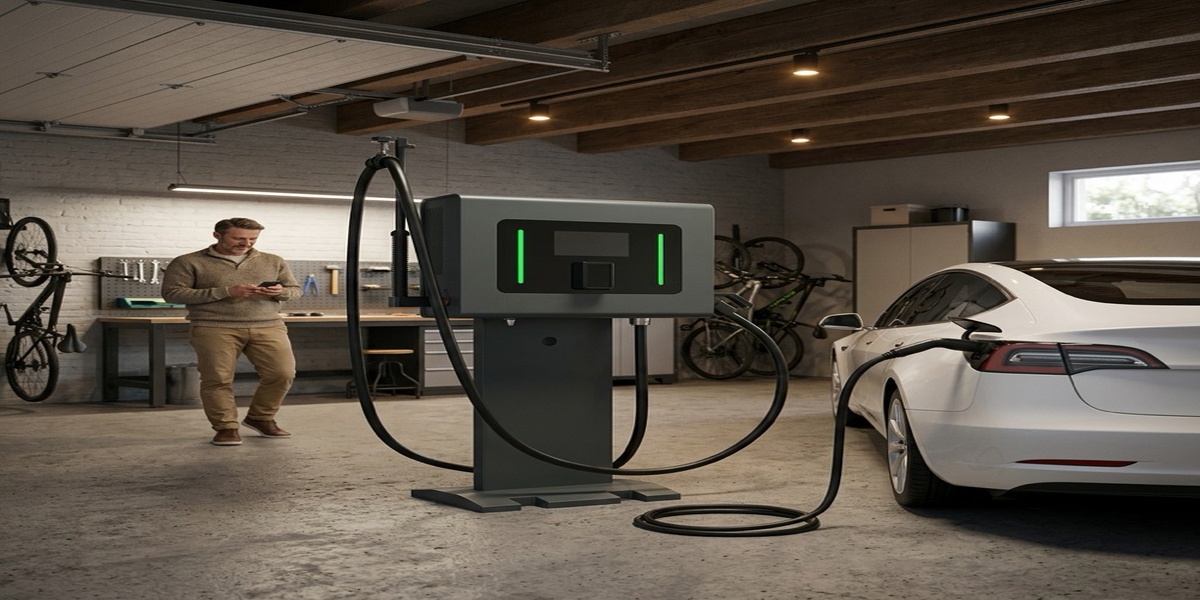
Apartment buildings serve unpredictable vehicle populations, so connector flexibility is a core requirement. The most future-proof units support CCS2, CHAdeMO, NACS, and GB/T via interchangeable cables — one station, every EV. In Europe, CCS2 is the dominant standard, but CHAdeMO-equipped Japanese vehicles and NACS-equipped imported models still appear in mixed fleets. A single multi-standard Wall Mounted DC Charging Station eliminates the “wrong connector” problem entirely.
Communication Protocols and Backend Management
For multi-user buildings, the charger’s brain matters more than its power stage. Confirm the unit supports:
- OCPP 1.6J (with TLS) or OCPP 2.1 for backend integration, remote monitoring, and firmware updates. OCPP 2.1 adds security improvements and better smart-charging support.
- 4G, Wi-Fi, and LAN connectivity so the unit works in underground carparks where cellular signal is weak (LAN/Wi-Fi bridging becomes the primary link).
- ISO 15118 for Plug & Charge (PnC), where the vehicle authenticates itself and billing happens automatically — a major convenience for card-free residents.
Environmental Protection and Physical Installation
- IP rating: Look for IP54 minimum for indoor parking; IP54 also covers most sheltered outdoor installations. Avoid IP23-rated units in dusty or damp underground garages.
- Temperature range: The unit must operate from at least -20°C to +50°C without derating below spec. Underground carparks stay mild, but surface parking in cold climates exposes units to freezing temperatures.
- Form factor: Wall-mounting saves valuable parking space and reduces installation cost compared to floor pedestals. Units with open-door designs allow quick power-module replacement without taking the whole station offline.
Payment, Access Control, and User Experience
Resident charging fails when the payment experience fails. Evaluate options in this order:
- RFID card / mobile app — the baseline for resident access and per-session billing.
- QR code payment — low-friction for guests and visitors.
- Plug & Charge (ISO 15118) — premium experience, automatic billing, no cards.
- POS terminal integration (e.g., NAYAX) — only needed if the building operates a public-facing charging service with contactless card payments.
Compliance and Certification
Certification is not paperwork — it is the difference between an insurable installation and a liability. Require documented compliance with:
- CE / ROHS (mandatory for EU markets)
- IEC 61851-1 / IEC 61851-23 (charging system safety and DC requirements)
- UL 2202:2022 and CSA standards where North American certification is needed
- OCPP conformance for backend interoperability
Cost and ROI: What Property Managers Should Actually Budget
tr>tr>tr>tr>tr>tr>tr>tr>
| Cost driver | AC solution (11kW x 6) | DC solution (30kW x 2 + 20kW x 1) | ||
| Hardware (indicative) | Moderate | Comparable or higher per unit, fewer units | ||
| Cabling & installation | High — new circuits to 6 bays | Lower — fewer, shorter runs | ||
| Transformer upgrade risk | High if all 6 run at once | Low — 3 units, load-managed | ||
| Bay utilization | ~1–2 sessions/day | ~4–8 sessions/day | ||
| Energy efficiency | On-board charger losses (up to 10%) | 95–98.5% conversion efficiency | ||
| Maintenance | Low per unit, but 6 units to maintain | Fewer units, remote diagnostics, swappable modules | ||
| Revenue potential | Per-kWh billing, low throughput | Per-kWh billing at 2–4x throughput |
The ROI calculation flips once you include bay throughput. A 30kW wallbox that serves 5 sessions per day at €0.55/kWh with 25kWh average delivery generates roughly €25/day in gross revenue — versus one 11kW AC bay that generates €4–5/day at best. For a building recovering costs through per-kWh billing, DC wallboxes typically pay back 2–3x faster than AC networks of equivalent total capacity. Demand charges deserve attention too: a 40kW unit drawing near-rated power at peak hours can raise a building’s demand tariff — the mitigation is OCPP smart-charging profiles that schedule sessions overnight when building load is low.
Deployment Blueprint: A 5-Step Process for Building Operators
- Audit the building: Map available electrical capacity, parking bay layout, and wall/pillar mounting points. Determine three-phase availability at each candidate location.
- Profile the demand: Count current EV owners, project 3-year EV adoption (European markets typically compound 20–40% annually), and model dwell-time distributions by bay.
- Right-size the power mix: Select 20kW/30kW/40kW units per bay using the dwell-time math above. A mixed deployment — e.g., two 20kW overnight bays plus one 40kW high-turnover bay — often beats a homogeneous fleet.
- Select the backend and access model: Choose an OCPP 1.6J/2.1 platform, define resident vs. visitor pricing, and set load-management rules before procurement.
- Verify supplier capability: Confirm certifications, spare-parts availability, swappable power modules, warranty terms (12+ months), and OTA firmware support. A 20kw 30kw 40kw DC Charger supplier that provides installation guidance and after-sales parts support reduces project risk substantially.
Frequently Asked Questions
1. Can a 20kW DC wallbox charge an EV overnight in an apartment building?
Yes. A 20kW charger adds roughly 100–160 km of range per hour, so over an 8-hour overnight session even a large 100kWh battery can recover from 20% to 100%, and a typical 60–77kWh pack finishes well before morning.
2. What is the difference between a DC wallbox and an AC wallbox?
An AC wallbox sends AC power to the vehicle’s on-board charger, which converts it to DC — a process capped by the vehicle’s on-board charger rating (often 3.3–11kW). A DC wallbox converts AC to DC internally and feeds the battery directly, delivering 20–40kW regardless of the vehicle’s on-board charger, making it 5–10x faster.
3. Do I need three-phase power for a 20–40kW DC charger?
Most 20–40kW DC chargers require 380/400VAC three-phase input. Some models offer optional 220V single-phase input for retrofit sites, usually with reduced output. Confirm three-phase availability at the mounting location before purchasing.
4. Which connectors should an apartment building charger support?
At minimum, CCS2 — the dominant European DC standard. For maximum future-proofing, choose units supporting CCS2, CHAdeMO, NACS, and GB/T with interchangeable cables, so any resident’s vehicle can charge regardless of brand or origin.
5. How does billing work for shared residential chargers?
Most units support RFID cards, QR codes, and mobile apps integrated with an OCPP backend that meters energy per session and invoices per kWh. Premium units support ISO 15118 Plug & Charge, where the vehicle authenticates and bills automatically with no card or app interaction.
6. Can multiple DC wallboxes operate on one building’s grid without overloading it?
Yes, provided the units support OCPP-based load management or dynamic power sharing, which throttles output when building loads spike. This is why a load-management-capable DC Wallbox CCS2 station, paired with a compatible backend, is the recommended configuration for multi-unit installations.
7. What certifications should I require from a 20–40kW DC charger supplier?
Require CE and ROHS for EU installations, IEC 61851-1 and IEC 61851-23 for charging-system safety, OCPP conformance for backend interoperability, and UL 2202 / CSA certification if you plan North American deployment.
Final Verdict: Match the Wallbox to the Building, Not the Other Way Around
The best 20–40kW DC wallbox for an apartment building is the one that fits its grid capacity, dwell-time profile, and connector mix — not the one with the highest kW number. Start with a grid audit, model resident charging patterns, and let those two inputs determine whether you need 20kW overnight units, 40kW high-turnover bays, or a hybrid of both. Then apply the technical checklist: 150–1000V output range, 95%+ efficiency, OCPP 1.6J/2.1 backend compatibility, IP54 protection, multi-standard connectors, and CE/UL certification. Done right, the network turns parking bays into predictable, low-maintenance revenue assets — and keeps EV-owning residents in the building.
Post time: Aug-21-2026