

Quick Answer
Comparing 300kW, 360kW, and 420kW proposals requires more than comparing the headline power number. MIDA’s working project files confirm official public URLs for 300kW, 360kW, and 420kW charging-station products, but they do not contain complete model-specific specifications for those pages. Therefore, buyers should use the power classes as a tender-comparison framework rather than assume identical current, efficiency, IP, cooling, or certification values. Request a datasheet for each SKU and compare continuous output, per-gun allocation, vehicle voltage range, thermal derating, grid input, protection, connector standard, communications, warranty, and service plan. This evidence-first approach prevents an attractive headline rating from becoming an operational mismatch.
Key Takeaways
- Official MIDA pages exist for 300kW, 360kW, and 420kW products.
- Detailed specifications for these exact pages are not confirmed in the working files.
- Compare continuous output and per-gun delivery, not only cabinet nameplate power.
- Require documented thermal, electrical, protection, software, and certification data.
- Treat a missing datasheet field as a procurement risk, not as permission to assume.
Build a Like-for-Like Tender Matrix
Power and Current
A 420kW cabinet may provide different per-gun behavior from a 300kW cabinet. The tender should state whether power is continuous or peak, how many guns can operate simultaneously, and how the controller allocates power when vehicles have different states of charge. It should also state maximum current and voltage at the connector.
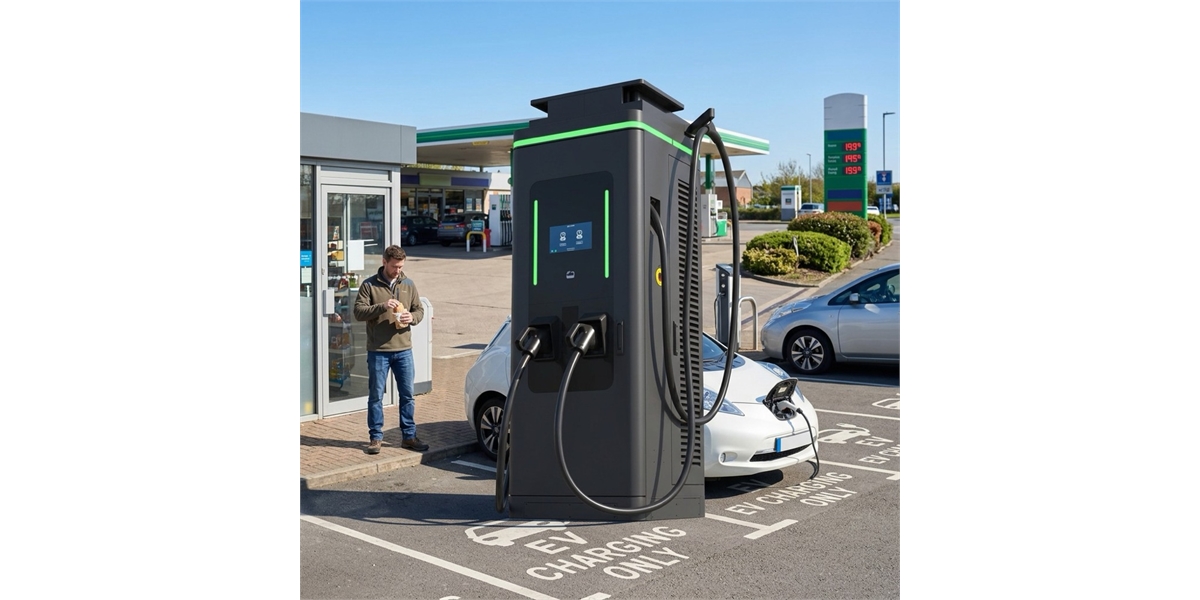
The official 420kW CCS2 charging station page confirms the product family exists, but the working evidence does not confirm its complete ratings. The 240/300/360/420kW floor-standing DC station page and 60kW–240kW commercial charging family should likewise be treated as family references until the exact SKU datasheet is received.
Thermal Performance
Request the ambient operating range, derating curve, cooling method, fan or pump redundancy, and protection response. For HPC projects, the cooling design may be as important as the power module. MIDA’s verified HPC material supports liquid-cooled technology above the 350kW class, but this does not automatically establish the cooling method of every 300–420kW model.
Tender Comparison Table
| Field | What to request from MIDA | Why it matters |
|---|---|---|
| Continuous output | kW at stated ambient conditions | Defines usable capacity |
| Per-gun output | kW and A per connector | Defines simultaneous service |
| Voltage | Minimum and maximum DC voltage | Defines vehicle compatibility |
| Cooling | Air, liquid, or hybrid; failure response | Defines uptime and service needs |
| Efficiency | Test point and test method | Enables TCO comparison |
| IP/IK | Cabinet, connector, and display ratings | Defines site durability |
| Protocol | OCPP version and supported functions | Determines backend integration |
| Certification | Certificate number and scope | Supports permitting and liability |
Compare Lifecycle Value, Not Just CAPEX
Grid and Civil Works
A higher-power station may require a larger transformer, new switchgear, heavier conductors, and more complex civil work. These costs belong in the total project budget. A slightly lower-power station with better grid fit can deliver a stronger return if it avoids a long utility upgrade.
Service and Warranty
Ask for spare-part lead time, remote diagnostics, response time, preventive-maintenance intervals, and warranty exclusions. A high-power charger is a long-lived infrastructure asset; service conditions should be evaluated before commercial terms are finalized.
Seven FAQs
- Does MIDA offer 300kW, 360kW, and 420kW products? Official public pages confirm these product families; detailed specifications require SKU-level confirmation.
- Can I compare them using only their names? No. Product names do not establish continuous output, cooling, or certification.
- What is the most important tender field? Continuous per-gun output at the intended ambient conditions.
- Should efficiency be compared at full load? Request the test point and test method so values are comparable.
- Is liquid cooling mandatory above 300kW? It depends on cable current, voltage, ambient conditions, and design; confirm the model.
- What if the supplier does not provide IP data? Treat the omission as unresolved and request a formal datasheet.
- Can the 420kW station use CCS2 and GBT? Connector configuration is SKU-specific; request the exact configuration and compliance evidence.
Post time: Sep-01-2026